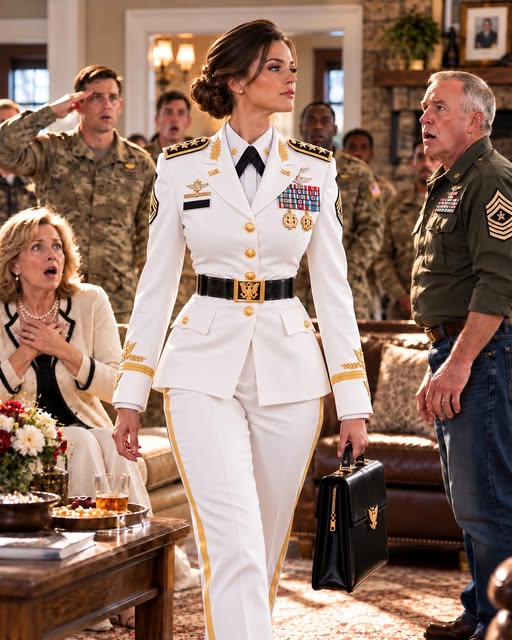
Martin did not answer immediately.
That was unusual.
He always had an answer.
If the grocery bill was higher than expected, he could explain market forces.
If the neighbor parked too close to our driveway, he could explain civic responsibility.
If a television commentator discussed the military, Martin could explain national defense.
Silence had never been one of his habits.
Mom held the fundraiser program between two fingers.
“Martin?”
He looked around the entryway.
Daniel Mercer was still there.
So were Sergeant First Class Reed and his wife, halfway through putting on their coats.
Martin gave a small, uncomfortable smile.
“It’s nothing formal.”
Mom looked down at the printed page.
“Your name is printed on it.”
“I helped out.”
“As what?”
“A volunteer.”
“Then why does this say advisory committee?”
He exhaled.
“Because these organizations give everybody titles.”
Daniel spoke carefully.
“That does happen sometimes.”
I appreciated the attempt to lower the temperature.
Martin seemed to grab hold of it.
“Exactly.”
But Mom was not finished.
“Why didn’t you tell me?”
“I probably did.”
“No.”
The single word changed the room.
Not because it was loud.
Because it was certain.
My mother had been uncertain for months.
Now she was not.
Martin’s shoulders lowered.
“Susan, can we talk about this later?”
“Yes.”
She surprised me.
Then she turned to the guests.
“Thank you for coming. I hope dinner wasn’t too awkward.”
Dana Reed hugged her.
“It was wonderful.”
Her husband shook Martin’s hand with noticeably less enthusiasm than when he arrived.
Captain Ruiz wished everyone goodnight.
Daniel was last.
At the door, he looked at me.
I gave him the smallest nod.
I was fine.
Or close enough to fine.
When the door shut, Martin remained facing it for several seconds.
Mom carried the program back to the dining room and placed it beside his untouched dessert plate.
Then she began clearing dishes.
Martin followed her.
“Susan.”
She stacked two plates.
“Susan, stop for a minute.”
“I’m cleaning.”
“We need to talk.”
She turned.
“You’re right.”
Martin glanced at me.
I was gathering glasses.
“In private.”
“No.”
He stared at her.
Mom picked up another plate.
“Claire stays.”
“Susan—”
“She stays.”
I had not heard that voice in years.
It was the voice she used when a car salesman once tried to convince her she did not understand financing.
The voice she used when my middle-school principal dismissed a teacher’s habit of publicly mocking students.
Quiet.
Controlled.
Immovable.
Martin sat.
I expected him to be angry.
Instead, he looked old.
Not physically.
Emotionally.
Like someone who had spent too long carrying a story that was heavier than he realized.
Mom sat across from him.
I took the chair at the end of the table.
For a while, nobody said anything.
Finally Mom asked, “Were you ever a command sergeant major?”
Martin looked at his hands.
“No.”
There it was.
No explanation.
No loophole.
One word.
Mom’s eyes closed briefly.
“What rank did you leave the Army?”
“Specialist.”
“How long did you serve?”
“Three years and seven months.”
“Overseas?”
“No.”
“Combat?”
“No.”
Each answer seemed to shrink him.
Not because specialist was an insignificant rank.
Not because three years was an insignificant period of service.
But because the difference between what he had done and what he had claimed was finally sitting at the table with us.
Mom looked at the framed photograph visible on the living room shelf.
“You told me that picture was taken in Iraq.”
“It wasn’t.”
“Where was it taken?”
“Fort Hood.”
The base had since been renamed Fort Cavazos, but neither Mom nor Martin seemed to notice the old name.
“When?”
“Nineteen ninety-six.”
“Whose uniform are you wearing?”
Martin hesitated.
“My cousin’s.”
I looked up.
That detail I had not known.
Mom’s face changed.
“Tom?”
Martin nodded.
The picture showed a younger Martin standing beside a military vehicle in desert camouflage.
I had assumed the uniform was his, even after determining the deployment story was false.
“Tom served in Iraq?” Mom asked.
“Yes.”
“And you used his photograph?”
“It was my photograph. I was visiting him before his unit moved.”
“You let me believe it was your deployment.”
“Yes.”
The clock on the wall ticked.
Mom folded her hands.
“Why?”
Martin looked toward me.
I said nothing.
Eventually he began.
“When I was eighteen, I thought I’d stay in the Army forever.”
“You enlisted at twenty-one,” I said.
He nodded.
“I tried college first. Didn’t work. Then I joined.”
His voice sounded different without performance in it.
“I liked basic training. I liked knowing what was expected. I liked getting something right and being told it was right.”
Mom listened.
“I got to my unit and thought I was going to become somebody.”
He gave a humorless smile.
“Then I discovered that becoming somebody takes longer than wanting it.”
He had struggled financially after his father became ill. He left the Reserve, took a warehouse job, married young, divorced eight years later, and spent most of his working life managing regional freight operations.
There was nothing remarkable about it.
There was also nothing shameful about it.
That, perhaps, was the tragedy.
Martin had possessed an ordinary life and convinced himself ordinary meant worthless.
“At first,” he said, “I only exaggerated a little.”
Mom’s mouth tightened.
“There are different kinds of exaggeration.”
“I know.”
“Do you?”
“Yes.”
He did not defend himself.
I had expected defensiveness.
Some part of me had prepared for it.
But the man across the table was not the Martin from breakfast.
He looked exhausted.
“A few years ago, I went to a reunion with a friend from work,” he continued. “Most of the people there had served. Somebody asked what I’d done.”
He looked at the table.
“I said I’d stayed in longer than I had.”
“And then?” I asked.
“And then the next question came.”
That was how lies grew.
Not always through grand planning.
Sometimes through maintenance.
One answer required another.
A claimed promotion needed a unit.
A unit needed dates.
Dates needed deployments.
Before long, Martin had built an entire second biography around the person he wished he had become.
Mom asked, “When did you start telling people you were a command sergeant major?”
“About five years ago.”
“Before we met.”
“Yes.”
“And the hats?”
He looked embarrassed.
“I ordered them.”
My mother actually stared at him.
“You had them custom made?”
“One was a gift.”
“From whom?”
Martin sighed.
“Me.”
I bit the inside of my cheek.
Not because it was funny.
Not exactly.
But because reality sometimes became so absurd that the human body had no appropriate response.
Mom leaned back.
“And these veteran organizations?”
“I volunteered.”
“As a retired command sergeant major?”
“I never filled out official paperwork saying that.”
“That isn’t what I asked.”
Martin rubbed his forehead.
“That’s how people knew me.”
“Because you told them.”
“Yes.”
“Did you take money?”
“No.”
“Did you control donations?”
“No.”
“Did anyone hire you because of the rank?”
“No.”
“Did you receive benefits?”
“No.”
I studied him.
“You’re certain?”
His head came up.
“Yes.”
That answer came faster.
Cleaner.
For the first time all evening, I believed him immediately.
Mom believed him too.
I could see it.
Her anger remained, but some deeper fear eased.
There was a difference between dishonesty designed to steal and dishonesty designed to impress.
The second could still damage people.
But it left a different road back.
Martin looked at me.
“You checked my record.”
It was not really a question.
“Yes.”
“How?”
“Through legitimate channels available to verify claims connected to veteran-facing organizations.”
That was as much as I intended to say.
He nodded.
“You knew before you came here.”
“I suspected. I confirmed enough after I arrived.”
His expression hardened slightly.
“Then why didn’t you say anything?”
“Because I wanted Mom to reach her own conclusions.”
“That was some kind of test?”
“No.”
I held his gaze.
“It was respect.”
He frowned.
“For who?”
“For her.”
Mom looked at me.
“If I had walked in on Thursday and announced that you were lying,” I said to Martin, “there was a good chance she would have felt forced to choose between us before she had even decided what she believed.”
He looked down.
“I didn’t want to do that to her.”
Mom’s eyes filled, but she blinked the tears away.
Martin said quietly, “I treated you badly.”
“Yes.”
“I thought you were unemployed.”
“You thought I had a life you didn’t respect.”
He flinched.
I continued.
“The problem isn’t that you didn’t know I was a major. The problem is that you decided I deserved less courtesy when you thought I wasn’t.”
Nobody spoke.
That was the part I needed him to understand.
I did not want an apology because my rank had been revealed.
I wanted him to understand that no rank should have been necessary.
Martin nodded slowly.
“You’re right.”
I had heard hundreds of forced acknowledgments in professional settings.
That one did not sound forced.
Mom pushed back from the table.
“I need air.”
She took her cardigan from the hook near the back door.
I stood.
“Want company?”
She looked at me for a long moment.
“Not yet.”
Then she stepped onto the porch.
Martin and I remained at the table.
The room felt larger without her.
He looked toward the door.
“Is she going to leave me?”
“I don’t know.”
“You must have an opinion.”
“I do.”
He gave a bitter smile.
“I suppose I deserve that.”
“This isn’t about what you deserve.”
He looked at me.
“It’s about what she wants.”
That silenced him.
After a moment, he said, “You really are intelligence?”
“Yes.”
He almost smiled.
“That figures.”
“Why?”
“You listen until people tell you what they didn’t mean to say.”
I thought about that.
“There are worse habits.”
He nodded.
Then, unexpectedly, he looked afraid.
Not of me.
Of losing the life he had built with my mother.
“I love her,” he said.
I believed that too.
Which complicated everything.
People liked simple categories.
Liar.
Good man.
Bad man.
Fraud.
Partner.
But most adults were several things at once.
Martin had lied.
Martin had also driven Mom to every physical therapy appointment after she injured her knee.
He had rebuilt the raised garden beds because bending had become painful for her.
He remembered the anniversary of Dad’s death and quietly disappeared for the afternoon because he knew she needed to be alone.
Love did not erase dishonesty.
Dishonesty did not automatically erase love.
The question was whether enough truth remained to rebuild anything.
Mom came inside fifteen minutes later.
Her cheeks were cold from the October air.
“I want you to leave tonight,” she told Martin.
He went still.
“For good?”
“I don’t know.”
He nodded.
“Okay.”
“You can stay at a hotel.”
“Okay.”
“You are not going to call me ten times.”
“I won’t.”
“You are not going to send Claire messages.”
“I won’t.”
“And tomorrow you are going to contact every veterans’ group where you used that rank and correct the record.”
His face tightened.
“That could be humiliating.”
Mom’s expression did not change.
“Then perhaps now you understand what honesty costs after you avoid it long enough.”
He lowered his gaze.
“Yes.”
She stood by the table while he packed a bag.
No shouting.
No dramatic accusations.
No slammed doors.
At nine forty-seven, Martin carried a small suitcase to his truck.
Before leaving, he stopped beside me.
“For what it’s worth,” he said, “Major Bennett…”
“Claire.”
He nodded.
“Claire. I am sorry.”
I believed he meant it.
I was not ready to do anything with that belief.
After he drove away, Mom locked the door.
Then she leaned against it.
And suddenly she laughed.
Not happily.
Not sadly.
Just helplessly.
I started laughing too.
“What?” I asked.
She covered her face.
“The hat.”
“What about it?”
“I spent thirty dollars having a special hook installed so he could display that ridiculous hat.”
That did it.
We laughed until she cried.
Then she cried until I stopped laughing.
I held her in the hallway where she had measured my height against the wall when I was six.
“I feel stupid,” she whispered.
“You’re not.”
“I believed him.”
“You believed someone you loved.”
“I ignored things.”
“Yes.”
She pulled back.
I could see she was surprised I had not contradicted her.
“I did,” she said.
“You did.”
“I kept thinking if I was patient, he’d relax.”
“I know.”
“I don’t want to live carefully in my own house.”
“Then don’t.”
She looked around.
The house seemed to hear her.
The next morning, she made pancakes.
She sang.
Badly.
Loudly.
I drank coffee at the kitchen table while she used far too much butter.
Around ten, her phone rang.
Martin.
She stared at the screen.
Then answered.
“Hello.”
I started to leave.
She shook her head.
Stay.
I stayed.
Martin spoke for several minutes.
Mom listened.
Then said, “Send me copies.”
A pause.
“All of them.”
Another pause.
“No, Martin. I’m not promising anything.”
She hung up.
“What happened?” I asked.
“He contacted three organizations.”
“Already?”
“He told them the truth.”
That surprised me.
“He says there are two more.”
“Okay.”
“He also says there’s something else I need to know.”
My stomach tightened.
“What?”
“He wants to bring me some paperwork this afternoon.”
“What kind?”
“He wouldn’t say.”
At two o’clock, Martin returned.
He looked as though he had not slept.
He did not wear a military hat.
That was the first thing I noticed.
The second was the folder in his hands.
Mom let him inside.
He remained standing.
“I corrected the groups,” he said.
He placed printed emails on the table.
They were brief.
Direct.
No excuses.
My name is Martin Hale. I allowed members of your organization to believe I retired from the United States Army as a command sergeant major. That statement is false.
He listed his actual service.
Specialist.
Army Reserve.
Three years, seven months.
No deployment.
“I resigned from the advisory committee,” he said.
Mom nodded.
“And the other paperwork?”
Martin looked at me.
Then at her.
“This has nothing to do with my Army story.”
He pulled another document from the folder.
A real estate appraisal.
For Mom’s house.
She stared at it.
“Why do you have this?”
Martin sat.
“Because six months ago, I asked you whether we should sell.”
“And I said no.”
“I know.”
“Then why did you order an appraisal?”
He swallowed.
“I thought you might change your mind.”
Mom’s face became very still.
There were no signatures.
No sales agreement.
No transfer.
Nothing had happened.
But beside the appraisal was a brochure for a retirement community in North Carolina.
A place Mom had never mentioned.
She read the first page.
Then the second.
“Were you planning to move?”
“I was thinking about it.”
“With me?”
“Yes.”
“Without asking me?”
“I thought if I showed you everything—”
She put the papers down.
“You thought you knew what I should want.”
Martin looked at her.
And in that sentence, something deeper than his military lies finally became visible.
He had not been trying to deceive her into selling.
He had been planning her future for her.
The same way he planned breakfast.
The same way he planned where she sat.
The same way he told me what a thirty-one-year-old woman’s life should look like.
Control did not always arrive looking cruel.
Sometimes it arrived carrying brochures and saying, I thought this would be good for you.
Mom closed the folder.
“Martin, you need to go.”
He nodded.
At the door, he paused.
“I didn’t sign anything.”
“I know.”
“I wouldn’t have.”
“I believe you.”
That seemed to surprise him.
“But believing that isn’t the same as wanting to live this way.”
He left.
Mom stood at the window watching his truck disappear.
Then she whispered, almost to herself, “I nearly let somebody else choose where I spent the rest of my life.”
I put my arm around her.
“No.”
She looked at me.
“You caught it.”
“No, Mom.”
I pointed to the folder.
“You did.”
That evening, while returning the appraisal papers to the folder, she found one final sheet tucked behind the retirement brochure.
It was not from Martin.
It was a handwritten letter.
The envelope had my mother’s name on it.
The handwriting was familiar.
I recognized it before she did.
Dad’s.
Mom sat down slowly.
“Claire,” she whispered, “I’ve never seen this before.”
And suddenly Martin’s secrets were no longer the only ones in the house.
**-END OF PART 3–PRESS NEX PART IN BOTTOM OF PAGE TO READ NEXT PART**