PART 2
For a few seconds after Martin told me to stay in the kitchen, nobody moved.
He had said it lightly, almost playfully, the way people sometimes disguise an insult as a joke because they expect everyone else to cooperate with the disguise.
“Don’t embarrass me,” he had said.
Then he carried a bowl of salad through the doorway as if the matter were settled.
I remained beside the counter.
Through the open archway, I could see the dining room Martin had spent most of the afternoon arranging.
My mother’s old oak table had been extended with both leaves. Martin had set out the good plates—the cream-colored ones with the narrow blue rim that had belonged to my grandmother. A bottle of sparkling water sat in an ice bucket where Dad used to put wine on holidays.
Everything looked familiar.
Nothing felt familiar.
Mom stood at the sink rinsing a serving spoon that was already clean.
“Claire,” she said quietly.
I waited.
She dried the spoon.
“I know he can be…”
She stopped.
“Can be what?”
Her eyes remained on the towel in her hands.
“Particular.”
I leaned against the counter.
“Mom, he just told your thirty-one-year-old daughter to stay in the kitchen so she wouldn’t embarrass him.”
“I heard him.”
“And?”
She finally looked at me.
There was no confusion in her expression.
That was the part I had been trying not to see since I arrived.
She understood perfectly well what was happening.
She simply did not know what to do with it.
“He’s nervous,” she said. “These men matter to him.”
“Why?”
Her mouth tightened.
“He wants them to respect him.”
That answer told me more than she probably intended.
I glanced toward the doorway.
Martin was adjusting napkins now.
He had changed shirts twice before the guests arrived. His newest command sergeant major hat rested prominently on the hall table, angled so anyone coming through the front door would notice it.
The embroidery was bright gold.
The story behind it was fiction.
Three weeks earlier, before I came home, my mother had casually mentioned that Martin wanted to attend a veterans’ charity dinner at Fort Eisenhower.
“He says he knows some people there,” she had told me.
Something in her tone had bothered me.
So I had asked one question.
“What unit was he with?”
Mom had given me the answer Martin always gave.
Several units.
Several commands.
Several places.
Never dates.
Never names that could be checked.
That alone did not prove anything. Veterans sometimes avoided details for a hundred legitimate reasons.
But Martin did not avoid military stories.
He collected them.
At breakfast, he described deployments.
At dinner, he described soldiers he had supposedly mentored.
At the hardware store, according to Mom, he corrected employees on the proper way to address a retired command sergeant major.
So I had done what intelligence officers do when something refuses to fit.
I looked closer.
His stories moved around.
His rank timelines did not add up.
The unit patches on two framed photographs belonged to formations that did not match the years he claimed to have served with them.
And one photograph supposedly taken in Kuwait contained a vehicle variant that had not entered service until years later.
None of that was proof by itself.
But it was enough to make me curious.
Then I found the name.
Martin Hale had served.
Just not the way he said.
He had enlisted in the Army Reserve at twenty-one.
He completed initial training, served a little over three years in a transportation unit, separated as a specialist, and had no overseas deployments.
There was nothing shameful about that.
Nothing at all.
Three years of honorable service was still service.
The shame was not in what Martin had actually done.
It was in what he had decided that truth was worth.
Apparently, not much.
The doorbell rang at six twelve.
Martin practically jogged to answer it.
His voice changed immediately.
It grew louder.
Warmer.
More commanding.
“Sergeant First Class Reed! Good to see you!”
A broad-shouldered man in civilian clothes stepped inside, followed by a woman wearing glasses and carrying a bakery box.
“This is my wife, Dana,” he said.
Martin shook her hand with both of his.
Another knock came less than a minute later.
Two more soldiers arrived, both in civilian clothes. One was Staff Sergeant Lewis, a communications specialist. The other was Captain Elena Ruiz, who worked in logistics at Fort Eisenhower.
Martin introduced everyone as though he had personally assembled a panel of experts.
Then the last guest arrived.
Major Daniel Mercer.
The instant I heard his voice in the hall, I closed my eyes for half a second.
Of course.
Of all the officers Martin could have invited.
Daniel and I had worked together eighteen months earlier during a joint intelligence exercise in Europe.
He was competent, thoughtful, and incapable of pretending not to notice something strange.
He was also the sort of person who remembered everyone.
Ranks.
Faces.
Names.
Birthdays.
The fact that I hated artificial sweetener.
Everything.
I heard him laugh at something Martin said.
Then Martin called toward the kitchen.
“Claire!”
I opened my eyes.
“Yes?”
“Bring out the appetizers.”
Mom gave me a look.
Not exactly an apology.
More like a plea for temporary peace.
I could have refused.
Instead, I picked up the tray.
Because by then I had decided I wanted to understand something more important than Martin’s lie.
I wanted to understand why my mother had allowed herself to become smaller around it.
I carried the tray into the dining room wearing jeans and a gray sweater.
Daniel Mercer looked up.
For the briefest instant, his expression changed.
Recognition.
Then professionalism took over.
“Claire,” he said.
Martin turned.
“You two know each other?”
Daniel looked at me.
I answered first.
“We’ve crossed paths through work.”
“Small world,” Martin said.
Daniel’s eyes stayed on mine for one second longer than necessary.
He had questions.
So did I.
But neither of us asked them.
Martin clapped a hand on my shoulder.
“This is Susan’s daughter. Between jobs at the moment.”
Daniel’s eyebrows moved almost imperceptibly.
Captain Ruiz took a sip of water.
I set the tray down.
“Enjoy.”
Martin smiled.
“See? She can follow instructions.”
No one laughed.
Martin seemed not to notice.
I returned to the kitchen.
A few minutes later, Mom joined me.
Her cheeks were pink.
“Did you know Major Mercer would be here?”
“No.”
“He seems nice.”
“He is.”
She lowered her voice.
“Does he know what you do?”
“Enough.”
Mom nodded.
She knew almost nothing about my current assignment, and she had never pushed.
That had always been one of the things I loved most about her.
When I joined the Army after college, Dad had asked fifty questions.
Mom asked one.
Are you sure this is yours?
Not, Is this sensible?
Not, Is this safe?
Not, Is this what I would choose?
Is it yours?
When I said yes, she hugged me and started researching military family support programs that night.
I looked at the woman standing beside me now.
“Mom, when did you stop telling Martin no?”
Her head came up sharply.
“I tell him no.”
“When?”
“That isn’t fair.”
“Maybe not.”
She folded the dish towel.
“I’m happy, Claire.”
I waited.
She looked away.
The silence answered for her.
From the dining room came Martin’s voice.
“When you’ve been responsible for hundreds of soldiers, you learn pretty quickly that standards matter.”
Someone murmured politely.
Martin continued.
“People today don’t understand chain of command.”
I watched my mother’s face.
She winced.
Only slightly.
But she winced.
“How much do you know?” I asked.
“About what?”
“His Army record.”
The towel stopped moving.
There it was.
I had expected surprise.
I got fear of a different kind.
Not fear of Martin.
Fear of the question.
“Mom.”
She put the towel down.
“He served.”
“I know.”
“He has paperwork.”
“I know.”
She studied me.
“What do you know?”
“I know he separated as a specialist.”
The kitchen seemed to become very quiet.
Mom pressed her palms against the counter.
For several seconds she said nothing.
Then, softly, “I found a box.”
“When?”
“Two months ago.”
I felt a slow ache settle behind my ribs.
“What was in it?”
“Old papers. Photographs. His discharge documents.”
“And you asked him?”
“Yes.”
“What did he say?”
She gave a tired little laugh.
“He said records from that period were complicated. That some assignments weren’t documented the way people think.”
I said nothing.
Mom knew enough about me to recognize the look on my face.
“I knew it sounded strange,” she said.
“But you accepted it.”
“I wanted to.”
That was different.
And somehow harder.
She rubbed her thumb along a worn place in the counter.
“After your father died, people stopped asking me to do things.”
Dad had been gone four years.
A heart attack at fifty-nine.
Sudden.
Ordinary.
Impossible.
Mom continued.
“For the first year, everyone was wonderful. Food appeared. Neighbors checked in. You called every Sunday from wherever you were.”
“I still do.”
“I know.”
Her smile was faint.
“But eventually people return to their own lives. They should. That’s normal.”
She looked toward the dining room.
“Martin made plans. He wanted to go places. He wanted dinner at six. He wanted the porch repainted. He wanted to join that walking club. At first, having somebody want things felt… good.”
I understood before she finished.
Structure could look like companionship when a person was lonely enough.
“He made the house feel occupied,” she said.
Her voice trembled only slightly.
“And then?”
“And then I started realizing everything had to be his way.”
“Why didn’t you tell me?”
“Because you would have come.”
“Yes.”
“That’s why.”
I stared at her.
She looked almost embarrassed.
“You had your work. Your life. You had finally stopped calling me every evening just to see if I remembered to eat.”
“I never—”
“You did.”
I almost smiled.
She almost did too.
Then Martin called from the other room.
“Susan?”
Mom straightened automatically.
The movement broke my heart more effectively than tears would have.
“I’m not going anywhere,” I said.
She looked at me.
“I know.”
“No. I mean tonight. I’m not going to start a fight. I’m not going to embarrass anybody.”
Relief crossed her face.
Then I added, “But I’m also not pretending anymore.”
Her relief faded.
“What are you going to do?”
“Change clothes.”
She blinked.
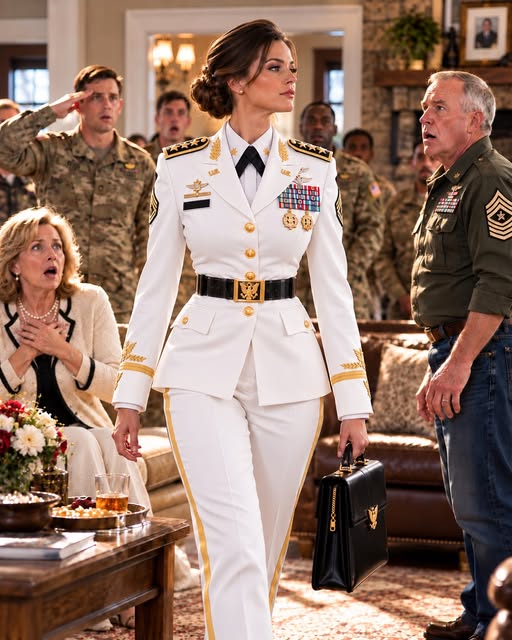
Twenty minutes later, I stood upstairs in my childhood bedroom buttoning my Army service uniform jacket.
I had brought it because I was scheduled to attend a formal command briefing Monday morning.
The uniform hung perfectly because habit is stronger than mood.
Nameplate.
Ribbons.
Badges.
Rank.
I checked everything twice.
Not because I needed Martin to see it.
Because putting it on reminded me who I was when nobody else was defining me.
Before leaving the room, I caught my reflection in the mirror.
Thirty-one.
Major.
Daughter.
Still the girl who had once taped glow-in-the-dark stars to that same ceiling.
People talked about identity as though adulthood settled it.
It didn’t.
We simply learned which parts of ourselves could stand beside the others.
When I came downstairs, the conversation in the dining room stopped.
Daniel saw me first.
His chair scraped back.
He stood.
“Room, attention.”
It was instinctive more than ceremonial, but the reaction traveled around the table. Lewis stood. Reed followed. Captain Ruiz rose as well.
I held up one hand immediately.
“Please. Sit down.”
Then I saw Martin.
His face had lost every trace of color.
His gaze moved from my rank insignia to my ribbons, then back to my face.
“You’re…”
“A major,” Daniel said, before apparently realizing that answering for me was not helping.
Martin looked toward Mom.
She stood in the kitchen doorway.
He stared at her.
“You knew?”
“Yes,” Mom said.
The answer seemed to hurt him more than anything else.
Not because she had betrayed him.
Because suddenly he understood that while he had been constructing an image of himself for her, she had been protecting a truth about me he had never bothered to ask for.
I walked to the table.
“Nobody needs to stand.”
They sat slowly.
Martin remained standing.
I pulled out the empty chair beside Mom’s place.
“Can I join dinner now?”
Martin swallowed.
“Of course.”
No one smiled.
I sat.
For a minute, there was only the quiet sound of forks and plates.
Then Captain Ruiz, perhaps deciding that somebody had to behave normally, asked me about Fort Eisenhower traffic.
That earned a laugh from Reed.
Conversation cautiously resumed.
Martin barely spoke.
I did not expose him.
I did not ask him to explain his hat.
I did not recite his actual service record.
I did not need to.
The truth could wait until there were fewer witnesses.
Halfway through dinner, Daniel asked, “How long are you in Georgia?”
“Another week, probably.”
“Still working with the same people?”
“Some.”
He nodded, understanding the boundary.
Martin watched us.
Something in his expression had changed.
The certainty was gone.
In its place was calculation.
Then confusion.
After dessert, the soldiers thanked Mom for dinner.
Daniel lingered near the front door.
When Martin stepped outside with Reed, Daniel lowered his voice.
“You okay?”
“Yes.”
“You sure?”
“Yes.”
He glanced toward the porch.
“Because this is one of the stranger dinner invitations I’ve accepted.”
I almost laughed.
“Did Martin tell you he was a retired command sergeant major?”
Daniel hesitated.
“That was the impression he gave.”
“What exactly did he say?”
Daniel thought.
“That he had served at senior enlisted level. He didn’t give me a unit.”
Of course he didn’t.
“Why did you come?”
“That’s the strange part.”
He reached into his coat pocket and handed me a folded program.
It was from a veterans’ scholarship fundraiser held three months earlier.
Martin’s name appeared under the heading COMMUNITY MILITARY ADVISORY COMMITTEE.
I looked up.
Daniel said quietly, “He’s been attending veteran events around Augusta for almost a year.”
My stomach tightened.
“Doing what?”
“Networking, mostly. Introducing himself. Offering to help organize fundraising.”
“Has he handled money?”
“I don’t know.”
That was when Mom stepped into the hall.
“What money?”
Daniel’s expression changed instantly.
“I don’t want to suggest anything improper, ma’am. I only meant that Mr. Hale has been active with a few local veteran groups.”
Mom held out her hand.
I gave her the program.
She read it.
Then she read it again.
“I’ve never seen this.”
Martin came back inside laughing at something Reed had said.
The laughter stopped when he saw the program in Mom’s hands.
For the second time that evening, all the confidence drained from his face.
Mom looked directly at him.
“Martin,” she said, “what is the Community Military Advisory Committee?”
He opened his mouth.
Closed it.
And for the first time since I had arrived, my mother did not look cautious.
She looked like herself.
-END OF PART 2, –PRESS NEX PART IN BOTTOM OF PAGE TO READ NEXT PART