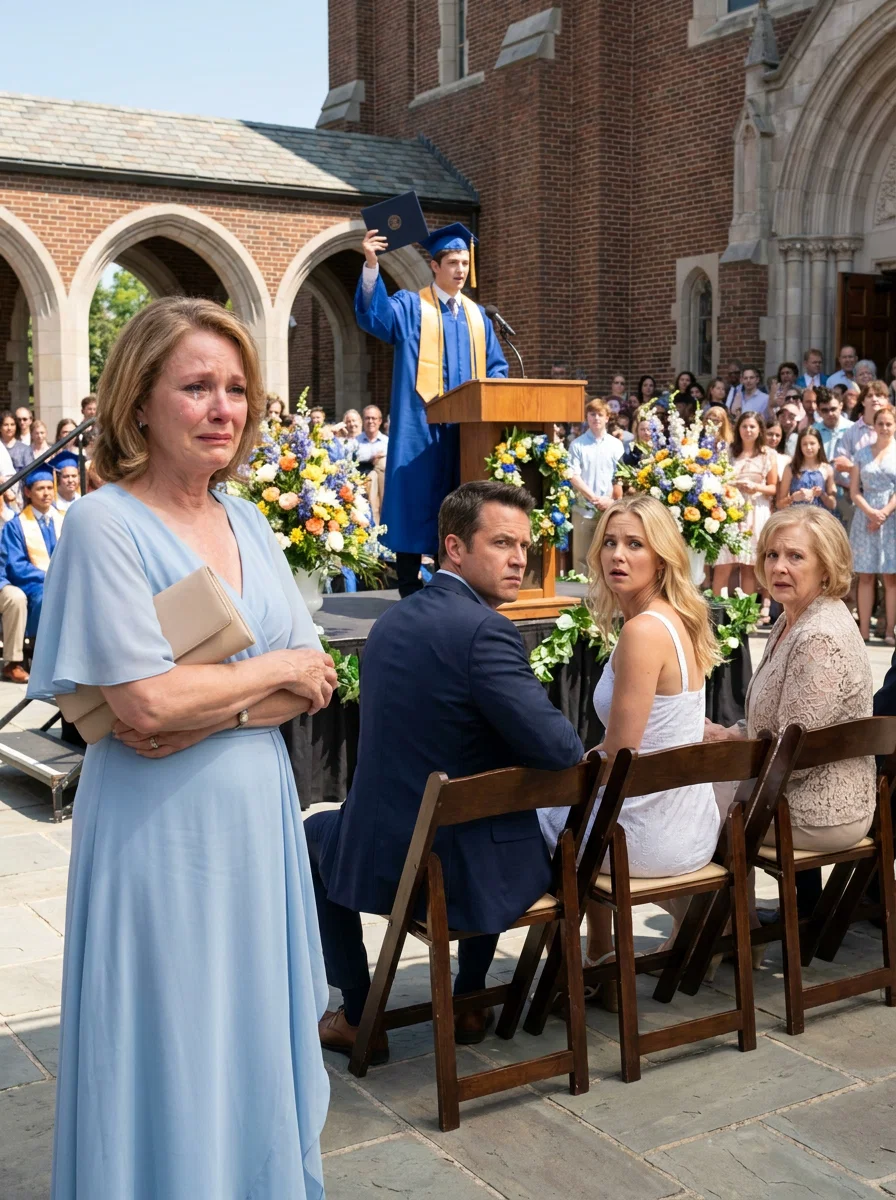
My ex-husband’s new wife sent me to the back during my son’s graduation… but one sentence he said made the entire auditorium stand up.
“Your place is not in the front row, Penelope. Leo already has a family that knows how to behave.”
That was what Cynthia, my ex-husband’s new wife, told me in front of half the audience as if eighteen years of sleepless nights could be erased with a stolen chair.
I remained still.
It was not because it didn’t hurt.
It hurt so much that I felt my throat close up completely.
But my son was behind the curtain, about to graduate from high school, and I was not going to turn the most important day of his life into a petty neighborhood squabble.
My name is Penelope Vance (Wait, no, I must choose another name)… My name is Penelope Foster, I am forty-three years old, and that morning I had ironed my blue dress twice.
It wasn’t a designer brand, as I had bought it on sale at a store in downtown Austin after finishing a double shift at the clinic where I work as a nursing assistant.
When I tried it on, I thought that Leo was going to think I looked beautiful in the photos.
My son, Leo Anderson, was graduating with honors from a private high school in the suburbs of San Antonio.
He had gotten in on a scholarship, through sheer hard work, perfect grades, and many nights studying while I sewed other people’s uniforms to cover his tuition fees.
A week earlier, he sent me a message: “Mom, I saved you a seat in the front row, left side, because I want to see you close by when they call my name.”
I replied with a heart emoji and cried in the clinic bathroom so no one would see me.
But when I arrived at the auditorium with my sister Susan, the seats were already taken.
In the front row, on the left, was Frank, my ex-husband, wearing an expensive suit and sporting the smile of an important man.
Next to him was Cynthia, in a beige dress, high heels, and with a triumphant expression, along with her mother, a cousin, and two men I didn’t even know.
On the back of a chair, I caught a glimpse of a piece of paper, half torn off, where my name was still legible: Penelope Foster.
I approached the young man in charge of the entrance.
“Excuse me, my son told me these places were for me and my sister,” I said.
The boy checked a list, looked at Cynthia, and lowered his voice while saying, “Ma’am, I was told those seats were for the father’s family, but you can stand in the back.”
Susan clutched the bouquet of sunflowers she was carrying and shouted, “Standing in the back? Are you even listening to what you are saying?”
Then Cynthia turned around, without shame and without lowering her voice, to say, “Leo doesn’t need any drama today, so if his mother wants to stay, she can watch the ceremony from the back as she should be used to by now.”
I felt like everyone was staring at me.
Perhaps it wasn’t true, but shame often makes any whisper sound like your own name.
Susan stepped forward and demanded, “Repeat that.”
I took her by the arm and pleaded, “No, Susan, not today.”
“Penelope, you cannot let that woman humiliate you,” my sister insisted.
“Not at my son’s graduation,” I replied firmly.
I looked at Frank, hoping at least that he would say something or that he would defend the place Leo had reserved for me, but he didn’t turn around.
He simply adjusted his jacket and looked at the stage, as if everything was in order and as if I truly belonged in the back.
I walked to the back of the auditorium with Susan, who was furious and trembling, and we stood by the wall under the red EXIT sign.
Without a chair, no program, and no place.
The ceremony began, and as they spoke of the effort, the dreams, and the families who support their children, I had to press my lips together to keep from crying.
Then the graduates entered, and I searched among the blue graduation caps until I found Leo.
He looked tall, serious, and handsome.
First, he looked toward the front row where Frank raised his hand and Cynthia smiled as if she had won something.
But Leo didn’t smile.
His eyes continued searching row by row until he found me at the bottom.
I tried to smile at him to tell him with my eyes that everything was alright.
But Leo stopped for half a second, and a look of pain appeared on his face that I will never forget.
I couldn’t believe what was about to happen next.
Leo continued walking, but he never looked back at the first row.
I knew him, and I knew when he was angry, even if he didn’t shout, just as I knew when he was sad, even if he remained silent.
I had raised him alone since he was six years old, after Frank decided he needed to start over in another house, with another woman, and with another life.
At first, he promised to come on Sundays, then every two weeks, and after that, only when there were photos, awards, or events where he could show off the son he hadn’t raised.
I never spoke badly of him in front of Leo, although many nights my son stayed by the window waiting for a car that never came.
I told him, “Your dad loves you in his own way.”
Then I would lock myself in the bathroom to cry, because some forms of love are too similar to abandonment.
The director stepped up to the microphone and announced, “And now we will hear a few words from our honor student, Leo Anderson.”
The auditorium erupted in applause, and my knees buckled.
Leo hadn’t told me he was going to talk.
Frank stood up from his seat, clapping loudly and barely turning to look at the others as if he too were receiving an award.
Cynthia raised her cell phone to record, and her mother wiped away fake tears.
Leo went up on stage, placed his hands on the podium, and looked at the paper he had prepared.
Then he looked at the first row where Frank smiled and Cynthia adjusted her hair.
Leo folded the sheet of paper once, twice, and set it aside.
The auditorium fell into a heavy silence.
“I had a written speech prepared about the future, discipline, and dreams, but something happened this morning that prevents me from reading it,” he said.
I felt like my heart was going to jump out of my chest, while Frank stiffened and Cynthia lowered her phone a little.
Leo took a deep breath and continued, “When I was a kid, I thought heroes wore capes or uniforms, but then I realized that some heroes wear worn-out shoes, come home tired from work, and still ask if you have done your homework.”
The silence became even heavier.
“Some heroes don’t have a truck or an expensive watch, but they work double shifts, eat less so their child can eat more, and sit in the kitchen at two in the morning to mend a ripped pair of pants before the final exam.”
Susan started crying next to me.
Leo looked up at me and said, “My hero is standing back there, under the exit sign, because someone decided to take the spot I set aside for her.”
A murmur rippled through the auditorium while Cynthia went white and Frank lowered his gaze.
“My mother, Penelope Foster, didn’t have a privileged life, but she built one for me,” Leo proclaimed.
He continued, “She taught me that poverty doesn’t define your worth, that tiredness is no excuse to give up, and that a mother can be broken inside and still smile so that her child isn’t afraid.”
I covered my mouth with my hand and could no longer hold back the tears.
Leo added, “So before I receive my diploma, I want to say something: if my mother is standing in the back, then the back is the most important place in this auditorium.”
First a teacher, then a student, then a whole row stood up, and within seconds, the entire auditorium was on its feet applauding.
People turned to look at me, some crying, while others looked at Cynthia with secondhand embarrassment.
Leo stepped away from the microphone, spoke with the director, and returned.
“With all due respect, principal, I cannot receive my diploma until my mother sits where I asked her to sit,” Leo stated.
The auditorium erupted again, and the director stepped off the stage and walked towards the front row.
“Mrs. Cynthia,” the director said firmly, “that seat was reserved by the student for his mother, and I ask that you leave.”
Cynthia feigned indignation and said, “There must be a misunderstanding.”
Leo spoke into the microphone, “There wasn’t one.”
Frank tried to get up but froze, and then Leo looked directly at him and said, “Dad, you can sit wherever you want, but that seat was never yours to give away.”
What happened next left everyone waiting for the whole truth.
Cynthia got up with a red face, and her mother, her cousin, and the two guests also moved about, gathering bags and cell phones as if they were suddenly in a great hurry.
Frank remained seated for a few more seconds, and I think he expected me to save him by doing what I always do, which is to smile, say it’s okay, and let everyone pretend it wasn’t cruelty but just confusion.
But I didn’t do it that time.
I walked down the hallway with Susan by my side, and each step felt heavy, not out of shame, but because of all the years I had allowed others to make me feel small so as not to make my son uncomfortable.
When I got to the first row, I saw the paper stuck to the back of the seat with my name, Penelope Foster, still there even though someone had tried to tear it off.
I sat down, and Susan sat next to me with the sunflowers in her hands as if they were a flag.
Leo returned to the podium and said, “Thank you.”
Some people laughed through their tears.
Then he gave the most beautiful speech I have ever heard, not just talking about me, but about mothers who get on the subway before sunrise, grandparents who take on new children when they are already tired, fathers who work nights, students who arrive hungry but don’t give up, and cleaning staff who open the schools before everyone else.
“Every diploma has invisible names on it,” he said, “and mine has my mom’s name in every corner.”
When he was handed his diploma, Leo didn’t look at the photographer first, but he looked at me.
He lifted it with both hands and moved his lips to say, “For you, Mom.”
That is when I broke down, crying without elegance, without my makeup intact, and not caring who was filming.
When the ceremony ended, Leo ran towards me and hugged me like he did when he was a child.
“Sorry, Mom,” he whispered.
“No, son, you didn’t do anything,” I replied.
“I sent Dad the places and I told him they were for you and Aunt Susan, but I didn’t know Cynthia was going to do that,” he explained.
“I know,” I said.
Frank approached with Cynthia behind him and said, “Leo, we need to talk in private.”
Leo looked at him with a calmness that hurt and replied, “There is nothing private about what you did.”
Cynthia intervened, “I just wanted to avoid tension.”
“You created it,” Leo replied.
Frank’s voice hardened as he said, “Son, be careful.”
Leo did not back down and said, “No, you be careful, because I’m tired of pretending I don’t see things so you don’t feel guilty.”
Frank was speechless.
Leo continued, “My mom never turned me against you, as she kept your overdue credit cards, made up excuses when you weren’t home, and told me you loved me the way you wanted, but today I saw your way.”
“You let them humiliate the woman who did the work you boasted about,” he added.
Cynthia tried to speak, but Leo cut her off, “My mom walked to the back so she wouldn’t ruin my graduation, which is called dignity, and you wouldn’t recognize her even if she was right in front of you.”
Susan murmured, “Amen.”
Afterwards, we went outside to take pictures, and Leo placed the diploma in my hands.
“No, it’s yours,” I told him.
“It’s yours too,” he said.
Then I saw the printed name, Leo Anderson, my last name.
My son looked at me and said, “Dad gave me a last name, but you gave me a life.”
Frank heard it from behind, and for the first time in years, he didn’t seem angry, but instead, he seemed lost.
Months later, Leo went to university on a full scholarship, and I returned to study nursing.
The video of that speech went viral, but for me, the millions of views weren’t what mattered, because those messages from mothers saying “I was there too” were the real value.
Because that is what I learned that day.
Sometimes life pushes you to the bottom not because you are worth less, but because from there you can see who really turns around to look for you.
And my son turned around.
The world wanted to put me behind, but Leo saw me.
And when a mother is seen by the child she raised with all her heart, no front-row seat is worth more than that.
THE END.