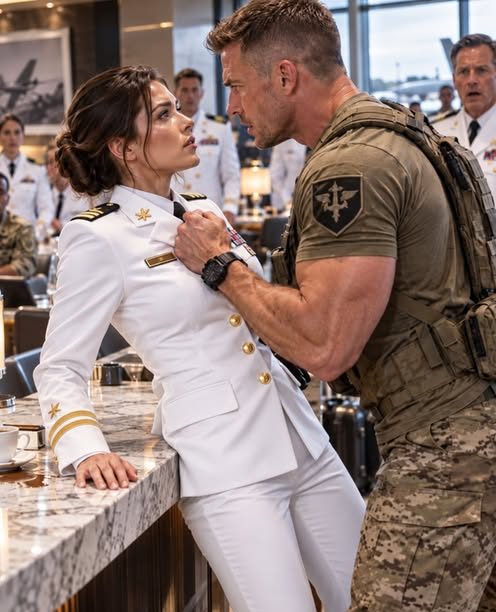
PART 3
I did not invite Nathan Hayes to Sparrow Point immediately.
For most people, that distinction would have meant nothing.
For me, it represented growth.
Old Elena would have made the decision in twelve seconds.
Assess available information.
Identify objective.
Limit exposure.
Proceed alone.
Instead, I spent an entire morning wondering whether some doors became heavier when opened without anyone beside you.
At eleven thirty, I found Nathan in the equipment bay helping Chief Petty Officer Marcus Bell inventory communications gear.
Bell was thirty-nine, compact, endlessly patient, and possessed of the rare ability to make sarcasm sound almost encouraging.
He looked up when I entered.
“Colonel.”
“Chief.”
Nathan straightened.
“Ma’am.”
I glanced at the open equipment case.
“How bad?”
Bell considered.
“Depends whether you’d prefer the official answer or the answer that lets you sleep.”
“Official.”
“We have everything.”
“And the other?”
“We have most of everything.”
“Good.”
Nathan almost smiled.
I pointed toward the corridor.
“Walk with me.”
We crossed the hangar and stepped outside.
The rain had finally stopped.
Sunlight appeared between clouds, turning puddles on the concrete into fractured mirrors.
Nathan waited.
He had been different since the airport.
Not timid.
I would have disliked that.
Careful.
There was a difference.
“I went to see my father,” I said.
His eyebrows lifted slightly.
“I assume that’s connected to the photograph.”
“It is.”
I showed him the brass key.
He read the wooden tag.
“Sparrow Point.”
“You know it?”
“My father took me fishing there once.”
“When?”
“I was maybe twelve.”
That would have been before his mother’s death.
Before his relationship with Michael became complicated.
“What do you remember?”
Nathan thought.
“Cold water.
Bad sandwiches.
Dad insisting canned tuna tasted better outdoors.”
“It doesn’t.”
“No.”
“What else?”
He looked toward the trees beyond the parking area.
“There was a cabin.”
My attention sharpened.
“Which cabin?”
“I don’t know.”
“Think.”
He closed his eyes briefly.
“Green door.
Porch facing the water.
There was a brass bell beside the steps.”
“Did you go inside?”
“I think so.”
“You think?”
“I was twelve.”
“Fair.”
He rubbed the back of his neck.
“There was a woman there.”
I waited.
Nathan’s eyes opened.
“Your mother.”
That answered the question.
“You’re sure?”
“I wasn’t until I saw the photograph again.”
“What was she doing?”
“Painting.”
My mother had painted landscapes.
Not well, according to her.
Beautifully, according to everyone else.
Only three of her paintings remained in Dad’s house.
The rest had disappeared over the years.
We had assumed she gave them away.
“What happened that day?”
“Nothing dramatic.”
I almost smiled.
“Good.”
Nathan seemed puzzled.
“I mean it.
I’m developing an appreciation for undramatic information.”
He nodded.
“Your mother made us lemonade.
Dad fixed something under the sink.
Then they talked on the porch while I skipped rocks.”
“About what?”
“I couldn’t hear.”
Of course.
I looked at the key again.
“I’m going there Saturday.”
Nathan was silent.
“That isn’t an order,” I said.
He looked at me.
“You’re asking if I want to come.”
“Yes.”
“Do you want me there?”
A surprisingly difficult question.
“I think your father intended you to be part of whatever this is.”
“That isn’t what I asked.”
There was no challenge in his tone.
Only honesty.
I appreciated it.
“I don’t know,” I admitted.
Nathan nodded slowly.
“Then I’ll come if that’s okay.”
“Why?”
“Because I spent six months wishing I had one more conversation with my father.”
He looked at the key.
“This might be the closest I get.”
Claire refused to be excluded.
I had expected that.
What surprised me was Dad’s decision to stay home.
Saturday morning, when Claire and I arrived to pick him up, he stood on the porch holding two travel mugs.
“Coffee,” he announced.
Claire accepted hers.
“Where’s your jacket?”
“Inside.”
“Get it.”
“I’m not going.”
Claire stared at him.
“Yes, you are.”
“No.”
“Dad.”
He handed me the second mug.
I studied his face.
“You’re afraid.”
Claire turned toward me.
Dad gave me the look he once reserved for teenagers who had broken curfew.
“That was unnecessarily direct.”
“Was it inaccurate?”
He looked toward the street.
Nathan was parked at the curb in an old blue pickup, giving us enough distance to have the conversation privately.
Dad sighed.
“I went with your mother once.”
“To Sparrow Point?”
“Yes.”
“What happened?”
“Nothing.”
Claire groaned.
“Apparently that’s the family motto.”
Dad ignored her.
“She asked me not to return.”
“Why?”
“Because she said the place belonged to a part of her life she hadn’t figured out how to share.”
“With us?”
“With anyone.”
He paused.
“I respected that.”
Claire’s voice softened.
“For twenty years?”
“Marriage isn’t knowing everything about another person.”
Dad looked at both of us.
“It’s trusting that the things you don’t know aren’t necessarily betrayals.”
I thought about that.
Seventeen years of classified work had forced my family to practice precisely that kind of trust with me.
I had rarely considered what it cost them.
Dad continued.
“Your mother deserved a room inside herself that wasn’t occupied by being my wife or your mother.”
Claire’s expression softened.
“So you’re not coming because she asked you not to?”
“Yes.”
“Even now?”
“Especially now.”
He looked at me.
“But I think she’d want you girls to go.”
That single sentence nearly undid me.
Girls.
Claire was forty-three.
I was forty-eight.
But to Dad, apparently, we were still girls headed somewhere unfamiliar.
He reached into his pocket.
Another key.
Smaller.
Silver.
“What is that?”
Dad placed it in my palm.
“I don’t know.”
“You have an impressive collection of mysterious keys.”
“Your mother was organized.”
“Secretive.”
Dad looked at me.
“So are you.”
I had no response.
Claire smiled into her coffee.
Nathan remained respectfully by his truck until Dad waved him over.
For a moment the two men simply looked at each other.
Then Dad extended his hand.
“You have Michael’s eyes.”
Nathan’s composure faltered.
“People usually say his shoulders.”
“Those too.”
They shook hands.
Dad did not mention the airport.
Neither did Nathan.
Instead Dad said, “Your father talked about you.”
Nathan looked uncertain.
“Good things?”
“Complicated things.”
Nathan laughed softly.
“That sounds more accurate.”
Dad smiled.
“He loved you.”
Nathan looked down.
“I know.”
The words came quietly.
But there was something new in them.
Perhaps six months earlier, he could not have said them.
Dad patted his shoulder once.
“Good.”
Sparrow Point sat at the end of a narrow road lined with cedar and alder.
The farther we drove, the more the modern world seemed to recede.
No storefronts.
No traffic signals.
Only damp trees, gray water appearing intermittently through branches, and small weathered houses tucked into the shoreline.
Claire drove.
I sat beside her.
Nathan followed in his truck.
“You like him,” Claire said.
I kept watching the road.
“Who?”
“Please.”
“He’s an officer under my command.”
“That wasn’t the question.”
“I don’t dislike him.”
“He grabbed you in an airport.”
I had told her a significantly softened version of the event.
“He made a serious mistake.”
“And?”
“And he acknowledged it.”
Claire turned onto a gravel lane.
“You always said apologies were cheap.”
“They are.”
“So?”
“Change isn’t.”
She glanced at me.
“Has he changed?”
“I’m watching.”
Claire smiled.
“You sound like Dad.”
“That is offensive.”
“You sound like Mom too.”
“That I can tolerate.”
The lane ended beside six small cabins facing Puget Sound.
Cabin 6 stood farthest from the road.
Green door.
Weathered porch.
Brass bell beside the steps.
Nathan parked behind us.
For several moments, none of us got out.
The cabin looked ordinary.
That made it stranger somehow.
If it had been abandoned or ominous, expectation would have provided structure.
Instead there were flower boxes beneath the windows.
Someone had recently swept the porch.
A ceramic bluebird sat beside the door.
Claire saw it too.
“Someone maintains this place.”
“Yes.”
“Dad?”
“No.”
“You sound very sure.”
“He would’ve told us.”
Claire gave me a pointed look.
“Eventually.”
Fair.
We approached the porch.
The brass key opened the front door.
Inside, dust floated in bands of sunlight.
The cabin smelled of cedar, paper, and faintly of lavender.
My mother’s perfume.
I stopped.
Claire did too.
“Oh,” she whispered.
Nathan remained near the doorway.
The main room contained a small fireplace, two armchairs, a wooden dining table, and shelves filled with books.
Several paintings hung on the walls.
My mother’s.
A ferry crossing gray water.
Mount Rainier at sunrise.
Dad sleeping in a lawn chair.
Claire at eight years old holding a jar full of fireflies.
And me.
I stood in front of the last painting.
I was perhaps twenty-three, wearing fatigues, asleep at the kitchen table with my head resting on folded arms.
I had never known she painted me.
Claire came beside me.
“She caught your stubbornness.”
“I’m asleep.”
“Exactly.”
I laughed.
Then cried.
It happened so quickly I couldn’t prevent it.
One moment I was smiling.
The next my vision blurred.
I turned away.
For seventeen years, I had been very good at controlling what other people saw.
Claire ignored seventeen years of training and wrapped her arms around me.
I let her.
Nathan quietly walked onto the porch.
That simple act—leaving without being asked—made me trust him more than any apology could have.
Claire rested her cheek against my shoulder.
“She missed you.”
“I know.”
“No.
I mean she really missed you.”
I looked at the painting.
“I thought coming home would make everything easier.”
Claire pulled back.
“Who told you that?”
“Nobody.”
“Good.
Because that person would’ve been lying.”
I laughed wetly.
Claire squeezed my hand.
“Coming home doesn’t fix the missing years.”
“No.”
“It just gives you somewhere to put them.”
That sounded like something Mom might have said.
“You’ve gotten wise.”
“I work at a community college.
We’re issued wisdom with the parking permit.”
We separated.
I wiped my face.
“Don’t tell Nathan.”
“That you cried?”
“Yes.”
“I’ll charge for silence.”
“Extortion.”
“Family pricing.”
The silver key opened a desk drawer.
Inside were twenty-two envelopes.
One for every September from 1998 through 2019.
Each labeled with a year.
Claire sat beside me.
Nathan had returned after I assured him he wasn’t intruding.
We spread the envelopes across the dining table.
Every one contained a letter.
Not to us.
To our mother.
The first was signed Michael.
The second too.
All twenty-two.
Nathan stared at them.
“My dad wrote your mother every year?”
“It looks that way.”
Claire glanced at me.
Neither of us said what immediately occurred to us.
Dad had known Michael.
Mom had known Michael.
There was history.
Secrecy.
Annual letters.
A private cabin.
A less generous imagination could build an entire betrayal from those pieces.
I felt Nathan tense.
“Maybe I should leave.”
“No,” I said.
He looked at me.
“If your father wanted these hidden from you, he wouldn’t have written my name on the photograph.”
Nathan sat again.
Claire reached for the oldest envelope.
“We should read them in order.”
I stopped her.
“Wait.”
She frowned.
“What?”
I looked around the cabin.
“There’s something missing.”
Nathan followed my gaze.
“What?”
“Her side.”
Claire understood.
“These are all from Michael.”
“Yes.”
“If Mom wrote back—”
“There should be copies.”
Nathan stood.
We searched.
Not aggressively.
There was something intimate about opening another person’s drawers, even when that person was your mother.
Kitchen cabinets yielded tea, expired cinnamon, and three mugs.
A bedroom wardrobe contained blankets.
A trunk held painting supplies.
Eventually Nathan noticed a loose floorboard beneath the desk.
He crouched.
“Colonel.”
Claire laughed.
“You can call her Elena here.”
Nathan looked at me.
I considered the implications.
This was not a military setting.
“Elena is fine.”
It seemed strangely significant.
He lifted the board.
Beneath it sat a wooden box.
No lock.
Inside were twenty-two journals.
Mom’s.
Each marked with a year.
Claire touched the first cover.
“She kept journals?”
“Apparently.”
“She told me diaries were dangerous because younger sisters always found them.”
“She was right.”
We began reading.
Slowly.
Carefully.
What emerged over the next three hours was not the scandal any of us had briefly feared.
It was something quieter.
And far more complicated.
Michael Hayes and my mother had been friends before either met our fathers.
They grew up in neighboring towns in Oregon.
Michael dated Mom’s older sister briefly in college.
After that ended, he and Mom stayed friends.
Years later, through an absurd coincidence, Michael served with Dad.
Mom’s journals described it as “proof that the universe has a very limited casting department.”
Claire laughed when she read that.
Then came the harder years.
Dad’s troubled return from deployment.
Michael’s marriage.
Nathan’s birth.
The death of Nathan’s mother, Susan.
And Michael’s retreat from fatherhood when grief overwhelmed him.
Mom had written:
Mike keeps saying Nathan is resilient.
Adults use that word too easily about children.
Sometimes resilient simply means they have learned nobody is coming quickly enough, so they stand up alone.
Nathan stopped reading.
He stared at the page.
Claire reached for his hand.
Not dramatically.
Not with pity.
She simply rested her fingers over his.
Nathan let her.
We continued.
Mom had challenged Michael for years.
Sometimes gently.
Sometimes not.
In a letter dated September 2004, Michael wrote:
You were right.
I thought providing for Nathan counted as being there.
It does not.
He does not need a hero.
He needs a father willing to be ordinary beside him.
Nathan covered his mouth.
I looked away to give him privacy.
After a while, he said, “He never told me this.”
“Maybe he couldn’t,” Claire said.
“He could command thirty men.”
“That might’ve been easier.”
Nathan gave a small, sad laugh.
“Probably.”
The letters became a record of two families trying, failing, adjusting, trying again.
Mom wrote about me too.
How worried she was when I chose special operations.
How proud she was.
How frightened.
She never asked me to leave the work because she understood asking would force me to choose between honesty and comforting her.
One journal entry stopped me.
September 18, 2011.
Elena called tonight.
Three minutes and fourteen seconds.
She said she was fine four times.
Thomas believes this is reassuring.
It is not.
I want to ask where she is.
I want to ask whether she is frightened.
I want to tell her to come home.
Instead I asked if she was eating.
Mothers become experts in asking small questions when the large ones are forbidden.
I closed the journal.
Claire stared out the window.
Nathan remained silent.
For years, I had believed silence was something I imposed on myself to protect my family.
I had never understood that they were maintaining the silence too.
For me.
Dad especially.
“There’s one more year,” Claire said.
The final journal.
The year Mom died.
Inside, most pages were blank.
Her illness had progressed quickly.
But September 18 contained four pages.
Her handwriting was weaker.
She wrote about Sparrow Point.
About the cabin.
About Michael visiting that afternoon.
Then:
Mike asked me what I want the girls to know.
I told him I want Claire to understand that staying near home was not a smaller life.
And I want Elena to understand that leaving was not a betrayal.
They have spent too many years measuring themselves against one another.
Claire believes Elena is brave because she goes.
Elena believes Claire is brave because she stays.
They are both correct.
I looked at my sister.
She was crying now.
Quietly.
For much of our adult lives, Claire and I had misunderstood each other’s choices.
I thought she resented me for leaving.
She thought I pitied her for staying.
Neither was true.
But neither of us had said so.
Mom continued.
Thomas worries Elena will never come home.
I think she will.
Not because she becomes tired of the world.
Because one day she will understand home is not the place that asks her to become who she used to be.
It is the place that lets her arrive as whoever she has become.
I had to stop again.
Outside, waves folded gently against the shore.
Nathan stood and walked to the window.
Claire leaned against me.
We stayed that way for a while.
Then she whispered, “Mom always did like having the last word.”
“She learned from Dad.”
“Other way around.”
At the bottom of the final page, Mom had written:
The rest is in the blue box.
There was no blue box.
We searched for forty minutes.
Nathan finally found it on the porch.
Not hidden.
Painted blue and used as a bench.
Claire stared at it.
“We’ve been sitting on the mystery.”
“Apparently.”
“That’s rude.”
Inside were three sealed envelopes.
One read THOMAS.
One read CLAIRE AND ELENA.
The last read NATHAN.
Nathan froze.
“She wrote me?”
“Looks like it.”
He didn’t pick it up.
“You can read it privately,” I said.
He nodded.
Then looked at me.
“Could I stay here?”
“Of course.”
Claire and I carried our envelope to the end of the dock.
The afternoon had turned clear.
Mount Rainier hovered pale in the distance.
We sat side by side.
“You open it,” Claire said.
“Why me?”
“You’re older.”
“That’s never helped me before.”
“Today it does.”
I opened the envelope.
The letter began:
My girls,
If you are reading this together, then at least one of my plans worked.
Claire laughed through tears.
I kept reading aloud.
Mom wrote that Sparrow Point had become her place to think because people she loved had spent their lives serving others.
Dad.
Michael.
Eventually me.
Claire in her own way.
She had watched each of us confuse usefulness with worth.
So she kept a place where nobody had to be useful.
Nobody had to earn rest.
Nobody had to report anything.
She wanted the cabin eventually transferred to Claire and me.
But there was a condition.
Of course there was.
Claire read over my shoulder.
“You may keep it only if you promise not to turn it into something practical.”
I laughed.
“That is absolutely aimed at you,” Claire said.
“You run a veterans center.”
“Yes, but I also own decorative pillows.”
“Strong defense.”
Mom continued.
Use this place badly.
Waste afternoons.
Burn dinner.
Read books with no educational value.
Invite people who need somewhere quiet.
Do not create a schedule.
Elena, this specifically means you.
Claire laughed so hard she had to wipe her eyes.
Then the letter changed.
There is one thing I hope you will do well.
Forgive imperfectly.
You will hear people talk about forgiveness as if it is a door you walk through once.
It isn’t.
Sometimes you forgive someone on Monday and feel angry again on Thursday.
Sometimes you understand why a person hurt you and still wish they had chosen differently.
Sometimes love survives without becoming simple.
That is all right.
I thought of Dad.
I thought of Nathan.
I thought of myself.
Mom’s last paragraph was short.
Do not make your lives into courtrooms.
You are allowed to remember what happened.
You are allowed to require better.
But leave room for evidence that people have changed.
Including yourselves.
Love,
Mom
Claire rested her head against my shoulder.
For several minutes, we watched the water.
Then she said, “You know what’s irritating?”
“What?”
“She was right.”
“About which thing?”
“All of it.”
I folded the letter carefully.
“I missed her funeral.”
Claire’s head lifted.
There it was.
The sentence I had never said aloud.
The wound beneath all the others.
I had been overseas.
There had been no way to return in time without compromising people whose safety depended on my location remaining secret.
Dad told me not to come.
Claire told me Mom would understand.
I hated them both for saying it.
I hated myself more for listening.
“I know,” Claire said.
“I should’ve been here.”
“You couldn’t.”
“I could have found a way.”
“No.”
“You don’t know that.”
“I do.”
Her voice was firmer now.
“Because Mom told me.”
I turned.
“What?”
“She made me promise not to tell you.”
I almost laughed.
“Apparently everybody in this family spent twenty years making promises not to tell me things.”
“She knew you would try.”
“To come home?”
“Yes.”
Claire looked toward the mountains.
“She was afraid you would abandon people who depended on you because of her.”
“I should have.”
“No.”
“You don’t get to decide that.”
“Neither do you.”
That silenced me.
Claire took my hand.
“Mom decided.”
I looked at her.
“She was awake the night before she died.
Completely clear.
She asked where you were.”
My chest tightened.
“What did you say?”
“That I didn’t know.”
“Good.”
“She smiled.”
Claire’s eyes filled.
“She said, ‘Then Elena is exactly where she needs to be.’”
I closed my eyes.
Seven years.
I had carried that guilt for seven years.
It did not disappear.
Mom had been right about forgiveness.
Apparently guilt worked the same way.
You didn’t set it down once.
You practiced setting it down.
Claire squeezed my fingers.
“She wasn’t angry.”
“I was.”
“At who?”
“Everybody.”
“Including her?”
I opened my eyes.
“Yes.”
Claire nodded.
“Me too.”
That surprised me.
“For dying?”
“For being calm about it.”
We both laughed.
Then cried again.
It was ridiculous.
Messy.
Entirely unlike the controlled conversations I had spent my career perfecting.
Maybe that was the point.
Nathan was still on the porch when we returned.
The envelope lay open beside him.
He held a single sheet of paper.
“You okay?”
I asked.
He nodded.
Then shook his head.
Then laughed.
“I don’t know.”
Claire sat opposite him.
“That seems to be today’s official answer.”
Nathan handed me the letter.
“Read it.”
“You sure?”
“Yes.”
My mother’s handwriting.
Nathan,
You will probably not remember me well.
But I remember the boy who refused lemonade because his father drank coffee and you believed adulthood was a beverage choice.
Nathan smiled.
“He still thinks coffee is adulthood.”
“Correct.”
I continued.
Your father worries he failed you.
He has.
You have failed him too.
This is what happens when people love each other long enough.
If all goes well, they accumulate evidence of disappointment and reasons to stay anyway.
Nathan has your mother’s kindness, Mike.
Do not punish him for your fear that the world will take it away.
And Nathan, if you someday read this, do not confuse your father’s awkwardness with absence of love.
Some people speak affection fluently.
Others translate it badly.
Make him practice.
Nathan stared toward the water.
“He never practiced.”
I handed the letter back.
“Maybe he tried.”
“Too late.”
“Yes.”
Nathan looked at me.
I did not soften it.
Some losses did not need silver linings.
“He should’ve told me,” Nathan said.
“Yes.”
“I should’ve gone home.”
“Probably.”
His eyes narrowed slightly.
“Most people keep telling me I couldn’t have known.”
“You couldn’t.”
“But?”
“But you asked what you should’ve done.”
He looked down.
“I should’ve gone home.”
“Maybe.”
“And now I can’t.”
“No.”
The words settled.
Nathan folded the letter.
“I keep wanting someone to tell me it wasn’t my fault.”
Claire spoke quietly.
“Would that help?”
“No.”
“Then maybe that’s not what you need.”
Nathan looked at her.
“What do I need?”
Claire glanced at me.
I shrugged.
She smiled faintly.
“Maybe permission to miss him without turning every memory into a trial.”
Nathan looked at the letter again.
Then nodded.
“I could try that.”
We returned to the base Monday.
Something had changed.
Not in rank.
Not in procedure.
Nathan still called me Colonel during duty hours.
I still reviewed his work exactly as carefully as everyone else’s.
But the hidden tension was gone.
Two weeks later, he requested a meeting.
He arrived carrying a folder.
“I’ve been offered another assignment.”
That surprised me.
“Where?”
“Virginia.”
“Promotion track?”
“Yes.”
“You want it?”
He hesitated.
“Six months ago I would’ve already packed.”
“And now?”
“My sister lives outside Tacoma.”
I remembered.
The sister who cared for their father.
“I haven’t seen much of her.”
“Because of the job?”
“Because I’m good at having reasons.”
I understood that.
“What does she think?”
“I haven’t asked.”
“Why not?”
Nathan smiled.
“I knew you were going to say that.”
“You asked for career advice from someone currently being lectured by her younger sister about answering family group texts.”
He laughed.
Then grew thoughtful.
“My father wanted me to make captain.”
“Do you?”
“I don’t know.”
“Then don’t make the decision based on what a dead man wanted.”
He winced slightly.
I raised a hand.
“I don’t mean forget him.”
“I know.”
“I mean he isn’t here to live with the consequences.”
Nathan nodded slowly.
“My sister has a daughter.”
I smiled.
“Your niece.”
“She’s six.”
“What does she call you?”
“Uncle Nate.”
“Good title.”
“She thinks I work on submarines.”
“Do you?”
“No.”
“Let her keep that one.”
He smiled.
I pushed the folder back toward him.
“Talk to your sister.”
“And the assignment?”
“Will still exist tomorrow.”
“What would you do?”
Six months earlier, I would have given him a perfectly reasoned career analysis.
Instead I said, “I’m trying to stop answering that question for other people.”
He considered that.
“Fair.”
At the door, he stopped.
“Colonel?”
“Yes?”
“For what it’s worth, I’m sorry the first version of me you met was the worst one.”
I looked at him.
“I don’t think it was the worst one.”
He seemed surprised.
“I think it was the version having the worst day and pretending he wasn’t.”
Nathan absorbed that.
“That’s generous.”
“No.
Generous would be forgetting it happened.”
I leaned back.
“I haven’t.”
He nodded.
“I understand.”
“But I don’t think you’re pretending anymore.”
Something eased in his face.
“No, ma’am.”
“Good.”
I finally called Mercer.
He answered immediately.
“You went to Sparrow Point.”
Not a question.
“You knew.”
“Some.”
“Did you know about the journals?”
“No.”
“The letters?”
“A few.”
“Why didn’t you tell me?”
“Because your mother threatened me.”
I almost laughed.
“With what?”
“She said if I interfered, she’d tell everyone I cried during Field of Dreams.”
“Did you?”
“That is classified.”
I smiled.
Then grew serious.
“You could’ve told me about Michael.”
“Yes.”
“You should have.”
“Yes.”
No defense.
It was infuriating how effective that was.
“I was angry.”
“You’re allowed.”
“I still am.”
“Also allowed.”
I looked through the office window.
Nathan crossed the hangar below, speaking with Chief Bell.
“I think I’m going to forgive you eventually.”
Mercer chuckled.
“High praise.”
“Don’t rush me.”
“I wouldn’t dream of it.”
Then he said, “Have you talked to Thomas?”
“Not yet.”
“Call him.”
I groaned.
“You and Mom would have been unbearable together.”
“We were.”
That caught me.
“You knew her better than you admitted.”
Mercer was quiet.
“We all did, Elena.”
“What does that mean?”
“It means your mother spent a lifetime feeding soldiers who showed up at your father’s door pretending they only needed coffee.”
I smiled.
That sounded exactly right.
“Daniel?”
“Yes?”
“Thank you.”
“For what?”
“Not telling me everything.”
He laughed softly.
“That’s a first.”
“Don’t enjoy it.”
“Too late.”
That Sunday, Claire and I invited Dad to Sparrow Point.
He refused.
Then Claire lied and said the porch railing needed repair.
He arrived with tools in eighteen minutes.
Nathan came too.
So did his sister, Rebecca.
She was forty-two, an elementary-school librarian with their father’s eyes and none of Nathan’s reserve.
Her daughter Sophie spent most of the afternoon collecting shells and informing Chief Bell—who somehow had also been invited—that every one was “extremely rare.”
Bell treated each discovery with appropriate gravity.
By four o’clock, the cabin smelled like chili.
Dad repaired a railing that did not need repair.
Claire rearranged books.
Rebecca and Nathan sat on the dock talking.
Not solving everything.
Talking.
That mattered more.
I stood in the kitchen washing mugs when Dad joined me.
“You opened Mom’s envelope?”
He asked it casually.
Too casually.
“Yes.”
He nodded.
“What did she say?”
“Nice try.”
His mouth twitched.
“There was one for you.”
“I know.”
“Did you read it?”
“No.”
I turned off the faucet.
“Why?”
Dad looked toward the blue box beneath the window.
“I thought I would.”
“But?”
“I don’t know if I’m ready.”
It was perhaps the most vulnerable thing I had ever heard my father admit.
I dried my hands.
“You don’t have to be.”
He looked at me.
“No?”
“No.”
“What if I wait too long?”
“You’ve got the letter.”
“That doesn’t answer the question.”
I thought of Nathan.
Of Michael.
Of Mom’s journal.
Of seventeen years spent believing strength meant being ready before anyone noticed you were afraid.
“No,” I said.
“It doesn’t.”
Dad smiled faintly.
“Your mother would’ve had a better answer.”
“Probably.”
“She usually did.”
We stood together.
Finally he said, “Did she write about me?”
“A lot.”
“Good things?”
“Complicated things.”
Dad laughed.
“Fair.”
Then his expression softened.
“Elena.”
“Yeah?”
“I’m glad you’re home.”
Once, those words would have made me defensive.
Home sounded like surrender.
Like an ending.
Now I looked through the window.
Claire was waving Nathan toward the cabin.
Rebecca was helping Sophie arrange shells on the porch rail.
Chief Bell was pretending not to steal pieces of cornbread.
The water beyond them was silver beneath the late-afternoon sun.
“I think I am too.”
Dad nodded.
He didn’t ask how long I would stay.
That was another kind of growth.
Three months later, Nathan turned down Virginia.
Not because I advised him to.
Because he talked to Rebecca.
He remained with the unit and applied for a different advancement path that would allow more predictable stateside rotations.
I approved the paperwork.
Without comment.
Mostly.
“You realize this won’t slow down the submarine rumors,” I said.
He sighed.
“Sophie told her entire class I’m a submarine captain.”
“Promotion already.”
“Apparently.”
Claire began using Sparrow Point for small weekend gatherings through her veterans program.
Not therapy.
Not seminars.
Just dinners.
Books.
Fishing.
Bad board games.
Exactly the kind of impractical purpose Mom would have approved.
Dad eventually opened his letter.
He never told me everything inside.
I never asked.
That might have been the largest change of all.
One evening in December, I found him alone on the dock at Sparrow Point.
Snow threatened in the mountains, though none had reached the water.
He held Mom’s letter.
“Good?”
I asked.
Dad considered.
“Complicated.”
I sat beside him.
We watched the water.
After a while he said, “Your mother asked me to do something.”
“What?”
“Stop waiting for the life we had.”
I didn’t speak.
“She knew I’d do that.”
“Did she tell you what to replace it with?”
“No.”
“Typical.”
He smiled.
“Apparently I’m supposed to figure that out myself.”
“Cruel woman.”
“Terrible.”
We both smiled.
Then Dad folded the letter.
“I’m thinking of taking that train trip.”
“What train trip?”
“The one your mother and I always talked about.”
“Across Canada?”
“Yes.”
“You hate trains.”
“I hate airports more.”
“Fair.”
He looked at me.
“Come for part of it.”
My first instinct was automatic.
Schedule.
Leave authorization.
Operational responsibilities.
Everything that made saying no easy.
Then I remembered Mom’s letter.
Use this place badly.
Waste afternoons.
Do not make your lives into courtrooms.
I smiled.
“How many days?”
Dad smiled too.
“Look at you negotiating.”
“I’m growing.”
“Slowly.”
“Careful.”
He laughed.
“Four days.”
“I can do four.”
It wasn’t a grand reconciliation.
No music played.
Nothing in the universe rearranged itself.
A father asked his daughter to take a train ride.
A daughter said yes.
Sometimes entire families changed through decisions that small.
In spring, our unit completed its first major evaluation under my command.
The result mattered less than what happened afterward.
We gathered in the briefing room.
Forty-three people.
Chief Bell leaned against the wall.
Nathan stood near the front.
I looked around at them.
“When I arrived,” I said, “I told you competence matters, judgment matters more, and trust matters most.”
Nathan lowered his head slightly.
He remembered.
So did I.
“What I didn’t tell you,” I continued, “is that trust isn’t something competent people automatically deserve.”
The room stayed still.
“Trust is what happens when people become willing to be known accurately.”
A few faces changed.
I thought of my family.
Of the lies we had never actually told one another.
Only silences.
Assumptions.
Half-understood sacrifices.
“We sometimes believe strength means controlling what other people see.
There are situations where that is necessary.”
I smiled faintly.
“But if you live that way everywhere, eventually nobody knows how to find you.”
My eyes moved briefly toward Nathan.
He nodded once.
“So here’s the expectation going forward.
Do the work.
Tell the truth.
Go home when you can.
Ask for help before you become certain you don’t need it.”
Chief Bell raised a hand.
“Colonel?”
“Yes?”
“Does that apply to commanding officers?”
The room became suspiciously quiet.
I looked at him.
“Chief, I was hoping nobody would notice.”
Laughter moved through the room.
Warm.
Easy.
Nathan smiled.
And I realized something.
For most of my career, I thought command meant becoming the person who had answers when everyone else was uncertain.
Now I understood another version.
Sometimes command meant making uncertainty safe enough that people could tell you the truth.
Sometimes family meant the same thing.
That September, on the eighteenth, we gathered at Sparrow Point.
Dad.
Claire.
Rebecca.
Nathan.
Sophie.
Mercer, who arrived carrying a pie and denied under oath that he had purchased it at a grocery store.
Chief Bell brought a fishing rod despite having no intention of fishing.
We hung one of Mom’s paintings above the fireplace.
The one of me asleep at the kitchen table.
I objected.
Everyone voted against me.
Military authority apparently had limits.
At sunset, Nathan stood beside me on the porch.
His promotion had been approved that morning.
Captain-select.
He hadn’t told anyone yet.
“You should tell Rebecca,” I said.
“I will.”
“When?”
“After dinner.”
“Good.”
He looked across the yard where his niece was teaching Dad how to make something with colored string.
Then he said, “I’ve been thinking about the airport.”
I sighed.
“You really know how to ruin a sunset.”
He laughed.
“Sorry.”
“What about it?”
“I’ve spent a year trying to understand why I behaved that way.”
“And?”
“I think I already knew.”
I looked at him.
“My father died,” Nathan said.
“I wasn’t there.
Everybody around me looked like they belonged somewhere except me.”
He shook his head.
“Then I saw you.
No uniform.
No visible reason to be in that room.
And instead of asking who you were, I decided.”
I nodded.
“That sounds accurate.”
“I don’t want to be that person again.”
“Then don’t.”
He looked surprised.
“That’s it?”
“Were you expecting a speech?”
“Possibly.”
“You’ve heard enough speeches.”
He smiled.
Then his expression became serious.
“You could have ended my career.”
“Yes.”
“Why didn’t you?”
I considered.
The easy answer would have been Michael.
His letter.
My father’s history.
But none of that had existed yet when I chose not to file the complaint.
“I wanted to know who you were after you realized you were wrong.”
Nathan looked at me.
“That was a risk.”
“Yes.”
“What if I’d stayed the same?”
“Then the consequences would have changed.”
He nodded.
“That seems fair.”
“It wasn’t forgiveness, Nathan.”
“I know.”
“It was time.”
“I know that too.”
Behind us, Claire called that dinner was ready.
Nathan turned toward the cabin.
Then stopped.
“Elena?”
We were off duty.
So I let the first name stand.
“Yeah?”
“Thank you for the time.”
I looked at him.
“You used it well.”
That was all.
It was enough.
Later, after everyone left, I remained on the porch.
Dad had gone home with Mercer.
Claire and Rebecca had taken Sophie back before bedtime.
Nathan left last.
The cabin became quiet.
I could hear the water.
The brass bell moved faintly in the wind.
Inside, Mom’s journals sat on the shelf.
Michael’s letters were beside them.
For years, those pages had waited.
Not for a dramatic revelation.
Not for hidden scandal.
Not for someone to expose a secret.
They had waited because sometimes the truth needed people to become ready for it.
I thought of my mother coming here every September.
Writing.
Painting.
Making room in her own life for questions that had no immediate answers.
At forty-eight, after seventeen years spent solving problems for a living, I was finally beginning to understand the value of an unanswered question.
Would Nathan become the officer his father hoped he could be?
Maybe.
Would Dad learn how to build a life that wasn’t organized around missing Mom?
He had started.
Would Claire and I ever recover all the years when we had mistaken distance for judgment?
No.
Some years stayed lost.
But we had stopped losing new ones.
And me?
I didn’t know how long I would remain in command.
I didn’t know whether Sparrow Point would still feel like home in ten years.
I didn’t know whether I would ever become someone who answered family messages promptly.
Claire considered that possibility unlikely.
But that night, before leaving the cabin, I took out my phone.
Our family group chat contained eleven unread messages.
Most were photographs of dinner.
One was Sophie holding a shell.
One was Dad asleep in an armchair while Mercer pointed at him accusingly.
Claire had written:
Proof Dad is finally learning to waste an evening.
I smiled.
Then typed:
Train trip next month.
Four days.
Dad and I.
Anyone jealous may submit complaints in writing.
Claire responded immediately.
I AM EXTREMELY JEALOUS.
Then Nathan, somehow now included in the family chat because Claire had no respect for boundaries, wrote:
Can complaints be submitted through chain of command?
I replied:
Request denied.
Dad sent:
Go to bed, Elena.
I stared at the screen.
Once, that simple sentence would have irritated me.
Now it felt like a gift.
I switched off the lights.
Locked the green door.
Then stood for a moment on the porch while the moonlight spread across Puget Sound.
Seventeen years had taught me how to enter dangerous places without being seen.
Coming home had required learning almost the opposite.
How to be seen.
How to stay.
How to let the people who loved me know when I was tired, uncertain, grieving, hopeful.
How to stop treating every mistake like an identity and every silence like a verdict.
My mother had been right.
Home wasn’t where people expected me to become who I had once been.
It was where I could arrive as whoever I had become.
I touched the old brass bell beside the porch.
It rang once.
A small, clear sound over the water.
Then I walked toward my car.
Tomorrow there would be briefings.
Decisions.
Responsibilities.
Nathan would probably submit something late.
Bell would complain about equipment.
Mercer would call with another problem he described as “interesting,” which generally meant inconvenient.
Life would continue.
That was the discovery waiting at Sparrow Point.
Not a buried secret.
Not a perfect explanation.
Something better.
A second chance did not erase the first story.
It simply gave you another page.
And for the first time in years, I was no longer afraid to see what came next.
-END OF PART 3 – PLEASE “LIKE” AND SHARE THIS POST ON FACEBOOK TO SUPPORT US IN SHARING EVEN MORE STORIES