PART 2
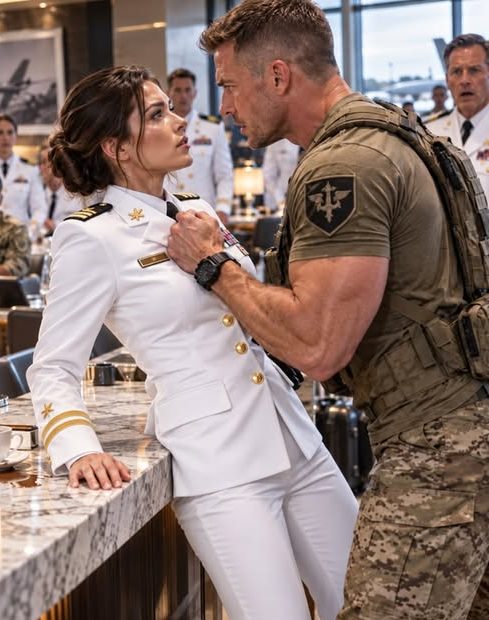
Lieutenant Commander Hayes released my hoodie as if the fabric had suddenly become electrically charged.
For three full seconds, nobody spoke.
Then Rear Admiral Daniel Mercer stepped farther into the lounge.
I had known Mercer for almost fifteen years, though there were entire stretches of that time when neither of us could publicly acknowledge the other existed.
He was fifty-eight now, silver at his temples, lean rather than imposing, with the calm expression of a man who had learned long ago that raising his voice usually meant losing control of a room.
At that moment, he didn’t need volume.
“Commander Hayes,” he said again.
Hayes straightened.
“Sir.”
“Step away.”
Hayes did.
I adjusted the front of my hoodie and picked up my bag.
The airman near the window looked as though he desperately wanted to disappear into the carpet.
Mercer glanced at the overturned coffee cup, the stain on my sleeve, and finally at me.
“You all right, Elena?”
“I need another coffee.”
One corner of his mouth moved.
“Still impossible, then.”
“Consistently.”
That tiny exchange changed the temperature in the room.
Not because it was funny.
Because Hayes understood what it meant.
The admiral knew me personally.
More importantly, he trusted me enough to use my first name.
Hayes swallowed.
“Colonel, I—”
I raised one hand.
“Not here.”
His mouth closed.
I wasn’t interested in watching a man apologize because an admiral was standing behind him.
An apology given under pressure was usually just another form of self-preservation.
I wanted to know what he would say when no one important was watching.
Mercer seemed to understand.
“Security has already been notified,” he said quietly.
“No formal complaint from me.”
Hayes looked up sharply.
Mercer studied me.
“Elena.”
“I said no complaint from me.
The lounge staff can report whatever they’re required to report.”
“That isn’t the same thing.”
“No.”
Mercer’s eyes narrowed slightly.
He had always disliked it when I answered a question he hadn’t technically asked.
“What are you doing?” he said.
“I haven’t decided yet.”
Hayes shifted his weight.
I looked at him for the first time since Mercer had entered.
His face had changed.
The arrogance was gone.
So was most of the color.
But underneath the embarrassment was something else.
Not anger.
Recognition.
It was there and gone so quickly I almost convinced myself I’d imagined it.
He had heard my name.
Not my rank.
Not the announcement that I would command his unit.
My name.
Vance.
Something about it had landed differently.
“Have we met?”
I asked.
Hayes blinked.
“No, ma’am.”
Too fast.
Mercer caught it too.
I could tell by the almost invisible lift of his chin.
Before I could press further, an airport employee arrived carrying towels, followed by a security supervisor whose professional concern increased noticeably after he saw Mercer’s uniform.
The moment broke apart.
Statements had to be taken.
Names recorded.
A replacement coffee appeared without anyone admitting who had ordered it.
By the time we left the lounge forty minutes later, Lieutenant Commander Hayes was headed toward a different gate under instructions to report directly to Joint Base Lewis-McChord after landing.
I watched him walk away.
Mercer stood beside me.
“You should have filed the complaint.”
“I still can.”
“You won’t.”
“Probably not.”
“That man put his hands on you.”
“I noticed.”
“Elena.”
I turned.
There were very few people alive who could use that tone with me.
Mercer was one of them.
It wasn’t command.
It was concern.
“Daniel, I’m not protecting him.”
“Then what are you doing?”
“Trying to understand him.”
Mercer sighed.
“That has always been your most admirable and most irritating quality.”
“You used to say that about my coffee.”
“Your coffee was never admirable.”
I smiled despite myself.
Then Mercer glanced toward the concourse where Hayes had disappeared.
“You recognized something.”
“So did you.”
“Yes.”
Neither of us said anything for several seconds.
Finally Mercer asked, “His reaction to your name?”
I nodded.
“Exactly.”
The flight south gave me two hours to think.
I spent most of them pretending not to.
Outside the window, the Pacific Northwest disappeared beneath a layer of cloud.
Across the aisle Mercer reviewed briefing papers on a secured tablet.
I opened my own files and stared at information I already knew.
Joint Special Mission Group Echo.
Forty-three assigned personnel.
Operations divided among reconnaissance, maritime interdiction, intelligence integration, and specialized recovery.
A unit that officially performed training and advisory work.
Officially.
I had been offered command three months earlier.
I had nearly declined.
Not because I didn’t want the responsibility.
Because taking it meant coming home.
Not geographically.
Emotionally.
For seventeen years, covert operations had given me an excellent excuse for distance.
Birthdays missed because of deployments.
Christmas dinners attended through grainy video calls from places I couldn’t name.
My younger sister Claire had eventually stopped asking when I would visit and started saying, “Let us know if you’re around.”
There was a world of difference between those two sentences.
My father had been worse.
Colonel Thomas Vance, retired United States Army.
A man who could rebuild a carburetor, organize a field hospital, and somehow turn every conversation with his oldest daughter into a tactical briefing.
He loved me.
I had never doubted that.
We simply had no idea how to talk to each other anymore.
My mother had once been the bridge.
After she died seven years ago, the bridge went with her.
Coming back to Washington meant being less than ninety minutes from the house where I’d grown up.
It meant Sunday dinners I could no longer blame on classified travel.
It meant answering questions.
It meant asking some.
That last part frightened me more than I liked to admit.
Mercer closed his tablet.
“You’re doing it again.”
“What?”
“Staring at the same page for twenty minutes.”
“Maybe it’s a very interesting page.”
“It contains the unit parking policy.”
“I care deeply about parking.”
“You don’t own a car.”
“That doesn’t diminish my interest.”
Mercer laughed quietly.
Then his expression changed.
“Your father knows you’re back?”
“He knows I’m taking a stateside posting.”
“That’s not what I asked.”
“No.”
“Elena.”
I leaned back.
“He knows I’m supposed to call.”
“And will you?”
“Eventually.”
“Your definition of eventually has always been elastic.”
I looked toward the window.
“Why are you suddenly interested in my family?”
“I’m not suddenly interested.”
Something in his tone made me turn.
Mercer looked down at his hands.
For a man who had briefed cabinet officials and four-star commanders without visible nerves, he suddenly seemed strangely careful.
“What?”
I asked.
“Nothing.”
“Daniel.”
He hesitated.
Then shook his head.
“Talk to your father.”
“That sounded suspiciously like an order.”
“Consider it advice from someone old enough to know when silence has lasted too long.”
I studied him.
“You know something.”
“I know your father.”
“You’ve met him twice.”
“Three times.”
I sat straighter.
“When?”
Mercer reopened his tablet.
“Call him.”
The conversation was over.
Which meant I thought about it for the remainder of the flight.
Joint Base Lewis-McChord smelled exactly as I remembered military installations smelling in autumn: wet pavement, pine trees, diesel exhaust, and institutional coffee.
The change-of-command ceremony was intentionally small.
That was my request.
No band.
No elaborate reception.
No long biographies listing assignments no one in the room was authorized to discuss anyway.
Forty-three people stood in formation inside a converted operations hangar.
I wore a uniform now.
Colonel Elena Vance.
No hoodie.
No faded jeans.
No useful anonymity.
I saw recognition ripple through the group when I entered.
News traveled quickly in military communities.
Embarrassing news traveled faster.
Lieutenant Commander Hayes stood in the second row.
His expression was perfectly neutral.
The ceremony lasted twenty-two minutes.
Afterward, the unit gathered for an informal welcome in the briefing room.
I gave them seven minutes.
I had timed it.
“You have all read my biography,” I said.
“Most of it is boring, some of it is incomplete, and at least one date is wrong.”
A few smiles.
Good.
“I’ve also read your records.
Those are incomplete too.”
More smiles.
Even Hayes almost reacted.
“My expectations are simple.
Competence matters.
Judgment matters more.
Trust matters most.
This unit operates in environments where rank can tell you who has authority, but only character tells you what they’ll do with it.”
The room grew quieter.
I did not look at Hayes.
“That means we will make mistakes.
We will own them.
We will correct them.
And then, when possible, we will allow people to become more than the worst decision they have made.”
Now I looked at him.
Only briefly.
His eyes met mine.
Something shifted there.
Not relief.
Perhaps surprise.
“Training schedule begins Monday,” I continued.
“Until then, go home.
Call your families.
Remember that a mission can always manufacture urgency.
The people waiting for you should not have to.”
That line wasn’t for them.
Not entirely.
I knew it as soon as I said it.
Mercer, standing near the back wall, knew it too.
When the briefing ended, Hayes remained behind.
Of course he did.
The door closed after the last operator left.
For a moment, he and I were alone.
He stood at attention.
“At ease,” I said.
He relaxed approximately half an inch.
I moved behind the conference table and sat.
“You wanted to speak.”
“Yes, ma’am.”
“Then speak.”
He took a breath.
“What happened this morning was unacceptable.”
I waited.
“I made assumptions about you based on how you were dressed, and then I compounded those assumptions because you didn’t respond the way I expected.”
Still I said nothing.
“My behavior was disrespectful before it became physical.
I have no excuse for either.”
“No.”
His jaw tightened.
“No, ma’am.”
“Why did you do it?”
He frowned.
“I behaved like an idiot.”
“That describes what happened.
It doesn’t explain why.”
Hayes looked toward the blank wall behind me.
For several seconds, I thought he might retreat into the familiar vocabulary of accountability, stress, operational tempo, poor judgment.
Instead he surprised me.
“I’ve been angry for a while.”
“At civilians?”
“At everybody.”
That answer cost him something.
I could see it.
“Why?”
“My father died six months ago.”
I said nothing.
Not because I didn’t care.
Because condolence offered too quickly could become a door people were forced to walk through before they were ready.
Hayes continued.
“He was sick for a while.
I was gone most of that time.”
“Deployment?”
“Yes.”
“You couldn’t return?”
“I could have.”
That was different.
His eyes dropped.
“He told me not to.”
“Why?”
“He said there was nothing I could do.”
I understood immediately.
And I suspected Hayes hated the fact that I understood.
“So you stayed.”
“Yes.”
“And now?”
“And now I keep thinking I should’ve ignored him.”
His voice was controlled, but quieter.
“My sister was there.
She handled everything.
Doctors.
Hospice.
Funeral arrangements.
All of it.”
He rubbed one thumb against the side of his index finger.
A nervous habit.
“I came home afterward and everyone kept telling me Dad was proud of me.
Like that was supposed to help.”
“Did it?”
“No.”
I leaned back.
“What was his name?”
Hayes looked at me.
“Michael.”
Something tightened in my chest.
“Michael Hayes?”
“Yes, ma’am.”
The room changed.
Not visibly.
Nothing moved.
The fluorescent lights still hummed.
Rain still tapped softly against the high windows.
But suddenly I was eighteen years old again, standing in my father’s garage while two young officers laughed over something I wasn’t allowed to know.
One of them had been Daniel Mercer.
The other—
A man with a broad smile and dark hair beginning to gray at the temples.
Mike Hayes.
I had not seen him in more than twenty years.
But I remembered.
More than I wanted to.
“Your father served in the Army before you joined the Navy,” I said.
Hayes blinked.
“Yes.”
“Special Forces.”
His surprise deepened.
“How did you know?”
I stood slowly.
“Because he knew my father.”
Hayes stared at me.
Then I saw the same expression I had noticed in the airport lounge.
Recognition.
“You knew,” I said.
He looked away.
“You knew my name.”
“I wasn’t sure.”
“At the airport?”
“No.
Not then.”
“But after Mercer said it.”
“Yes.”
“What did you recognize?”
Hayes hesitated.
“My dad had a photograph.”
My pulse slowed.
It was an old instinct.
When something mattered, everything inside me became quiet.
“What photograph?”
“He kept it in his desk.”
“Of what?”
Hayes looked at me again.
“Your family.”
I dismissed him ten minutes later.
Not because the conversation was finished.
Because it had become too important to conduct between duty schedules and fluorescent lights.
Hayes had agreed to bring the photograph the next morning.
I watched him leave, then called the one person who had already proven he knew more than he was saying.
Mercer answered on the second ring.
“You finally called your father?”
“No.”
A pause.
“That was fast.”
“Michael Hayes.”
Silence.
Not surprise.
Silence.
Which was worse.
“You knew,” I said.
“I knew Hayes was his son.”
“And you didn’t think that was worth mentioning?”
“I didn’t know whether he knew about you.”
“Apparently he had a photograph of my family in his father’s desk.”
Mercer exhaled slowly.
“Elena.”
“Tell me.”
“This isn’t a conversation for a secure line.”
“This is a secure line.”
“Not secure enough.”
“Daniel.”
“Go see your father.”
I closed my eyes.
“Why does everybody suddenly want me to visit my father?”
“Because Thomas is the only person who can tell you what that photograph means.”
“You can.”
“No.”
“Can’t or won’t?”
His answer took too long.
“Both.”
Then the connection ended.
I stared at the phone.
Admiral Daniel Mercer had just hung up on me.
That alone made the situation historic.
My father lived in Gig Harbor in the same blue-gray house my parents had bought when Claire and I were teenagers.
I drove there the following evening.
The rental car felt too clean.
The neighborhood felt too familiar.
Nothing had changed and everything had.
The cedar fence had been replaced.
The old maple in the front yard was taller.
My mother’s ceramic wind chime still hung beside the porch.
One blue piece was missing.
I sat in the car for almost five minutes.
I had walked into buildings where armed men were waiting for me with less hesitation.
Finally the front door opened.
My father stepped onto the porch.
At seventy-four, Thomas Vance had grown thinner.
His hair was entirely white now.
He wore khaki pants and the green flannel shirt Claire bought him every Christmas because he refused to admit he liked them.
He looked at the rental car.
Then at me.
“Planning to invade the driveway?”
I opened the door.
“Assessing the perimeter.”
“You’ve been sitting there long enough to draft a report.”
I climbed out.
For a moment, neither of us moved.
Then Dad descended the porch steps.
We met halfway up the path.
He hugged me.
It was awkward for the first second.
Then it wasn’t.
His hand pressed briefly against the back of my head the same way it had when I was twelve.
“You’re too thin,” he said.
“You’re too old.”
“That’s generally how time works.”
I laughed.
He did too.
And somehow that was enough to get us through the door.
Claire was already inside.
I should have known.
My younger sister believed family gatherings happened through a combination of planning and ambush.
She came out of the kitchen carrying a wooden spoon.
“You called him before you called me.”
“I didn’t call him.”
Claire pointed the spoon at Dad.
“You called her?”
“No.”
They looked at me.
I held up my hands.
“This is starting to feel hostile.”
Claire crossed the room and hugged me.
She smelled like vanilla and the citrus shampoo she’d used since college.
Unlike Dad, Claire did not let go quickly.
“You look tired,” she murmured.
“You sound like Mom.”
“That was intentional.”
When she stepped back, her eyes were bright.
Claire had always felt everything openly.
I had spent most of my adult life learning how not to.
Dinner was pot roast.
Dad’s attempt.
Claire’s rescue.
The first twenty minutes were almost painfully normal.
Claire talked about her job at the community college, where she ran the veterans transition program.
Dad complained that his neighbor’s dog had developed a personal grudge against his recycling bin.
I told sanitized stories about moving back to Washington.
Nobody mentioned deployments.
Nobody mentioned Mom.
Nobody mentioned why I was really there.
Finally Claire set down her fork.
“This is weird.”
Dad sighed.
“We made it twenty-eight minutes.”
“That’s impressive for us.”
I looked between them.
“What is weird?”
Claire gave me a look.
“You don’t drive to Gig Harbor on a weeknight because you suddenly miss Dad’s pot roast.”
“I’m sitting right here,” Dad said.
“You know what you’ve done.”
He nodded.
“Fair.”
I put my napkin beside my plate.
“Do either of you remember Michael Hayes?”
Dad stopped moving.
Claire looked at him.
There it was.
The answer before the answer.
My father sat back.
“Where did you hear that name?”
“His son works for me.”
For the first time that evening, genuine surprise crossed Dad’s face.
“Nathan?”
“You know him?”
“Knew of him.”
“Dad.”
He pushed his plate away.
“How much did Nathan tell you?”
“That his father kept a photograph of our family.”
Dad looked toward the kitchen doorway.
A tiny movement.
But I noticed.
Claire noticed me noticing.
She turned.
“What?”
“Nothing,” Dad said.
Claire folded her arms.
“That was very clearly something.”
Dad was quiet.
Then he rose.
“Come with me.”
He led us into the hallway.
My mother’s photographs still covered the walls.
Claire’s graduation.
My commissioning ceremony.
Family vacations.
Dad asleep in a hammock with a book over his face.
Mom laughing beside a Christmas tree.
Dad stopped in front of a photograph I knew well.
The four of us at Mount Rainier.
I was sixteen.
Claire was eleven.
Mom wore a red jacket.
Dad had one arm around each of us.
He lifted the frame from the wall.
Behind it was a small recessed compartment.
Claire stared.
“You have a secret compartment behind Mom’s Rainier picture?”
Dad grimaced.
“When you say it like that, it sounds strange.”
“It is strange.”
Inside was a narrow envelope.
Dad removed it and carried it to the kitchen table.
He didn’t open it.
Instead he placed both hands flat on either side.
“Your mother made me promise not to tell you unless circumstances made it necessary.”
My stomach tightened.
“What circumstances?”
“She wasn’t very specific.”
“Convenient.”
“Elena.”
I heard the warning in his voice.
Not an order.
A request.
Give me room.
I did.
Dad opened the envelope.
Inside were three photographs.
The first showed my father and Michael Hayes standing beside a helicopter somewhere dry and mountainous.
Both looked absurdly young.
The second showed Daniel Mercer with them.
The third was the picture Nathan Hayes had apparently seen.
Our family.
But this wasn’t a copy of the Rainier photograph.
It was older.
I was perhaps nine.
Claire was four.
Mom sat on the porch steps holding Claire on her lap.
I stood beside Dad.
Michael Hayes was behind us.
His hand rested on my father’s shoulder.
On the back, in my mother’s handwriting, were five words.
For Michael.
Because family remembers.
I looked at Dad.
“What does that mean?”
He stared at the photograph.
“Mike saved my life.”
I waited.
Dad continued.
“Not the way you’re thinking.”
He sat again.
“We were overseas.
Operation went bad.
I came home physically fine.”
His fingers touched the edge of the photograph.
“But I wasn’t fine.”
Claire’s voice softened.
“You never told us.”
“No.”
“Did Mom know?”
“Eventually.”
Dad looked at me.
“Mike was the one who noticed.”
Something about that sentence hurt more than I expected.
My father had always seemed indestructible when I was a child.
Even later, when I knew better, some part of me had preserved the illusion.
“What happened?”
I asked.
“I stopped sleeping.
Stopped talking.
Started finding reasons not to come home.”
He gave a humorless smile.
“Sound familiar?”
I looked away.
“Elena,” he said gently, “I’m not accusing you.”
It felt like he was.
Perhaps because some truths resembled accusations even when spoken kindly.
“Mike showed up one night,” Dad continued.
“Sat in this kitchen for six hours.
Didn’t ask questions.
Didn’t offer advice.
Just sat here.”
Claire wiped beneath one eye.
Dad looked at her.
“Your mother eventually came downstairs, took one look at us, and made eggs.”
That sounded exactly like Mom.
“She told Mike that anyone willing to sit in silence that long deserved breakfast.”
Dad smiled.
“He became family after that.”
“Then why don’t I remember him?”
“You do.”
I frowned.
“He was Uncle Mike.”
The room went very still.
A half-memory surfaced.
A man pushing me on a tire swing.
A booming laugh.
A birthday card with a badly drawn horse because I’d been obsessed with horses that year.
Claire whispered, “Uncle Mike moved away.”
Dad nodded.
“He transferred.
Later retired.”
“And you lost touch?”
“No.”
Again, too much meaning inside one word.
“Then why did you never mention him?”
Dad looked at the photograph.
“Because Mike asked me not to.”
I felt frustration rise.
“Why?”
“He had a son.”
“Nathan.”
“Yes.”
Dad’s eyes met mine.
“And Mike was afraid Nathan was becoming too much like him.”
I almost laughed.
“That’s not exactly unusual between fathers and sons.”
“No.
But Mike carried guilt.”
“For what?”
Dad looked toward the rain-darkened windows.
“When Nathan was fourteen, his mother died.”
Hayes hadn’t mentioned that.
“Mike threw himself into work.
Nathan was passed between relatives, schools, coaches.
He grew up believing his father chose service over him.”
Claire frowned.
“Did he?”
“For a while,” Dad said.
“Yes.”
There was no defense in his voice.
No attempt to improve the truth.
“Years later,” he continued, “Mike tried to repair things.
Nathan joined the Navy anyway.
Or maybe because of him.
I’m not sure.”
“And where do we fit?”
Dad looked at me.
“Mike followed your career.”
That surprised me more than it should have.
“He knew what you were doing?”
“Enough.”
“From you?”
“Sometimes.”
I stood.
“You discussed my career with him?”
“Nothing classified.”
“That’s not the point.”
“I know.”
“Do you?”
Dad rose too, but his voice stayed calm.
“Elena, he cared about you.”
“He barely knew me.”
“He knew you more than you remember.”
I turned away.
Claire touched my arm.
“Elena.”
“I spent seventeen years building a life none of you could talk about, and apparently everybody was talking about it.”
“No,” Dad said.
“We were trying to understand how to keep loving you from a distance.”
The words stopped me.
He hadn’t raised his voice.
That made them harder to dismiss.
Dad’s expression softened.
“Do you know what your mother used to say after your calls?”
I didn’t answer.
“She’d say, ‘Elena sounds happy.’
Even when you clearly weren’t.”
My throat tightened.
“She needed to believe that.”
“No,” Dad said.
“She needed you to believe she believed it.”
I looked at him.
The room seemed suddenly too small for the years between us.
Claire sat down quietly.
Dad continued.
“We knew enough to know there were things you couldn’t share.
So we learned not to ask.”
“You stopped asking everything.”
“Yes.”
“Why?”
“Because every question seemed to make you farther away.”
There it was.
Not blame.
Regret.
His and mine together.
I sat again.
For a long time nobody spoke.
Rain moved against the windows in silver lines.
Finally I asked, “What did Michael want you to keep from me?”
Dad looked at the envelope.
“Not from you.”
“Then from whom?”
“Nathan.”
I stared at him.
Dad reached into the envelope again.
There was one more item.
A folded letter.
Unopened.
My name was written across the front.
Not in my mother’s handwriting.
Michael Hayes’s.
Dad slid it toward me.
“He sent this three weeks before he died.”
I didn’t touch it.
“You’ve had this six months?”
“Yes.”
“And you didn’t tell me?”
“He asked me to wait.”
“For what?”
Dad looked almost embarrassed.
“For you to come home.”
The anger I expected never arrived.
Something sadder took its place.
“Why?”
“He said if I mailed it to wherever you were, you would read it like an operator.”
“What does that mean?”
Dad smiled faintly.
“You’d analyze it.
Categorize it.
Put it somewhere secure.”
Claire almost smiled too.
“That does sound like you.”
I ignored her.
“What did he want instead?”
Dad’s eyes settled on mine.
“He wanted you to read it as a daughter.”
I looked down at the envelope.
For Elena.
My name.
Nothing else.
I finally opened it.
The letter was only two pages.
Mike’s handwriting was uneven, probably from illness.
Elena,
If you’re reading this at your father’s kitchen table, Thomas kept his promise.
That made me smile despite myself.
Mike continued.
I owe you an apology for watching your life from a distance.
Your father sent occasional updates because I asked.
Your mother sent Christmas photographs because she believed nobody who had eaten her pancakes should be allowed to disappear completely.
I remember those pancakes.
You probably don’t remember me well.
That is all right.
Children are supposed to move forward.
Old men are the ones who look backward.
I paused.
Claire leaned forward but did not ask to see the letter.
I read on.
Nathan is my son.
He is also the greatest unfinished conversation of my life.
He believes I was disappointed in him.
The truth is almost the opposite.
I was afraid of what I recognized in him.
Pride.
Restlessness.
The need to prove usefulness before accepting love.
Your father and I carried those things for too many years.
I watched you carry them too.
My eyes stopped.
Dad looked down.
I continued.
There may come a day when Nathan serves with you.
If that happens, do not protect him for my sake.
Do not punish him for mine either.
See him clearly.
That is something I failed to do often enough.
He is better than his worst days.
So are you.
I swallowed.
Then came the final paragraph.
There is one more thing Thomas has promised not to tell you unless you decide to remain in Washington.
Ask him about Sparrow Point.
Ask him why your mother went there every September.
And Elena—
before you decide your family kept secrets from you, remember that sometimes people are not hiding the truth.
Sometimes they are waiting until they finally understand it themselves.
—Mike
I lowered the letter.
Claire stared at Dad.
“Sparrow Point?”
Dad looked tired suddenly.
Older than he had an hour earlier.
I knew Sparrow Point.
Everyone around Puget Sound did.
A narrow stretch of shoreline north of Gig Harbor, mostly private property and old summer houses.
Mom used to go away for one weekend every September.
She called it her retreat.
She took books.
A thermos.
Sometimes paints.
We never questioned it.
At least I hadn’t.
“Why did Mom go there?”
Claire asked.
Dad stared at the tabletop.
“She made me promise that part was hers to tell.”
Claire’s expression changed.
“Dad.
Mom has been gone seven years.”
“I know.”
“Then she can’t tell us.”
Dad slowly lifted his head.
“She can.”
Neither Claire nor I moved.
My father stood and walked to the old secretary desk in the living room.
He opened the bottom drawer and removed a small brass key.
Attached to it was a faded wooden tag.
SPARROW POINT — CABIN 6.
He set it on the table between us.
“Your mother left something there,” he said.
My fingers closed around the key.
“What?”
Dad’s eyes met mine.
“I don’t know.”
For once, I believed him completely.
“But whatever it is,” he continued, “Michael Hayes knew about it.”
The next morning, Lieutenant Commander Nathan Hayes arrived at my office carrying an old photograph in a protective sleeve.
It was the same family picture.
Mom on the porch.
Claire in her lap.
Me beside Dad.
Michael Hayes behind us.
Nathan placed it carefully on my desk.
“My father kept this for twenty-six years,” he said.
I turned it over.
On the back, beneath my mother’s words, there was another line.
Smaller.
Fainter.
Written in pencil.
A line that did not appear on Dad’s copy.
I read it twice.
Then looked at Nathan.
“Did you know this was here?”
He shook his head.
“What does it say?”
I turned the photograph toward him.
Together we read the six words his father had written years ago.
When Elena comes home, tell her.
And beneath it was a date.
September 18.
The same date my mother had visited Sparrow Point every year.
Yesterday had been September 18.
The key to Cabin 6 was still in my pocket.
For the first time since taking command, I understood that whatever waited at Sparrow Point did not belong only to my family.
Somehow, it belonged to Nathan’s too.
And I had to decide whether discovering it was something I should do alone—
or whether the son of Michael Hayes had been meant to come with me.
-END OF PART 2 – CLICK THE “NEXT PART” SECTION AT THE BOTTOM OF THE PAGE TO CONTINUE READING