Julian stayed planted on the dock, a drink in one hand and binoculars in the other, while the cutter carved down the strip of water separating him from us.
Victoria had finally killed her engine, but I was still strapped to the second jet ski with my wrists bound and blood running down my legs.
The water had gone strangely calm around me.
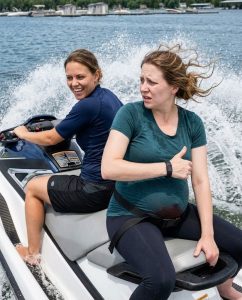
My body had not.
A sharp cramp folded through my abdomen, followed by another wave of pressure so strong that I bit the inside of my cheek to keep from screaming.
One of the helicopters banked above us while a rescue crew came alongside my jet ski.
A man in a life vest leaned across the gap and took one look at the canvas strap around my body.
His expression changed.
“Ma’am, don’t move.”
“I can’t,” I whispered.
He reached for the restraints while another crew member stabilized the jet ski.
I saw his eyes go to my wrists.
I saw his eyes go to my stomach.
I saw his eyes drop toward the blood in the water, and suddenly everyone around me started moving faster.
They cut the zip ties first.
The second my hands came free, I grabbed my stomach.
“My baby.”
“We’ve got you.”
Those three words nearly broke me.
Not because I believed everything was suddenly safe, but because they were the first words anyone had spoken to me that day without trying to manipulate, embarrass, drug, or frighten me.
Behind us, Victoria sat frozen on her jet ski.
She was no longer smiling.
A crew member ordered her to keep her hands visible while another secured the tow line and photographed the restraint system before removing it.
That mattered later.
At the time, all I cared about was getting off the machine without falling.
The moment they lifted the canvas strap away from my abdomen, another contraction hit.
I doubled forward.
One of the rescuers caught my shoulders.
“Easy.”
“No,” I gasped. “Something’s wrong.”
They transferred me onto the cutter, laid me flat, and began checking what they could while coordinating emergency medical care on shore.
I kept turning my head toward the dock.
Julian was still there.
He had lowered the binoculars.
He had put down his drink.
He had finally started moving.
But not toward me.
He was talking rapidly to two men from the retreat, pointing toward the water and then toward the hotel buildings behind him as if this were a public-relations problem he could still manage.
That was Julian’s gift.
When something terrible happened, his first instinct was never to ask who was hurt.
It was to ask who had seen it.
The cutter reached the dock, but the rescue team did not hand me back to my husband.
Julian tried anyway.
“Genevieve!”
I heard his shoes pounding across the boards as they carried me toward the waiting medical transport.
“Genevieve, thank God. Babe, listen to me. This got completely out of control.”
I turned my head toward him.
For years, I had mistaken his polished calm for competence.
Now I could finally see what it really was.
Control.
He needed to control the room, the story, the witnesses, the version of himself everyone remembered afterward.
“What did you give me?” I asked.
He stopped.
Only for half a second.
But I saw it.
“What?”
“The capsules.”
His face reset immediately.
“Your vitamins.”
“No.”
“Genevieve, you’re in shock.”
I almost laughed.
Even then, with my wrists raw from plastic ties and my clothes soaked in seawater, he was trying to explain my own memory to me.
A responder stepped between us.
Julian lifted both palms.
“I’m her husband.”
The responder did not move.
“She needs medical care.”
Julian’s eyes flicked past him toward the executives gathering near the dock.
There it was again.
The audience.
Victoria was brought in separately a few minutes later.
She kept saying the same thing.
“It was supposed to be a joke.”
Then she changed it.
“She agreed to ride.”
Then she changed it again.
“She panicked and made it dangerous.”
I listened from the stretcher while somebody covered me with a dry blanket.
Each version was a little more careful than the one before it.
None explained the zip ties.
None explained the strap.
None explained why I had awakened offshore with no memory of getting there.
And none explained my husband standing on the dock watching through binoculars.
At the hospital, the argument stopped mattering.
The doctors took one look at my condition and moved quickly.
The bleeding, the trauma, and the contractions had turned the rest of the night into a blur of clipped instructions, bright lights, signatures, monitors, and hands moving around me.
Someone asked whether Julian should be allowed into the treatment area.
“No.”
The answer came out before I had time to think about it.
It was the first decision I made as a woman who no longer had a husband she trusted.
They took blood for testing.
They documented the bruising beginning around my wrists and abdomen.
They recorded the abrasions left by the restraints.
And when the medical team told me the baby needed to be delivered immediately, I signed the consent forms myself.
I remember staring at my own hand afterward.
It was shaking so badly that my signature barely looked like mine.
My daughter was delivered that night.
She was small enough to terrify me and loud enough to make me cry the second I heard her.
That cry changed the entire shape of my fear.
Until then, part of me had still been trapped on the water, trying to survive the next jerk of the tow rope.
Then I heard my child, and the fear turned into something cleaner.
Purpose.
My father arrived before sunrise.
He did not arrive in uniform.
There was no dramatic entourage and no speech about rank.
He came into my room wearing a plain button-down shirt with the sleeves rolled once at the wrists, looking less like the retired admiral Julian had never bothered to understand and more like a father who had spent the flight imagining every possible way he might lose his daughter.
He stopped beside the bed.
For a few seconds, neither of us spoke.
Then he looked at the dark marks around my wrists.
His jaw tightened.
“Tell me what you need.”
Not what happened.
Not what he was going to do.
What I needed.
That was the difference between protection and control, and I understood it more clearly in that moment than I had in ten years of marriage.
“I need everything preserved,” I said.
He nodded once.
“The watch data. The rescue records. Whatever they recovered from the jet skis. My bloodwork.”
“All right.”
“And Dad?”
“Yes?”
“Don’t make this disappear quietly.”
His eyes met mine.
“I wasn’t planning to.”
“I mean it. I don’t want favors. I don’t want someone scared into backing off because of who you are.”
He understood immediately.
“You want the record to stand on its own.”
“Yes.”
He pulled the chair closer and sat down.
“Then that’s what we do.”
By midmorning, the first medical results came back.
The capsules Julian had handed me had not been prenatal vitamins.
There was a sedating substance in my system that was not part of my prescribed pregnancy care.
The exact finding mattered less to me than one simple fact.
I had not imagined the missing hour.
Someone had put me in a state where I could be moved without understanding what was happening.
And Julian had been the last person I remembered handing me anything before I lost consciousness.
When investigators asked him about the capsules, his story shifted.
He said he had picked them up from my bag.
Then he said Victoria had handed them to him.
Then he said he could not remember because everyone had been drinking and the retreat had been chaotic.
There was one problem.
Several executives had watched him place the capsules and water directly into my hands after the jet-ski argument.
They had assumed exactly what I had assumed.
Prenatal vitamins.
One of them later admitted he had thought the whole exchange looked strangely performative, especially after Julian kissed my forehead and announced loudly that he was taking care of me.
Julian had wanted witnesses to see a caring husband.
Instead, he had created witnesses to the last thing I swallowed before waking up restrained on open water.
That was the first crack in the version of events he tried to build.
The second came from the jet ski itself.
The canvas restraint had not fallen around me accidentally.
The zip ties had not appeared by magic.
The tow setup required preparation.
Whatever argument anyone wanted to make about motive, the physical arrangement was impossible to explain as a spontaneous joyride.
Then there was my watch.
Julian had always disliked it.
Not openly.
He just thought it was ugly.
Too heavy.
Too practical.
Not expensive-looking enough for the wife of a man who wanted photographs of every successful moment.
He never understood why I wore it anyway.
The hidden distress function had transmitted my location, time, movement, and emergency activation before anyone on shore knew help was coming.
The device that Julian had dismissed as one of my father’s eccentric gifts became the most neutral witness in the entire story.
It did not love me.
It did not hate Victoria.
It did not care about Julian’s investors.
It simply recorded when I asked for help and where I was when I did it.
By afternoon, Julian stopped asking hospital staff to let him see me.
He started sending messages instead.
The first was apologetic.
The second was defensive.
The third blamed Victoria.
The fourth blamed me.
He said I had always been secretive.
He said my refusal to loosen up had humiliated him in front of investors.
He said Victoria had taken a prank too far.
Then came the message that told me more than all the others combined.
He wrote that whatever happened between us, I needed to think about the company before I made any statements that could damage it.
I read the message twice.
My daughter was asleep beside me.
My wrists were bandaged.
My abdomen hurt every time I shifted.
And Julian was worried about quarterly confidence.