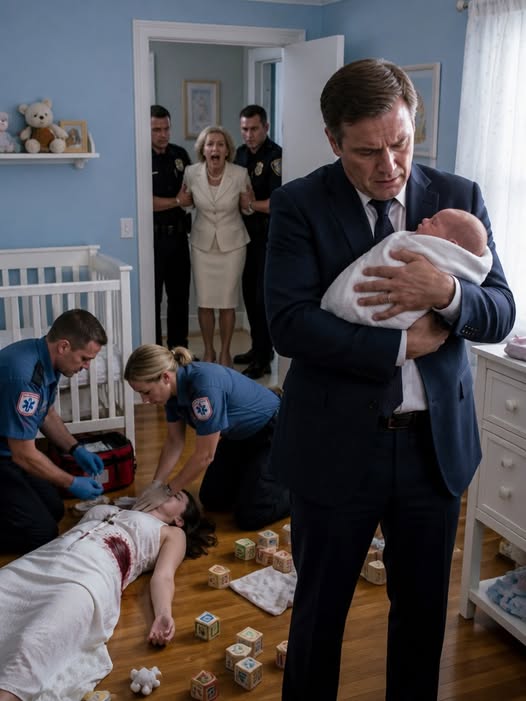
Tommy came through the door walking like something hurt that he had been taught not to mention.
That was the first thing I noticed.
Not his face, because his face was pointed at the floor. Not his backpack, though it hung crookedly from one shoulder instead of bouncing against his spine the way it usually did. Not even the silence, though that came a second later and filled the kitchen so completely that the hum of the refrigerator seemed suddenly too loud.
It was the way he walked.
Slowly.
Carefully.
Like each step had been negotiated with his body before he took it.
I was standing at the sink when I heard him on the porch. Our porch was old, the boards loose in places, and I knew the sound of my son’s footsteps on it better than I knew most people’s voices. Tommy usually came home like weather. Sneakers thumping, backpack sliding, door swinging open before the knob had finished turning. He would call out before he saw me, already asking what was for dinner or whether I had found his blue controller or if we could stop by the library because the next book in his series had “probably definitely” arrived.
He was eight years old and still believed “probably definitely” was a useful category of truth.
He had his mother’s eyes and my stubbornness and a laugh that started somewhere in his whole body before it reached his face. He was a child made of motion, questions, and sudden affection. He hugged with full force. He talked to grocery store cashiers like they were old friends. He cried at sad commercials and then denied it with great dignity. He had once spent twenty-three minutes trying to convince a beetle to move off the sidewalk because, he said, “It doesn’t know people have shoes.”
That boy did not come through the door.
The child who entered my kitchen pushed the door open with his fingertips and stood just inside the frame as though waiting to be told whether he had permission to occupy the room.
I set down the glass I had been holding.
I did it before I had consciously decided to move, some fatherly instinct already ahead of my thoughts. The glass touched the counter with a soft click. Water slid down its side and pooled beneath it.
“Hey, buddy,” I said.
His shoulders tightened.
Only a little.
Only enough.
“Hey,” he answered.
His voice was too flat.
It was the voice children use when they are trying to sound normal for adults who ask too many questions.
I wiped my hands on a dish towel and turned fully toward him. “You okay?”
“Yeah.”
That came too quickly.
“Anything happen at Mom’s?”
“No.”
Again too quick.
His mother, Lauren, had dropped him off ten minutes earlier than scheduled. She had not come to the door. I had heard a car in the driveway, the brief pause of an engine, then tires moving away before Tommy even reached the porch. That was unusual but not unheard of. Since the divorce, Lauren had become increasingly fond of drop-offs conducted as if the custody exchange were a package delivery. Sometimes she texted from the driveway. Sometimes she honked once. Sometimes she told me she was in a hurry before I had asked a question.
Still, something about that engine leaving before the door opened had stayed with me.
Tommy stood with both hands gripping the straps of his backpack. His knuckles were pale. His jaw was clenched in the particular way it got when he was working very hard to contain something.
“Do you want to sit down at the kitchen table?” I asked.
He flinched.
It was small, there and gone in less than a second. But I saw it because I had been watching his face, and his face was pointed at the floor.
That was wrong.
Tommy always looked at me when we talked. He was the kind of child who made eye contact with sincerity, who turned his whole body toward you when you spoke, who gave you his attention as if you were the most interesting thing in the room. He had done that since he was old enough to understand language, and he was not doing it now.
Something cold moved through my chest.
I forced myself not to step toward him too quickly.
“Tommy,” I said, very quietly, carefully smoothing every edge out of my voice, “can I look at your back?”
His whole body went still.
Not confused.
Not surprised.
Still.
As if the question had found the exact place he was trying to hide.
For a moment, he did not move. He stood in the middle of the kitchen with the late afternoon light coming through the window behind him, dust floating in the air, his little sneakers planted on the worn linoleum. He looked so small that I had to press one hand against the counter to keep myself from crossing the room and pulling him against me.
Then he turned around.
He lifted his shirt.
I called 911 before he put it back down.
Not his pediatrician.
Not his mother.
Not my lawyer, though I had his number saved after two years of difficult custody communication and Lauren’s increasing accusations that I was “controlling” whenever I asked basic questions.
Those calls would come later.
What I understood in that moment, looking at my son’s back with my phone already in my hand, was that lawyers argue, doctors document, social workers assess, but police preserve evidence now.
Evidence disappears.
Evidence gets explained away. Washed off. Covered. Reframed. Evidence becomes “rough play” or “a fall” or “children exaggerate” when the people who created it realize it exists.
I was not going to give anyone time to decide what the story would be.
The dispatcher asked me questions.
I answered them.
My voice sounded calm enough that some distant part of me felt disgusted by it. I gave my name, address, my son’s age, the fact that he had visible injuries, the fact that he had just returned from his mother’s residence, the fact that I needed medical evaluation and police response.
Tommy stood facing the refrigerator, shirt still lifted in one hand.
I covered the phone with my palm.
“You can put your shirt down, buddy.”
He did.
He turned slowly.
His eyes came up only as far as my chest.
“Did I do something wrong?” he asked.
That question nearly dropped me to my knees.
“No,” I said.
The word came out too forcefully. I softened it immediately.
“No, Tommy. You did not do anything wrong.”
He nodded once, but he did not seem to believe me.
The dispatcher stayed on the line until the first officers arrived. While we waited, I helped Tommy take off his backpack and set it on the counter instead of asking him to bend down. I asked if he wanted water. He said no. I asked if he wanted to sit on the couch instead of the chair. He thought about that, then nodded.
He moved toward the living room with the same careful walk.
Every step was a sentence I did not yet know how to read.
The police arrived first, two officers who stepped into my house with the quiet caution of people entering a room where harm had already happened. One spoke to me by the door. The other crouched near Tommy but did not crowd him. He introduced himself. He asked Tommy if he was hurt. Tommy looked at me before answering.
That look told me more than the answer did.
The ambulance came next.
I rode with him.
He did not ask why.
That was another wrong thing.
An eight-year-old should ask why.
The hospital waiting room was too bright in the way hospitals are always too bright, fluorescent and indifferent, full of people sitting with the particular stillness of endurance. A woman with a towel pressed around her hand. A teenager sleeping against his mother’s shoulder. An old man coughing into a mask. A television mounted high in the corner playing a cooking show nobody watched.
Tommy sat beside me with his hands in his lap.
He had not asked for his tablet.
He had not asked for headphones.
He had not asked for the vending machine or the bathroom or how long it would take.
He sat and breathed.
Every few minutes, he leaned very slightly toward me, not asking to be held, just moving his shoulder until it touched mine.
I let him.
The doctor who examined him was a woman in her forties with short gray-streaked hair and the kind of face that stays professionally neutral without going cold. Her name was Dr. Patel. She spoke to Tommy first, not to me, and she spoke to him the way adults rarely speak to children, as though what he said was the most important information in the room.
“Hi, Tommy. I’m Dr. Patel. I’m going to help check your body and make sure you’re safe. Your dad is going to stay right there unless you want something different. Is that okay?”
Tommy nodded.
She waited.
“Can you say it for me?”
“It’s okay,” he said.
“Thank you.”
That small respect broke something open in my chest.
I sat in the corner while she worked, and I watched my son’s face, and I kept both hands flat on my thighs because I had discovered that was the best way to keep them from shaking.
A nurse brought me water.
I did not drink it.
Dr. Patel asked gentle questions and wrote down careful answers. She did not rush him. She did not supply words. She did not act shocked in ways that would make him responsible for her reaction. When she needed him to move, she explained exactly what she was doing before she did it.
Tommy obeyed with the exhausted compliance of a child who had recently learned resistance made things worse.
I wanted to put my fist through the wall.
Instead, I sat still.
Lauren arrived twenty minutes after us.
I heard her before I saw her.
Her voice came down the hallway sharp with offense, demanding to know where her son was, who had authorized this, why no one had called her first. She appeared outside the exam room wearing jeans, a cream sweater, and the long camel coat she wore when she wanted to look calm and expensive. Her hair was smooth, her makeup careful. She had not looked like that in the car when she dropped him off. She had prepared herself before coming inside.
She had prepared a story too.
I knew it from the first sentence.
“This is all being blown completely out of proportion,” she said before Dr. Patel had finished speaking.
The doctor turned toward her.
“And you are?”
“I’m his mother.”
Dr. Patel’s face remained neutral. “We’ll speak in the hallway.”
Lauren looked past her toward me.
Her eyes were furious.
Not frightened.
Furious.
That told me something.
In the hallway, she delivered the story the way people deliver stories they have rehearsed during a drive. Tommy had slipped in the bathroom. He bruised easily. He had been dramatic all weekend. Children his age manipulated situations when they wanted attention. He had not wanted to come back to her house after his father’s weekend, and this was the result of too much indulgence.
She said all of it too smoothly.
The fluency was its own kind of evidence.
Dr. Patel listened.
Then she said, “The injuries do not correspond to a simple fall.”
Lauren laughed once, dry and incredulous.
“With all due respect, Doctor, Tommy is very imaginative. He turns everything into a performance. He has learned that if he acts fragile enough, his father panics.”
Dr. Patel did not look at me when Lauren said that.
She kept her eyes on Lauren.
“The hospital has notified the appropriate authorities and requested social services involvement.”
Lauren’s face changed.
Only slightly.
She moved toward the exam room door.
A nurse stepped into her path.
“I’m his mother,” Lauren snapped.
“Exactly,” the nurse replied.
One word, and it stripped away the version of the evening Lauren had been narrating.
Inside, Tommy was sitting up on the exam table holding a stuffed rabbit from the waiting room’s toy box. It was battered, gray at the ears, one button eye scratched. Someone had left it behind or donated it, and now my son held it with both hands like it had been assigned to keep him on earth.
When I came in, he reached for my hand.
He held it so hard I felt his pulse.
“Dad,” he said.
“I’m here.”
“If I fall asleep, will you take me with you?”
“Yes,” I said. “I’m taking you with me.”
His fingers tightened.
“Even if Mom says no?”
“Even if the whole world says no.”
He looked at me for the first time since he had come through the door at home.
Really looked.
The way he used to.
Searching for the thing children search for in a parent’s face: confirmation that the person in front of them is telling the truth.
Whatever he found was enough.
He loosened his grip slightly, though he did not let go.
The social worker’s name was Renee.
She arrived with a soft gray bag and a face that carried both kindness and history. She moved slowly, deliberately, with the quiet presence of someone who had done this before in too many hospital rooms with too many children under too many fluorescent lights. Her bag held small figures, paper, crayons, a simple drawing of a house with rooms, and a few carefully chosen questions that did not feel like questions until after they had opened a door.
She sat with Tommy.
I sat nearby, close enough for him to see me but far enough not to answer for him.
Renee explained what she was doing.
She told him he could stop at any time.
She told him not knowing was an okay answer.
She told him he was not in trouble.
Tommy watched her with solemn concentration.
At first, he answered in pieces.
Edges before center.
Children who have been afraid for a long time rarely begin with the worst thing. They test the air first. They offer a small truth and wait to see if the world punishes them for it.
He told her about Derek.
Derek was Lauren’s boyfriend of fourteen months. He wore pressed shirts, expensive shoes, and called me “buddy” with the confidence of a man staking territorial claims through courtesy. He worked in finance. He had a good haircut. He smiled easily at adults and never quite smiled with his eyes when he looked at Tommy.
I had noticed that smile.
I had filed it away without knowing what to do with it, the way you notice a sound in a wall and cannot tell whether it means pipes settling or something alive moving where it should not be.
Tommy said Derek did not like noise.
He said Derek got angry when he took too long in the shower.
He said Derek punished him for asking to call me.
He said Lauren heard him crying from the other room and turned up the television.
She turned up the television.
Those words entered me and found places to live.
I stood carefully.
Renee looked up.
I said, “I’ll be right back.”
I walked down the hallway to the bathroom near the vending machines. I locked the door. I gripped the sink. Then I threw up with the water running so no one would hear.
When it was over, I stayed bent over the sink, both hands on the porcelain, my breath coming hard. The mirror above the sink showed a face I recognized only technically. Mine, but older. Paler. Eyes bloodshot. Mouth tight. A father trying not to become a storm in a building where his child needed shelter.
“Don’t fall apart now,” I said to the mirror.
My voice sounded strange.
“Fall apart later.”
I washed my mouth.
I dried my hands.
I went back.
Derek arrived at four in the morning.
By then, the hospital had entered that hollow hour when time becomes unreal. Vending machines glowed in empty hallways. Nurses moved quietly between rooms. The sky outside the windows was still black. Tommy had dozed in short, restless bursts, waking each time footsteps passed the door.
Derek came in with damp hair, an expensive jacket, and the expression of a man offended before he had been formally accused. That is the expression of someone expecting accusation and deciding his first move will be to look wounded.
“This is all a big misunderstanding,” he told me in the hallway outside the waiting area.
I laughed.
I had not planned to laugh.
The sound came out of somewhere I did not know I had.
“My son can’t sit down because of a misunderstanding?”
Derek spread his hands in the gesture of a reasonable man explaining something to an unreasonable one.
“Tommy is a difficult kid. Sensitive. You know that. He has tantrums. He exaggerates. Lauren and I have been trying to set boundaries, and he doesn’t respond well to boundaries.”
“Boundaries,” I repeated.
“Yes. Structure. Discipline. Things children need.”
The doctor was passing through the hallway. She stopped.
“A child does not produce this pattern of injuries on his own,” Dr. Patel said.
Derek’s jaw tightened.
“You don’t live with him.”
“Fortunately,” she replied, and continued walking.
For the first time all night, I saw Derek lose control of his face.
Not much.
Just enough.
Lauren stood beside him. She had taken his hand at some point, the same hand my son had identified in fear, and she was holding it with the intimacy of a woman choosing which version of her life to defend.
She looked at me.
“You never gave us a fair chance.”
I stared at her.
“The divorce made you bitter,” she continued. “Tommy picks up on that. He knows you dislike Derek. He knows if he says certain things, you’ll react. Children are perceptive.”
I thought of every phone call during the past year.
Tommy seems different when he comes back.
He says he doesn’t want to talk when you’re there.
He asked if he could call me from the bathroom.
He cried last night and wouldn’t tell me why.
Every time, Lauren had called me paranoid. Controlling. Unable to accept the new structure of her life. She said I was undermining her household. She said I was poisoning Tommy against Derek. She said co-parenting required trust, and I had never trusted her after the divorce.
I had tried to be reasonable.
I had tried to say it gently.
I had tried to document without accusing.
I had tried to protect Tommy without making the custody situation worse.
That night, standing under hospital lights while she held Derek’s hand, I understood that the time for that conversation was finished.
So I said nothing.
Mrs. Gable arrived at a quarter past five.
She came through the emergency entrance wearing a winter coat buttoned wrong, reading glasses pushed up onto her forehead, and the red-rimmed eyes of someone who had been awake and crying. She carried a paper bag of pastries in one hand and an old cell phone in the other, holding it carefully, the way you hold something you are afraid of dropping.
Her full name was Ruth Gable. She lived in the apartment below Lauren’s. I had seen her twice during custody exchanges. A small woman in her sixties with white hair and kind, worried eyes. Once she had waved at Tommy and given him a peppermint from her purse. Lauren had rolled her eyes afterward and said the woman was nosy.
Mrs. Gable had lived below Lauren for three years.
She had heard things.
That was what she told the officer in the hallway.
She had told herself they were not her business. She had told herself children cried, adults argued, apartment walls exaggerated everything. She had been frightened. She had questioned her own judgment. She had said to herself, again and again, that it was not her place.
Then one morning she saw Tommy walking down the staircase.
One hand pressed against the wall.
Moving with the careful caution of someone much older.
She went back into her apartment, sat at her little kitchen table, and held her phone in both hands for a long time.
Then she saved the recording.
Now, standing in the fluorescent hospital air, she pressed play.
Derek’s voice came from the small speaker, muffled by floorboards but clear enough.
“If you cry louder, your dad’s gonna pay for being a meddler.”
Then a sound I will not describe.
Then Lauren’s voice.
“Just shut him up already. We’re handing him over tomorrow.”
Nobody spoke.
Mrs. Gable was crying openly, not trying to stop.
“I thought I was overreacting,” she said. “That’s what I kept telling myself. Then I saw the boy on the stairs.”
I could not hug her.
I could not move at all.
All I could say was, “Thank you for not deleting it.”
She nodded and wiped her face with the sleeve of her coat, then handed the phone to the officer.
Lauren had gone completely still.
Derek began speaking at once, saying something about context, about audio quality, about people misunderstanding discipline. His lawyer’s future arguments were already rehearsing themselves in his mouth.
But the officer was no longer looking at him like a man in a domestic disagreement.
He was looking at him like evidence had just learned how to speak.
The emergency protective order came through that morning.
The language in the court ruling was direct. Tommy would not return to Lauren’s residence while the investigation proceeded. Primary physical care would remain with me pending further review.
I had expected to feel relief.
Something clean.
Something with edges.
Instead, I felt a sick and hollow exhaustion.
My son’s safety had required a hospital, a recording, a doctor’s testimony, a police report, a social worker with a bag of small figures, and a neighbor brave enough to stop doubting herself. It had required evidence. Proof. Systems. Forms. People with titles confirming what I had seen in thirty seconds when Tommy came through my front door.
I had known.
I had called.
But the weight of what the knowing meant, of all the days before I knew and the weekends before that and the nights he had slept in a room where the television volume went up when he cried, did not lift with the ruling.
It settled.
Tommy slept in my room for the first three nights.
He needed the light on.
He needed the door open.
He asked me each night before he fell asleep whether Derek knew our address, whether his mother had a key, whether I would call again if someone tried to break the door.
I told him, “I will call again, and I will not wait.”
He asked, “Will they believe you?”
That question came from somewhere deep and already damaged.
Children who have not been believed, or who have watched adults choose not to see, learn quickly that being believed is not the default. They learn that their account of events competes with the accounts of louder people. They learn adults adjudicate when they should listen.
I said, “They will believe us.”
He did not fully believe me yet.
He was right not to.
Trust does not come back because an adult makes a declaration. It comes back the way children return to the ocean after a big wave has knocked them down: first the toes, then the ankles, then the knees, then maybe the whole body, and only after a long time standing at the edge, deciding whether the water is safe again.
I learned to talk differently during those weeks.
I stopped saying, “Don’t be afraid.”
I started saying, “I’m with you even when you’re afraid.”
The difference is not small.
“Don’t be afraid” is an instruction that tells a child his feeling is wrong. “I’m with you inside the feeling” tells him the feeling is allowed, and he is not alone inside it.
I stopped telling him to sit up straight at dinner.
I said, “Sit however is most comfortable.”
For three weeks, he sat sideways in his chair, one knee up, angled like someone protecting himself. I did not comment on it. I just passed him food and talked about the things he wanted to talk about, which at first was not much, and then slowly became more.
He started drawing.
He had always drawn. Since he was small, he had filled pages with houses, cars, round-headed people, robots, impossible animals, and maps of places that existed only in his head. But the drawings changed after he came home.
At first, houses with no doors.
Then houses with doors but no windows.
Then a car with no wheels, sitting in the middle of a field going nowhere.
Then a small figure standing at a table, alone, with something that might have been food in front of it.
I did not analyze them in front of him.
I bought more paper.
I sharpened pencils.
I placed the drawings in a folder unless he told me to throw them away.
One afternoon, he came to me with a drawing and handed it over without explanation. Then he went back to his room.
I looked at it for a long time before I understood what I was seeing.
It was a sofa.
Our sofa.
The living room sofa, recognizable by the shape of the armrest he had drawn with characteristic precision. Above it, in careful second-grade printing, he had written:
It doesn’t hurt here.
I stood in the kitchen holding the paper while evening light moved across the floor.
Then I taped it to the refrigerator.
Not as a trophy.
Not as something to show people.
As a reminder to myself, every time I opened the refrigerator, of what the ordinary texture of our daily life meant to him now.
The sofa.
The room.
The house where sitting down did not come with a cost.
The first supervised visit with Lauren took place at a neutral facility, a squat brick building beside a dentist’s office, with bright carpet, plastic chairs, and motivational posters no child in crisis would ever read. The room had a low table, a shelf of toys, and a supervisor who sat in the corner with a notepad.
Tommy brought a small rubber ball with him.
He held it in his lap and turned it in both hands while Lauren tried to talk about his classroom, his friends, whether he was keeping up with his reading log.
He answered with small, clipped responses.
Yes.
Fine.
I don’t know.
He kept the table between them.
Lauren looked thinner. Tired. Less polished. I watched from behind one-way glass because the supervisor said that was allowed, and because Tommy had asked if I would stay in the building.
Lauren’s voice sounded gentle.
Too gentle.
It reminded me of how she used to speak early in our marriage when apologizing without naming what she had done. Softness as a substitute for accountability.
Then Tommy asked, “Does Derek still live with you?”
Lauren looked at her hands.
“It’s complicated,” she said.
Tommy turned the rubber ball once.
Twice.
“Then I’m not going.”
The visit ended in twenty minutes.
Afterward, Lauren waited in the parking lot.
I had seen her car when I pulled in and told myself to walk past her directly. No scenes. No parking lot confrontation. Let the legal process handle what the legal process handled.
But she stepped into my path.
I stopped.
“You took my son from me,” she said.
I looked at her face.
I had loved that face once.
That is an uncomfortable truth.
Before the divorce, before the bitterness, before Derek, before lawyers, before exchanges conducted through text messages and cold front porches, I had loved her. I had watched her sleep with our newborn son against her chest and thought no person on earth could look softer. I had made coffee for her after sleepless nights. I had held her while she cried from exhaustion. I had believed we would grow old into some better version of ourselves.
Now she stood in a parking lot and accused me of stealing a child she had failed to protect.
“No,” I said. “You left him alone with someone he was afraid of. When he came home injured, you said he was being dramatic.”
She looked away.
For one second, shame crossed her face.
Then it hardened.
“You don’t understand what it’s like to be the parent he doesn’t prefer.”
There it was.
Not remorse.
Competition.
“You made this about being chosen,” I said. “He needed safety.”
She said nothing.
I walked to my car.
Tommy was in the back seat. He had fallen asleep against the window with his seatbelt still on, one hand resting open on his knee, his breathing slow and even in the unguarded way children breathe when they are genuinely at rest.
His face in sleep had the softness of his face when he was much younger, before things became complicated, before he learned that certain rooms were dangerous and certain adults could not be trusted.
I started the car and drove home through ordinary streets.
The corner store with lights on.
A bus pulling away from its stop.
Someone walking a dog along the sidewalk in the early evening, the dog’s nose working at the grass, the person on the other end of the leash unhurried.
My son slept in the back seat.
The investigation took months.
Lauren’s attorney made arguments.
Derek’s attorney made different arguments.
My attorney sat across tables from both of them and said back the things I had documented: the calls, the dates, the times I expressed concern, the evenings Tommy came home changed in ways I had written down without yet knowing why I was writing them down.
The hospital records.
The social worker’s report.
Mrs. Gable’s recording, authenticated and submitted and played in a room where Lauren sat with her hands folded and her face arranged into an expression I did not have a name for.
Derek denied.
Then minimized.
Then blamed stress.
Then blamed Tommy.
That was the part I could not forgive.
Not the denial. I expected denial. Not even the attempt to protect himself. Cowards do that. But blaming a child for the harm done to him revealed something so rotten that every remaining trace of my restraint turned to stone.
Lauren cried during one hearing.
I did not look at her.
The court’s final custody determination was not the last thing.
People like to think legal rulings create endings. They do not. They create conditions in which healing may begin, if everyone survives the process.
The nearest thing that resembles an ending happens slowly, at a kitchen table, over ordinary evenings.
Tommy stopped sleeping with the light on around the four-month mark.
He moved back to his room in increments.
First a few nights a week.
Then most nights.
Then all of them.
For a long time, he left his door open, and I left mine open too. A hallway between us carried the sounds of the house freely: the furnace, the refrigerator’s hum, rain against windows, whatever was on the television turned low.
He started asking questions about the future in the way children ask them when they have decided the future is something they are going to have.
He asked about middle school.
He asked about soccer tryouts.
He asked whether we could paint his room blue.
He asked once, very casually while I was making dinner, whether we could get a dog.
I told him we could look into it.
He said he had already named it.
I asked what the name was.
He thought about it for a second, testing the word before saying it out loud.
Then he told me.
I have kept the name private, the way I have kept private many small particular things from those months, because some parts of healing belong only to the person doing the healing.
I will say the name made me laugh.
And he laughed too.
The sound moved through the kitchen and out through the screen door into the backyard, where evening was coming in slow and blue and ordinary.
The drawing is still on the refrigerator.
I have never taken it down.
It doesn’t hurt here.
Four words in second-grade printing, slightly uneven, one letter larger than the rest. A sofa. A room in a house. The simplest thing a child can communicate after a period of sustained harm: this place is different. This place is safe.
I look at it most mornings when I make coffee.
Not because I need reminding that he is safe now, though some mornings I do.
Because it says something I want to carry through the day.
A child can endure a great deal and still find his way back to ordinary life, to rubber balls in his lap and dogs he has already named and questions about the future, if someone refuses to look away. If someone refuses to wait. If someone refuses to let louder people decide what the story is going to be.
There are still difficult days.
I will not pretend otherwise.
Some mornings, Tommy wakes quiet. Some nights, a sound in the hallway makes him sit up too fast. Sometimes he asks questions that have no answer gentle enough to be fair.
“Why didn’t Mom stop him?”
“Did she believe me?”
“Is she mad because I told?”
Each question arrives like a stone handed to me by a child who should not have had to carry it.
I do not lie to him.
I also do not give him adult pain in the name of honesty.
“I don’t know why she made the choices she made,” I tell him. “But I know you did the right thing by telling the truth.”
Sometimes that is enough.
Sometimes it is not.
When it is not, I sit beside him on the sofa.
The sofa from the drawing.
The place where it does not hurt.
We sit there until his breathing changes.
Once, many months after the hospital, he leaned against me during a movie and said, “Dad?”
“Yeah?”
“I think my body is forgetting to be scared here.”
I stared at the television and did not move, afraid that if I moved too quickly, the sentence would break.
“That’s good,” I said.
He nodded.
“I think so too.”
He fell asleep before the movie ended.
I sat there for a long time with my arm around him, listening to his breath.
I thought about the night in the hospital bathroom, the cold porcelain under my hands, my own face in the mirror saying, Don’t fall apart now. Fall apart later.
I did fall apart later.
Of course I did.
In the shower, where he could not hear.
In the car, after lawyer meetings.
Once in the grocery store aisle between cereal and pancake mix because I saw a mother snap at a child and the child flinched.
I fell apart and then came back.
That was the whole of it, in the end.
You go back.
Every time.
You go back to the exam room.
You go back from the bathroom.
You go back to the court hearing.
You go back to the kitchen.
You go back to the child who is watching to see whether you are still there.
You go back not because you are unbreakable.
But because love, real love, is not the feeling that keeps you from breaking.
It is the decision to return with all the broken pieces and sit beside your child anyway.
Tommy came through the door walking like something hurt that he was not allowed to talk about.
Now he runs through that same door again.
Not always.
Not every day.
Healing is not a straight line drawn for adults to admire.
But sometimes, when school is good and the weather is warm and the future feels close enough for him to reach, he forgets to be careful. He bursts through the door, backpack sliding, sneakers loud on the old porch boards, already talking before I see his face.
“Dad, guess what happened.”
And I turn from the sink.
And I listen.
Because once, his footsteps told me everything.