Chapter One: The Yellow Emoji
“We’re canceling your kids’ Christmas gifts. Money’s tight.”
My father’s text arrived on a bleak, overcast Tuesday morning. I was standing by the kitchen sink, pouring dark roast into my favorite chipped mug—the one my youngest daughter, Chloe, had haphazardly painted with crooked daisies in the second grade. I remember the exact chill of the granite counter against my hip when my phone vibrated. I had reached for it expecting a mundane grocery list from my husband, Mark, or perhaps a mundane email from the PTA. Instead, I read the fifteen words that would irrevocably shatter the foundation of how I viewed my own parents.
“Money’s tight,” my dad, Arthur, had written, punctuation notably absent, followed immediately by a single, small frowning emoji.
As if that tiny, pathetic yellow circle could somehow cushion the blow.
I stood paralyzed, the hot coffee slowly turning lukewarm in my grip. I read the message three times, my brain struggling to process the clinical detachment of the words. My father was a stoic man, certainly not given to effusive warmth, but he had never been actively cruel. Yet, the utter flatness of this text felt like a heavy oak door quietly and firmly clicking shut in my face.
My pulse kicked up a notch. Is he sick? I thought frantically. Are they losing the house? I quickly typed back, my fingers trembling slightly. I asked if everything was okay. I practically begged to know if there was a sudden health crisis or a catastrophic financial emergency I needed to be aware of—something, anything, serious enough that my three children, ages six, nine, and twelve, were about to lose out on the one holiday tradition that made their entire year feel magical.
His reply pinged back a minute later.
“Just tight right now, sweetheart. We’ll make it up to them next year.”
No explanation. No phone call to soften the disappointment. Just a vague promise for a hypothetical future.
I typed back that I understood. I sent a heart emoji. Because that is exactly what you do when you are conditioned to be the “easy” daughter. You swallow the hurt. You offer grace. You blindly trust your parents, even when a cold, uncomfortable instinct in your gut whispers that the math of their story doesn’t quite add up.
That evening, I sat my children down in the living room. I told them that Christmas was going to be significantly smaller this year. I explained, using my most gentle, empathetic voice, that Grandpa Arthur and Grandma Helen were navigating a difficult season, and that our family needed to step up by being understanding and profoundly grateful for what we already had.
My oldest daughter, Maya, who at twelve was already far too observant for her own good, just stared at her lap. She nodded quietly and murmured, “Okay, Mom.” But I could see the sharp, heavy disappointment pooling behind her dark eyes.
For a week, I wore my patience like a badge of honor. I felt like a fiercely good daughter—compassionate, reasonable, the kind of person who doesn’t throw a tantrum when her aging parents ask for grace.
That fragile illusion lasted exactly nine days.
Then, the video dropped into the group chat.
Chapter Two: The Unwrapping
It was a Thursday evening, the kind of mundane night filled with homework and the smell of roasting chicken. My phone chirped with a notification from the extended family group chat—a sprawling digital thread that included all four of us siblings, plus various aunts, uncles, and older cousins. Usually, it was a dumping ground for generic recipes and blurry vacation photos.
This time, it was a video posted by my younger sister, Sarah.
The caption read: “Early Christmas surprise for the kiddos! They just couldn’t wait!”
I tapped play, expecting to see them unwrap matching pajamas or a board game.
Instead, the screen illuminated with the chaotic joy of Sarah’s sprawling living room. Her three children were aggressively tearing into heavy, metallic wrapping paper.
“Oh my god!” my teenage nephew yelled, holding up a brand-new, top-of-the-line iPad Pro, the plastic film still gleaming under the recessed lighting. He was grinning ear to ear.
To his left, my eleven-year-old niece shrieked at a pitch that hurt my ears. She was frantically waving a rose-gold Apple Watch, still nestled in its pristine white box.
And on the floor, Sarah’s youngest was already lacing up a pair of exclusive, limited-edition designer sneakers that I knew for a fact cost more than my entire monthly grocery budget.
But it wasn’t the extravagant gifts that made all the air rush out of my lungs.
It was the background.
Standing right behind the children, beaming with unadulterated pride and holding up his own smartphone to record the joyous chaos, was my father. Arthur.
My stomach plummeted so violently I thought I might be sick. I had to set my phone face down on the kitchen island, gripping the cool marble edge just to steady my shaking hands. I picked the phone back up. I watched the video again. And again. I scoured the pixelated background, desperately searching for some hidden context, some miraculous explanation that proved this wasn’t exactly what it looked like.
But there was no alternate reality.
My father—the exact same man who had callously texted me that money was “too tight” for my children to receive even a token gift—had somehow magically manifested thousands of dollars in disposable income to lavish upon his other grandchildren.
I sank into a kitchen chair and just stared blindly at the beige wall for a very long time. A fundamental shift occurred deep within my chest. The warmth of familial trust crystallized into something quiet, sharp, and incredibly cold.
I thought about my own kids. I thought about how remarkably gracious they had been. I thought about how my nine-year-old son, Leo, had proudly told his friends at school that our Christmas would be simple this year because “family comes first.”
I thought about how fiercely I had defended my parents to Mark when he had raised a skeptical eyebrow at the sudden cancellation of gifts. I had scolded my husband, telling him not to jump to cynical conclusions, insisting there was a valid, heartbreaking reason for my parents’ financial struggles.
There was no good reason.
There was only a deliberate, calculated choice. A choice to guarantee my sister’s children a lavish, unforgettable holiday, while actively instructing my kids to expect nothing, to shrink themselves, to sacrifice quietly so that Grandpa and Grandma could play the role of struggling martyrs.
I didn’t call my parents that night. I didn’t draft a furious, tear-stained text message demanding an explanation.
Instead, I sat in the dim light of my kitchen, letting that video play on a toxic loop in my mind. Years of subtle slights, of brushed-off comments, of Sarah’s kids always getting the better bedrooms on family vacations and the bigger slice of cake—it all finally clicked into place. They were puzzle pieces I had intentionally refused to look at directly, afraid of the ugly picture they formed.
I wasn’t just hurt anymore. I was utterly, irrevocably done being the patient, quiet daughter.
I picked up my phone one last time, bypassed the family chat, and opened my calendar app. I started looking at flight patterns and hotel availability for a very different kind of holiday trip.
I was about to teach my parents that grace, once abused, is rarely offered a second time.
Chapter Three: The Magic Kingdom
I did not speak a single word to my parents for the next two weeks. Whenever Mom texted a generic “thinking of you,” I replied with a thumbs-up emoji. Nothing more.
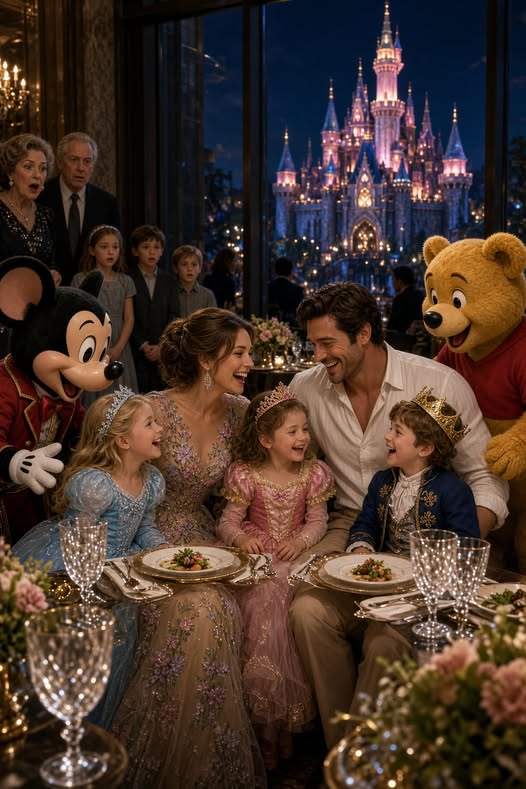
Behind the curtain of my silence, Mark and I were moving with frantic, joyous purpose. We quietly booked four nights at a premium hotel directly across the street from Disneyland. It was the exact type of extravagant, memory-making trip we had been putting off for five years because it always felt just a little too expensive to justify.
This time, I didn’t think twice about pulling the money from our savings. I didn’t wince when I typed in my credit card number.
I gathered Maya, Leo, and Chloe in the living room and told them we were doing something entirely different for the holidays this year. Just the five of us. When I pulled out the Mickey Mouse ears I had hidden in the closet, I watched their faces light up with a pure, unadulterated joy that made every single dollar feel entirely worth it.
We packed our suitcases in absolute secrecy, telling the grandparents absolutely nothing about our whereabouts. We hit the highway at dawn, Christmas music blaring from the car speakers, with Chloe excitedly counting down the freeway exits on her small fingers.
When we finally walked through the iconic gates of Disneyland, the smell of spun sugar and popcorn hitting the air, Leo grabbed my hand tightly.
“Mom,” he whispered, his eyes wide with awe. “This is already the best Christmas ever.”
Hearing those words, something tight and painful inside my chest finally uncoiled. I hadn’t even realized how much tension I had been carrying, how much of my parents’ manufactured guilt I had internalized.
We spent our days riding rollercoasters until we were dizzy, eating obscenely overpriced churros, and taking a ridiculous amount of photos in front of Sleeping Beauty’s castle, all of us wearing the matching, aggressively festive pajamas I had ordered the week prior.
I began posting the photos on my social media every single day.
I didn’t do it to prove anything. Not at first, anyway. I genuinely just wanted to document how deliriously happy my kids looked. But somewhere around the evening of day two, I noticed a distinct shift in the digital atmosphere. The photos were generating significantly more attention from my extended family than my usual posts.
My Aunt Linda commented on a photo of us eating character dining: “Wow! How on earth did you guys afford a Disney trip during such a tight year?”
My older cousin, David, sent a laughing-crying emoji on a picture of Maya holding a massive stuffed animal, adding the caption: “Guess money isn’t tight for everyone! Must be nice.”
I saw the notifications. I read the comments. I didn’t respond to a single one of them.
I just kept posting. For the first time in weeks, for the first time in perhaps my entire adult life, I felt like I was no longer performing a quiet, agonizing sacrifice for people who didn’t even deserve an audience.
On our third night, while we were sitting at a crowded restaurant inside the park, exhausted and happy, my phone buzzed violently against the table.
It was a direct message on Instagram. It was from my eleven-year-old niece—the exact same little girl who had been shrieking over her new Apple Watch in the group chat video.
She had apparently asked Sarah for my phone number so she could see the Disneyland pictures up close. Her message was simple, direct, and completely unfiltered in that brutal way only a child’s words can be.
“Why didn’t you invite us? That looks so fun.”
I stared at the glowing screen for a long, heavy moment. The ambient noise of the restaurant faded away. I felt the collective weight of thirty years of favoritism settle heavily into my chest.
I didn’t feel angry at my niece. She was just a child, repeating the innocence of not understanding the ugly adult decisions happening above her head. But I also knew exactly what I had to do.
I typed back four words. Calm, steady, and entirely devoid of emotion. They were the exact same four words my father had used to dismiss my children weeks earlier.
“Money’s tight, sweetie,” I wrote.
I hit send. I placed the phone face down on the table, picked up my fork, and continued eating dinner with the family I had chosen to protect.
I didn’t feel a surge of vindictive pride. But I also didn’t feel a shred of guilt. Because for the very first time, I had forced my sister, my parents, and my entire extended family to look in the mirror. I had let them see exactly how it felt to be told no while somebody else got everything.
The silence that followed was deafening, but I knew the storm was about to break.
Chapter Four: The Echo Chamber
The silence didn’t last long. It rarely does when you hold up a mirror to people who prefer the dark.
Less than an hour after I hit send on that message to my niece, my phone erupted. It vibrated so hard it nearly danced off the restaurant table. I didn’t need to look at the screen to know who it was, but I glanced down anyway.
Mom Calling.
I let it ring once. Twice. I took a deep, steadying breath, inhaling the scent of theme park fries and my own resolve, before finally pressing the green button.
“Hello?”
I didn’t even get the chance to say her name before her voice came slicing through the receiver, sharp, frantic, and dripping with accusation. She was already mid-sentence, fueled by a fury I hadn’t heard directed at me since I was a teenager.
“How could you possibly say something like that to her?!” Mom demanded, her voice shaking so badly it distorted the audio. “She is eleven years old, Jillian! How could you be so utterly cruel to a child? Sarah is in tears. You ruined their evening!”
I sat there, perfectly still. I didn’t interrupt. I let her talk. I let her hurl every accusation, every disappointed sigh, every sharp barb she had loaded in her arsenal. I listened to her defend my sister’s child with a ferocity she had never, not once, shown for mine.
When she finally ran out of breath, a heavy silence settled over the line.
“Are you finished?” I asked, my voice terrifyingly calm.
“Jillian, you need to call Sarah and apologize right now,” she commanded.
“No, Mom,” I said, the word dropping like a stone. “I am not going to apologize.”
“How can you—”
“I used four words, Mom,” I cut in, my voice rising just enough to command the space. “Four words. Money’s tight, sweetie. Do you know where I heard those words? Because I have been holding onto them for two agonizing weeks.”
I heard a sharp intake of breath on the other end, but I didn’t stop.
“That is exactly what Dad texted me about my own kids,” I continued, the anger finally bleeding into my tone. “Except, my kids are the ones who actually went without. My kids were told to expect nothing. My kids were told to be gracious and sacrifice because you two were struggling. While you sat in Sarah’s living room, watching your other grandchildren tear open iPads, Apple Watches, and designer shoes.”
“Jillian, you don’t understand the whole—”
“I understand perfectly,” I snapped. “I just used his exact words. If hearing them feels cruel to you now, if it feels unfair and heartless, then maybe, just maybe, you finally understand a fraction of what it felt like on my end.”
The silence on the other end of the line stretched out, long and absolute. For a few seconds, the connection was so quiet I genuinely thought she had hung up in a fit of rage.
But then, I heard a ragged exhale.
When Mom finally spoke again, the righteous fury had completely evaporated. It was replaced by a small, hesitant sound—something that sounded dangerously close to profound shame.
“We… we didn’t mean for it to look like that,” she mumbled, her voice lacking any of its usual conviction. “Sarah… Sarah’s husband had his hours cut at work this year. We just wanted to help them out. We wanted to make sure they had a good Christmas. We didn’t think… we didn’t realize how it would look to you.”
“You didn’t think about us at all,” I corrected gently, though the truth of it still stung. “You decided Sarah’s kids deserved a magical holiday to make up for a hard year, and you decided my kids could just carry the financial burden of that choice.”
“Jillian, please…”
“I love you, Mom,” I said, and surprisingly, I meant it. “And I love Dad. But your favoritism has a heavy cost. It always has. I’ve paid it my entire life. But this year, my children are simply not going to be the ones who pay for it.”
I didn’t wait for her to formulate another excuse. I said goodbye and ended the call.
I slid the phone back into my purse. Across the table, Mark was watching me, his eyes full of quiet support. Maya, Leo, and Chloe were oblivious, arguing over which ride to tackle next, their faces smeared with chocolate.
We had not resolved everything. You cannot repair three decades of structural family damage with one dramatic phone call. But as I stood up from the table, gathering our bags to head back out into the bright, chaotic lights of the park, I felt lighter than I had in years.
I had finally put down a heavy, suffocating weight I hadn’t even realized I was carrying.
The next morning, my phone remained mercifully quiet. We spent our final day at the park entirely off the grid, laughing until our ribs ached, building memories that had absolutely nothing to do with what we lacked, and everything to do with what we had.
But the true fallout of my rebellion was waiting for us back home.
Chapter Five: The Empty Driveway
We returned home late Sunday night, exhausted, sunburned, and happy. The house was cold and quiet, smelling faintly of stale air and pine needles from our small, unlit Christmas tree.
As Mark carried the sleeping kids up to their beds, I stood in the kitchen, sorting through the mail that had piled up on the counter. Mixed among the bills and junk flyers was a thick, cream-colored envelope. I recognized my father’s blocky, aggressive handwriting immediately.
I stared at it for a long moment before sliding my finger under the flap.
Inside was a single check, made out to me, for one thousand dollars. Attached to it was a small, yellow sticky note.
“For the kids’ Christmas. Sorry for the misunderstanding. —Dad”
I looked at the check. A week ago, this would have felt like a massive victory. It would have felt like an apology, an acknowledgment of my pain. I would have cashed it, bought the kids the gifts they had asked for, and pretended the whole ugly incident had never happened. I would have gone back to being the easy, patient daughter.
But standing in my kitchen now, looking at the zeros written in blue ink, I felt nothing but a profound, hollow sadness.
He still didn’t get it. They thought the issue was the money. They thought they could simply buy their way out of the emotional damage they had caused, applying a financial bandage to a structural crack in our family’s foundation.
I walked over to the kitchen drawer, pulled out a pen, and flipped the check over. I didn’t endorse it. I simply wrote VOID in large, dark letters across the back.
I slipped it back into the envelope, added a stamp, and dropped it into the outgoing mail pile by the front door. I didn’t write a note. The silence, I decided, would speak louder than any words I could offer.
The holidays came and went. We didn’t attend the annual extended family dinner at my parents’ house. I told Mom we were starting a new tradition this year—just our immediate family. She didn’t argue. I suspect she was relieved not to have to navigate the awkward tension my presence would undoubtedly bring.
I saw the photos they posted online, of course. Sarah’s kids looking thrilled, the table laden with food, my parents smiling tightly for the camera. But for the first time in my life, looking at those photos didn’t incite a familiar pang of jealousy or a desperate need to be included. I looked at them like an outsider observing a play I was no longer cast in.
In January, Sarah finally called me.
It was a Tuesday afternoon, exactly one month since the Disneyland trip. I hesitated before answering, expecting an ambush, but her voice was surprisingly soft, almost hesitant.
“Hey, Jilly,” she said, using the childhood nickname I hadn’t heard in years.
“Hi, Sarah.”
“I… I wanted to call and talk about Christmas,” she started, her breathing slightly erratic. “Mom told me what happened. With Dad’s text, and… and what you said to Maya.”
I braced myself. “And?”
“And I’m sorry,” she whispered.
I stopped wiping the kitchen counter. “You’re sorry?”
“I didn’t know Dad told you they couldn’t afford gifts for your kids,” she explained, her voice cracking. “I swear to you, Jillian, I didn’t know. When they bought the iPads and the watches, Mom told me they had received a bonus from Dad’s pension. They said they wanted to spoil the kids because Greg’s hours got cut. I never, ever would have let them do that if I knew they were telling you they were broke.”
I closed my eyes, a surprising wave of relief washing over me. The anger I had harbored toward my sister began to immediately dissolve. It wasn’t Sarah’s fault. It had never been her fault. She was just playing the role she had been assigned, just like I was.
“I believe you, Sarah,” I said quietly.
“I confronted Mom about it,” she continued, sounding fierce. “I told her it was completely messed up. I told her that she can’t use my financial issues as an excuse to treat your kids like second-class citizens. It’s not fair to them, and it’s not fair to put me in the middle of it.”
Tears pricked the corners of my eyes. In thirty years, it was the first time my sister had ever actively stood up to our parents on my behalf.
“Thank you,” I whispered.
“We’re sisters, Jilly,” she said firmly. “I might be the favorite, but I’m not blind.”
We talked for an hour. We didn’t solve everything, but we built a bridge over the wreckage our parents had created. We agreed that moving forward, we would communicate directly with each other regarding holidays and gifts, completely cutting our parents out as the unreliable middlemen.
As for my parents, our relationship has settled into a cool, polite distance. We still talk occasionally. We will likely still see them for major milestones. But the dynamic has fundamentally shifted. I am no longer the quiet, accommodating daughter waiting for scraps of affection. I no longer perform sacrifice to earn their approval.
They know it, and I know it.
Sometimes, the most empowering thing you can do is not to fight for a seat at a table where you are not valued, but to stand up, push your chair in, and walk away to build your own table.
My kids don’t remember the Christmas they didn’t get presents from their grandparents. They remember the churros. They remember the matching pajamas. They remember the magic we created for them, on our own terms.
And that is a legacy I am proud to leave them.
If this story resonated with you, if you have ever felt like the outsider in your own family, know that you have the power to rewrite your own traditions. Don’t forget to hit subscribe, because I have so many more stories of reclaiming peace waiting just for you.