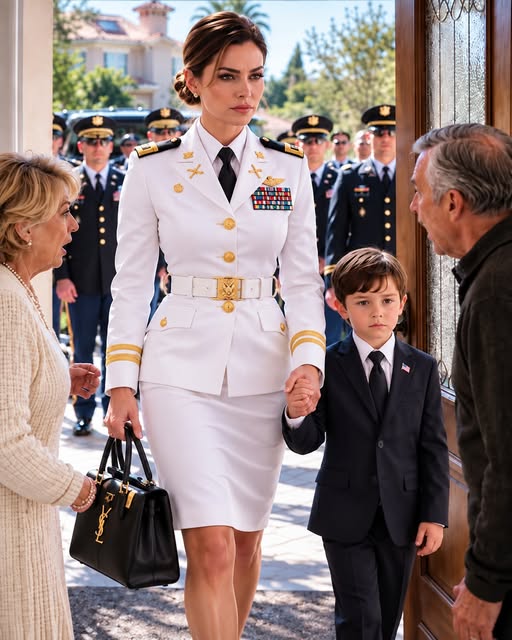
The first thing Eli asked when the sun came up was whether Grandpa was coming back.
We were sitting in a small, warm room at the Nevada Highway Patrol station.
Someone had brought him hot chocolate in a paper cup, and he was carefully dipping the corner of a graham cracker into it.
He looked up at me with those enormous brown eyes that had always reminded me of my younger brother.
“Mom, is Grandpa lost?”
I put down the coffee I hadn’t touched.
“No, sweetheart.”
“Then why didn’t he come back?”
For twelve years, I had served as an officer in the United States Army.
I had learned to make difficult decisions with incomplete information, to keep my voice steady when everyone around me was frightened, and to recognize when someone was telling me what they thought I wanted to hear.
But nothing in my training had taught me how to explain betrayal to a six-year-old.
I pulled my chair closer.
“Grandpa and Grandma made a very bad decision last night.
The police are helping us sort everything out.”
Eli considered that.
“Are they in trouble?”
“They have some things they need to explain.”
“Like when I broke your blue cup?”
I almost smiled.
“A little more serious than that.”
He looked into his hot chocolate.
“I said sorry about the cup.”
“I know you did.”
“Maybe they will say sorry, too.”
I brushed his hair away from the small bruise on his forehead.
“Maybe, baby.”
What I didn’t tell him was that I had stopped expecting apologies from my parents a long time ago.
And by eight that morning, I would discover that their decision to leave us on Highway 95 had begun months before we ever climbed into their truck.
The investigator assigned to our case was a woman named Detective Rachel Moreno.
She was in her early forties, with dark hair pulled into a low ponytail and the kind of quiet manner that made people feel comfortable speaking.
She entered the room carrying a folder and a small stuffed dinosaur.
“Someone told me we have a dinosaur expert here.”
Eli immediately straightened.
“That’s a triceratops.”
“Really?
I thought it was a stegosaurus.”
He gave her the patient look children reserve for adults who know absolutely nothing.
“Stegosauruses have plates.
Triceratops have three horns.”
“Well, then I’m glad I found an expert.”
She handed him the toy.
Within five minutes, Eli was sitting with a female officer named Janet, explaining the differences between prehistoric reptiles while eating a second packet of crackers.
Rachel waited until they were occupied before turning to me.
“I’ve reviewed the initial report,” she said.
“And I need to ask you some questions.”
“Of course.”
“Your parents were driving you and your son from Las Vegas to Reno?”
“Yes.”
“Why?”
I hesitated.
The answer should have been simple.
Three weeks earlier, I had accepted a position as a civilian emergency-management consultant with a company based in Reno.
After years of military service and constant relocation, I wanted something more predictable for Eli.
My parents had offered to help me move.
They had seemed unusually enthusiastic.
My mother had even suggested that Eli and I stay with them for several weeks while I searched for a house.
At the time, I thought they were finally making an effort to rebuild our relationship.
Now I wasn’t so sure.
“They offered to drive us,” I explained.
“My car was being transported separately.
Most of our belongings are already in storage in Reno.”
“Where were you staying before the trip?”
“An apartment in Henderson.”
“Was the lease in your name?”
“Yes.”
Rachel made a note.
“Do you have access to your bank accounts?”
“I should.
My wallet is with my mother, but I can verify my identity.”
“Do your parents have access to any of those accounts?”
“No.”
Then I remembered something.
“At least, I don’t think they do.”
Rachel looked up.
“What makes you say that?”
“My father helped me establish a savings account when I was younger.
I transferred the money years ago, but he was involved with some of the original paperwork.”
“Have you checked your accounts recently?”
“Not since last week.”
She closed the folder.
“Let’s start there.”
By nine o’clock, Eli had been examined at a local medical clinic.
His bruise was minor, and his lungs were clear.
The doctor supplied a replacement rescue inhaler after verifying his prescription.
The truck driver who had rescued us, a broad-shouldered man named Daniel Brooks, had left his phone number with the officers.
He had also insisted on paying for breakfast.
When I called to thank him, he sounded embarrassed.
“Ma’am, anybody would’ve stopped.”
I looked through the clinic window at the long, empty highway.
“Not everybody did.”
There was a brief silence.
Then he said, “Well, I’m glad I was the one who came along.”
He told me he had two grandchildren in Oregon.
“Little one’s about your boy’s age.
Couldn’t imagine seeing her out there in that cold.”
I thanked him again.
After the call, I sat in the clinic waiting room and stared at my phone.
It had finally charged.
Twenty-three missed calls appeared on the screen.
Not one was from my parents.
Most were from my younger brother, Michael.
The others were from a number I didn’t recognize.
I called Michael first.
He answered before the second ring.
“Claire?”
“Michael.”
“Oh, thank God.”
His voice sounded exhausted.
“Where are you?”
“Tonopah.”
“What?”
“Mom and Dad left Eli and me on the highway last night.”
Silence.
Then I heard him sit down.
“Claire, what are you talking about?”
I explained what had happened.
For a long time, he said nothing.
Finally, he whispered, “They told me you had taken Eli and disappeared.”
I closed my eyes.
“Of course they did.”
“They said you’d had some kind of breakdown during the drive.
Dad said you demanded they pull over and then walked away.”
“With a six-year-old?
In freezing weather?”
“I know.
It didn’t make sense.”
“Did you ask them why they didn’t call the police?”
“Yes.”
“And?”
He exhaled.
“Dad said you threatened to make trouble if they contacted anyone.”
I looked at Eli, who was coloring a picture of a dinosaur beside the receptionist.
“Michael, there’s traffic-camera footage.”
“I believe you.”
The words came so quickly that I almost missed them.
I had spent most of my adult life expecting Michael to defend our parents.
He was thirty-four, six years younger than me, and had always been the one who stayed close to home.
When I enlisted, he was still in middle school.
When I deployed, he was the one who visited our parents on weekends.
He knew their routines, their moods, and their explanations for why things happened the way they did.
I had assumed he would accept their version of last night.
Instead, he said something that made me sit upright.
“Claire, there’s something you need to know about the house.”
My parents lived in a beautiful two-story home outside Henderson.
It had a courtyard, a small swimming pool, and a kitchen my mother had remodeled three times.
My father, a retired real estate broker, loved telling people that the house was completely paid off.
It was his favorite accomplishment.
Or so I thought.
“Mom called me two weeks ago,” Michael said.
“She wanted to know whether I could lend them forty thousand dollars.”
I stared at the wall.
“Forty thousand?”
“She said Dad had made a bad investment.”
“What kind of investment?”
“She wouldn’t tell me.”
“Did you give it to them?”
“No.
I don’t have that kind of money.”
Michael worked as a high school science teacher.
His wife, Anna, was a nurse, and they had two young children.
Their savings were modest.
“After that,” he continued, “Dad started asking questions about your military retirement accounts.”
A cold feeling settled in my stomach.
“What questions?”
“Whether you could withdraw money early.
Whether you’d received any settlement when you left active duty.
Whether you had a life insurance policy.”
I stood.
Rachel, who had been speaking with another officer across the room, noticed immediately.
“Michael, why didn’t you tell me?”
“Because Dad said he was helping you plan for retirement.
You’d just left the Army.
I thought—”
He stopped.
“I should’ve called you.”
“No.
You didn’t know.”
But I was beginning to understand something.
My parents hadn’t simply decided they were tired of helping me move.
Something else was happening.
And they had been keeping it from both of us.
By late morning, Rachel had confirmed that investigators had obtained the relevant traffic-camera footage.
It showed the truck stopping, my father unloading our belongings, and the vehicle leaving.
The camera angle wasn’t perfect, and it hadn’t recorded the conversation inside the truck, but the sequence was clear.
Rachel explained that the footage would be preserved as evidence.
She also told me my parents had been contacted.
My father had agreed to come to the station later that day.
My mother had declined to answer questions until she spoke with an attorney.
I felt strangely little satisfaction.
Part of me had expected relief when someone finally confirmed what had happened.
Instead, I felt tired.
I wanted my apartment keys.
I wanted my wallet.
I wanted Eli’s dinosaur blanket washed and warm.
Most of all, I wanted to understand why my parents had looked at their grandson and decided that leaving him on a dark highway was an acceptable choice.
Rachel seemed to read something in my expression.
“You don’t have to figure out your entire family today.”
I looked at her.
“That’s difficult for me.”
“Why?”
“Because I usually figure things out.”
She smiled faintly.
“Then consider this your first assignment: get some rest.”
Michael arrived in Tonopah shortly after four that afternoon.
He had driven from Henderson with Anna, who had arranged for her sister to watch their children.
The moment he entered the motel room the police had helped us arrange, Eli ran toward him.
“Uncle Mike!”
Michael scooped him up.
“Hey, dinosaur man.”
“Did you know triceratops had hundreds of teeth?”
“I did not.”
“Well, now you do.”
Michael laughed, but when he looked over Eli’s shoulder at me, his eyes were wet.
Anna came straight to me and wrapped her arms around my shoulders.
She didn’t ask for explanations.
She simply held me.
And for the first time since the truck disappeared into the darkness, I allowed myself to cry.
Not loudly.
Not dramatically.
Just a few exhausted tears against the shoulder of someone who had shown up without being asked.
That evening, after Eli fell asleep, the three of us sat around the small motel table.
Michael had brought my laptop from the apartment.
He had also brought an envelope.
“What’s that?”
I asked.
He pushed it toward me.
“Mom gave this to me last month.
She said I should keep it somewhere safe.”
Inside were copies of several financial documents.
A mortgage statement.
A notice from a private lender.
And a letter addressed to my father.
I read the first page.
Then I read it again.
My parents had taken out a substantial loan against their home.
They had missed multiple payments.
The lender was demanding that they bring the account current.
“How much do they owe?”
Anna asked.
I turned to the final page.
“More than three hundred thousand dollars.”
Michael stared at the table.
“Dad told everyone the house was paid off.”
I examined the documents.
There were references to a limited liability company I didn’t recognize.
Silver Mesa Holdings.
My father’s name appeared as managing member.
Then I noticed something else.
A second name.
Mine.
Claire Bennett.
Listed as an authorized representative.
I felt my pulse quicken.
“I’ve never heard of this company.”
Michael leaned forward.
“What?”
I pointed to the document.
“That’s my name.”
Anna studied the page.
“Could it be someone else?”
“Not with my middle initial and former mailing address.”
Michael rubbed his forehead.
“I don’t understand.”
Neither did I.
But the pieces were beginning to fit together.
My father had been asking about my retirement savings.
My mother had taken my wallet.
They had insisted on driving me instead of letting me fly to Reno.
And now my name appeared on documents connected to a business I knew nothing about.
I opened my laptop.
“Let’s find out what Silver Mesa Holdings is.”
The Nevada business registry showed that Silver Mesa Holdings had been established four years earlier.
Its registered address was my parents’ home.
My father was the manager.
I was listed in an older filing as an authorized representative, although the public record did not establish whether I had ever consented to that role.
Four years earlier, I had been stationed overseas.
I remembered sending my parents copies of several documents when they helped manage a property I owned in Henderson.
At the time, it had seemed practical.
My father had spent thirty years working in real estate.
I had trusted him.
I opened another document.
A property transfer.
My stomach tightened.
The address belonged to a small rental house I had purchased after my first deployment.
It had been my first real investment.
I had kept it for years, intending to sell it eventually to help pay for Eli’s education.
My father had been overseeing the tenants while I was away.
According to the filing, Silver Mesa Holdings had acquired an interest in the property.
I stared at the date.
Three years earlier.
I had been deployed at the time.
“Michael,” I said slowly, “I think Dad used my property to secure part of his business financing.”
Anna leaned back.
“Without telling you?”
“I don’t know yet.”
I wanted to be careful.
A name on a filing wasn’t proof of fraud.
A recorded document didn’t tell me everything about the transaction.
And I had signed plenty of paperwork over the years without remembering every detail.
But I knew one thing.
I had never agreed to put my son’s future at risk for my father’s business.
The next morning, I called an attorney in Reno.
Her name was Evelyn Price, and she specialized in property disputes and financial matters.
A former colleague had recommended her when I first started preparing for civilian life.
She listened without interrupting.
When I finished explaining the documents, she asked me to send copies through her secure client portal.
“Claire, I don’t want you drawing conclusions until we review the original filings.”
“I understand.”
“But I do want you to preserve everything.
Emails, messages, bank statements, anything connected to the property.”
“Already started.”
She gave a small laugh.
“Military?”
“Former Army.”
“I thought so.”
Then her voice grew serious.
“One more thing.
Don’t sign anything your parents send you.
Not until we’ve reviewed it.”
I promised I wouldn’t.
After the call, I found Michael standing outside the motel room.
He was holding two cups of coffee.
“Peace offering,” he said.
“For what?”
“For not paying enough attention.”
I took one cup.
“You didn’t do anything wrong.”
He shook his head.
“I spent years assuming you and Dad just didn’t get along because you’re both stubborn.”
“We are both stubborn.”
“Yeah, but that’s not the whole story.”
We stood quietly in the cool morning air.
Across the parking lot, Eli and Anna were examining a small patch of desert plants.
Michael watched them for a moment.
“Do you remember when you left for basic training?”
“Of course.”
“Dad told me you were leaving because you didn’t want to be part of the family anymore.”
I looked at him.
“I left because I wanted to serve.”
“I know that now.”
He swallowed.
“I was twelve.
I believed him.”
For years, I had thought my little brother resented me for leaving.
He had thought I didn’t want to come home.
And neither of us had ever asked the other whether it was true.
That afternoon, Rachel called with an update.
My parents had returned my wallet and apartment keys through their attorney.
The wallet contained my identification and bank cards.
Nothing appeared to be missing.
But when I checked my accounts, I discovered an attempted transaction.
Someone had tried to initiate a large transfer from my savings account shortly after midnight on the night we were abandoned.
The bank had rejected it because additional verification was required.
I immediately reported the attempt.
The account was secured, and the bank opened an investigation.
I couldn’t prove who had initiated the transfer.
But the timing troubled me.
Evelyn requested the transaction records.
Rachel added the information to her case file.
And I began to understand why my mother had been so interested in my wallet.
Two days later, my father called.
I was sitting on the motel bed, folding Eli’s clean clothes.
His name appeared on the screen.
For a moment, I considered letting it ring.
Then I answered.
“Hello.”
“Claire.”
His voice sounded older than I remembered.
“How’s the boy?”
“Eli is fine.”
“Good.”
A pause.
“Your mother and I have been worried.”
I looked at the wall.
I could have reminded him that he had left us on a freezing highway.
I could have asked whether he had been worried while driving away.
Instead, I said, “What do you want, Dad?”
He sighed.
“Things got out of hand.”
“Yes, they did.”
“We never meant for anyone to get hurt.”
I closed my eyes.
“Then why did you leave?”
He didn’t answer immediately.
When he finally spoke, his voice was quieter.
“Your mother thought you needed time to reconsider.”
“Reconsider what?”
Another silence.
“The arrangement.”
I sat upright.
“What arrangement?”
“The one we discussed about the property.”
“We never discussed an arrangement.”
“Claire, you know how difficult things have been.”
“No.
I don’t.
Because neither of you told me.”
His breathing changed.
“Your mother said you understood.”
A familiar feeling returned.
For years, my parents had passed messages through each other.
My father would tell me my mother was upset.
My mother would tell me my father had already explained something.
Somehow, I was always expected to understand conversations that had never happened.
“Dad, did you put my name on Silver Mesa Holdings?”
Silence.
Then he said, “We can discuss that when you come home.”
“I’m not coming to your house.”
“Claire—”
“I’ll discuss it with you through my attorney.”
He said nothing.
Then, very softly, he asked, “Are you really going to let strangers tear this family apart?”
I looked across the room at Eli’s dinosaur blanket, freshly washed and folded.
“No, Dad.
I’m going to find out what happened.”
I ended the call.
My hands were shaking.
But my voice had remained steady.
That evening, Michael received a message from our mother.
She wanted him to come home.
Alone.
He showed me the text.
Your father isn’t well.
We need to talk.
Please don’t involve Claire until we understand everything.
Michael stared at the screen.
“What do you think?”
“I think you should decide what you’re comfortable doing.”
“Would you be angry if I went?”
“No.”
He looked surprised.
“Really?”
“Michael, they’re your parents, too.
You don’t have to stop loving them because I’m hurt.”
He sat beside me.
“But I don’t want you thinking I’m taking their side.”
I shook my head.
“There shouldn’t be sides.
There should be the truth.”
He nodded slowly.
Then he typed a reply.
I’ll come tomorrow.
Anna is coming with me.
Our mother responded almost immediately.
That isn’t necessary.
Michael read the message.
For the first time, he didn’t change his plans to make her comfortable.
The following afternoon, while Michael and Anna were in Henderson, Evelyn called.
She had obtained additional records connected to Silver Mesa Holdings.
The company had originally been created to purchase and renovate small residential properties.
My father had invested heavily in several projects shortly before the local market slowed.
The projects had encountered delays.
Construction costs had risen.
One property remained unfinished.
Another had been sold at a loss.
And the company had borrowed money to keep operating.
My rental property had become entangled in the financing.
Evelyn was still examining the documents to determine how that had happened.
But she had found something else.
“Claire, did your mother ever mention a trust established by your grandmother?”
I frowned.
“My grandmother left me some money when she died.
Dad said it was used for my college expenses.”
“Did you ever receive an accounting?”
“No.”
“Do you remember signing any documents when you turned twenty-one?”
“Possibly.
Why?”
Evelyn paused.
“Because I found a reference to a family trust in the company’s financial disclosures.
It appears that funds from that trust may have been used as part of the original investment.”
I sat very still.
My grandmother, Margaret, had been the person who encouraged me to join the Army.
She had taught me to drive.
She had attended every school ceremony she could.
When I was little, she used to say that the most important thing a person could own was the freedom to choose their own life.
She died when I was nineteen.
I had never questioned what happened to her estate.
Until now.
Michael called that night.
His voice was subdued.
“Claire, I talked to Mom.”
“And?”
“She told me something about Grandma.”
I gripped the phone.
“What?”
“Apparently, Grandma left you more than money.”
My heart began to pound.
“What do you mean?”
Michael took a breath.
“She left you a property outside Reno.”
I stared at the dark motel window.
“That’s impossible.”
“Mom says Dad was supposed to transfer it to you when you turned thirty.”
I was thirty-eight.
“Why didn’t he?”
“She said they decided to wait because you were deployed so often.”
I couldn’t speak.
Then Michael added, “Claire, there’s something else.”
“What?”
“Mom said Grandma left a letter for you.”
I closed my eyes.
“Where is it?”
“Dad has it.”
“Did she tell you what it says?”
“No.”
He hesitated.
“But she said that’s where everything started.”
The following morning, Evelyn called again.
She had located the original trust attorney, a retired lawyer named Samuel Whitaker who still lived in Reno.
He remembered my grandmother.
And he remembered me.
“He says he has a copy of the letter,” Evelyn told me.
I stood beside the motel window, watching Eli and Michael build a miniature dinosaur landscape from rocks and sand.
“Can I see it?”
“Yes.
He’s agreed to meet with us tomorrow.”
I looked toward the distant mountains.
For almost twenty years, I had believed my grandmother’s final gift was a small college fund.
Now there was a house I had never seen.
A trust I had never understood.
And a letter my father had kept from me.
I thought about the way my mother had smiled when the truck drove away.
I had assumed she was pleased to be rid of us.
But perhaps she had been thinking about something else entirely.
Perhaps she believed that once I was stranded, frightened, and desperate, I would finally agree to whatever my parents wanted.
What she hadn’t anticipated was that I would find help.
Or that the documents she had spent years keeping out of my hands would finally begin finding their way back to me.
The next morning, I would meet the man who had helped my grandmother prepare her estate.
And I would learn that she had anticipated a family disagreement long before any of us knew there would be one.
-END OF PART 2 – CLICK THE “NEXT PART” SECTION AT THE BOTTOM OF THE PAGE TO CONTINUE READING