PART 2
For several seconds, nobody moved.
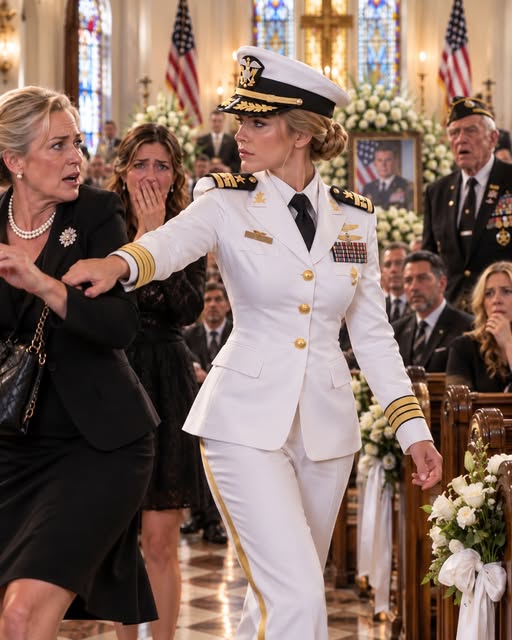
The elderly veteran stood in the center aisle, one hand resting lightly on the back of a pew.
His silver hair was combed neatly to one side, and a small American flag pin gleamed above the ribbons on his jacket.
I recognized him, although it had been more than a decade since I’d last seen him.
Brigadier General Thomas Whitaker.
Retired.
Dad’s oldest friend.
When I was growing up, Uncle Tom had been a permanent fixture in our house.
He’d helped Dad build our back porch, taught Emily to fish, and once driven three hours through a thunderstorm because our refrigerator had broken on Thanksgiving morning.
He’d also been the man who encouraged me to apply to the Naval Academy when practically everyone in Cedar Creek expected me to attend a college closer to home.
Now he was looking at me with an expression I couldn’t quite read.
“Hello, Sarah,” he said.
My throat tightened.
“Hello, General.”
His mouth curved into the faintest smile.
“Still calling me that?”
“Old habits, sir.”
“Your father would have something to say about that.”
A few people smiled.
The tension in the sanctuary eased slightly.
My mother remained motionless beside the doors.
“Thomas,” she said quietly, “this is neither the time nor the place.”
“I know, Elaine.”
He looked toward the congregation.
“That’s why I’m not going to turn James’s memorial into a discussion about private family matters.”
He paused.
“But there’s something James specifically asked me to say if Sarah came home.”
I felt Emily’s hand slip into mine.
Uncle Tom reached inside his jacket and withdrew a folded sheet of paper.
It was yellow legal paper.
Dad’s favorite.
He carried those little yellow pads everywhere.
He wrote grocery lists on them, sketched plans for birdhouses, and used them to leave messages beside the coffeepot whenever he left early for an appointment.
Seeing that familiar paper in another man’s hand almost undid me.
“James gave me this three months before he died,” Uncle Tom continued.
“He told me I was to keep it until the right moment.”
My mother closed her eyes.
“Thomas, please.”
He looked at her with unmistakable gentleness.
“Elaine, he loved you.
You know that.
But he loved both his daughters, too.”
Then he unfolded the paper.
“James asked me to read this.”
He put on his glasses.
And suddenly, across twelve years and thousands of miles, I heard my father’s voice in every word.
“‘If Sarah comes to my memorial in her Navy uniform, I want everyone to understand that she is wearing it at my request.
“‘My daughter has spent most of her adult life serving people she will never meet.
She has missed birthdays, holidays, and more ordinary Sunday dinners than I care to count.
“‘I have missed her at every one of them.
“‘But missing someone and being disappointed in them are two very different things.
“‘I have never been disappointed in Sarah for choosing the life she believed she was meant to live.
“‘And if anyone believes that my daughter’s absence means she stopped loving this family, I ask them to remember that love sometimes travels farther than we can see.’”
Uncle Tom lowered the letter.
Nobody spoke.
I stared at the floor because I couldn’t bear to look at the faces around me.
Dad had always been proud of my service.
He’d told me that in countless letters.
But hearing his words spoken inside the church where I’d grown up was different.
For years, I had imagined my hometown as a place that no longer had room for me.
Now my father’s words were making room.
Uncle Tom looked directly at me.
“Your father asked me to tell you something else, Sarah.”
I raised my head.
“He said you were never supposed to carry his pride as another responsibility.
He was proud of you long before you earned a single ribbon.”
That was when I started crying.
Not dramatically.
Not loudly.
Just a few tears that escaped before I could stop them.
Emily squeezed my hand.
And in the silence of that church, she whispered, “He really did love you, Sarah.”
“I know,” I whispered back.
But knowing and believing, I was beginning to understand, were not always the same thing.
The Seat Beside My Sister
Uncle Tom folded the letter carefully and returned it to his jacket.
Then he stepped toward the sanctuary doors.
“James saved a seat for you,” he told me.
I looked up.
“What?”
“In the front row.
Beside Emily.”
He glanced at my mother.
“And I believe we should honor that.”
For the first time since I’d arrived, Mom seemed uncertain what to say.
She looked from Uncle Tom to Emily, then to me.
Something flickered across her face.
For a brief moment, I thought she might reach for my hand.
Instead, she stepped aside.
“People are waiting,” she said.
It was a small concession.
But after twelve years, I knew better than to expect everything to change in a single morning.
I walked into the sanctuary with Emily beside me.
As we passed the pews, familiar faces emerged from the crowd.
Mr.
Henderson, who had taught me high school chemistry, gave me a quiet nod.
Mrs.
Parker, our old neighbor, pressed a tissue into my hand.
Near the middle aisle, I recognized Daniel Reeves, a boy who’d once taken me to our senior prom.
His hair had begun to gray at the temples, and a little girl in a blue coat sat beside him.
He offered a sympathetic smile.
I returned it.
No one asked questions.
For once, nobody seemed interested in explaining my life to me.
At the front, an empty seat waited between Emily and Uncle Tom.
A small white rose rested on the cushion.
Beside it was a folded card with my name written in Dad’s familiar handwriting.
For Sarah.
My knees nearly gave way.
“Did he leave this, too?”
I asked.
Uncle Tom nodded.
“He made arrangements.”
I picked up the card.
Inside was a single sentence.
You made it home, sweetheart.
I had spent six weeks recovering from an injury and twelve years wondering whether I still belonged in Cedar Creek.
And somehow, Dad had found a way to answer both questions.
I sat down.
Emily leaned against my shoulder.
On the other side of the aisle, Mom took her place in the family pew, leaving one empty space between herself and us.
I noticed it.
So did Emily.
But neither of us said anything.
The organ began to play.
And my father’s memorial finally started.
There were photographs displayed near the pulpit.
Dad in uniform at twenty-five, standing beside a military transport plane.
Dad and Mom on their wedding day, laughing so hard that neither of them was looking at the camera.
Dad holding Emily when she was a newborn, looking terrified and delighted at the same time.
And one photograph I hadn’t seen in years.
I was sixteen, standing beside Dad in the driveway, holding a wrench and grinning triumphantly beside our old blue pickup truck.
My hair was tied up in a messy ponytail.
There was grease on my cheek.
Dad had one arm around my shoulders.
I remembered the moment perfectly.
He’d refused to let me drive until I learned how to change a tire.
I had spent most of that Saturday complaining about it.
Then the following winter, when a tire blew on a lonely stretch of highway, I’d called him afterward.
“Guess you were right,” I’d admitted.
He had laughed for a full minute.
“Put that in writing, Sarah.
Your mother will never believe it.”
I smiled through my tears.
The pastor, Reverend Collins, approached the pulpit and opened his Bible.
He spoke about Dad’s faith, his service, and his extraordinary talent for appearing whenever someone needed help.
He recalled how Dad had organized repairs after a tornado damaged several homes outside town.
How he had volunteered at the veterans’ center.
How he’d driven elderly church members to medical appointments without ever mentioning it to anyone.
Then the pastor closed his Bible.
“James Mitchell once told me that the most important things he ever did were not listed anywhere on his military record.”
He looked toward our family.
“He said they were raising two daughters and learning, with varying degrees of success, how to be the husband Elaine deserved.”
A gentle ripple of laughter moved through the congregation.
My mother lowered her head.
“James was a man who understood duty,” the pastor continued.
“But he also understood that duty without tenderness can leave people feeling terribly alone.”
Those words stayed with me.
I wondered whether Dad had ever said something similar in one of the letters I hadn’t received.
The Missing Years
After the service, everyone gathered in the fellowship hall.
Long tables were covered with white tablecloths, casseroles, sandwiches, homemade pies, and enormous silver urns of coffee.
It looked exactly like every church gathering I remembered from childhood.
The smell of fresh coffee and baked ham floated through the room.
Someone had brought Mom’s favorite lemon bars.
Someone else had made Dad’s beloved pecan pie.
For a moment, I could almost imagine him coming through the doors, greeting everybody by name and making a joke about how he hoped there would be leftovers.
Instead, I stood beside a table of framed photographs, holding a paper cup of coffee I hadn’t touched.
“You’re Commander Mitchell now, aren’t you?”
I turned.
Daniel Reeves stood beside me, holding two plates of food.
I smiled.
“Still keeping up with the Navy?”
“Small town.
People talk.”
“Apparently.”
He winced.
“Sorry.
That came out wrong.”
“No, it’s okay.”
He handed me one of the plates.
“I remember you never ate at church functions because you were always too busy helping somebody else.”
“I remember you stealing the last dinner roll at our graduation luncheon.”
“That is an allegation I continue to deny.”
We both laughed.
It was the first unguarded laugh I’d had since arriving in Tennessee.
Daniel glanced toward the sanctuary.
“Your dad was proud of you, Sarah.”
I looked down.
“So I keep hearing.”
“He talked about you whenever he got the chance.”
That surprised me.
“Really?”
Daniel nodded.
“He came to the high school every Veterans Day.
He always brought pictures from your graduation, and later he’d show the students those photographs of you aboard ship.”
I stared at him.
Dad had never mentioned that.
“He even convinced my daughter she should consider the Naval Academy.”
I looked toward the little girl in the blue coat, now happily eating a cookie beside an older woman.
“How old is she?”
“Eleven.
Already thinks she can run the whole country.”
“Sounds like Academy material.”
Daniel laughed.
Then his expression softened.
“Sarah, I don’t know what happened between you and your mother.
And I’m not going to pretend it’s my business.”
I waited.
“But your father never spoke about you as though you had abandoned anybody.”
I swallowed.
“Thank you.”
He nodded and returned to his family.
I stood there wondering how two completely different versions of my life could have existed in the same town.
One in which I’d become a distant daughter who forgot where she came from.
And another in which my father had proudly carried photographs of me into classrooms.
Both versions had been circulating for years.
And until that morning, I hadn’t known about either.
Emily found me fifteen minutes later.
She had changed out of the dark coat she’d worn to the service and was carrying a small cardboard box.
“Come outside with me,” she said.
“What’s that?”
“Something Dad left.”
I looked at the box.
“Another letter?”
“Maybe more than one.”
She gave me a strange little smile.
“Come on.”
We slipped through a side door and walked onto the covered porch behind the church.
The November air smelled of wet leaves and distant wood smoke.
Beyond the parking lot, bare branches swayed beneath a low gray sky.
Emily set the box on a wooden bench.
For a moment, she simply stood there, studying me.
“You look different,” she said.
“Twelve years will do that.”
“No.
I mean…”
She searched for the right words.
“You look like you’re expecting somebody to tell you to leave.”
I looked away.
She was right.
Even after Uncle Tom’s speech, I had been waiting for another uncomfortable conversation.
Another reminder that I didn’t quite fit anymore.
Emily sat down.
“Sarah, there’s something I need to tell you.”
I joined her.
“When Dad started getting sick, he asked me to help organize his papers.”
I turned toward her.
“What papers?”
“Military records.
Insurance documents.
The house.
You know how he was about keeping everything in those filing cabinets.”
I smiled faintly.
“He labeled his socks.”
“He labeled the drawer containing his socks.”
We laughed.
Then Emily grew serious.
“He also had a box of letters.”
My stomach tightened.
“Letters to me?”
She nodded.
“Some were copies of letters he’d mailed.
Others were ones he’d started writing but never finished.”
“Why didn’t he send them?”
“I don’t know.
Sometimes he wrote things and decided he needed more time to figure out what he wanted to say.”
That sounded like Dad.
He had never been especially good at difficult conversations.
He could explain battlefield logistics or rebuild a lawn mower without a manual.
But when something involved hurt feelings, he often retreated to the kitchen, made pancakes, and hoped everyone would feel better by breakfast.
Emily pulled a small stack of envelopes from the box.
My name was written on every one.
Some were dated years earlier.
Others were from the last few months of his life.
“Why are you giving me these now?”
I asked.
“Because he asked me to.”
She hesitated.
“And because there’s something about those years you don’t know.”
I looked at her.
“Emily.”
“I know.
I should have told you sooner.”
She stared at her hands.
“But when you left, I was only fifteen.
Mom was upset, Dad was trying to hold everything together, and I didn’t know whose version of things to believe.”
My chest tightened.
“What version?”
Emily took a breath.
“Mom told me you didn’t want us contacting you.”
The words seemed to hang in the cold air.
“What?”
“She said you needed distance.
That you wanted to build your own life and that we had to respect it.”
I stared at her.
“Emily, I wrote to you.”
Her eyes filled.
“I know that now.”
“Birthday cards.
Christmas cards.
I sent you a graduation present.”
She nodded slowly.
“I got the graduation present.”
“You never answered.”
“Mom told me you’d asked her not to give you my new address.”
I felt as though a door I’d spent years trying to open had suddenly been revealed as something else entirely.
“I never said that.”
“I believe you.”
She said it without hesitation.
I searched her face.
“How long have you known?”
“Not long enough to make this easier.”
She wiped her cheek.
“I found something in Dad’s filing cabinet while I was organizing the house.”
She reached into the box.
And pulled out a bundle of unopened envelopes.
All addressed to me.
All written in handwriting I recognized immediately.
Emily’s.
The Letters That Never Left Home
I picked up the first envelope.
The paper was slightly yellowed, and the stamp had begun to peel at one corner.
The return address belonged to our childhood home.
The postmark was missing.
I turned it over.
It had never been mailed.
There were eleven envelopes in all.
Birthdays.
Christmases.
A college acceptance letter.
An announcement about Emily’s engagement.
And one addressed simply:
Sarah, I really need my big sister.
I couldn’t speak.
Emily took the envelope from my hand and held it carefully.
“I wrote this when I was twenty-one.”
“What happened?”
She gave me a sad smile.
“Nothing terrible.
I was just scared.”
She told me about her first teaching job, the one she’d taken in Nashville after graduating from college.
She’d moved into a tiny apartment with unreliable heating, an elderly cat she’d adopted from a shelter, and a roommate who played the trumpet at two in the morning.
She had been lonely.
And she’d wanted her sister.
“I asked Mom if she knew how to reach you,” Emily said.
“She told me you were deployed and couldn’t receive personal mail.”
I shook my head.
“That’s not how it works.”
“I know that now.”
“Did Dad know?”
Emily looked down.
“That’s the part I haven’t figured out.”
I opened the envelope.
Inside were three pages covered in Emily’s small, neat handwriting.
She had written about missing me.
About wishing I could visit.
About how every time something exciting happened, her first instinct was still to run down the hallway and tell me.
Then she’d written a sentence that nearly broke my heart.
I don’t know if you want to be my sister anymore, but I still want to be yours.
I covered my mouth.
“Oh, Em.”
She leaned against me.
“I was young.
I didn’t understand.”
I wrapped my arms around her.
“I never stopped wanting you.”
“I know.”
We sat together for a long time.
Inside the church, people were laughing softly, washing dishes, and folding tables.
Life was continuing in its ordinary way.
But out on that porch, twelve years of silence had begun to change shape.
Not disappear.
Not become harmless.
Just become something we could finally understand.
“There’s another thing,” Emily said eventually.
I looked at her.
She reached into the box and removed a small notebook with a worn brown cover.
“Dad kept a record of your deployments.”
I took it.
Inside were dates, locations, newspaper clippings, and handwritten notes.
He had recorded promotions, assignments, and the occasions when I’d been able to call home.
Every few pages, he’d written little reminders.
Sarah loves the pecan pie from Miller’s Bakery.
Ask about her new commanding officer.
Send photographs of the garden.
Remember to tell her the truck finally died.
I smiled through another wave of tears.
Then I turned to a page dated seven years earlier.
A sentence was underlined.
Elaine says Sarah would rather I stop writing.
I don’t believe it.
I read it twice.
A few pages later, another entry.
Sarah says she hasn’t received the last three letters.
Need to check the address.
And beneath it:
Something isn’t right.
My pulse quickened.
“Emily, did Dad know Mom was keeping the letters?”
She looked helpless.
“I don’t know.”
I turned another page.
The next entry was written in darker ink.
Talked with Elaine tonight.
We have allowed our fear to become something else.
I need to fix this.
Below it was a date.
September 18.
Seven years earlier.
I stared at those words.
Dad had known something was wrong.
But what had happened afterward?
I flipped through the notebook.
Several pages had been removed.
Not torn out carelessly.
Detached neatly along the perforations.
“Where are the missing pages?”
I asked.
Emily shook her head.
“I was hoping you knew.”
I closed the notebook.
For the first time that morning, my sadness was accompanied by something sharper.
Not anger exactly.
A need to understand.
Why had my mother been so determined to keep us apart?
And why had Dad, who could face almost anything without hesitation, apparently struggled for years to bring his family back together?
A Conversation I Had Avoided for Twelve Years
We were still sitting on the porch when the door opened.
Mom stepped outside.
She had taken off her black coat and was carrying a small paper plate with a slice of pecan pie.
“There you are,” she said.
Her voice was quieter than it had been that morning.
“People are starting to leave.”
Emily stood.
“I’ll go help with the cleanup.”
She looked at me, silently asking whether I wanted her to stay.
I gave her a small nod.
“It’s okay.”
She squeezed my shoulder and went inside.
Mom set the plate on the bench.
“Your father would have wanted you to eat something.”
I looked at the pie.
It was such a familiar gesture that for a moment, I almost forgot how much distance stood between us.
Growing up, Mom had always offered food when she didn’t know how to say something.
A sandwich after a disappointing exam.
A bowl of soup after an argument.
Hot chocolate whenever one of us came home crying.
But sometimes food had become a substitute for conversations we desperately needed.
“Mom,” I said, “Emily showed me the letters.”
She stopped moving.
“What letters?”
“The ones she wrote to me.”
Her expression changed almost imperceptibly.
“Oh.”
“Why weren’t they mailed?”
She sat down at the opposite end of the bench.
For several seconds, she studied the parking lot.
“Your sister was going through a difficult time.”
“She needed me.”
“She needed stability.”
“And I couldn’t give her that?”
Mom folded her hands.
“You were never home, Sarah.”
It was an old argument.
One we’d had before I left for Annapolis.
One we’d had when I accepted my first assignment overseas.
One that seemed to return every time I missed a family gathering or had to end a telephone call early.
“I couldn’t always be here,” I said.
“But I could have written to her.
I could have called when I was allowed.
I could have reminded her that I loved her.”
Mom looked down.
“I thought it would be easier if she stopped expecting you.”
The admission was so quiet I almost missed it.
I stared at her.
“Easier for whom?”
She didn’t answer immediately.
A car pulled out of the parking lot.
Its tires crunched over the gravel.
Then she said, “You don’t understand what it was like after you left.”
I waited.
“Your father missed you terribly.
Emily cried whenever you couldn’t come home.
Every holiday became another reminder that you weren’t there.”
My throat tightened.
“I missed you, too.”
“You didn’t seem to.”
“Because I was trying not to make leaving harder.”
Mom looked at me.
I continued.
“Do you know how many times I sat in an airport bathroom crying before a deployment because I knew if I called home, I might not be able to pull myself together?”
She said nothing.
“I didn’t stop missing this family because I joined the Navy.”
Her eyes moved toward my uniform.
“I know that now.”
I wanted to believe her.
But there were still eleven unopened letters sitting in the box beside me.
“Why did you tell people I abandoned you?”
Mom flinched.
“I didn’t use those words.”
“Maybe not.
But that’s what everyone believed.”
She stared at the church doors.
“People asked questions.
They wanted to know why you weren’t visiting.
Why you weren’t coming home for Christmas.
And after a while, I got tired of explaining.”
“Explaining what?”
“That you had chosen a life far away from us.”
I closed my eyes briefly.
There it was.
The familiar divide.
To Mom, my service had always been a choice against my family.
To me, it had been a calling that I hoped my family could understand.
We had spent years standing on opposite sides of that misunderstanding.
But the letters made it impossible to pretend misunderstanding explained everything.
“Mom, you could have sent Emily’s letters.”
“I know.”
“You could have given her my address.”
“I know.”
“You could have told me she needed me.”
Her voice broke.
“I know, Sarah.”
I looked at her.
For the first time that morning, I saw how tired she was.
Not simply tired from planning a memorial.
She looked like someone who had spent years carrying a story that had become too heavy to hold.
But I wasn’t ready to comfort her.
Not yet.
“Did Dad know?”
She lowered her eyes.
“Your father knew we were having difficulties.”
“That’s not what I asked.”
A long silence followed.
Finally, she said, “He knew some of it.”
“How much?”
“I don’t know what he told you.”
“Not enough.”
Mom drew a trembling breath.
Then she stood.
“I can’t do this here.”
I looked at her, exhausted.
“Then where, Mom?”
She glanced toward the parking lot.
“Come to the house tomorrow afternoon.
There’s something you need to see.”
Before I could ask another question, she went back inside.
I remained on the bench, watching the church door close.
Something you need to see.
The words could have meant anything.
Another letter.
An old photograph.
An explanation she’d postponed for twelve years.
I looked down at Dad’s notebook.
Then I reached for the first unopened envelope Emily had written to me.
Whatever Mom wanted to show me, I had a feeling it would not be the only truth waiting at our childhood home.
That evening, I returned to my hotel and hung my uniform carefully in the closet.
The room was quiet except for the hum of the heater.
Outside, rain began tapping against the window.
I changed into sweatpants and one of Dad’s old University of Tennessee sweatshirts that Emily had slipped into my car before I left the church.
It still smelled faintly of cedarwood and laundry detergent.
I sat cross-legged on the bed and opened the box of letters.
For nearly two hours, I read.
Emily’s letters came first.
She had written about college.
About falling in love for the first time.
About the day she received her teaching certificate.
One letter contained a photograph of her standing outside a school with a bright yellow sign reading Welcome, Miss Mitchell.
On the back she’d written:
I wish you could have been here.
I pressed the photograph against my chest.
Then I opened Dad’s letters.
Some were ordinary.
He complained about the stubborn lawn mower.
He described the new pastor.
He reported that Mom had planted hydrangeas along the front porch and that the neighborhood deer seemed personally offended by the arrangement.
I laughed at that one.
But the later letters were different.
Dad had begun writing more openly about regret.
In one dated two years before his death, he’d written:
I’ve spent much of my life believing that if I worked hard enough, I could solve almost any problem.
But families don’t work like engines, sweetheart.
You can’t always identify the broken part and replace it.
Sometimes you have to admit you helped create the problem in the first place.
I reread the paragraph.
Then continued.
Your mother and I have not always known how to love you in the ways you needed.
I won’t speak for her, but I can tell you I made mistakes.
I thought that keeping peace meant avoiding uncomfortable conversations.
I was wrong.
My eyes filled.
Dad had never said anything like that to me before.
I thought back to the strained phone calls over the years.
The birthdays when he sounded distracted.
The times he’d asked me whether I might consider a position closer to home.
I had interpreted those conversations as disappointment.
Maybe he had been trying to find a way back to me.
Maybe neither of us had known how to begin.
I opened the final letter in the stack.
It was dated four months before his death.
Sarah,
There’s something I should have told you years ago.
I intended to explain it the last time we spoke, but you sounded so happy describing your new assignment that I couldn’t bring myself to interrupt.
I need you to know that your mother and I made decisions when you were younger that affected all of us.
Some were made out of fear.
Others were made because we thought we understood what was best.
We were wrong about more than we realized.
I hope you’ll come home one day, not because you owe us anything, but because there are pieces of our story you deserve to have.
Love, Dad.
I stared at the signature.
Pieces of our story.
I looked at the notebook Emily had given me.
Then at the letter Uncle Tom had read in church.
Three different messages.
Three different hints that Dad had been trying to tell me something.
I reached for my phone.
There was one person who might know what he meant.
The General’s Second Promise
Uncle Tom answered on the third ring.
“Sarah?”
“How did you know it was me?”
“Your father made me memorize that number years ago.”
I smiled faintly.
“Of course he did.”
“How are you holding up?”
I looked around the hotel room at the scattered envelopes.
“Honestly?
I’m not sure.”
There was a pause.
“Your father always said you were honest when you finally stopped pretending you were fine.”
I laughed softly.
“That sounds like him.”
“What can I do for you, sweetheart?”
I took a breath.
“Did Dad ask you to keep anything else secret?”
The line went quiet.
Not disconnected.
Just quiet.
Then Uncle Tom said, “What have you found?”
“Letters.
Emily’s letters.
Dad’s notebook.”
“Ah.”
“And some pages are missing.”
He sighed.
“I wondered when those would turn up.”
My heart began beating faster.
“You know about them?”
“I know what James wrote on them.”
“Then tell me.”
Another pause.
“Sarah, your father was a good man.
But good men can make mistakes when they’re afraid of losing people.”
“I know that.”
“He spent years trying to understand what had happened to your family.”
I gripped the phone.
“What happened?”
Uncle Tom spoke slowly.
“Before you left for the Naval Academy, your mother was offered a job in Nashville.”
I frowned.
“A job?”
“An administrative position at a hospital.
It would have meant moving the whole family.”
I sat up.
“I never heard about that.”
“Your father didn’t want to leave Cedar Creek.
Your mother did.”
I stared at the rain streaking the window.
“Why?”
“She wanted a new beginning.
She’d spent years being the wife of an Army officer, moving whenever his assignments changed.
For once, she wanted to make a decision about her own future.”
That was a side of Mom I’d never considered.
Growing up, I’d thought of her as the one who loved our hometown most.
The one who wanted everything to stay exactly the same.
“Did she take the job?”
“No.”
“Because of Dad?”
“Partly.”
“And partly?”
Uncle Tom hesitated.
“She told James she couldn’t move while you were preparing to leave for Annapolis.
She wanted the family to stay together for your last year at home.”
I frowned.
“But I didn’t even know I’d been accepted yet.”
“I know.”
I rubbed my forehead.
“So what happened?”
“Your father asked her to reconsider.
He told her you and Emily were growing up and that she deserved to pursue something of her own.”
For a moment, I couldn’t reconcile those words with the mother I knew.
“Then why didn’t she go?”
“Because by then, your acceptance letter had arrived.”
My breath caught.
“What?”
“And your mother was frightened.”
“Of me leaving?”
“Of everything changing at once.”
I looked toward Dad’s sweatshirt folded beside me.
I remembered the day my acceptance packet arrived.
Mom had cried.
I’d assumed they were happy tears.
Later that evening, she’d asked whether I was absolutely certain I wanted to go.
She’d mentioned local colleges.
She’d talked about how lonely Emily would be.
And she’d reminded me that Dad was getting older.
At seventeen, I’d interpreted it all as her refusing to understand my dreams.
Maybe she’d also been grieving the dream she’d set aside.
“Sarah,” Uncle Tom said gently, “your mother made decisions she needs to explain herself.
I won’t do that for her.”
I looked down.
“But your father made me promise something.”
“What?”
“If you ever came home and started asking questions, I was to give you one final envelope.”
I stopped breathing for a moment.
“Where is it?”
“In the safe at the veterans’ center.”
“What’s in it?”
“I don’t know everything.
James sealed it himself.”
“Then why didn’t you give it to me today?”
“Because he left instructions.”
“What instructions?”
Uncle Tom’s voice softened.
“He said you should read it after you talked to your mother.”
I closed my eyes.
“She asked me to come to the house tomorrow.”
“Then go.”
“And if she won’t tell me the truth?”
“She may be more ready than you think.”
I wasn’t sure I believed him.
But after everything that had happened that day, I was beginning to realize that my family’s story was much larger than the version I’d carried around for twelve years.
I barely slept.
By morning, the rain had stopped.
Sunlight spilled through the hotel curtains, illuminating the letters scattered across the desk.
I made coffee and sat beside the window with Dad’s notebook.
There was something about the missing pages that wouldn’t leave me alone.
The entry before them was dated seven years earlier.
The one after them was written nearly six months later.
Between those dates, Dad had changed.
His later entries were shorter.
Less about my deployments.
More about family.
He’d started recording conversations with Emily, visits from Uncle Tom, and little reminders about Mom’s favorite flowers.
One entry read:
Elaine says she thinks Sarah has forgotten the sound of home.
I told her home should never be a place someone is afraid to return to.
I stared at that sentence.
It felt like a message meant for all of us.
Another entry, written a year later, caught my attention.
Spoke to the lawyer today.
Everything is arranged.
Thomas understands.
The lawyer?
I frowned.
Dad had mentioned his estate planning during our last telephone call, but he hadn’t indicated anything unusual.
I turned a few more pages.
Near the back of the notebook, he’d written an address in Nashville.
Beneath it was a woman’s name.
Margaret Ellis.
Then:
She kept the original.
I read the words again.
The original what?
I took out my phone and searched through my old contacts.
The name was unfamiliar.
The address belonged to an office building near Vanderbilt University.
I considered calling Uncle Tom again.
Instead, I closed the notebook.
I’d promised myself I would go to Mom’s house that afternoon.
For once, I was going to have the difficult conversation before searching for answers somewhere else.
The drive to our childhood home took twenty minutes.
Cedar Creek looked smaller than I remembered.
The old hardware store had become a coffee shop.
The movie theater was closed.
But the elementary school still stood beside the railroad tracks, and the enormous oak tree outside the courthouse looked exactly as it had when Dad used to take us there for the Fourth of July parade.
I turned onto Willow Lane.
Our house appeared at the end of the street.
White siding.
Green shutters.
A wraparound porch Dad had built himself.
The hydrangeas Mom had planted were bare for winter, their dried blossoms rustling in the breeze.
For a moment, I remained in the driveway.
I remembered learning to ride my bicycle there.
Helping Dad paint the porch.
Watching Mom wave goodbye from the front steps on the morning I left for Annapolis.
Twelve years.
And suddenly, I was seventeen again.
I climbed out of the car.
Before I reached the porch, the front door opened.
Mom stood there in a blue cardigan and dark slacks.
Without her carefully styled hair and formal black dress, she looked smaller.
More like the mother who used to wake me for school.
“You’re early,” she said.
“I can come back.”
“No.”
She stepped aside.
“Come in.”
The house smelled of coffee, lemon polish, and cinnamon.
Just as it always had.
Dad’s boots were still beside the back door.
His reading glasses lay on the little table beside his favorite chair.
On the mantel, photographs of Emily and me stood beside a framed picture of Dad receiving a military commendation.
I stopped in front of one photograph.
My Naval Academy graduation.
Mom stood on one side of me.
Dad on the other.
I remembered being happy that day.
But in the photograph, Mom’s smile looked strangely restrained.
“That was a difficult weekend,” she said behind me.
I turned.
“Why?”
She looked at the photograph.
“Because I was proud of you.
And I was sad.
And I didn’t know how to be both without making you feel guilty.”
I said nothing.
She gestured toward the kitchen.
“Come sit down.”
We sat at the same table where I’d done homework, eaten birthday cake, and argued about curfews.
Mom poured coffee into two familiar ceramic mugs.
Mine had a little blue sailboat on it.
She’d kept it.
For some reason, that hurt more than I expected.
Then she placed a thick manila envelope on the table.
My name was written across the front.
“Your father wanted you to have this,” she said.
I stared at it.
“What is it?”
“The thing I should have shown you before you left home.”
I slowly opened the envelope.
Inside was a folder containing several old documents.
At the top was a letter from the Naval Academy.
My acceptance letter.
But it wasn’t addressed to me.
It was addressed to my parents.
I frowned.
“Why did Dad keep this?”
Mom drew a deep breath.
“Because when it arrived, I was the first person to open it.”
I looked up.
She folded her hands.
“And for three weeks, I didn’t tell either of you.”
I stared at her.
“Three weeks?”
She nodded, tears gathering in her eyes.
“I was afraid that once you knew you had been accepted, you would leave.”
“But I was going to find out.”
“I know.”
She pushed another document toward me.
It was an old employment contract.
Nashville Regional Medical Center.
The salary was circled in blue ink.
Beside it was a handwritten note.
Offer expires March 15.
The same month my acceptance letter had arrived.
Mom looked at the documents.
“I had a chance to build a career.
Your father encouraged me to take it.
But I couldn’t imagine moving, letting you leave, and watching everything I’d spent twenty years building change at once.”
She wiped her cheek.
“So I turned down the job.
Then I blamed you for leaving.”
I looked at the letter.
For twelve years, I’d believed Mom was angry because she disapproved of my military career.
But now I was beginning to see something more complicated.
She had been grieving a future she never pursued.
And somehow, I’d become the person she held responsible.
“Mom,” I said quietly, “why didn’t you tell me?”
“Because I was ashamed.”
Her voice cracked.
“And every year that passed, telling you became harder.”
She reached into the envelope and removed one final sheet.
It was a letter from Dad.
Dated the week before I left for Annapolis.
My heart began to race.
“What’s this?”
Mom looked at me.
“Your father wrote it after he found out what I’d done.”
I unfolded the paper.
And read the opening sentence.
Sarah, before you leave, there’s something your mother and I need to tell you about the day you were accepted into the Naval Academy.
I stopped.
Below it was a second paragraph, written in Dad’s familiar handwriting.
The decision you made was always yours.
But the reason we allowed you to believe you had to choose between your dreams and your family is something we both deeply regret.
I looked up.
Mom was crying now.
“Sarah,” she whispered, “there’s one more thing about that year you need to understand.”
She reached across the table and placed a small photograph beside the letter.
It showed Dad standing outside an unfamiliar brick building in Nashville.
Beside him was a woman I had never seen before.
On the back, in Dad’s handwriting, were three words.
Margaret.
September 18.
The exact date of the missing pages in his notebook.
Mom looked at the photograph, then at me.
“Margaret Ellis was the person your father went to when he realized our family was falling apart.”
I remembered the address in Nashville.
The lawyer.
The missing pages.
Uncle Tom’s final envelope.
And suddenly, I understood that Dad had spent his final years trying to bring together something none of us had been willing to examine.
Mom reached for my hand.
“There’s something Margaret helped him prepare,” she said.
“And before you read it, I need to tell you the truth about what happened after you left.”
-END OF PART 2 – CLICK THE “NEXT PART” SECTION AT THE BOTTOM OF THE PAGE TO CONTINUE READING