Chapter 1: The Maximum Distributed Load
In the molded-fiber packaging sector, we test every prototype against an engineering metric known as the edge-crush resistance. We place a humble, corrugated cardboard container or a thermoformed sugarcane platter between two parallel steel platens, apply hydraulic downward pressure, and record the exact kilonewton rating at which the sidewalls buckle. Every material, no matter how carefully bonded with thermosetting resin, possesses a finite limit. Pile enough mass onto an unreinforced corner, and the fibers shear. The failure is never truly sudden; microscopic fissures develop along the fluting long before the structure folds inward with a dry, hollow snap.
I have spent twenty-two years running Barnes Paper and Table, an industrial converting facility on the perimeter of Philadelphia. I know how much weight an eighteen-gram unbleached fiber tray can support before the baked macaroni collapses through the bottom.
What I had failed to calculate, until a brisk Tuesday in late April, was the tensile strength of my own spine.
“Your daughter can wear something off the rack, Deborah,” my mother said through the receiver. Her voice carried the serene, unruffled cadence of an appellate judge denying a frivolous motion. “A young girl has no business parading around in three thousand dollars’ worth of Parisian silk. Madison only turns eighteen once.”
I stood beside my corner window overlooking the primary loading bay. Outside, a hydraulic dock leveler banged against the chassis of an incoming trailer from International Paper. The coffee in my ceramic mug had cooled to a lukewarm sludge, but I did not set it down.
“You returned the gown,” I repeated. The words felt foreign in my mouth, like small, jagged pebbles.
“The studio was remarkably understanding once I explained there had been an acute family emergency,” Linda Barnes replied, completely untroubled. “They had a standby client from Greenwich who fit the bodice perfectly. After deducting their restocking tariff, the net wire came to twenty-seven hundred and change. I had them remit the credit directly to my account.”
“And that money is gone.”
“It has been reallocated,” she corrected me, her tone sharpening with the familiar, maternal irritation she reserved for obstinate children and slow-witted bank tellers. “Madison and her classmates have been planning this excursion to the Riviera Maya for six months. Cheryl was short on the resort deposit, and Madison has worked so hard this semester. Sophie has her entire life ahead of her to be extravagant. Don’t be so provincial about a high school dance.”
My left thumb pressed against the ceramic glaze of my mug until the nail turned chalk-white.
“I see,” I said. “That is your calculation.”
“It is common sense, Deborah. You’ve always had a vulgar relationship with your earnings. Just because your factory had a profitable quarter doesn’t mean your child needs to dress like an empress. Go to the department store in King of Prussia. Buy her something navy. A nice, modest A-line.”
“Thank you for the guidance, Mother.”
“Don’t take that tone with me,” she warned, though there was victory in her sigh. “Call Cheryl tonight and congratulate your niece. We need to present a unified front.”
I disconnected the call without uttering another syllable.
I did not fling the porcelain mug against the wall. I did not scream into the acoustic ceiling tiles. When you supervise thirty-eight blue-collar manufacturing workers through two economic contractions and a catastrophic raw-pulp embargo, you learn that rage is a low-efficiency fuel. It burns hot, produces excessive soot, and leaves the machinery fouled.
Cold, procedural arithmetic is infinitely more lethal.
I sat at my oak desk, entered my administrative passcode, and brought up a spreadsheet entitled L_BARNES_60TH_GALA_MASTER.xlsx.
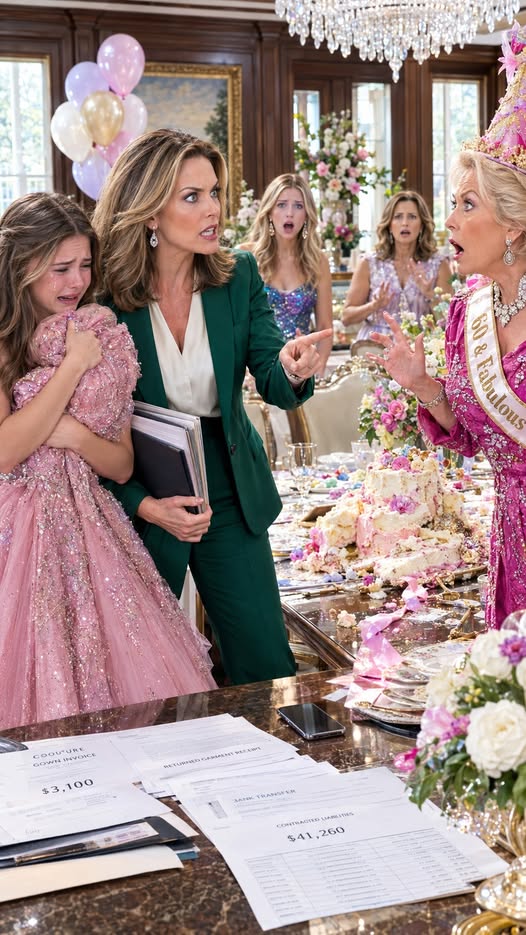
The master budget occupied ninety-six lines across seven tabs. The bottom-right cell, highlighted in soft gold, displayed the total contracted liabilities: $41,260.00.
For eleven months, I had functioned as the unpaid executive producer of Linda Barnes’s entry into her seventh decade. She had demanded a milestone gathering that would announce to the old-money enclaves of Chester County that while her husband, my father, might have departed this earth six years ago, Linda remained socially invincible. There was a historic waterfront venue booked along the Delaware River. There was a seven-piece swing ensemble for the reception, followed by a professional DJ. There were iced seafood towers, hand-tied centerpieces featuring out-of-season white peonies, custom-monogrammed Irish linen napkins, and a five-tier genoise sponge cake frosted with edible twenty-four-karat gold leaf.
I had already disbursed seventeen thousand dollars in non-refundable retainer deposits from my personal checking account. Another twenty-four thousand was due in phased disbursements over the coming three weeks.
I reached for my desk phone, pressed the outside line, and dialed Leah Vance, the events director at The Foundry on the Delaware.
“Leah,” I said when she answered on the third ring. “It’s Deborah Barnes.”
“Deborah! Hi! I was just reviewing your floor plan for the dessert lounge. The uplighting company wanted to know—”
“Cancel it,” I said.
The line fell dead. Through the receiver, I could hear the faint, ambient clatter of a commercial keyboard in Leah’s office suddenly halt.
“Excuse me?” she whispered.
“Cancel the reservation for May twenty-third,” I instructed, my voice level, steady, and entirely free of tremor. “All of it. The ballroom, the terrace, the riverside deck, the bar package.”
“Deborah… your mother’s sixtieth. We’re four weeks out. The contract stipulate that cancellations within thirty days forfeit the entire eighty-percent operational deposit. You’ll lose over six thousand dollars on our venue alone.”
“I am aware of the liquidated damages clause,” I replied. “Terminate the agreement. Release the date to your standby list. Send the termination acknowledgment to my corporate email.”
“Are… are you all right?”
“I have never been clearer in my life, Leah. And if Linda calls your office asking to alter the arrangements, inform her that the contracting client has closed the file.”
I hung up, exhaled through my nose, and brought up the vendor index.
Next was the caterer. Then the florist. Then the talent agency managing the swing band. Then the boutique bakery in Fishtown. Then the photographer. One by one, I systematically severed each arterial line that supplied life to my mother’s grand theatrical triumph.
By twenty minutes past five, the party had ceased to exist.
Somewhere in a logistics depot outside Harrisburg, two hundred custom-milled cocktail napkins embossed with Linda: Sixty & Magnificent sat in a shrink-wrapped carton, completely unaware that their reason for being had been erased from the universe.
Yet, as I closed my laptop and stepped into the quiet hallway of my plant, a cold realization seized my chest. Canceling a birthday party was simple bookkeeping; reclaiming my daughter’s stolen dignity would require a far more dangerous confrontation.