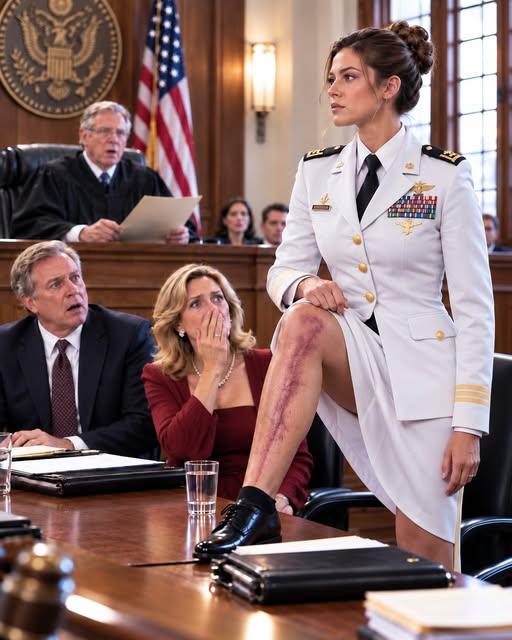
PART 2
Judge Simmons held the document by its upper corner as though age had made the paper fragile.
For several seconds, nobody spoke.
I knew the signature at the bottom.
Samuel Carter.
My grandfather had always signed his name with an oversized S and a final stroke that climbed upward, almost optimistic.
My father knew it too.
He leaned slightly forward.
Mom’s hand stopped moving against the strand of pearls at her throat.
Judge Simmons adjusted his glasses.
“This is a notarized property agreement dated March 16, 2012,” he said.
“It was recorded with the Portsmouth Circuit Court land records three weeks later.”
Dad blinked.
“There must be some mistake.”
Judge Simmons looked over the top of the page.
“About the signature?”
“No, Your Honor.
About what it means.”
The judge considered that answer for a moment.
“Then perhaps we should read what it means.”
I remained standing beside the defendant’s table.
The courtroom seemed unusually still.
Even the ventilation system sounded loud.
Judge Simmons read slowly.
“Samuel Edward Carter grants Evelyn Marie Carter sole beneficial ownership of the property located at 1187 Willow Creek Road, together with all structures and improvements thereon, while retaining a life estate for himself.”
My father closed his eyes briefly.
I knew enough about property law to understand the words.
Grandpa had kept the right to live there while he was alive.
After his death, the farmhouse was mine.
Not informally.
Not because of something scribbled in a birthday card.
Legally.
Completely.
Judge Simmons continued.
“The document also states that neither Robert Carter nor Margaret Carter holds an ownership interest.”
Mom whispered, “Robert.”
Dad didn’t look at her.
The judge lowered the paper.
“Mr.
Carter, were you aware of this instrument?”
Dad cleared his throat.
“I knew Dad intended Evelyn to have the house eventually.”
“Eventually?”
“He talked about it.”
Judge Simmons tapped the document gently against the desk.
“This isn’t a conversation.”
“No, sir.”
“This is a recorded deed arrangement.”
Dad shifted in his chair.
It was a small movement, but I recognized it.
He used to do the same thing at the dinner table whenever Grandpa challenged him.
My grandfather had been one of the few people Dad couldn’t intimidate with silence.
Judge Simmons looked toward me.
“Commander Carter, were you aware this document had been recorded?”
“I knew my grandfather left me the farmhouse, Your Honor.
I had a copy of his will.
I didn’t know about this specific filing.”
The judge nodded.
“That explains part of what I’m seeing here.”
He lifted another sheet.
“Property taxes have been paid consistently through an escrow account associated with Commander Carter’s military credit union.”
Dad turned sharply toward me.
I met his eyes.
For the first time since I had walked into the courtroom, he looked less angry than confused.
“You paid them?”
I almost laughed, but there was nothing funny about it.
“Every year.”
His eyebrows drew together.
“But the county notices—”
“Went to the farmhouse,” I said quietly.
“The payment drafts came from my account.”
Judge Simmons looked from my father to me.
“Mr.
Carter, your complaint alleges that you personally paid all property taxes beginning in 2015.”
Dad didn’t answer immediately.
Mom stared down at her purse.
Finally, Dad said, “I believed I had.”
Judge Simmons’s expression remained neutral.
“That’s different from having paid them.”
“I understand.”
Something changed in the room.
Not dramatically.
There was no gasp from the spectators, no triumphant swell inside me.
Instead, I felt something unexpected.
Disappointment.
Dad looked smaller sitting there.
Not physically smaller.
Just older.
For twelve years I had imagined my parents frozen exactly as I’d left them—unyielding, certain, convinced that my choices were evidence of some personal defect.
But gray had spread through my father’s hair.
There were fine lines beside my mother’s eyes I didn’t remember.
Time had happened to them too.
Judge Simmons placed the papers together.
“I have several questions before this court proceeds.”
He asked my parents about the farmhouse.
Dad explained that after Grandpa died, they had occasionally checked the property.
The roof had begun leaking.
The porch needed structural work.
The well pump had failed twice.
They had hired contractors.
Mom had arranged lawn maintenance for a time.
Dad had replaced several windows.
As he talked, I realized something uncomfortable.
Some of it was true.
I had paid the taxes.
But I had not lived there.
During deployments, I had barely thought about whether the gutters were clear or the porch boards were rotting.
Grandpa’s place had existed in my mind almost like a photograph—unchanging, protected by memory.
Buildings didn’t work that way.
Neither did families.
Judge Simmons asked Dad to provide receipts.
Dad opened a leather folder.
“There.”
A clerk carried them to the bench.
The judge studied the pages.
“These appear to reflect repairs.”
“They do.”
“But not property taxes.”
Dad nodded reluctantly.
“No.”
Judge Simmons looked at my parents.
“Then why does your complaint state otherwise?”
Mom finally spoke.
Her voice was quieter than I remembered.
“Because we misunderstood something.”
Dad turned toward her.
“Margaret.”
She looked back at him.
“No, Robert.”
He stiffened.
Mom took a folded paper from her purse.
“I told you we should have asked first.”
My stomach tightened.
Judge Simmons held out his hand.
“May I see that?”
She walked it forward herself.
When she returned to her seat, she didn’t reach for her pearls again.
Judge Simmons unfolded the page.
His eyebrows rose.
“Interesting.”
I hated that word.
Interesting was rarely reassuring in a courtroom.
“What is it?”
I asked.
The judge glanced at me.
“A county property statement from 2018.
It lists your grandfather’s estate as the mailing contact.”
“That’s impossible,” I said.
“He died in 2014.”
“Correct.”
Dad leaned forward.
“That’s what I told the clerk.”
Judge Simmons examined the document more carefully.
“And someone apparently changed the mailing address afterward.”
My pulse slowed.
“To whose address?”
The judge read it.
My parents’ house.
Dad nodded.
“We started receiving notices.”
“But you didn’t receive the electronic payment confirmations,” I said.
“No.”
“Because those went to me.”
Dad’s mouth tightened.
“Apparently.”
Judge Simmons rested his hands on the bench.
“This sounds increasingly like a mixture of poor recordkeeping, assumptions, and incomplete communication.”
I looked at my father.
“Except you sued me.”
He met my eyes.
“Yes.”
The word carried no excuse.
That surprised me more than anything else that morning.
Judge Simmons leaned back.
“Before I make any determination, I’m ordering both parties to provide complete financial and property-maintenance records.
Commander Carter, you’ll submit your tax records and proof of ownership.
Mr. and Mrs.
Carter, you’ll submit receipts for repairs you’ve made.”
He paused.
“I am also requesting the county land records office determine why an outdated estate contact remained connected with this property years after Mr.
Samuel Carter’s death.”
Dad started to say something.
The judge raised one finger.
“And I strongly suggest that before our next hearing, all three of you find out what actually happened.”
The gavel came down lightly.
“Continued for fourteen days.”
That was it.
No victory.
No loss.
Just another date.
The clerk began gathering papers.
People stood.
I remained seated.
My knee had started throbbing beneath the uniform trousers.
Across the aisle, Mom slipped her purse strap over her shoulder.
Dad closed his leather folder.
For a moment, nobody seemed certain who should leave first.
Then Mom looked at me.
“Your grandfather used to keep copies of everything.”
“I know.”
She hesitated.
“In the workshop.”
I studied her face.
“What are you telling me?”
“Maybe nothing.”
Dad sighed.
“Margaret.”
She ignored him.
“He had a metal filing cabinet behind the tool bench.”
“I remember.”
“There might be records.”
Dad pushed his chair in.
“We looked.”
Mom turned toward him.
“You looked through the top drawer.”
His expression changed.
A tiny thing.
But I noticed.
“You knew there were more?”
I asked.
Mom lowered her voice.
“Your grandfather didn’t trust filing cabinets.”
Despite myself, I almost smiled.
That sounded exactly like him.
Grandpa trusted coffee cans buried beneath workbenches more than bank vaults.
“He used to say thieves go for drawers first,” Mom continued.
Judge Simmons was leaving through the side door when he overheard her.
He stopped.
“Mrs.
Carter.”
She froze.
“Yes, Your Honor?”
“If you discover documents relating to this case, preserve them exactly as found.”
“Of course.”
“And share them with the other party.”
Mom nodded.
“Yes, sir.”
The judge looked at all three of us.
“Families often remember the same person differently.”
Nobody answered.
He gave us one last thoughtful look.
“Documents sometimes help.”
Then he disappeared into chambers.
Outside the courtroom, I headed toward the elevator.
“Evelyn.”
Mom’s voice stopped me.
Twelve years.
Twelve years since I’d heard her say my name directly.
I turned.
She stood several yards away beside Dad.
Up close, I noticed she’d cut her hair shorter.
Silver had begun appearing near her temples.
“What?”
I asked.
She opened her mouth.
Nothing came out.
Dad glanced toward the elevator.
“We should inspect the workshop.”
“Fine.”
“Tomorrow?”
“Today.”
My answer surprised all three of us.
Dad frowned.
“It’s going to rain.”
“It’s Virginia.”
Mom almost smiled.
“You still say that?”
I didn’t.
The elevator doors opened.
I stepped inside.
Before they closed, Mom said, “Evelyn.”
I looked at her.
Her gaze went to the ribbons on my uniform.
Not with embarrassment this time.
More like uncertainty.
“I didn’t know.”
The doors began sliding together.
I could have asked what she meant.
My service?
My rank?
My injuries?
The property taxes?
My life?
Instead, I said, “There’s a lot you don’t know.”
The doors closed.
I changed before driving to the farmhouse.
The uniform went back into its garment bag.
I traded dress shoes for boots and pulled on an old Navy sweatshirt.
Knox climbed into the truck as soon as I opened the passenger door.
He had never met my parents.
That thought seemed strange.
Dogs made time measurable in ways people didn’t.
To Knox, my parents simply didn’t exist.
As we drove west, clouds gathered over the Elizabeth River.
The farther I went from Norfolk, the more familiar the roads became.
A bait shop that used to be blue was now yellow.
A gas station had become a pharmacy.
The elementary school where I learned cursive had a new gymnasium.
But the turn onto Willow Creek Road still felt the same.
Narrow pavement.
Drainage ditches.
Pine trees leaning toward the power lines.
Grandpa’s mailbox appeared around the bend.
CARTER was still painted on the side.
Faded, but readable.
Dad’s car sat near the barn.
Mom was already on the porch when I pulled in.
She watched Knox jump from the truck.
“He’s large.”
“That’s his main hobby.”
“What kind?”
“Mostly Labrador.
Probably some shepherd.”
Knox approached her cautiously.
Mom held out one hand.
He sniffed it.
Then, to my surprise, leaned against her leg.
She laughed.
The sound caught me off guard.
For one second I remembered her at thirty-eight, standing in our old kitchen with flour on her cheek.
Then the memory was gone.
Dad appeared from around the side of the house carrying a flashlight.
“We should do this before the storm.”
His tone had returned to practical.
That was easier for all of us.
The workshop stood behind the barn.
Grandpa had built it from salvaged lumber sometime in the seventies.
Opening the door released the smell of cedar, dust, machine oil, and damp wood.
My throat tightened.
Nothing produces memory like smell.
I saw Grandpa again sharpening mower blades.
Grandpa showing me how to repair a gate hinge.
Grandpa pretending not to notice when I borrowed his socket set and failed to return half of it.
Dad switched on the overhead light.
It flickered twice.
“Still works.”
“He’d be offended you doubted it,” I said.
Dad looked at me.
Then, unexpectedly, nodded.
“Probably.”
The filing cabinet remained against the wall.
Green metal.
Four drawers.
Dad opened the first.
Insurance records.
Old tractor manuals.
Receipts from hardware stores.
The second contained tax returns.
The third stuck halfway.
Dad pulled harder.
“Don’t.”
He stopped.
I crouched.
“Grandpa used to wedge a carpenter’s pencil along the rail.”
I reached beneath the lip.
There it was.
A yellow pencil, brittle with age.
I slid it sideways.
The drawer opened.
Dad stared.
“You remembered that?”
“I spent more time out here than you did.”
The words came out sharper than I intended.
His expression closed.
Mom, standing behind us, said quietly, “She’s right.”
Dad looked at her.
Mom shrugged.
“She did.”
I turned back to the drawer.
Inside were envelopes arranged by year.
Then several folders labeled with names.
ROBERT.
MARGARET.
EVELYN.
My hand stopped.
Dad noticed.
“Open it.”
I looked at him.
“It’s mine.”
“I know.”
His answer was surprisingly gentle.
I removed the folder.
Inside were school photographs, report cards, newspaper clippings, postcards, and letters.
My breath caught.
The top clipping showed me at seventeen beside a high-school track trophy.
Another showed my Naval Academy graduation.
I stared at it.
Dad shifted beside me.
“Where did he get that?”
“I sent it.”
A silence.
“You sent Dad photographs?”
“Sometimes.”
Dad looked at the floor.
I opened another envelope.
Inside was a letter written in my grandfather’s handwriting.
The date was February 2013.
Evelyn,
If you’re reading this because you’re snooping, put it back.
If you’re reading it because I’m gone, then I suppose you’ve finally earned the right.
I smiled.
Mom leaned closer.
“That’s him.”
I continued reading silently.
Most of the letter was practical.
Which attorney had drafted the deed.
Where insurance information could be found.
Who maintained the well.
Then came a paragraph that made me stop.
You and your father are more alike than either of you has the good sense to admit.
I reread the sentence.
Dad noticed my expression.
“What?”
I handed him the letter.
He read.
A strange smile appeared briefly.
“Dad always thought he was funny.”
“He was.”
“Sometimes.”
Mom sat on an overturned bucket.
Dad continued reading.
His face gradually changed.
At the end he handed the page back.
I looked at the final paragraphs.
Robert thinks strength means holding your ground.
You think strength means walking your own road.
Both of you may be right, but neither of you knows when to turn around.
The farmhouse belongs to you because you understand what it means to come home without needing to stay.
Don’t let the place become a monument.
Houses are for living.
Use it.
Sell it.
Fix it.
Fill it with people.
Just don’t let pride make the decision for you.
I folded the letter carefully.
Rain began tapping the metal roof.
Mom watched me.
“What did he say?”
I hesitated.
Then handed it to her.
She read slowly.
Dad walked toward the workbench.
For a while only the rain spoke.
Finally Mom whispered, “He knew.”
“Knew what?”
Dad asked.
“All of it.”
Dad crossed his arms.
“Dad had opinions about everything.”
Mom looked at him.
“Robert.”
He sighed.
“Fine.”
She gave me the letter.
“He worried about you two.”
I looked at Dad.
“Apparently.”
We searched the remaining folders.
The ROBERT folder contained similar things.
Certificates from Dad’s engineering career.
Photographs of him repairing the farmhouse roof with Grandpa.
A Father’s Day card Dad had made when he was eight.
Dad picked it up and stared.
“I thought he threw this away.”
Mom smiled faintly.
“He didn’t throw anything away.”
We were still sorting when Knox began sniffing beneath the workbench.
“Leave it,” I told him.
He ignored me.
Knox was exceptionally obedient whenever obedience happened to align with his interests.
He pushed his nose behind a wooden crate.
Something scraped.
Dad moved the crate.
Behind it sat an old red toolbox.
“That wasn’t there before,” he said.
“Sure?”
“I cleaned this shop after the funeral.”
Mom came over.
“You cleaned around things.”
“I cleaned.”
“You relocated dust.”
Dad gave her a look.
For the first time, I laughed.
A small laugh.
But real.
They both looked at me.
That made me stop.
Then Mom started laughing too.
Even Dad smiled.
For half a minute, the twelve missing years disappeared.
Then we remembered ourselves.
Dad opened the toolbox.
Wrenches.
Screwdrivers.
A roll of electrical tape.
Under the removable tray was a small metal cashbox.
Locked.
Dad searched the toolbox.
“No key.”
I turned toward the pegboard.
Grandpa always kept keys on labeled hooks.
None matched.
Mom said, “Check the coffee tin.”
There were three.
One contained nails.
One washers.
The third held random keys.
We tried them until a brass key turned.
Inside the cashbox were documents.
Bank statements.
Canceled checks.
Several photographs.
And a sealed envelope.
Across the front Grandpa had written:
FOR ROBERT AND EVELYN TO OPEN TOGETHER.
Dad and I looked at each other.
Mom slowly stepped backward.
“Well.”
Dad stared at the envelope.
“Did you know about this?”
“No.”
“You’re sure?”
“Robert, I spent forty-three years married to you.
I can lie better than that.”
I looked down at Grandpa’s handwriting.
The envelope had remained sealed for more than a decade.
Dad pulled a folding chair toward the workbench.
My knee had begun aching again, so I sat opposite him.
Neither of us touched the envelope.
“You open it,” he said.
“No.”
“It’s addressed to both of us.”
“Exactly.”
He looked at me.
I put one finger on the corner.
“So we both open it.”
Dad placed his hand on the other side.
Together, awkwardly, we broke the seal.
Inside were four handwritten pages.
I recognized Grandpa’s writing immediately.
Dad began reading aloud.
Robert and Evelyn,
If you two are sitting in the same room willingly, then either a miracle happened or somebody forced you.
Mom covered her mouth.
Dad stopped.
I raised an eyebrow.
“Keep going.”
He did.
I know what happened between you.
Not every word.
Enough.
Robert believes Evelyn chose the Navy over her family.
Evelyn believes Robert asked her to choose.
Both stories contain truth.
Neither story contains all of it.
Dad stopped again.
His jaw tightened.
“What does that mean?”
I asked.
“I don’t know.”
“Keep reading.”
He skipped to the next paragraph.
There is something I should have told both of you while I was alive.
Something about the farmhouse.
And something about the money.
Dad’s voice became quieter.
My grandfather’s letter continued.
In 2011, before Evelyn received her orders, Robert came to me asking for a loan.
Dad abruptly put the letter down.
Mom stared at him.
I felt the atmosphere change.
Not dangerously.
But unmistakably.
“You borrowed money from Grandpa?”
I asked.
Dad rubbed his forehead.
“It was complicated.”
“How much?”
He didn’t answer.
I looked at the papers inside the cashbox.
Bank statements.
Canceled checks.
My grandfather hadn’t hidden them without reason.
Mom said, “Robert?”
Dad lowered his hand.
“Seventy-eight thousand dollars.”
I stared.
Even the rain seemed quieter.
“For what?”
“The business.”
“What business?”
Dad looked at Mom.
Her face had gone pale.
“You told me the company covered the loss.”
Dad shook his head.
“They didn’t.”
Mom sat slowly.
“What loss?”
Dad looked between us.
“My engineering partnership nearly collapsed in 2011.”
I remembered that year differently.
Dad coming home late.
Dad criticizing everything I did.
Dad insisting the Navy was a mistake.
Dad telling me family responsibilities mattered more than chasing some fantasy career.
I had assumed he was angry because I was leaving.
Now, for the first time, I saw the possibility that something else had been happening.
Grandpa’s letter lay between us.
“Read the rest,” I said.
Dad picked it up.
His voice had changed.
Robert repaid me every dollar.
That is important.
He was not irresponsible.
He was frightened.
There are differences.
My father stopped.
His eyes stayed on the page.
I had never heard anyone describe him as frightened.
Especially not Grandpa.
He continued.
What Robert never understood was that I did not loan him the money from my savings.
I refinanced part of the farmhouse.
Dad looked up.
“What?”
Mom leaned forward.
Dad read it again.
I refinanced part of the farmhouse.
I did not tell him because he would have refused.
I did not tell Evelyn because the debt was mine, not hers.
When Robert repaid me, I used the money to clear the loan.
I thought that settled matters.
I was wrong.
Beneath the letter were loan records.
Dad pulled them out.
His hands had started trembling.
“Why would he do that?”
I knew the answer before I said it.
“Because you were his son.”
Dad looked at me.
There was no accusation in my voice.
That seemed to affect him more than accusation would have.
Mom picked up the next page.
“I’ll read.”
Grandpa’s letter continued.
The farmhouse has carried this family through more than one difficult year.
That is why I gave it to Evelyn.
Not because I loved her more.
Not because Robert disappointed me.
I gave it to the person least likely to see it as money.
I lowered my eyes.
That sentence landed somewhere deep.
Grandpa had understood me.
Maybe better than I had understood myself.
Mom continued.
But there is another matter.
After Evelyn was injured, the Navy contacted the emergency person she had listed.
I looked up sharply.
“What?”
Dad stared at me.
“You were injured?”
I almost laughed from disbelief.
“You didn’t know?”
“No.”
“You knew I came back.”
“I knew you left active field assignments.”
“Robert,” Mom whispered.
Dad ignored her.
“How badly?”
I stared at him.
The reconstructed knee.
The surgeries.
The months of rehabilitation.
The cane I used for almost a year.
The nights Knox had eventually learned to wake me from dreams I never described.
“You really didn’t know.”
Dad shook his head slowly.
My chest felt hollow.
“Grandpa knew.”
Dad’s gaze went back to the letter.
Mom continued reading.
I did not tell Robert.
Evelyn asked me not to.
I respected her request.
But I came to regret something else.
I let each of you believe the other had chosen silence.
My breathing slowed.
I remembered the hospital overseas.
My grandfather answering the phone.
His voice shaking despite his effort to hide it.
Don’t you call them, Grandpa.
Kid—
Promise me.
And he had.
Mom’s voice softened.
Robert tried to contact Evelyn through me three times after she was injured.
Dad looked at me.
I stared at him.
“What?”
“I called Dad,” he said.
“When?”
“When Lewis contacted us.”
The name hit me.
“Lewis?”
Mom nodded.
“He called the house.”
I couldn’t speak.
Lewis had been my closest friend.
The flag in my Navy chest had belonged to him.
He had never told me he called my parents.
Mom’s eyes filled, though no tears fell.
“He said you’d been hurt.
He couldn’t give details.”
Dad looked down.
“I asked Dad where you were.”
My heart thudded.
“And?”
“He told me you didn’t want contact.”
I closed my eyes.
Of course he had.
Because that was what I’d asked.
Dad’s voice became rough.
“I thought you’d made your choice.”
I opened my eyes.
“You stopped calling after three attempts.”
“You hadn’t spoken to us in years.”
“You told me I wasn’t your daughter if I chose that life.”
Dad flinched.
“I said things I shouldn’t have.”
Mom looked between us.
“No.”
We turned toward her.
She folded Grandpa’s letter.
“We are not doing this the old way.”
Her voice was calm.
“We are not going to decide one person is guilty enough that everyone else gets to stay innocent.”
No one spoke.
She looked at Dad.
“You were cruel when Evelyn left.”
His face tightened.
Mom turned to me.
“And you closed every door.”
I wanted to argue.
But Grandpa’s letter sat inches from my hand.
Both stories contain truth.
Neither story contains all of it.
Mom looked down.
“And I let both of you.”
The workshop grew quiet.
Rain drummed on the roof.
Knox lay beneath my chair.
Dad sat across from me looking exhausted.
For years, I’d imagined reconciliation as some impossible grand event.
An apology.
An embrace.
One perfect conversation that fixed every broken year.
Instead, we sat in a dusty workshop beside a toolbox, surrounded by dead batteries and rusted drill bits.
No one knew what to say.
Maybe that was more honest.
Dad finally pointed to the last page.
“There’s more.”
Mom handed it to me.
I read.
There is one thing none of you knows.
After the farmhouse loan was repaid, I started another account.
Every month I put something into it.
Sometimes fifty dollars.
Sometimes five hundred.
It wasn’t much at first.
Later it became more.
The account was meant for the house.
Repairs.
Taxes.
Whatever came.
My eyes moved faster.
The last line made me stop.
The account remains active.
It belongs neither to Robert nor Evelyn individually.
The instructions for accessing it are with attorney Daniel Mercer.
Use it together.
Or don’t use it at all.
I looked at Dad.
He looked at me.
Mom whispered, “Daniel Mercer?”
Dad nodded slowly.
“Dad’s attorney.”
“Is he still alive?”
“I don’t know.”
I reached for my phone.
No signal inside the workshop.
Dad stood.
“House phone used to work.”
“It hasn’t in years,” Mom said.
We stepped outside.
The rain had softened.
I walked toward the porch until one bar appeared on my phone.
Daniel Mercer.
Portsmouth attorney.
I searched.
There he was.
Mercer & Hale.
Estate planning.
Still practicing.
Dad stood behind me.
I called.
A receptionist answered.
“Mercer and Hale, good afternoon.”
“My name is Evelyn Carter.
I’m calling about Samuel Carter.”
Silence.
Then typing.
“Samuel Edward Carter?”
“Yes.”
“And your date of birth?”
I gave it.
“One moment.”
A minute passed.
Dad watched me.
Mom stood beneath the porch roof with Knox.
The receptionist returned.
“Ms.
Carter?”
“Yes.”
“Mr.
Mercer left instructions regarding this matter.”
My fingers tightened around the phone.
“What instructions?”
Another pause.
“That he is to speak only when both Evelyn Carter and Robert Carter are present.”
I looked at Dad.
He heard.
His expression changed.
“When can we see him?”
“Tomorrow at ten.”
I looked toward the farmhouse.
The peeling paint.
The dying oak.
The porch Grandpa had built.
For the first time, the place no longer felt abandoned.
It felt like it had been waiting.
“Tomorrow,” I said.
Daniel Mercer was eighty-one years old, wore suspenders beneath his suit jacket, and had apparently been expecting us for twelve years.
When Dad and I entered his office the next morning, he looked at us over wire-rimmed glasses.
“Well.”
He stood.
“Samuel would have been annoyed it took this long.”
Dad almost smiled.
“I imagine so.”
Mr.
Mercer shook his hand.
Then mine.
His eyes paused on my limp.
He didn’t comment.
I appreciated that immediately.
Mom had come too, though she insisted on waiting in the reception area.
“This was between Samuel, Robert, and Evelyn,” she’d said.
It was the kind of boundary she’d once been terrible at respecting.
Maybe people could change quietly.
Mr.
Mercer opened a thick file.
“Your grandfather established a maintenance trust in 2014.”
Dad frowned.
“He died in 2014.”
“Correct.
Five months before his death.”
“How much?”
Mr.
Mercer ignored the question.
“Samuel anticipated you would ask that first.”
Dad sighed.
“Of course he did.”
The attorney pushed a letter across the desk.
Same handwriting.
Same upward final stroke.
Dad looked at me.
“You read.”
I opened it.
Robert and Evelyn,
Money makes otherwise sensible people forget what questions matter.
So before Mercer tells you what is in the account, answer this:
What is the farmhouse for?
Dad looked at me.
I looked at him.
Mr.
Mercer leaned back in his chair.
“Samuel required an answer.”
Dad stared at the paper.
“Legally?”
“No.”
“Then why—”
“Because I promised him.”
Dad sighed.
Mr.
Mercer smiled.
“He assumed you’d sigh.”
Despite everything, I laughed.
Dad did too.
It felt less strange this time.
I thought about the question.
What was the farmhouse for?
Memory?
Inheritance?
Proof Grandpa had chosen me?
An asset?
A burden?
Finally I said, “It was home.”
Dad nodded.
“It was.”
I looked at him.
“But I don’t think that’s enough anymore.”
He studied me.
“No.”
Mr.
Mercer waited.
I pictured the porch repaired.
The rooms open.
Someone cooking in Grandpa’s kitchen.
People arguing about coffee.
Boots by the door.
Life.
I remembered his letter.
Houses are for living.
“I think,” I said slowly, “it’s supposed to be useful.”
Dad’s eyes stayed on mine.
Then he nodded.
“That’s what Dad would say.”
Mr.
Mercer closed the file.
“Good.”
Dad frowned.
“That’s it?”
“That’s it.”
“You’re not going to make me answer?”
“You already did.”
Dad looked confused.
Mr.
Mercer smiled.
“When you agreed with her.”
Then he turned the folder around.
“The account currently contains two hundred and forty-six thousand dollars.”
Dad stared.
I thought I’d misheard.
“What?”
“Your father’s original deposits were modest.
He invested conservatively.
The account has continued growing.”
Dad leaned back.
“Two hundred and forty-six—”
“Approximately.”
I stared at the statement.
Grandpa, who reused aluminum foil and complained when light bulbs burned unnecessarily, had left nearly a quarter million dollars for a farmhouse.
“Why?”
Mr.
Mercer folded his hands.
“Because the trust isn’t only for the farmhouse.”
He opened another section of the file.
My stomach tightened.
“What else?”
“Samuel amended the trust shortly before his death.”
Dad leaned forward.
Mr.
Mercer removed a final document.
“This is the portion he instructed me not to disclose until both of you appeared together.”
He turned it toward us.
The title read:
CARTER FAMILY RESILIENCE TRUST.
Beneath it was a handwritten note from Grandpa.
If they ever come here together, tell them the house was only the beginning.
I looked at my father.
He looked back at me.
For perhaps the first time in my life, neither of us tried to guess the answer alone.
-END OF PART 2 – CLICK THE “NEXT PART” SECTION AT THE BOTTOM OF THE PAGE TO CONTINUE READING