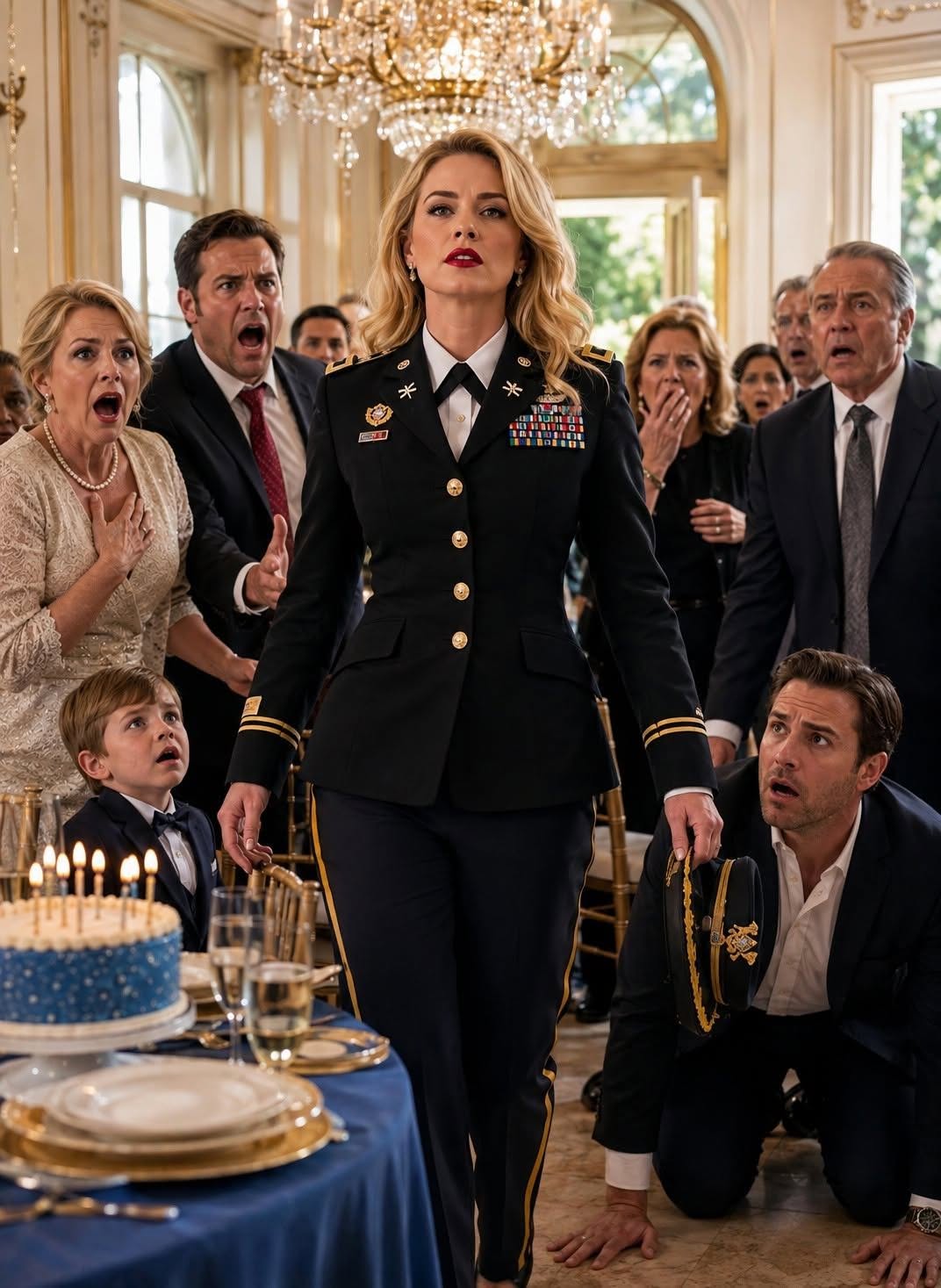
She looked at Howard, then at me, then at the uniformed officers standing near the entrance.
Her mouth tightened.
“Well,” she said, forcing a laugh. “This is certainly dramatic.”
Nobody laughed with her.
The senior officer who had saluted me stepped slightly to the side.
Colonel Marcus Reed.
He had served under me during one of the hardest assignments of my career.
He knew how much I hated spectacle.
His eyes flicked toward Noah.
Then back to me.
“Ma’am, the convoy can wait.”
That single sentence did more damage to Ethan’s family than anything I could have said.
Because everyone in that room understood immediately.
Those vehicles weren’t there for decoration.
The officers weren’t actors.
And I wasn’t wearing a costume.
Ethan lowered his glass.
His face had turned gray.
“Claire,” he said quietly. “What exactly is going on?”
I looked at him.
For twelve years, that man had known where I slept.
He knew what coffee I drank.
He knew I hated cilantro.
He knew I cried every time Noah had a fever.
But somehow, he had never cared enough to truly understand the woman standing beside him.
“You told me to stay upstairs,” I said.
His jaw tightened.
“I didn’t mean—”
“You texted me at two in the morning and told me not to attend our son’s birthday.”
A few guests glanced at each other.
Ethan noticed.
Immediately, his eyes hardened.
“Can we not do this in front of everyone?”
I almost smiled.
That was always his family’s rule.
Humiliate me publicly.
Resolve it privately.
“No,” I said. “We’re not doing anything right now.”
I turned toward Noah.
His eyes were huge.
“Mom?”
Everything inside me softened.
I walked across the room and knelt in front of him.
His paper crown was slightly crooked.
Chocolate frosting covered one corner of his mouth.
“Hey, birthday boy.”
He looked at my uniform.
Then touched one of the ribbons carefully.
“Are you going to work?”
“Yes.”
His face dropped.
“But you promised.”
“I know.”
Behind me, the room stayed completely silent.
I reached into my jacket pocket.
“I also promised I’d be front row.”
Noah stared at me.
“So?”
“So before I leave, you and I are finishing your birthday the way we planned.”
He blinked.
“Really?”
“Really.”
He threw both arms around my neck.
And that was the moment Ethan finally understood something his mother never had.
This wasn’t about making them ashamed.
It was about refusing to let their shame control me anymore.
I stood and looked toward Colonel Reed.
“Twenty minutes.”
“Yes, ma’am.”
No hesitation.
No argument.
Just respect.
Then I turned toward the guests.
“Please. Continue.”
Nobody moved.
Noah looked around impatiently.
“Dad, you have to light the candles again.”
The absurdity of it almost made me laugh.
Ethan stood frozen beside the champagne.
Noah frowned.
“Dad.”
Ethan snapped back to reality.
“Right. Yes. Of course.”
He reached for the lighter.
His hand was shaking.
We sang again.
This time, I stood beside my son.
Front row.
Exactly where I had promised.
Noah blew out all eight candles because Margaret had bought one extra and insisted it was “for good luck.”
Everyone clapped.
I cut the first piece.
Noah gave it to me.
Margaret looked like she might choke.
And for fifteen beautiful minutes, I ignored all of them.
I watched my son open the small telescope I had bought him.
I helped him untangle the ribbon from a remote-control helicopter.
I laughed when frosting landed on my sleeve.
Then at exactly 9:39, Colonel Reed stepped forward.
“Ma’am.”
Time.
Noah’s smile faded.
I crouched beside him.
“I have to go to work.”
“For how long?”
“Just today.”
“You’ll come back?”
That question hit harder than anything Ethan had said.
Because children always hear more than adults think they do.
I glanced toward Ethan.
He couldn’t meet my eyes.
“Yes,” I told Noah. “I’m coming back.”
Then I kissed his forehead.
“Happy birthday.”
He hugged me hard.
“Love you, Mom.”
“I love you more.”
When I stood, Howard was still holding the blue folder.
I looked at him.
“Come with me.”
Ethan stepped forward.
“No. Claire, wait.”
I stopped.
His mother grabbed his arm.
“Ethan.”
He pulled away from her.
“No, Mom.”
That surprised me.
He came toward me.
“What is in that folder?”
I looked at Howard.
Then back at my husband.
“Documents.”
“What documents?”
“You know exactly what kind.”
His face changed.
Not because he knew everything.
Because he knew enough.
Years ago, when his company nearly failed, he had signed so many emergency restructuring papers that he had stopped reading carefully.
He had been desperate.
His father had told him to let the company collapse.
Margaret had blamed market conditions.
I had quietly moved money through a holding entity, purchased the distressed note attached to the house, restructured the debt, and prevented foreclosure.
Ethan knew an outside investor had intervened.
He never knew that investor was me.
“Claire,” he whispered. “Who owns the company?”
I didn’t answer.
Howard did.
“My client.”
Silence.
The guests nearest us stopped pretending not to listen.
Ethan stared at me.
“You?”
“Yes.”
“You own Ashford Residential Holdings?”
“Yes.”
His mouth opened.
Closed.
Then opened again.
“That company bought the mortgage.”
“Yes.”
“And the secondary lien.”
“Yes.”
“And the development guarantee on Arlington?”
“Yes.”
The color disappeared from his face.
Margaret stepped in immediately.
“Now hold on.”
Howard turned toward her.
“Mrs. Whitmore, I would strongly advise you not to interrupt.”
Her eyes widened.
Nobody spoke to Margaret that way.
Ever.
She straightened her shoulders.
“This is a family matter.”
Howard’s expression didn’t change.
“It became a legal matter several years ago.”
Ethan looked sick.
“Why didn’t you tell me?”
I stared at him.
“You never asked who saved you.”
His eyes dropped.
That landed.
Because it was true.
When the crisis disappeared, Ethan celebrated.
His family congratulated him.
His father told everyone Ethan had “weathered the market.”
Nobody asked questions.
And I let them believe it.
For years.
Margaret suddenly laughed.
A thin, brittle sound.
“This is ridiculous. Ethan earned this house.”
Howard opened the folder.
I raised one hand.
“Howard.”
He stopped again.
I looked at Margaret.
“No. Ethan lived in this house.”
Her face hardened.
“There is a difference.”
She stepped closer.
“You think putting on a uniform and waving some papers around makes you superior to this family?”
The temperature in the room changed.
I saw Colonel Reed’s jaw tighten.
I also saw Howard look down like he was fighting a smile.
But I didn’t need either of them.
I walked toward Margaret until we were standing three feet apart.
“I have never thought I was superior to you.”
“Then what is all this?”
“This is me finally refusing to be treated as inferior.”
She froze.
I continued.
“You insulted my clothes.”
Her nostrils flared.
“You mocked my work.”
Nothing.
“You called me lucky Ethan married me.”
A few guests looked down.
“You told people I came from nothing.”
Margaret crossed her arms.
“Well, didn’t you?”
“Yes.”
That answer caught her off guard.
“I came from almost nothing.”
I nodded.
“My father repaired air conditioners. My mother worked double shifts at a nursing home. I paid for school through service. I bought my first car with cash I saved from deployment pay.”
I looked around the room.
“I’m not embarrassed by any of that.”
Nobody moved.
“The only thing I’m embarrassed by is how long I let my son watch people disrespect his mother while his father said nothing.”
Ethan flinched.
Good.
He needed to.
Margaret opened her mouth again.
I held up one finger.
“No.”
She actually stopped.
“You’ve had twelve years.”
I turned away from her.
“Now you can listen.”
Then Noah appeared beside us.
I hadn’t realized he had walked over.
His little face was tight.
“Grandma doesn’t like you?”
Everything inside me went cold.
This was exactly what I had wanted to avoid.
I crouched immediately.
“Noah.”
“Does Grandma not like you?”
Margaret rushed forward.
“Sweetheart, of course I like your mother.”
Noah looked at her.
“Then why did you tell her not to come?”
Ethan snapped his head toward his mother.
I did too.
Noah had heard.
Of course he had.
Maybe last night.
Maybe this morning.
Maybe Margaret had said it in front of him because she thought children were furniture.
“Noah,” Ethan said carefully.
But Noah was staring at Margaret.
“You said important people were coming.”
Margaret’s face went blank.
“You heard that?”
“You said Mom talks wrong.”
The room became painfully still.
My chest tightened.
Noah looked at me.
“You don’t talk wrong.”
I had commanded troops under fire.
I had delivered casualty notifications.
I had stood in rooms where decisions affected hundreds of lives.
Nothing prepared me for that.
I pulled him into my arms.
“No, baby.”
His voice became muffled against my uniform.
“I like how you talk.”
A laugh broke out somewhere behind us.
Not mocking.
Warm.
Then another.
The tension cracked.
I kissed the top of his head.
“Thank you.”
He pulled back.
“Are you mad at Grandma?”
I took a breath.
“I’m disappointed in some choices Grandma made.”
Margaret looked almost offended by my restraint.
Noah nodded slowly.
“Like when I lied about the lamp?”
Despite everything, I smiled.
“Something like that.”
“Did she get grounded?”
A few guests covered their mouths.
Howard turned away completely.
Even Colonel Reed coughed.
Margaret looked furious.
I kept my face straight.
“Adults don’t usually get grounded.”
“They should.”
This time, half the room laughed.
I hugged him one more time.
“You go play.”
He pointed toward the officers outside.
“Are those your soldiers?”
Colonel Reed answered before I could.
“Some of us used to be, young man.”
Noah’s eyes widened.
“Did my mom boss you around?”
Reed glanced at me.
“Every chance she got.”
Noah grinned.
Then he ran back toward his presents.
The second he was out of earshot, Ethan whispered, “We need to talk.”
“Yes.”
“Now.”
“No.”
He stared at me.
“I have a briefing.”
“You can’t just drop this and leave.”
“I didn’t drop anything.”
I looked at my phone.
“You sent the message.”
His face tightened.
“I was under pressure.”
“From your mother?”
He didn’t answer.
That was answer enough.
I nodded slowly.
“Interesting.”
“Claire.”
“For twelve years, every time she insulted me, you said she didn’t mean it.”
“That’s not fair.”
“Every time she excluded me, you said keeping the peace was easier.”
“I was trying to manage the situation.”
“You were managing me.”
That shut him up.
I stepped closer.
“And last night, when she asked you to remove your wife from your own child’s birthday, you did it.”
He lowered his voice.
“I made a mistake.”
“Yes.”
The simplicity of my answer hit him harder than anger would have.
“What are you going to do?”
I looked toward Howard.
“Nothing today.”
Margaret scoffed.
“How generous.”
I ignored her.
“This is Noah’s birthday. He gets his party.”
Then I looked at Ethan.
“Tomorrow morning, Howard will send you copies of everything.”
“Everything?”
“Property documents. Financial disclosures. The guarantees I made. The debts I resolved.”
Ethan swallowed.
“And then?”
“And then you and I decide whether this marriage has anything left worth saving.”
Margaret’s face changed.
For the first time that morning, she looked frightened.
Not for her son.
For herself.
“Ethan, do not let her threaten you.”
I turned toward her.
“Margaret.”
She stared at me.
“This conversation no longer includes you.”
Her mouth fell open.
I walked toward the door.
Behind me, Ethan followed.
“Claire.”
I kept walking.
He caught my arm lightly.
Instinct took over.
I stopped.
Looked at his hand.
He removed it immediately.
“I’m sorry.”
“For grabbing me?”
“For everything.”
I studied his face.
He looked sincere.
But regret after consequences is not the same thing as courage before them.
“I have to go.”
“When will you be back?”
“Tonight.”
“Can we talk then?”
“Yes.”
He exhaled.
Then I added, “Alone.”
His eyes moved toward his mother.
“She’s staying here.”
“No.”
He blinked.
“What?”
“Your mother will not be in this house when I come home.”
Margaret had followed us close enough to hear.
She laughed.
“You cannot be serious.”
I looked toward Howard.
He finally removed one document from the folder.
One page.
He handed it to Ethan.
Ethan read the top.
Then his face changed.
“What is it?” Margaret demanded.
Ethan didn’t answer.
She yanked the page from his hand.
I watched her eyes move down the document.
Her lips parted.
The property deed.
The controlling interest.
My name.
Claire Elizabeth Whitmore.
Not Ethan.
Not his father.
Not the family trust.
Me.
Margaret looked up.
“This cannot be legal.”
Howard spoke calmly.
“It is.”
“You expect me to believe she owns this entire property?”
“Technically, an entity entirely controlled by Mrs. Whitmore holds the relevant title and secured interest. Functionally, yes.”
Margaret stared at me.
“But this is Ethan’s house.”
“No,” I said.
“It is our home.”
I paused.
“And there is a difference between those two things too.”
Her fingers tightened around the paper.
“You would throw your own husband out?”
“I said nothing about throwing Ethan out.”
Then I looked directly at her.
“But you were invited here as a guest.”
That landed exactly where I intended.
Margaret went white.
I stepped closer.
“You taught me something important last night.”
She looked at me.
“Sometimes, when someone is ashamed to have you in their home, the respectful thing to do is leave.”
Her face twisted.
“You vindictive—”
“Mom.”
Ethan’s voice cracked across the foyer.
Everyone turned.
I had never heard him speak to her like that.
Margaret stared at him.
He walked toward her.
“Stop.”
She looked betrayed.
“Excuse me?”
“I said stop.”
Her voice dropped.
“You are taking her side?”
Ethan looked at me.
Then at the officers.
Then at the document in his mother’s hand.
Finally, he looked toward Noah.
“No.”
His voice was quiet.
“I’m finally taking my wife’s side.”
I should have felt satisfaction.
I didn’t.
Because twelve years late is still late.
Margaret’s face crumpled into anger.
“After everything your father and I gave you—”
“You refused to save my company.”
She froze.
Ethan pointed toward the document.
“She did.”
Margaret said nothing.
“I asked Dad for help.”
Still nothing.
“He told me failure would build character.”
Ethan laughed bitterly.
“And apparently Claire saved the house while you were telling your friends I had handled the crisis.”
Margaret’s eyes moved toward the guests.
Several looked away.
Humiliation.
Her greatest fear.
Now she was drowning in it.
But I didn’t enjoy watching it.
That surprised me.
Maybe because I had spent years imagining a moment like this.
In every fantasy, I thought vindication would feel warm.
It didn’t.
It felt empty.
Because none of it could give me back twelve years.
Colonel Reed checked his watch.
I nodded.
Time to go.
I stepped outside.
The Virginia morning was bright and cold.
The line of government vehicles gleamed along the curb.
Neighbors had come outside.
Of course they had.
I descended the front steps.
Then I heard footsteps behind me.
Noah.
“Mom!”
I turned.
He ran down the steps holding his telescope box.
Ethan was behind him.
“Noah, slow down.”
Noah stopped in front of me.
“You forgot this.”
I laughed softly.
“That’s your present.”
“I know.”
He held out a small envelope taped to the top.
There was a drawing inside.
Three stick figures.
Me.
Ethan.
Noah.
Our house behind us.
Above the figures, Noah had written in crooked letters:
MY FAMILY.
My throat tightened.
“When did you make this?”
“Yesterday.”
He pointed at my stick figure.
“I didn’t know about the army clothes, so I drew your blue sweater.”
I stared at the drawing.
Then at Ethan.
He looked broken.
Good.
Maybe some things needed to break before they could be rebuilt correctly.
I folded the drawing carefully.
“This is coming with me.”
Noah smiled.
“Okay.”
I kissed him and got into the vehicle.
As the convoy pulled away, I looked back once.
Ethan stood on the driveway.
Margaret stood behind him.
And for the first time in twelve years, he wasn’t standing beside her.
He was standing between us.
That evening, I returned at 7:46.
Margaret’s car was gone.
So were the cars belonging to most of the guests.
The decorations remained.
Half-deflated balloons drifted against the ceiling.
Noah was asleep on the couch with his telescope instructions across his chest.
Ethan sat in the kitchen.
Alone.
No champagne.
No expensive watch.
No performance.
Just Ethan.
I carried Noah upstairs, tucked him into bed, and returned.
Ethan hadn’t moved.
On the table between us sat his phone.
Beside it was a printed copy of the message he had sent me at 2:07 a.m.
I sat across from him.
He looked at the page.
“I’ve read this about a hundred times.”
I said nothing.
“I keep trying to find a version where I don’t sound like a coward.”
“There isn’t one.”
He nodded.
“I know.”
For several seconds, neither of us spoke.
Then he said, “I knew you were military.”
“Not really.”
“I knew you had served.”
“You thought I had an administrative reserve job.”
He looked ashamed.
“Yes.”
“Because that was easier than asking.”
“Yes.”
“Why?”
His eyes lifted.
And for once, he didn’t defend himself.
“Because I think part of me liked believing I was the impressive one.”
That surprised me.
He continued.
“My family always measured everything. Money. Schools. Cars. Clubs. Connections.”
He rubbed both hands over his face.
“And when I met you, you didn’t care about any of it.”
“I cared about you.”
“I know.”
His voice cracked slightly.
“And somehow, over time, instead of protecting that, I started needing you to fit into my world.”
I leaned back.
“No.”
He looked at me.
“You started needing me to shrink inside your world.”
He closed his eyes.
“Yes.”
Silence.
Then I asked the question I had been avoiding for years.
“Did you know your mother was insulting me when I wasn’t there?”
His face answered before his mouth did.
“Yes.”
My chest tightened.
“How bad?”
He swallowed.
“She called you provincial.”
I almost laughed.
Of course she did.
“She said you lacked refinement.”
I stared at him.
“She told people?”
“Sometimes.”
“And you?”
“I told her to stop.”
“When?”
He hesitated.
“Privately.”
There it was again.
Public humiliation.
Private defense.
Worthless.
I stood.
Ethan stood too.
“Claire, please.”
I turned.
“I need space.”
“I know.”
“No. I don’t think you do.”
I pointed around the kitchen.
“This house almost disappeared five years ago.”
He looked down.
“You came home every night terrified.”
“I remember.”
“You couldn’t sleep.”
“I know.”
“You thought Noah would lose his home.”
His eyes closed.
“I fixed it.”
He nodded.
“And after I fixed it, you let your father tell people you had pulled off some brilliant recovery.”
“I was embarrassed.”
“Of me?”
“No.”
He looked at me.
“Of myself.”
That stopped me.
He continued.
“I knew somebody had stepped in. I knew the restructuring had saved us. But I didn’t know who.”
“You could have found out.”
“Yes.”
“Why didn’t you?”
“Because if it wasn’t me, I didn’t want to know.”
That was probably the most truthful thing he had ever said.
I sat again.
He did too.
Then he pushed his phone toward me.
“I called my father after you left.”
I waited.
“He knew.”
I frowned.
“Knew what?”
“That the holding company belonged to you.”
Now it was my turn to freeze.
“What?”
“He found out four years ago.”
My stomach dropped.
“How?”
“He said one of his attorneys recognized Howard’s name during a separate filing.”
I stared at Ethan.
“And he never told you?”
“No.”
“Why?”
Ethan laughed once.
Without humor.
“He said he wanted to see how long I would keep taking credit.”
I couldn’t speak.
Ethan continued.
“He knew you saved the house.”
My pulse accelerated.
“He knew you covered part of the Arlington exposure.”
“Yes.”
“And he let Margaret mock me.”
“Yes.”
I stood again.
This time because sitting was impossible.
Then a voice came from the doorway.
“Because I was ashamed.”
I turned.
Richard Whitmore stood in the kitchen.
Ethan’s father.
Sixty-eight.
Silver hair.
Perfect coat.
A man who had spent twelve years speaking to me like I was a polite inconvenience.
Ethan stood.
“Dad?”
Richard looked at me.
Not Ethan.
Me.
“I used the back entrance.”
“I noticed.”
He nodded.
Fair.
Then he walked toward the table and placed an envelope down.
“What is that?” Ethan asked.
Richard ignored him.
“Claire, I owe you an apology.”
I stared at him.
“You owe me several.”
“Yes.”
That answer surprised both of us.
He pulled out a chair but didn’t sit.
“I knew about the house.”
“I heard.”
“I also knew more about your career than Margaret did.”
My eyes narrowed.
“How much?”
“Not details.”
He shook his head.
“But enough to know you were not doing paperwork.”
I felt anger rising.
“Then why?”
“Because you made me uncomfortable.”
Ethan stared at him.
“Dad.”
Richard raised one hand.
“No. She deserves the truth.”
He looked at me.
“When Ethan’s company started failing, I refused to help because I thought losing something would teach him discipline.”
Ethan laughed bitterly.
“Excellent parenting.”
Richard ignored him.
“Then you saved him.”
He looked around the house.
“Quietly.”
I said nothing.
“And I realized the person I had dismissed as unsophisticated had done something I was too proud to do.”
His jaw tightened.
“You protected my son.”
I folded my arms.
“So you responded by allowing your wife to humiliate me.”
“Yes.”
“Why?”
His eyes met mine.
“Because admitting what you had done meant admitting I had been wrong about you.”
There it was.
Not ignorance.
Pride.
Somehow that was worse.
Richard pushed the envelope toward me.
“I resigned from Whitmore Development this afternoon.”
Ethan stared at him.
“What?”
Richard finally looked at his son.
“The board will announce it Monday.”
“Why?”
“Because today I watched my grandson ask why his grandmother didn’t like his mother.”
Silence.
Richard looked at me again.
“And I realized this family had turned arrogance into tradition.”
Margaret would have called the line melodramatic.
But Richard didn’t speak dramatically.
He sounded tired.
Ancient.
He tapped the envelope.
“My voting shares.”
Ethan stopped breathing.
I looked down.
“What about them?”
“I am transferring them.”
“To Ethan?”
“No.”
Richard’s eyes stayed on mine.
“To Noah’s trust.”
I stared at him.
Ethan did too.
Richard continued.
“Not to you. Not to Ethan. To Noah. Managed independently until he is thirty.”
“Dad, you can’t just—”
“I can.”
“Why?”
“Because this family needs to stop teaching children that money makes them better than people.”
For several seconds, nobody moved.
Then I pushed the envelope back.
“No.”
Richard blinked.
“You haven’t even read it.”
“I don’t need to.”
“Claire—”
“Noah doesn’t need a fortune to repair what happened today.”
His face changed.
“He needs adults who behave better.”
Richard slowly lowered his hand.
I continued.
“If you want to leave him something, leave him an example.”
Nobody spoke.
Then I heard tiny footsteps upstairs.
Noah appeared at the top of the staircase rubbing one eye.
“Why is Grandpa here?”
All three men looked guilty.
I almost laughed.
Noah came downstairs.
Richard knelt awkwardly.
“Hey, buddy.”
“Did you miss cake?”
“I did.”
“There’s some left.”
“I heard.”
Noah looked at him seriously.
“Grandma was mean to Mom.”
Richard’s face crumpled in a way I had never seen.
“Yes.”
Noah waited.
Children are merciless with silence.
Richard swallowed.
“And I was too.”
Noah frowned.
“You were?”
“Yes.”
“Why?”
Richard looked at me.
Then back at his grandson.
“Because sometimes adults are foolish for a very long time.”
Noah considered that.
Then nodded.
“You should say sorry.”
Ethan covered his mouth.
I looked away.
Richard almost smiled.
“You’re right.”
Then he stood.
Faced me.
And did something I never thought Richard Whitmore would do.
He apologized without explaining himself.
“Claire, I am sorry.”
No excuses.
No qualifications.
No “if you were offended.”
Just the words.
I nodded.
“I hear you.”
Not forgiveness.
Not yet.
But acknowledgment.
Sometimes that is enough for one night.
Richard left ten minutes later.
Noah went back to bed.
Then Ethan and I returned to the kitchen.
“What happens now?” he asked.
I looked at the man I had loved for twelve years.
I still loved him.
That was the hardest part.
Love does not disappear just because respect has been damaged.
But love without respect becomes something dangerous.
“I’m not filing anything tomorrow.”
Hope flashed across his face.
I stopped it immediately.
“That does not mean everything is fine.”
“I know.”
“You’re moving into the guest room.”
He nodded.
“Your mother is not allowed here without my agreement.”
Another nod.
“Noah will never again be used as an excuse for excluding me.”
“Agreed.”
“And if you ever ask me to hide so your family can feel comfortable—”
“I won’t.”
I looked at him.
“Don’t promise quickly.”
He stopped.
“Think before you answer.”
He did.
For almost a full minute.
Then he said, “I will never ask you to disappear for someone else again.”
That was better.
I nodded.
“And we are going to counseling.”
“Yes.”
“Not with someone Margaret knows.”
Despite everything, he laughed.
I almost did too.
Almost.
Then Ethan looked at my uniform jacket hanging across the chair.
“Can I ask you something?”
“Yes.”
“What rank are you?”
I stared at him for two seconds.
Then I laughed.
Actually laughed.
He started laughing too.
It was ridiculous.
After everything.
After twelve years.
My own husband finally asked.
I told him.
His mouth fell open.
“You’re serious?”
“Yes.”
He sat back.
“Oh my God.”
“Apparently that was the general reaction this morning.”
He rubbed his face.
“I may never recover.”
“You’ll survive.”
He looked toward the hallway.
“Mom probably won’t.”
“That is no longer my problem.”
“No.”
His expression changed.
“For the first time, I think it’s mine.”
Good.
The next morning, I woke before sunrise.
Habit.
I walked downstairs in sweatpants and found Noah sitting at the kitchen island eating cereal.
He looked at me.
“Mom?”
“Yeah?”
“Are you still rich?”
I nearly inhaled my coffee.
“What?”
He shrugged.
“Dad said you own the house.”
I closed my eyes.
Of course he heard that too.
I sat beside him.
“Our family is comfortable.”
“That means rich.”
“Eat your cereal.”
He grinned.
Then his expression became serious.
“Are we moving?”
There it was.
The real question.
“No.”
“Is Dad leaving?”
“Dad is sleeping in the guest room for a while.”
“Because he was mean?”
“Because adults sometimes need space to fix things.”
Noah nodded.
Then he spooned cereal into his mouth.
“Grandma called last night.”
I froze.
“When?”
“Dad didn’t answer.”
Interesting.
Noah looked pleased.
“He pushed the red button.”
I smiled despite myself.
“Did he?”
“Yep.”
Then Noah leaned closer.
“Mom?”
“Yeah?”
“At my next birthday, can the army people come again?”
I laughed.
“We’ll see.”
“Colonel Reed said you bossed him around.”
“He exaggerates.”
“He said you made people do push-ups.”
“He definitely exaggerates.”
Noah grinned.
Then he asked one last question.
“Were you scared yesterday?”
I looked at him.
“Why?”
“Because everybody was staring.”
I thought about it.
“Yes.”
His eyes widened.
“You were?”
“Of course.”
“But you didn’t look scared.”
“That doesn’t mean I wasn’t.”
Noah stared into his cereal.
Then smiled.
“So being brave means you can be scared?”
I touched his hair.
“Yes.”
“That’s exactly what it means.”
He nodded like he had learned something important.
Maybe he had.
Maybe I had too.
For twelve years, I thought strength meant not reacting.
Not correcting.
Not escalating.
Not giving people the satisfaction of knowing they had hurt me.
I called it discipline.
Sometimes it was.
But sometimes silence was simply permission wearing a respectable uniform.
That birthday changed our family.
Not instantly.
Margaret did not transform overnight.
She sent six messages the next day.
Then twelve.
Then an email accusing me of “weaponizing private financial matters.”
I did not respond.
Ethan did.
Three sentences.
Claire is my wife.
You disrespected her.
Until you can acknowledge that without blaming her, do not contact us.
He showed me before sending it.
I changed nothing.
Richard began seeing Noah without Margaret.
Howard restructured the house documents so there could never again be confusion about ownership or obligations.
Ethan entered therapy.
So did we.
Some sessions were ugly.
Some ended in silence.
Once, I walked out.
Once, Ethan cried.
Once, I admitted that hiding important parts of myself had also created distance between us.
But I never accepted responsibility for his family’s cruelty.
Those were two different things.
Six months later, Margaret asked to meet me.
Alone.
I almost refused.
Then I agreed.
Public place.
Forty-five minutes.
Noah not present.
She arrived ten minutes early.
Margaret was never early.
She looked smaller somehow.
Not physically.
Just less certain.
For several minutes, she talked about weather.
I let her.
Finally she set down her coffee.
“I was cruel to you.”
I said nothing.
Her hands tightened around the cup.
“I kept telling myself I was protecting Ethan.”
“From what?”
She looked at me.
“From becoming ordinary.”
I almost laughed.
Instead, I waited.
She swallowed.
“And then I realized I had raised him to be terrified of ordinary things.”
I leaned back.
“What ordinary things?”
“Being wrong.”
Her voice cracked.
“Needing help.”
Another pause.
“Having a wife stronger than he was in certain ways.”
I studied her.
Then she said the one thing I had never expected.
“I was jealous of you.”
That stunned me.
She smiled sadly.
“Not your rank.”
She shook her head.
“Not your money.”
Then she looked down.
“Your freedom.”
I didn’t understand.
She explained.
“You never needed our approval.”
I almost interrupted.
But she continued.
“And I hated that because I had spent my whole life needing everyone’s.”
For the first time, I saw her clearly.
Not as a villain.
Not as a victim.
As a woman who had turned her own insecurity into a weapon and handed it down to her son.
Understanding did not erase the damage.
But it explained the shape of it.
“I am sorry,” she said.
I nodded.
“Thank you.”
She waited.
“For?”
“For saying it.”
Her eyes filled.
“Will you forgive me?”
I looked through the café window.
Cars moved along the road.
People passed.
Life continuing exactly as it always had.
Then I looked back at her.
“Maybe.”
She swallowed.
“But forgiveness will not restore the old relationship.”
Her face tightened.
“What does that mean?”
“It means there is no going back.”
I leaned forward.
“If we have a relationship, it will be a new one.”
She nodded slowly.
“With boundaries.”
Another nod.
“With respect.”
“Yes.”
“And if you ever speak about me in front of Noah the way you used to—”
“I won’t.”
I held her gaze.
She corrected herself.
“I understand.”
That mattered.
One year after the birthday, Noah turned eight.
We held the party in the same house.
No country-club investors.
No executives.
No strategic guest list.
Just children.
Parents.
Pizza.
A magician Noah insisted was “probably real.”
Colonel Reed came for twenty minutes and brought a model helicopter.
Richard arrived carrying three books about astronomy.
Margaret came too.
She wore jeans.
I nearly died.
Ethan saw my face and whispered, “Don’t stare.”
“I’m trying not to.”
“She owns denim.”
“Apparently.”
Margaret caught us looking.
For one terrifying second, I thought she might be offended.
Instead, she looked down at her jeans.
Then at me.
“Supermarket.”
I burst out laughing.
She did too.
It wasn’t perfect.
It wasn’t erased.
It wasn’t some magical ending where everyone forgot what had happened.
But it was different.
That afternoon, Noah climbed onto a chair.
“Speech!”
Everyone looked at him.
I frowned.
“What speech?”
“My birthday speech.”
Apparently that was a thing now.
He stood proudly.
“I want to thank everybody for coming.”
Applause.
“And Mom.”
He pointed at me.
“For not missing my birthday again.”
The adults went quiet.
Noah frowned.
“What?”
I smiled.
“Nothing.”
He continued.
“And Dad.”
Ethan raised his eyebrows.
“For pushing the red button when Grandma calls too much.”
The entire backyard exploded in laughter.
Margaret shouted, “Noah!”
He giggled.
Then he lifted his juice box.
“And Grandpa.”
Richard nodded solemnly.
“For being less foolish.”
Even I lost it.
Finally Noah raised both arms.
“And me, because I’m eight.”
Huge applause.
He jumped down.
I looked around the yard.
At Richard.
At Margaret.
At Ethan.
Then at the house I had once saved in secret.
For years, I thought the deed was the proof of my strength.
It wasn’t.
The uniform wasn’t either.
Neither were the ribbons, the rank, the investments, the classified rooms, or the money.
My strength had never been in what I owned.
It was in the moment I finally understood that keeping peace and keeping silent were not the same thing.
Ethan came to stand beside me.
“You okay?”
I nodded.
He followed my gaze toward Noah.
“He remembered.”
“Kids remember everything.”
“I know.”
He was quiet.
Then he said, “I’m glad you came downstairs.”
I looked at him.
“So am I.”
He smiled.
“Front row?”
I looked toward our son.
Noah was lighting eight candles with Richard supervising from a dangerously close distance.
“Always.”
We walked toward the table.
Margaret moved aside without being asked.
Ethan stood beside me.
Not in front.
Not behind.
Beside.
Noah looked up.
“You ready?”
I smiled.
“Ready.”
Everyone began singing.
And this time, no one in that house wondered whether I belonged there.
Least of all me.