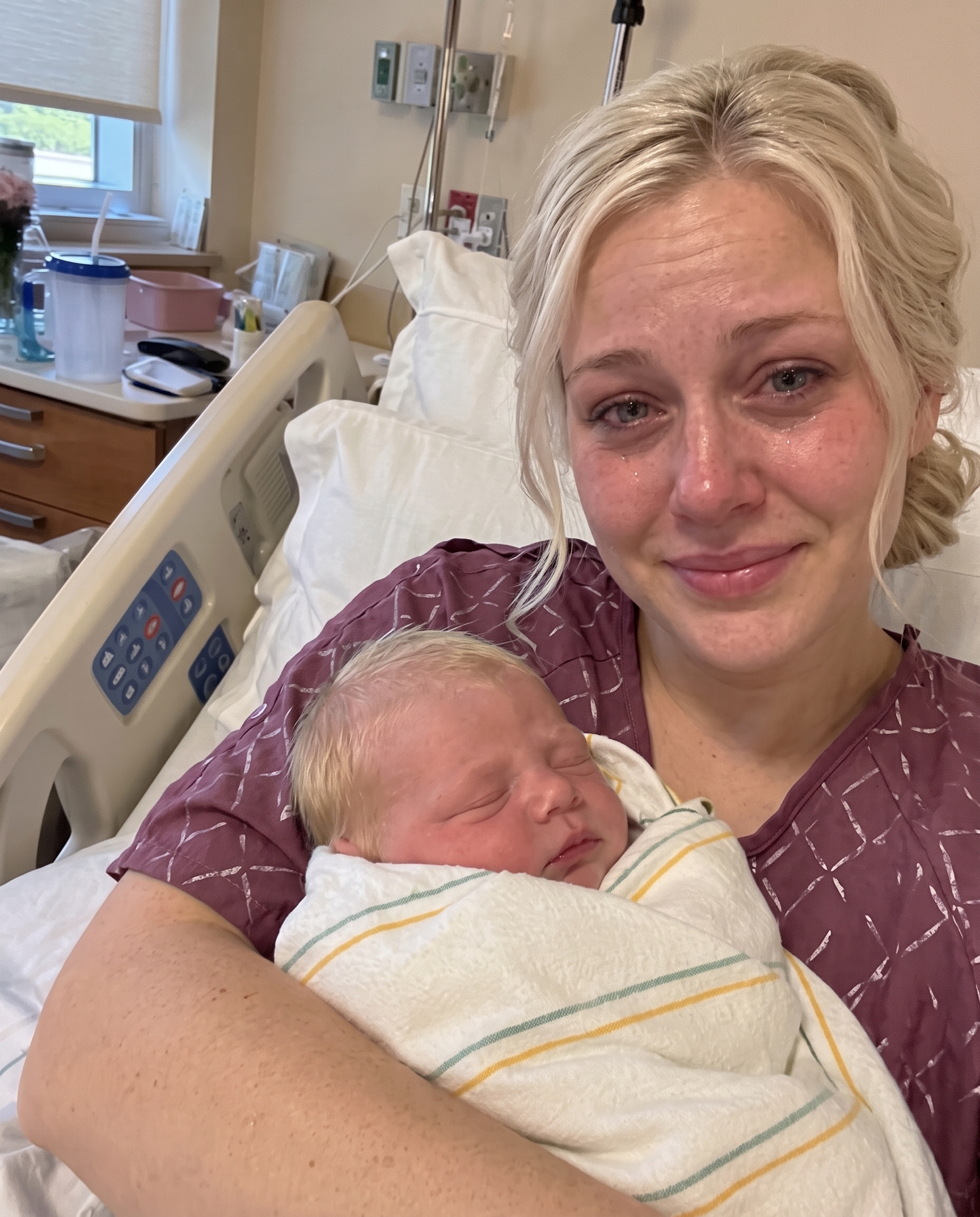
Six weeks before our daughter was due, my husband packed two suitcases, transferred nearly all the money from our shared savings account, and left our apartment as calmly as if he were running an ordinary errand.
There was no shouting. No dramatic goodbye. No slammed door.
Eric zipped his coat, checked his phone, picked up his keys, and barely looked at me while I stood in the kitchen with one hand beneath my stomach.
“You really took the savings?” I asked.
“I put most of it in there,” he replied. “You still have your salary.”
“My maternity leave starts soon.”
He shrugged.
“Then you’ll work something out. You’re the one who wanted this baby so badly.”
He walked out before dinner.
The next several weeks no longer felt like a normal sequence of days. I remember them in pieces: plastic chairs in the obstetrician’s waiting room, overdue notices on the counter, nights when I watched the clock change from two to three to four while sleep refused to come.
My blood pressure kept climbing. At thirty-four weeks, my doctor stopped halfway through an exam and called someone from the hallway.
Everything moved too quickly after that.
Chloe arrived by emergency C-section before I fully understood what was happening.
She was tiny, determined, and beautiful.
The NICU frightened me more than I can explain. Machines beeped around her. Thin wires seemed enormous beside her small body. Every alarm made my heart stop for a second.
But the nurses kept telling me the same thing.
“She’s doing her part. You have to do yours.”
So I did.
I sold jewelry I no longer wore. I canceled streaming services, subscriptions, memberships, and anything else that wasn’t necessary. I bought cheap groceries and learned exactly how long a tank of gas could last.
Most days, I sat beside Chloe’s incubator and watched her breathe.
Sometimes I talked to her.
Sometimes I had no words left.
Either way, I kept making the same promise.
“We’re going home.”
Eventually, we did.
But leaving the hospital did not mean the difficult part was over.
Chloe still needed medication, breathing treatments, checkups, and supplies that my insurance only partly covered.
One afternoon, I drove to the pharmacy with her asleep in the back seat. I was still recovering from surgery, and every awkward movement reminded me of it, but there was no one else to make the trip.
The pharmacist told me the total.
I checked my balance.
Then I checked again.
I did not have enough.
I returned to the car without everything Chloe needed and sat behind the steering wheel for several minutes.
Eric’s number was still saved in my phone.
I stared at his name longer than I want to admit.
Then I called.
He answered on the fourth ring.
“What?”
No hello. No question about the baby.
I kept my voice steady.
“Chloe needs another breathing treatment. I can’t cover all of it today. You took the savings, and I need you to help.”
Eric sighed as if I had interrupted something important.
“She has two parents,” I continued.
There was a pause.
Then he said, “You wanted to keep her. You handle it.”
I gripped the steering wheel.
“She’s your daughter.”
“I’m not doing this, Claire.”
“She needs you.”
“Ask somebody else.”
“Eric, please.”
His answer came cold and immediate.
“Ask someone who actually wants to deal with this.”
Then the call ended.
I should have driven home.
Part of me knew that.
But exhaustion can make you cling to strange hopes. I convinced myself that maybe a phone made it too easy for him to be detached. Maybe if he actually saw Chloe, something inside him would finally respond.
So I drove to the address I had for him.
Chloe was in her carrier when I walked to the door.
A woman named Tessa answered.
She was wearing one of Eric’s shirts.
Her eyes moved to the carrier, then back to me.
“Eric,” she called. “Claire’s here.”
He appeared behind her looking annoyed.
I lifted the carrier slightly.
“Please look at your daughter.”
He did, but only briefly.
“I’m not asking for anything for myself,” I said. “Her treatment is expensive.”
“I have a life now.”
“So does she.”
He looked away.
“Stop coming here.”
Tessa folded her arms.
I waited for Eric to soften.
He didn’t.
The door closed.
I stood on the porch listening to Chloe make small noises inside the carrier, and something inside me finally became quiet.
Not destroyed.
Not defeated.
Finished.
For weeks, I had been trying to make Eric remember that we mattered.
I stopped trying.
When I reached home, my neighbor June helped me carry Chloe upstairs.
“Do you need anything?” she asked.
My usual answer almost escaped automatically.
No, I’m fine.
Instead, I sat down and opened my phone.
There was one person I never expected to call.
Barbara.
Eric’s mother and I had never been close.
She thought I was too sensitive. I thought she defended Eric too quickly. During our marriage, I rarely complained about him to her because I assumed she would always take his side.
After Eric left, Barbara stopped calling.
I assumed that meant she had chosen.
Still, that night, I called her.
She answered in a sleepy voice.
“Claire?”
And I told her everything.
I told her about the money, the pregnancy, the emergency delivery, the NICU, the pharmacy, Eric’s refusal to help, and the visit to Tessa’s house.
For once, I did not soften the story.
I did not make Eric sound better.
When I finished, Barbara said nothing.
The silence lasted so long that I checked the phone.
“Barbara?”
Finally, she spoke.
“He told me you left him.”
I sat straighter.
“What?”
“He said you wanted the marriage over.”
“No. He packed and left.”
Another pause.
“He also said you didn’t want me involved with you or the baby.”
I stared at the wall.
“Barbara, that isn’t true.”
Her breathing changed.
“I understand.”
Then, in a flat and very controlled voice, she said, “I’m coming over.”
About an hour later, Barbara appeared at my door wearing a coat over her pajamas and carrying grocery bags.
This was the same woman who had spent years finding subtle faults with nearly everything I did.
That night, she walked inside without criticism.
She placed the groceries on the counter, washed her hands, and carefully lifted Chloe from the bassinet.
“Well,” she whispered. “Aren’t you something?”
Chloe yawned.
I laughed before I could stop myself.
Barbara looked at me.
“Did you get all of her medicine?”
I shook my head.
“Not all of it.”
“And Eric refused?”
“Yes.”
Her mouth tightened.
She looked down at Chloe for a long time.
Then she said quietly, “I have spent years making that man’s life easier than it should have been.”
It sounded less like a statement to me and more like a realization she had finally said aloud.
Barbara stayed until Chloe fell asleep.
Before leaving, she put on her coat.
“I’ll be back in the morning.”
“Why?”
A small smile appeared.
“Because I have a plan.”
She arrived before sunrise.
She refused to explain during the drive.
Instead, she headed toward Eric’s neighborhood while most of the houses were still dark.
When she parked, she opened the trunk.
It was packed.
Baseball trophies. Childhood photographs. College boxes. Winter clothes. An old guitar. School keepsakes. Everything Eric had left at his mother’s house because he assumed she would store it forever.
We carried the boxes to his porch and arranged them neatly.
Barbara placed a handwritten note on top.
YOU WANTED YOUR OWN LIFE. HERE IT IS.
I looked at her.
“This is the plan?”
“The first part.”
“There’s more?”
“Much more.”
We waited from a short distance away.
About twenty minutes later, Eric opened the door.
He stopped.
“What is all this?”
Tessa came out behind him holding coffee.
She picked up a trophy.
“Why is your childhood on the porch?”
“I don’t know.”
Then Eric found the note.
A few seconds later, Barbara stepped into view.
“Mom?”
“Good morning.”
“What are you doing?”
“You said you wanted your own life. I’m no longer storing the old one for you.”
Eric shook his head.
“You’re doing this because Claire complained.”
“No,” Barbara said. “I’m doing it because I finally know what happened.”
Eric looked at the boxes.
“So you brought my stuff here. Great.”
Barbara reached into her purse.
“The boxes are not the important part.”
She pulled out an envelope.
Tessa’s expression changed.
Eric frowned.
“What is that?”
“Formal notice that our housing arrangement is changing.”
“What housing arrangement?”
Barbara looked toward Tessa.
“The arrangement where Eric rents this house from me for far less than market value.”
Tessa became completely still.
Barbara continued.
“I bought the house because Eric couldn’t qualify for the mortgage. He has paid me a family rate ever since.”
Tessa slowly turned toward him.
“You told me this house was yours.”
Eric looked irritated.
“Can everyone stop talking?”
Nobody did.
Barbara handed him the envelope.
“When the current arrangement ends, so does the discounted rent. After that, you can pay the normal amount or move somewhere else.”
Eric stared at her.
“You can’t change everything because you’re angry.”
“I’m not angry.”
Her voice stayed calm.
“I’m disappointed in what I helped you become.”
He looked away.
“Claire did not ask me to do this,” Barbara added. “I finally realized how often I protected you from the consequences of your choices.”
She turned toward the car.
“We’re finished here.”
Eric followed us.
“Mom, wait.”
Barbara opened my door.
“No. I waited thirty-four years for you to grow up.”
Then we drove away.
On the way home, Barbara stopped at the pharmacy.
She went inside and paid for Chloe’s medicine and supplies without making a speech about it.
I sat in the passenger seat afterward with the bag on my lap.
Eric had told me to ask someone else.
Barbara had never even heard the exact words he used.
Somehow, that made her help feel heavier.
“I’ll pay you back,” I said.
“Yes,” she answered.
I looked at her.
“You will,” she continued. “Because I’m helping you get stable. I am not becoming another woman who permanently cleans up Eric’s responsibilities.”
That distinction mattered.
That evening, she sat at my kitchen table with a notebook.
“How much was in the savings account?”
I told her.
“Shared bills?”
I listed them.
“Furniture he took?”
I gave her the details.
“Medical expenses?”
I nodded.
Barbara wrote everything down carefully.
“He says most of the money was his,” I said.
“Then let the records determine that.”
So I collected everything I had.
Bank statements.
Screenshots.
Bills.
Messages.
Dates.
Amounts.
Receipts.
Things I had saved without realizing they might become important.
Then Barbara drove me somewhere I had not expected.
A family law office.
I stopped near the elevator.
“I can’t afford this.”
“The consultation has been covered.”
“Barbara—”
She raised one hand.
“After today, this is your case. Your lawyer handles it. I’m only opening a door.”
That was the beginning of a different kind of life.
I stopped calling Eric for mercy.
My lawyer contacted him when necessary.
I organized documents.
Two weeks later, Eric received formal paperwork.
His first response came by text.
You’ve lost your mind.
I forwarded it to my lawyer.
Then another message.
My mother is turning you against me.
Forwarded.
A few days later, Barbara called.
“Tessa knows.”
“Knows what?”
“Enough.”
The next time Eric called his mother, Tessa could be heard in the background.
“You told me Claire left you!”
Then another accusation followed.
“You said this house belonged to you!”
And then:
“You said the baby didn’t need anything!”
Barbara pulled the phone away from her ear.
“I think he is having an uncomfortable evening.”
For the first time in weeks, I smiled.
Not because Tessa was upset.
Because Eric’s stories had finally collided.
He had told one version to his mother, another to Tessa, and another to himself.
Now all three versions were standing in the same hallway.
There was no room for them anymore.
One evening, Barbara sat at my kitchen table while Chloe slept nearby.
She was quiet for a long time.
Then she said, “I taught him some of this.”
I looked at her.
“When Eric made a mess, I fixed it before he had to deal with it. Rent. Cars. Missed deadlines. Bills. Every time, I told myself I was helping.”
She rubbed her palms together.
“Maybe I was teaching him that somebody else would always carry the consequences.”
Her eyes moved toward Chloe’s room.
I did not tell her she was wrong.
I did not tell her she was right.
Some realizations need silence more than comfort.
Three weeks later, Eric arrived at Barbara’s house while Chloe and I were visiting.
He walked in frustrated.
“Tell Claire she’s being unreasonable.”
Barbara kept stirring her coffee.
“No.”
Eric stared at her.
“You’re my mother.”
“Exactly.”
Then he noticed Chloe sleeping nearby.
His expression changed.
For once, nobody rushed to make things easier for him.
Nobody invited him closer.
Nobody explained what to say.
He stood there looking at his daughter.
Finally, he asked, “Can I hold her?”
I studied him.
“When did you last ask about her breathing treatments?”
His mouth opened.
Then closed.
“I don’t know.”
I let the silence remain.
“You can learn how to be her father,” I said. “But you cannot step into that role only when it feels convenient.”
He nodded.
“I know.”
I lifted Chloe carefully and placed her in his arms.
He looked terrified.
“Support her head,” I said.
“I know.”
Barbara made a quiet sound.
“Clearly, we aren’t assuming anything anymore.”
Even Eric managed a tired half-smile.
Nothing transformed overnight.
Real life was slower than that.
Eric moved into an apartment rather than pay normal rent on Barbara’s house.
Tessa left not long afterward.
For a while, Eric’s life became smaller and less comfortable.
What mattered to me was what happened next.
Support payments began arriving regularly.
He started appearing for scheduled visits.
Sometimes Chloe cried almost the entire time.
Sometimes Eric looked completely lost.
I stopped managing his emotions.
I did not reassure him every time he felt awkward.
I did not tell him fatherhood should feel easy.
I did not make Chloe’s discomfort disappear for his benefit.
He kept coming back anyway.
Barbara changed too.
She still loved her son.
She answered his calls.
She saw him.
But she stopped paying unexpected bills and solving every problem before he felt the consequences.
When Eric complained, she listened.
Then she let him solve it.
“It is extremely uncomfortable,” she told me once. “Apparently parenting still counts when you’re sixty-two.”
The legal process was not dramatic. It was mostly paperwork, appointments, and patient conversations with people who cared more about dates than feelings. That surprised me. For months, my life had felt like one emergency after another, yet the path forward was built from ordinary things: bank records, pharmacy receipts, medical statements, screenshots, lease documents, and messages saved at the right time. My attorney never promised revenge or a perfect ending. She promised structure. That was enough. I learned to separate what Eric said from what the records showed. I learned that guilt was not the same thing as responsibility. I learned that asking for support was not weakness when the support was for our daughter. Most importantly, I stopped treating every angry message like a command that required an immediate answer. Sometimes I forwarded it. Sometimes I documented it. Sometimes I simply put the phone down, fed Chloe, and returned to the life directly in front of me.
Months later, Barbara sat in my kitchen on an ordinary afternoon.
Chloe was sleeping nearby.
The apartment was small, slightly cluttered, and completely mine.
My bills.
My decisions.
My responsibility.
My peace.
Barbara bent down and picked up one of Chloe’s tiny socks.
“I spent years thinking you weren’t good enough for my son,” she said.
I raised an eyebrow.
“That is an interesting confession to make in my kitchen.”
She laughed.
“I know.”
Then she looked toward Chloe.
“Now I wonder whether my son was ever good enough for you.”
I smiled.
Not because Eric had suddenly become someone else.
He hadn’t.
He was still learning.
Still uncertain.
Still trying to build a relationship with a daughter he had ignored when she needed him most.
But I had stopped begging him to care.
Barbara had stopped protecting him from the consequences when he didn’t.
And Chloe was getting stronger.
She no longer needed machines to breathe.
She laughed at strange noises.
She reached for anything within range.
She had no idea how hard those first months had been.
Someday, I might tell her.
For now, I simply watched her sleep.
I no longer felt like I was waiting for Eric to rescue us.
I no longer felt as though stability depended on somebody changing their mind about me.
What I felt was quieter.
Not victory.
Not revenge.
Not even relief.
Just solid ground beneath my feet.
And for the first time in a long time, it was mine.