I was disappointed, but I tried not to think much of it.
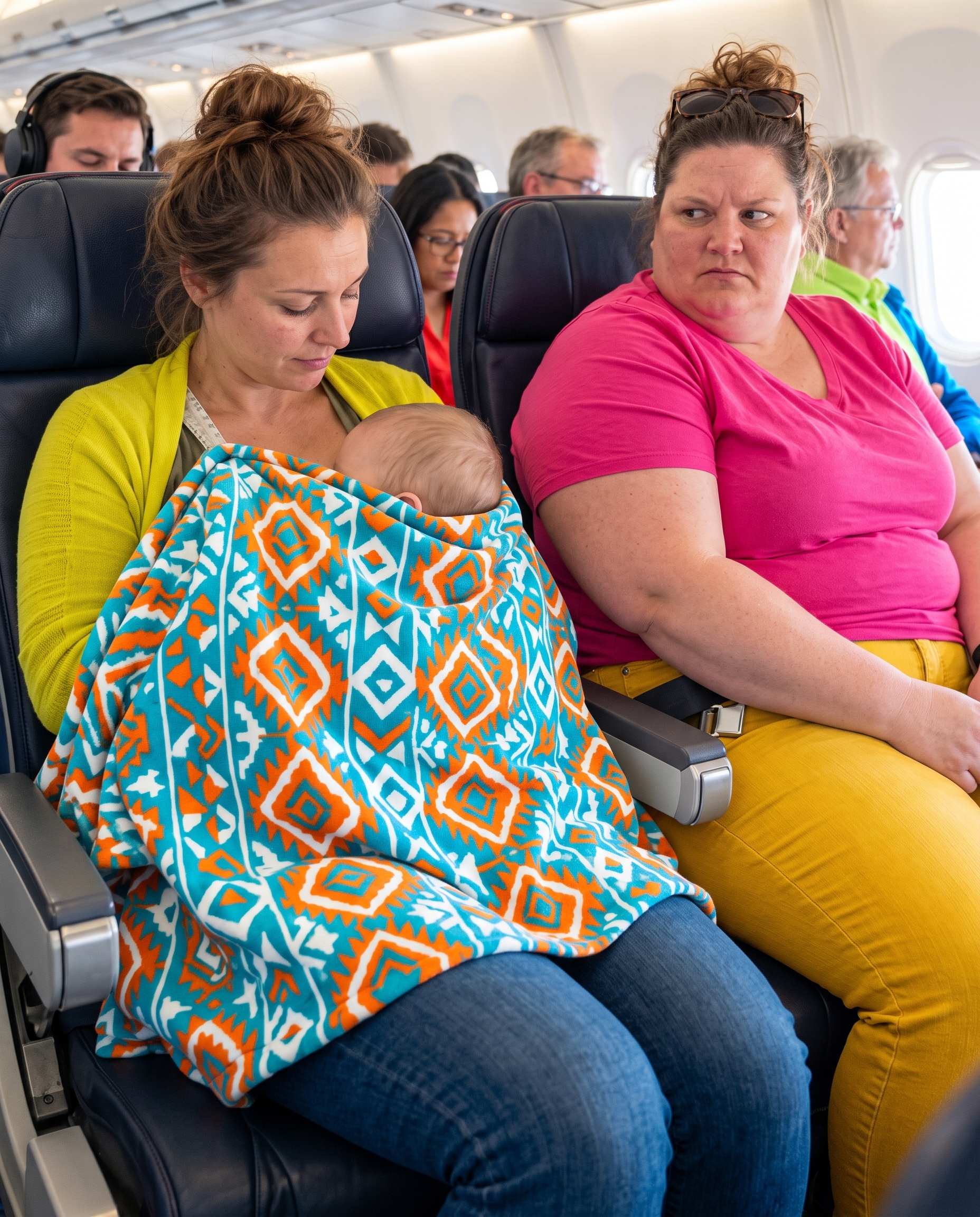
I had Noah in my arms when I took my seat beside a woman who introduced herself as Evelyn.
Even before the plane left the gate, Evelyn looked annoyed.
She glanced at Noah, then at me, and rolled her eyes.
“If your baby starts screaming, I’m not going to sit here and listen to it,” she said. “I’m warning you. You’ll have to do something about it.”
I didn’t want an argument.
I simply nodded and tried to settle into my seat.
Thankfully, Noah was sleeping peacefully.
For the first few hours, everything was quiet.
Then Noah woke up.
At first, he began fussing softly. I rocked him gently and offered him his pacifier.
It didn’t work.
He started crying.
I tried everything I could think of, but eventually I realized what was wrong.
He was hungry.
There was no mystery. No way to negotiate with a hungry five-month-old. He needed to eat.
So I pulled out my nursing cover, made sure I was completely covered, and began breastfeeding him.
That’s when Evelyn let out a long, dramatic sigh.
Then she turned toward me.
“Oh, my God!” she exclaimed. “I paid for this seat not only to listen to someone else’s baby scream, but now I have to watch you feed him too?”
Her voice was loud enough that several passengers nearby turned around.
“How shameless!”
I felt my stomach drop.
I gave her an apologetic smile.
“I’m sorry,” I said quietly. “I just need to feed him. He’s hungry.”
Evelyn rolled her eyes.
“People with babies like that should stay home.”
I stared at her, stunned.
“What kind of mother are you if you can’t even calm your own child down?”
My cheeks were burning.
I could feel people watching us, but I didn’t know where to look.
I had already spent the previous month trying to hold myself together after losing my husband. Now, sitting in an airplane full of strangers, I was being publicly humiliated for feeding my hungry baby.
I tried to remain calm.
“I understand you’re uncomfortable,” I said. “But this is a six-hour flight. He can’t go without food.”
Evelyn looked at me as if I had personally offended her.
Then she gasped.
“Then lock yourself in the bathroom and feed him there!”
Her voice became even louder.
“Why should I have to sit here and watch you do that? Have some shame!”
I opened my mouth to respond.
But before I could say a word, someone appeared beside me.
It was Louise.
My eight-year-old daughter had been watching from the row behind us.
She looked at me, then at Evelyn.
“Mom,” she said calmly, “why don’t you take my seat?”
I looked at her, confused.
Louise continued.
“I’ll sit next to this lady so she won’t feel uncomfortable.”
For a second, I didn’t know what to say.
Then I nodded.
We switched seats.
I moved one row back with Noah, while Louise sat beside Evelyn.
I assumed my daughter was simply trying to help.
I thought she was being kind.
I didn’t realize she had noticed something I hadn’t.
As I settled into Louise’s seat, I watched her open her tablet.
She tapped on something and turned the screen toward Evelyn.
Then something strange happened.
Evelyn suddenly screamed.
She jumped out of her seat and hurried away from it.
People throughout the cabin turned their heads.
I sat there, confused.
What had Louise shown her?
Why had this woman reacted like that?
Only later did I understand.
Before Louise had switched seats with me, she had noticed a small photograph lying near Evelyn’s shoe.
It was an ordinary-looking photograph.
But it showed a young woman holding a baby who appeared to be about Noah’s age.
Louise had picked it up.
Then she had noticed a family photograph on Evelyn’s tablet.
She placed the two images beside each other.
And then she asked Evelyn one simple question.
A question that would change everything.
“Would you want someone to treat your daughter the way you’re treating my mom?”
Evelyn’s face changed immediately.
The anger disappeared.
So did the confidence.
For the first time since the flight began, she was completely silent.
The young woman in the photograph was her daughter, Jenna.
And the baby in her arms was Evelyn’s grandson.
A grandson she had never met.
Evelyn was actually flying to see Jenna and the baby for the first time.
But there was something else Louise didn’t know at first.
Evelyn had spent the entire journey planning what she was going to say to her daughter.
She was going to criticize Jenna’s home.
Her schedule.
Her partner.
Her parenting.
She had already decided which things were wrong and how she was going to tell her daughter to fix them.
She had been preparing to walk back into Jenna’s life carrying the same criticism that had pushed her daughter away in the first place.
And then an eight-year-old girl had held up a photograph and forced her to look at herself.
Louise hadn’t shouted.
She hadn’t insulted Evelyn.
She hadn’t called her names.
She simply asked her to imagine someone treating Jenna the same way.
That question hit harder than any argument could have.
Evelyn finally admitted that her constant disapproval had damaged her relationship with her daughter.
She had convinced herself that she was only trying to help.
She believed she was offering advice because she knew better.
But somewhere along the way, helping had turned into controlling.
Concern had turned into criticism.
And being right had become more important than being welcomed into her daughter’s life.
This wasn’t really about a crying baby anymore.
It wasn’t about a seat.
It wasn’t even about breastfeeding.
It was about the way people sometimes hurt the people they love while convincing themselves they’re doing it for their own good.
Evelyn looked at me.
Then she looked at Louise.
And she admitted that she had been wrong.
I told her that if she truly wanted to repair things with Jenna, the best place to begin was with an apology.
Not an explanation.
Not an excuse.
An apology.
So Evelyn took out her phone and sent Jenna a message.
She didn’t blame anyone else.
She didn’t justify her behavior.
She simply apologized.
She told her daughter that she was sorry for constantly criticizing her and that she wanted to learn how to listen before correcting her.
For several minutes, there was no response.
Then Jenna replied.
She told her mother that she could still come.
But only if she meant every word.
At baggage claim, we saw Jenna waiting.
She was holding her baby in a green carrier.
Evelyn stopped several feet away.
For once, she didn’t rush forward.
She didn’t tell Jenna what to do.
She didn’t criticize the way she was holding the baby.
She simply asked:
“Can I hug you?”
Jenna looked at her mother for a long moment.
She was still guarded.
Still hurt.
But eventually, she nodded.
Evelyn stepped forward and hugged her.
Then the two women walked toward the baggage carousel together.
I didn’t know whether their relationship would ever return to what it had once been.
Maybe it wouldn’t.
Some wounds don’t disappear after one apology.
But something had changed.
Evelyn had finally understood that love isn’t always about knowing what’s best for someone else.
Sometimes it’s about knowing when to stop talking and start listening.
Weeks later, after we had settled in at my mother’s house, a card arrived for me.
Inside was a photograph.
It showed Evelyn holding her grandson.
Jenna was sitting beside her.
They weren’t smiling like nothing had ever happened.
It wasn’t a perfect family photograph.
It was something more meaningful than that.
It was a beginning.
Beneath the photograph, Evelyn had written a short message.
She said she was learning to ask before helping and to listen before criticizing.
Louise immediately took the card and pinned it to the kitchen notice board.
When I asked her why, she shrugged.
“Because speaking up can do more than stop something uncomfortable,” she said. “Sometimes it can help someone decide what happens next.”
That sentence stayed with me.
Mark had always taught Louise that courage wasn’t the absence of fear.
He believed courage meant deciding which fear deserved to be obeyed.
And on that airplane, our little girl had done exactly that.
She had seen her mother being humiliated.
She had seen her baby brother going hungry.
And she had seen a stranger treating another person in a way she would never want someone to treat her own family.
So she spoke up.
She didn’t scream.
She didn’t fight.
She asked one question.
And somehow, that one question did what anger never could.
It made Evelyn stop and see herself.
It made her realize that being right wasn’t worth losing her daughter.
It made her apologize.
And perhaps most importantly, it gave her a chance to become the mother—and grandmother—she still had time to be.
As for me, I will never forget that flight.
I boarded that plane carrying grief, exhaustion, and a baby who simply needed his mother.
I thought the hardest thing I would face that day would be getting through six hours in the air while mourning my husband.
Instead, I watched my eight-year-old daughter stand up for me in the quietest and most powerful way possible.
She protected her little brother.
She defended her mother.
And without even realizing it, she gave a hurting stranger the chance to change her life.
Sometimes the most powerful lessons don’t come from adults.
Sometimes they come from an eight-year-old girl who simply asks the question everyone else was too afraid to ask.