But our quiet exit was instantly halted when the cockpit door flew open and the airline captain stepped out, snapping into a rigid, trembling salute that silenced the entire cabin.
Part 1
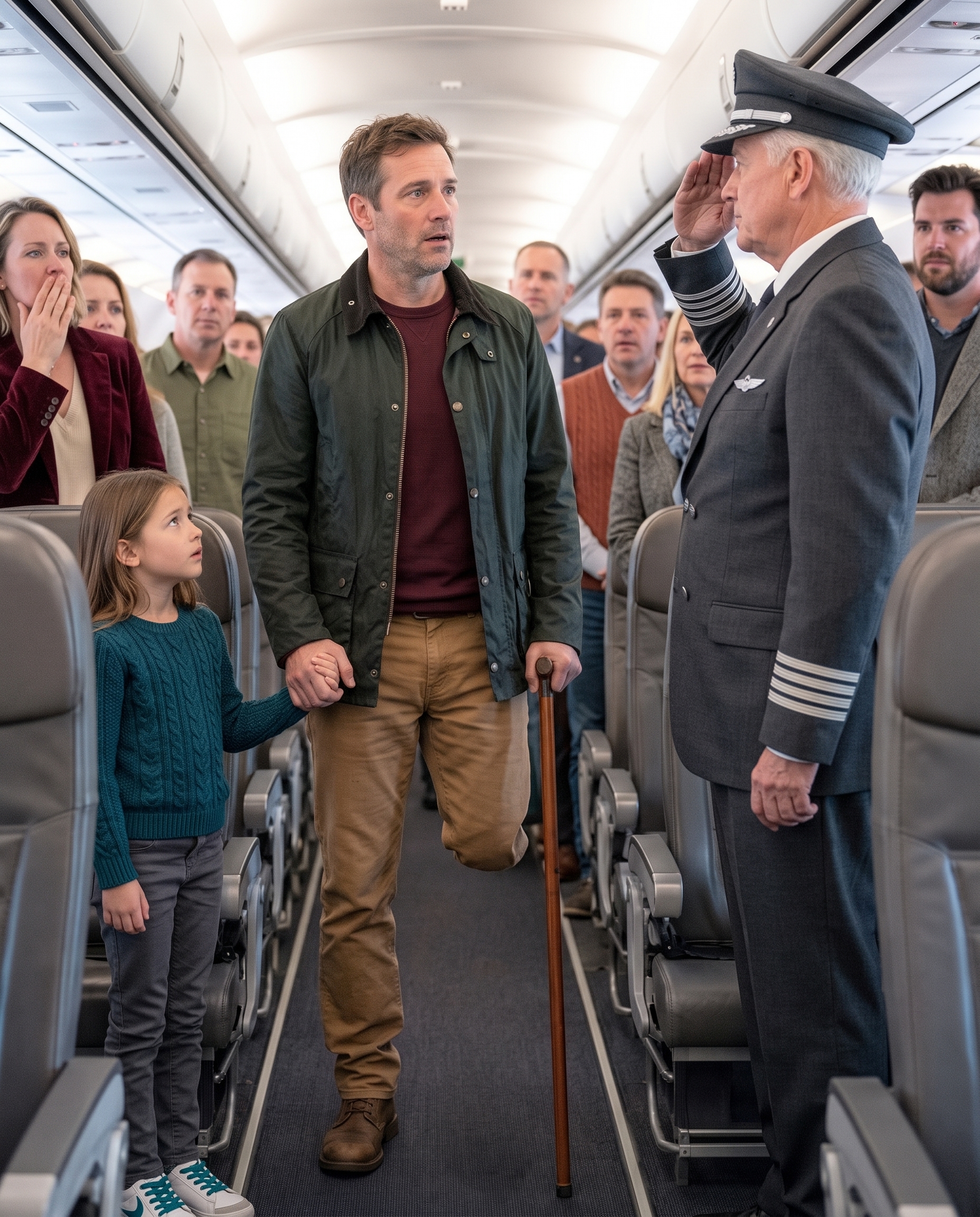
“Sir, we’re going to move you and your child to the back,” the gate agent announced, loudly enough for almost everyone in the cabin to hear.
What he didn’t know was that my veteran ID was tucked behind my boarding pass, my unit challenge coin was clipped to my carry-on, and the flight manifest already contained my last name beside the name of the one person aboard that aircraft who would understand exactly what I had sacrificed.
My daughter Maya looked up at me with the small, confused expression children get when adults suddenly make the world feel unfair.
“Daddy,” she whispered, “I thought these were supposed to be our special seats.”
That hurt more than losing the leg. More than needing the cane. More than having hundreds of passengers stare at us as though we were an inconvenience they wanted moved out of the way.
My name is Marcus Vance. I’m forty-one years old, a widower, a single father, and a veteran who returned from his final deployment without most of his left leg below the knee.
I don’t tell strangers about that at airport gates. I don’t carry my past around like a medal. Most days, I’m simply the exhausted father in a flannel shirt trying to keep up with a second-grader who still asks whether her mother can see her from heaven.
That morning, Maya and I were flying to the Carolina coast. It wasn’t a vacation. It wasn’t supposed to be a fun trip. We were heading to the beach where Elena and I had fallen in love, the same beach she had asked me to take Maya to before cancer took her from us two years earlier.
Inside the carry-on I held tightly against my chest was the small container I had packed before sunrise. Elena was going home to the ocean.
Those first-class tickets had taken me two years to save for. During that time, a coffee can sat on top of our refrigerator with “Mama’s Beach Fund” written across it in Maya’s uneven handwriting. Some Fridays, I put twenty dollars inside. Other Fridays, I could only spare two. Maya used to drop pennies from her pink purse into it as though she were personally responsible for making the trip happen.
A child should never have to save pennies just to say goodbye to her mother. But she did.
And when we finally boarded the plane, when she saw those wide leather seats and whispered, “Daddy, are these really ours?” something inside me loosened for the first time in months. For ten precious minutes, I felt as though I had kept my promise to her.
Then the gate agent stepped onto the aircraft with a tablet in his hand, followed closely by a man in a navy suit. The man had arrived late. He was an important corporate passenger traveling on a company account, and apparently he required a first-class seat.
That was the word they used. Required. Not wanted. Not requested. Required.
The agent glanced at my cane, my worn boots, Maya’s hand-me-down coat, and apparently decided we would be the easiest passengers to move. People rarely become invisible in one sudden moment. Usually, it happens after they have been useful too many times, stayed quiet too many times, and said thank you too many times.
I reached for our tickets. “These seats belong to us,” I said. “I paid for them.”
He gave me the kind of polished professional smile that contained no warmth at all. “I understand, sir. Please don’t make this more difficult than necessary.”
Maya’s fingers tightened around mine.
I could have argued. I could have raised my voice. I could have told him about the coffee can, the ashes, the hospital room, and the way my wife had looked at me when she asked me to take our daughter to the ocean someday.
But my little girl was watching.
So I smiled at her. “You know what, sweetheart?” I said. “Maybe the best seats are in the back. We’ll get to see the whole plane from there.”
She nodded, but tears were already gathering in her eyes. That was what nearly broke me. It wasn’t the seat. I had slept in places far worse than the last row of an airplane. It was watching my daughter realize, right in front of me, that some people could look at her father and decide he wasn’t important enough to matter.
So I carefully stood. The left side of my body burned. The aisle suddenly seemed impossibly narrow. I lifted the carry-on as though it contained something sacred, because it did, and reached for Maya’s hand.
The entire cabin grew quiet in that terrible way people become silent when they know something is wrong but don’t want to get involved. We started walking.
Then the cockpit door opened.
The captain stepped out. He had gray at his temples, a perfectly pressed uniform, and a calm expression. He didn’t look at the gate agent first. He looked directly at me.
Then his eyes moved to the challenge coin clipped to my bag. To my cane. To the veteran ID still partly visible beside my boarding pass.
Something changed in his expression. Recognition. Not because he knew my face, but because he recognized my story.
He stepped completely into the aisle, came to attention, and slowly raised his hand in a crisp salute.
The entire plane fell silent. My bag nearly slipped from my hand.
For two years, I had been the widower who limped through school pickup. The quiet father people noticed at the grocery store. The man strangers stepped around whenever I moved too slowly.
And now the captain of the aircraft was standing before everyone and saluting me. I straightened as much as my body allowed, then returned the salute.
Maya stared up at me as though she were seeing a part of her father she had never been allowed to see before.
The captain lowered his hand and walked toward us. “Sir,” he said loudly enough for everyone in first class to hear, “it is an honor to have you aboard my aircraft.”