Part 1
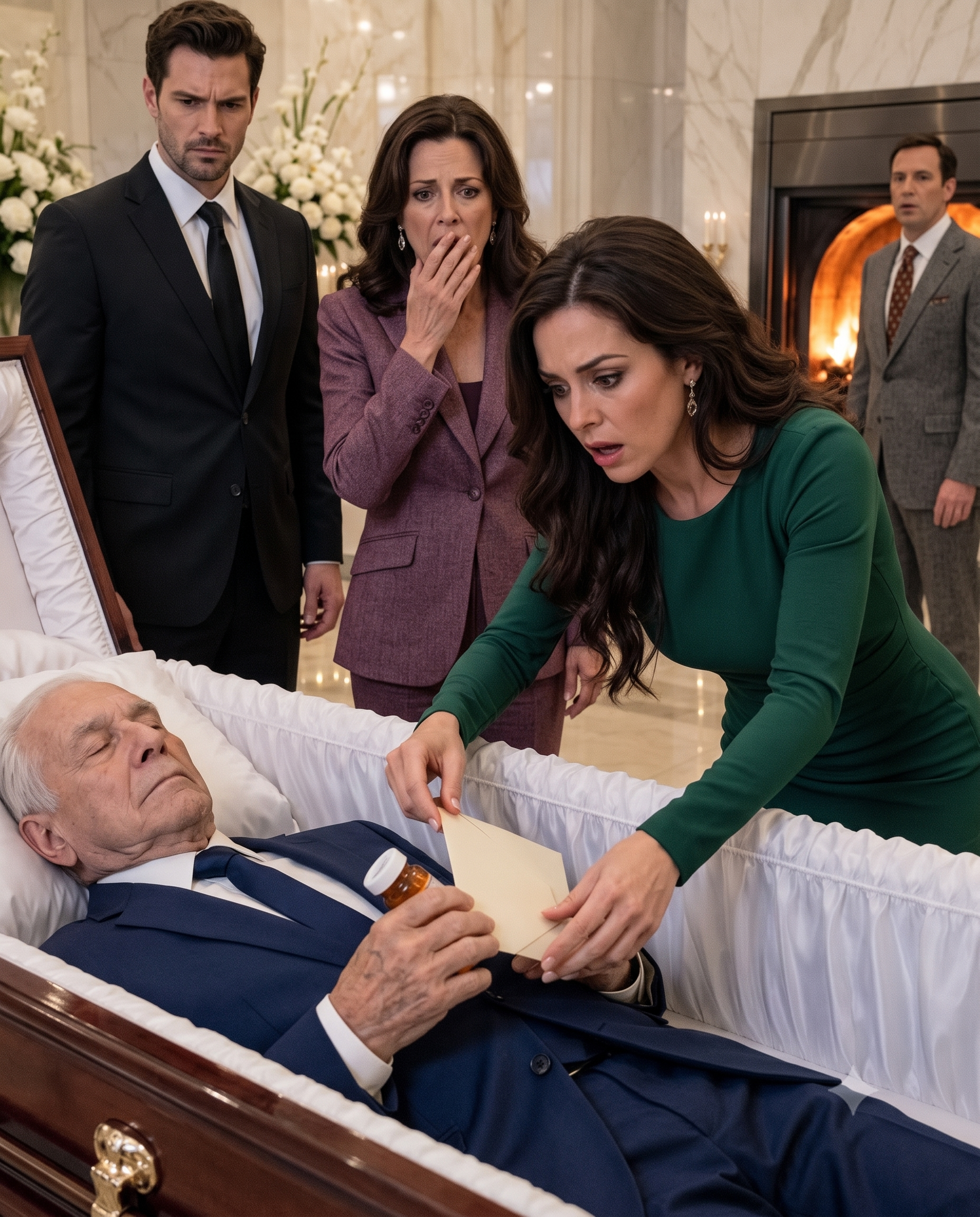
“I want your father cremated before noon. Don’t ask questions, Valeria.”
That was the very first thing my husband said to me the morning after my father died.
My name is Valeria Vargas. I’m thirty-four years old, and until that terrible dawn, I truly believed I knew the man I had been married to for six years. Julian Vance had entered my life when I was still living under the protective wing of my father, Richard Vargas—founder of Vargas Group, a massive commercial enterprise whose name was stamped across office towers, municipal contracts, and financial news headlines.
My father was a stern man who spoke in brief, dry sentences, but he never let me go unsupported. After my mother passed away, he raised me between our estate in Greenwich, Connecticut, and his executive headquarters in Manhattan. I went to university to study fine arts. He would have preferred I learned balance sheets and corporate strategy, but he never forced my hand.
Julian, on the other hand, seemed to understand me completely. He was attentive, humble, and knew precisely how to charm anyone in a room. Even my mother-in-law, Eleanor, moved into our home “to help us settle in.” Over time, Eleanor began repeating that a dutiful wife should entrust all major financial decisions to her husband.
My father never openly argued with her. He only warned me in private: “Having a good heart doesn’t mean hand-delivering the keys to your life.”
I thought he was just being an overly protective patriarch.
The night before he died, we had dinner together at the estate. My father barely touched the pot roast that Sarah, our longtime housekeeper, had prepared. He stared intently at Julian for several long seconds before uttering a strange remark: “Choosing business partners is far more dangerous than choosing family.”
At three o’clock in the morning, Julian shook me awake.
“Your father had a massive heart attack,” he whispered, his hands trembling.
We rushed to the hospital. By the time we arrived, Richard Vargas was already dead.
The emergency room physician stated he was brought in without a pulse. Julian insisted he had found my father struggling for air in his study and that, rather than waking me and causing panic, he decided to drive him to the hospital himself.
Something felt deeply off: my father had a severe, dark purple bruise on his right wrist, and Julian couldn’t clearly explain why it had taken him nearly an hour to make a twenty-minute drive to the ER.
I was too shattered by grief to ask the hard questions.
When we returned home, I was greeted by a mahogany casket, white floral arrangements, flickering candles, and a crew of quiet funeral attendants. Everything was arranged. Too well arranged.
“The cremation is scheduled for eleven o’clock,” Eleanor said, smoothing down her black dress. “If we miss our slot, it will be a logistical nightmare.”
I moved toward the casket. “I want to open it.”
Julian immediately stepped in front of me, blocking the latch. “Valeria, please. You don’t want to remember him like this.”
He handed me a glass of warm water with sugar, insisting I drink it to calm my nerves. Within minutes, my legs felt uncomfortably heavy, and my vision blurred at the edges.
Before I drifted into an unnatural sleep, I caught the faint sound of Eleanor whispering in the hallway: “It’s taking effect already.”
And Julian responding: “Then tell the transport crew to hurry before anyone shows up to inspect the body.”
I woke up abruptly just after seven in the morning. The black hearse was already pulling out of the long driveway.
I ran out the door barefoot, flagged down a taxi, and demanded they take me straight to the municipal crematorium in Westchester.
When I arrived, I was met by Thomas Ramos, a veteran mortuary director who had known my father for decades. He looked at me with deep sympathy and asked if I wanted a private moment to say goodbye.
Julian, who was already standing inside the prep room, turned ghostly white.
“There’s no need to disturb the body!” Julian insisted, stepping forward. “Let the man rest in peace.”
Thomas ignored the outburst. He unlatched the heavy lid, adjusted the collar of my father’s dress shirt, and noticed that Richard’s right hand was tightly clenched into a hard, rigid fist.
“Let me straighten his fingers,” Thomas murmured, reaching down.
“Don’t touch him!” Julian shouted.
Everyone in the room went dead silent.
Thomas slowly, deliberately pried open the stiffened fingers.
Out fell a tiny, unlabeled glass pill vial and a tightly crumpled scrap of paper.
The mortician picked up the note and read it silently. The color instantly drained from his face.
“Halt the cremation!” Thomas barked at his staff. “Call the police immediately!”
I snatched the paper from his hand.
I recognized my father’s trembling, hurried handwriting instantly.
The note simply read: “Julian swapped my medication. Do not cremate me.”
I slowly lifted my eyes to look at my husband.
And I had no idea that this terrifying note was only the beginning of a nightmare that would tear my entire world apart.
Part 2
Julian dropped to his knees right beside the casket.
“Valeria, listen to me!” he stammered, his voice cracking with panic. “Your father was confused! He had dementia! I was only giving him his daily vitamins!”
Eleanor began wailing at the top of her lungs, screaming that the funeral staff was ruining her innocent son’s reputation over “the rambling scribbles of a dying old man.” But the police arrived within minutes, secured the glass vial in an evidence bag, and placed a mandatory hold on the body for a full forensic autopsy.
Two days later, the preliminary toxicology report came back.
The lab discovered high concentrations of an unprescribed chemical agent in his system—a compound that, when combined with my father’s daily heart prescription, was guaranteed to trigger a fatal, untraceable arrhythmia.
Then another lie unraveled.
The estate’s driveway security cameras showed Julian pulling out of the garage with my father in the passenger seat at 2:14 AM. The hospital admissions desk didn’t log their arrival until 3:03 AM. Satellite GPS data from Julian’s vehicle revealed that for thirty minutes, the car had sat idling in the dark parking lot of an unaccredited private medical clinic on the outskirts of town.
Faced with the GPS data, the clinic’s head doctor, Dr. Pablo Cuellar, broke down during police interrogation. He confessed that weeks earlier, Julian had paid him thousands in cash to explain which specific drug interactions could successfully mimic a natural cardiac arrest.
My marriage was disintegrating piece by piece right before my eyes.
Following the formal memorial service, my father’s long-time corporate attorney, Mateo Herrera, convened an emergency meeting of the family and board members.
Richard Vargas had left me an estate comprising controlling shares, real estate holdings, and liquid assets valued at nearly $250 million. However, his will contained a strict, unusual stipulation: for six months, I was required to step into the role of Executive Chair at VTech Solutions—a struggling tech subsidiary that was losing millions—and either turn the company around or prove definitively that an insider was actively sabotaging its operations.
If I failed to fulfill the contract terms, the entire $250 million estate would automatically transfer to a charitable foundation.
That very evening, Julian’s demeanor shifted from desperate groveling to cold condescension.
“You don’t know the first thing about running a corporation, Valeria,” he said softly, sliding a legal folder across the dining table. “Sign this general power of attorney. I’ll take control of VTech and handle the board for you.”
The document granted him total authorization to liquidate assets, transfer corporate shares, and reassign property deeds.
Mateo examined the digital metadata of the document. It had been created five days prior to my father’s death.
I picked up the pages and ripped them down the middle right in front of Julian’s face.
“I would rather lose every single dollar than hand you a fraction of what my father spent his life building.”
From that moment on, the retaliatory attacks began. Unscrupulous tabloid outlets began running smear pieces calling me an “unstable, grieving heiress.” They published edited video clips of me fainting at the funeral. Eleanor began calling distant relatives and board members, claiming I was suffering a psychotic breakdown.
However, a private toxicology test I underwent revealed trace amounts of heavy sedatives in my own bloodstream.