 PART 2
Every eye in the ballroom turned toward my father.
Reverend Charles Whitmore stood beneath the crystal chandeliers with one hand gripping the podium and the other pressed against his chest. For decades, that stage had belonged to him. He had preached from it, raised millions from it, and built a reputation powerful enough to make politicians seek his blessing before elections.
Now the screen behind him displayed his signature on documents connected to offshore accounts opened in my name.
Blake Harrington’s smile widened.
“The person who signed those documents wasn’t me,” he repeated.
My mother slowly backed away from my father.
“Charles,” she whispered, “what is he talking about?”
My father did not look at her.
He looked at me.
For the first time that evening, there was no anger in his eyes. No disappointment. No carefully practiced authority.
Only fear.
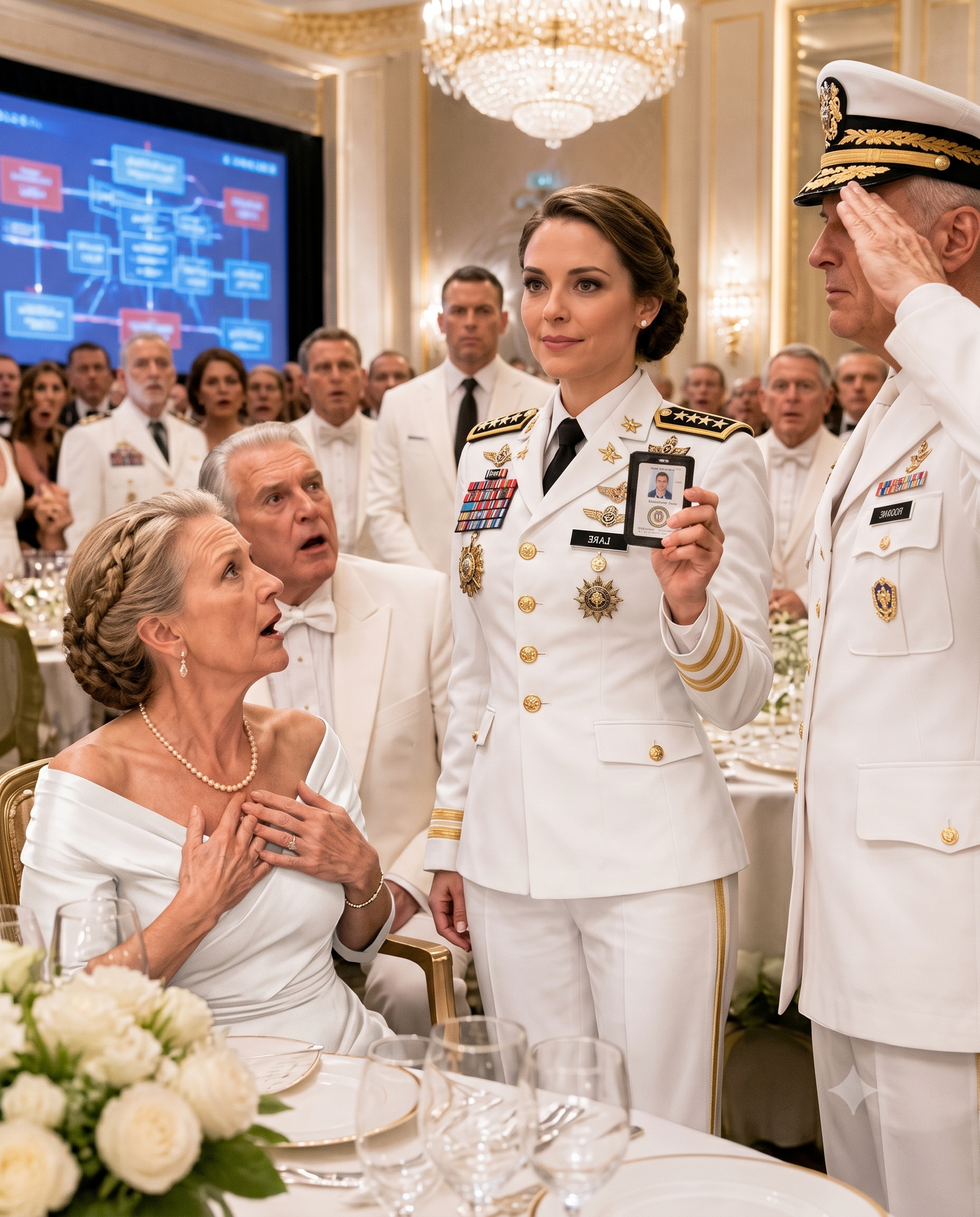
General Nora Pierce stepped closer to the podium.
“Colonel Lane,” she said quietly, “do you recognize the signature?”
I studied the enlarged document.
At first glance, it looked like mine.
The slant of the A.
The sharp line through the L.
Even the small hook at the end of my last name.
But whoever had copied it had made one mistake.
I had signed my name differently since joining the Army.
The signature on the offshore account was the version I had used when I was eighteen.
Before my first deployment.
Before I became Colonel Ava Lane.
Before I legally shortened my middle name on military records.
“This was copied from an old document,” I said.
My father’s eyes flickered.
That tiny reaction was enough.
I turned toward the federal agents. “Search the foundation’s personnel files from the year I graduated high school. My father had my original college applications, tax forms, and enlistment paperwork.”
A low murmur moved through the crowd.
My father finally found his voice.
“This is absurd.”
He released the podium and stepped toward me, attempting to recover the calm, fatherly expression that had fooled thousands of people.
“Ava has always been imaginative,” he told the guests. “She has spent years resenting her family. I am afraid this is what happens when bitterness is allowed to grow.”
A few people shifted uncomfortably.
That was his favorite weapon.
Not anger.
Concern.
He never called anyone a liar directly. He made them sound unstable, wounded, and confused until everyone else did it for him.
When I was sixteen, I had told him that one of the church elders made inappropriate comments to teenage girls. My father did not investigate.
He prayed for my “spirit of accusation.”
When I was nineteen, I told my mother that the foundation was using my Social Security number on paperwork I had never seen. She said my father handled the family’s finances and that questioning him was disrespectful.
When I came home from my first deployment with a commendation, my father introduced me at church as “our daughter who helps with computers.”
He had spent my entire life reducing me until I was small enough to control.
But I was no longer nineteen.
And this time, he was standing in a room filled with cameras.
I lifted the microphone.
“My resentment did not create those accounts,” I said. “My bitterness did not transfer eleven million dollars through companies controlled by Blake. And my imagination did not forge my signature.”
My father’s smile tightened.
Blake laughed suddenly.
It was too loud and too sharp.
“Eleven million?” he said. “You think this is about eleven million?”
Marissa stared at him.
“What does that mean?”
Blake looked at her as if he had forgotten she was there.
For one second, something ugly passed across his face.
Then he shrugged.
“It means your sister has incomplete information.”
The assistant U.S. attorney, Daniel Cross, stepped forward.
“Mr. Harrington, you have the right to remain silent.”
Blake spread his arms.
“Am I under arrest?”
“Not yet.”
“Then I’m leaving.”
He took two steps toward the ballroom doors.
The federal agents blocked him.
The room erupted in whispers.
My mother grabbed my wrist.
“Ava,” she said through clenched teeth, “stop this.”
I looked down at her hand.
She released me immediately.
“Stop what?” I asked.
“This humiliation.”
The answer hurt more than I expected.
Not because she defended my father.
Because after everything displayed on that screen, she still believed the greatest crime was embarrassment.
“Your name is on those foundation documents too,” I said.
Her face changed.
“What?”
I pressed the remote.
A new set of records appeared.
Celeste Whitmore.
Board secretary.
Authorized signatory.
Recipient of consulting payments totaling four hundred and eighty thousand dollars.
My mother stared at the screen.
“That isn’t possible.”
“You signed the annual reports.”
“Your father told me they were routine.”
“You received the payments.”
“He handled our accounts.”
“You attended the board meetings.”
“I attended charity dinners!”
Her voice cracked so loudly that the ballroom fell silent again.
My mother’s composure vanished.
She looked around at the donors and socialites she had spent years impressing. Her pearls trembled against her throat.
“I did not know,” she whispered.
My father turned to her.
“Celeste, say nothing.”
She stared at him.
It was the first time I had ever seen my mother disobey him without first asking permission.
“How much?” she asked.
My father’s jaw tightened.
“How much money did you put through my name?”
“This is not the place.”
“You chose this place.”
The words were barely louder than a breath, but they struck him harder than a shout.
Marissa stepped between them.
“Someone needs to explain what is happening.”
Her face was pale, and her hands shook against the fabric of her designer dress.
For years, Marissa had been the perfect daughter.
She married the right man.
Hosted the right fundraisers.
Smiled in the right photographs.
My parents praised her marriage as proof that obedience brought blessings.
Now she looked at Blake as if she were seeing a stranger.
“Did you use Ava’s identity?” she asked.
Blake rolled his eyes.
“Don’t start.”
“Answer me.”
“This is business.”
“You told me the companies were investments.”
“They were investments.”
“In my father’s foundation?”
Blake’s expression hardened.
“You liked the house, didn’t you?”
Marissa flinched.
“You liked the vacations. You liked the private school applications. You liked showing everyone that you married better than your sister.”
The insult landed exactly where he intended.
Marissa’s face crumpled.
My father stepped forward.
“That is enough.”
Blake turned on him.
“You don’t get to silence me now.”
The entire room seemed to hold its breath.
My father and Blake stared at each other with the cold recognition of men who had shared secrets too long.
I felt General Pierce move beside me.
She spoke without looking away from them.
“They’re about to turn on each other.”
“I know.”
Blake pointed toward the screen.
“You want to know why Ava’s name is on those accounts?” he asked the room. “Ask Reverend Whitmore what happened twenty-three years ago.”
My father lunged for the microphone.
Daniel Cross intercepted him.
Blake’s smile returned.
“There it is,” he said. “The famous pastor finally showing his temper.”
My father lowered his voice.
“You made an agreement.”
“And you broke it when you let her walk in here with federal agents.”
“I did not know she was involved.”
“That was your mistake.”
I stepped off the stage.
“What happened twenty-three years ago?”
Neither man answered.
Twenty-three years.
I counted backward.
I had been eleven.
A memory surfaced.
Rain striking the windows of our old house.
My mother crying in the kitchen.
My father burning papers in a metal trash can behind the garage.
A woman from the church disappearing without explanation.
Her name had been Ruth Bellamy.
She worked as the foundation’s bookkeeper.
One week, she was there.
The next, my father told everyone she had stolen money and fled the state.
No charges were ever filed.
No one saw her again.
I looked at my father.
“Ruth Bellamy.”
His face drained of color.
My mother covered her mouth.
Marissa whispered, “Who is that?”
“A woman who used to keep the foundation’s books,” I said. “Dad accused her of stealing.”
Blake laughed under his breath.
“He accused her because she found the first account.”
My chest tightened.
“What first account?”
Blake nodded toward my father.
“Ask him.”
My father stood perfectly still.
The polished pastor was gone now.
In his place was an aging man trapped by a past he had believed was buried.
“Ruth was confused,” he said.
“Ruth had copies,” Blake replied.
“You never met her.”
“No, but my father did.”
That silenced everyone.
Blake’s father, Gregory Harrington, had been one of the foundation’s earliest donors. He died twelve years ago and left Blake control of several real estate companies.
According to the investigation, those companies had later become part of the laundering network.
Blake took a slow step toward me.
“My father kept a private ledger,” he said. “Names, dates, transfers, favors. He believed evidence was more valuable than money.”
“Where is it?” Daniel Cross asked.
Blake ignored him.
“When my father died, Reverend Whitmore came to our house before the body was even taken away. He searched the office for three hours.”
My father shook his head.
“Lies.”
“You found the safe,” Blake continued, “but the ledger wasn’t inside.”
“Because it never existed.”
Blake’s smile became almost cheerful.
“That’s what I let you believe.”
A flash of rage crossed my father’s face.
The federal agents noticed.
So did every phone recording the scene.
I looked toward Daniel Cross.
“Was this ledger mentioned in the investigation?”
“No.”
“Then why reveal it now?”
Blake turned to me.
“Because you ruined my life tonight.”
“You built your life on stolen money.”
“So did your family.”
My mother began to cry.
Not gracefully.
Not quietly.
Her shoulders shook as years of denial collapsed around her.
My father leaned toward her.
“Pull yourself together.”
She slapped him.
The sound cracked through the ballroom.
Nobody moved.
My mother stared at her own hand in horror.
Then she looked at my father.
“You used my name,” she said.
He touched his cheek.
“I protected this family.”
“You protected yourself.”
“Everything I did was for you and the girls.”
“No,” I said. “Everything you did was so people would worship you.”
His gaze snapped toward me.
“You know nothing about sacrifice.”
“I know I spent sixteen years serving a country while you told people I fixed computers.”
“I gave you every opportunity.”
“You gave Marissa opportunities. You gave me warnings.”
“Because you were reckless.”
“I enlisted.”
“You abandoned this family.”
The words hit a place inside me that had never fully healed.
For years, I had wondered whether leaving home had made me selfish.
Whether my father was right.
Whether choosing a life outside his control had been betrayal.
General Pierce stepped forward.
“Colonel Lane did not abandon anyone,” she said. “She served in combat zones, protected classified systems, and prevented attacks that could have endangered thousands of American service members.”
My father looked at the stars on her uniform.
For once, his title meant nothing.
General Pierce’s voice remained calm.
“You should be careful when speaking about sacrifice.”
Applause began near the back of the room.
One person.
Then another.
Soon the ballroom filled with it.
Not loud.
Not celebratory.
But steady.
My father’s expression collapsed.
He had spent a lifetime chasing admiration.
Now the same people who once stood when he entered the room were applauding the daughter he had dismissed.
I should have felt victorious.
Instead, I felt tired.
Because justice did not erase childhood.
It did not return birthdays he had forgotten, letters he had never answered, or the nights I sat alone in military housing wondering why my family could celebrate strangers but not me.
Daniel Cross raised his hand, and the applause faded.
“Mr. Harrington,” he said, “where is the ledger?”
Blake glanced around the room.
“I want a deal.”
“You are not in a position to negotiate.”
“I am the only person who knows where it is.”
My father suddenly laughed.
It was a soft, broken sound.
“You always were arrogant.”
Blake turned toward him.
“And you always underestimated me.”
“No,” my father said. “I understood you perfectly.”
Something about his tone made me uneasy.
Blake heard it too.
His confidence faltered.
My father looked toward the screen.
“You thought I did not know about Gregory’s ledger,” he said. “You thought you were threatening me all these years with information I had never seen.”
Blake said nothing.
“But your father was not as clever as you believed.”
My father reached into the inside pocket of his jacket.
Both agents moved immediately.
“Hands where we can see them,” one ordered.
My father slowly withdrew a small brass key.
Blake stared at it.
“No.”
My father held it between two fingers.
“Your father gave me the ledger before he died.”
“That’s impossible.”
“He discovered you were stealing from your own companies. He knew you had gambling debts. He knew you would use his records as leverage.”
Blake’s face twisted.
“My father hated you.”
“Your father feared you.”
“That key doesn’t prove anything.”
“It opens a deposit box in Savannah.”
Blake lunged.
The agents grabbed him before he reached my father.
Marissa screamed.
Blake fought violently, knocking over a chair and sending a champagne glass shattering across the floor.
“You lying old fraud!” he shouted. “You said it was gone!”
My father watched him struggle.
Then he looked at me.
“Now you understand,” he said. “I kept that ledger to protect this family.”
“No,” I replied. “You kept it to control Blake.”
His silence confirmed it.
Daniel Cross took the key.
“Which bank?”
My father hesitated.
“Answer him,” my mother said.
He ignored her.
Daniel stepped closer.
“Reverend Whitmore, withholding evidence in a federal investigation will not improve your position.”
My father lifted his chin.
“I want immunity.”
A bitter laugh escaped me.
“You accuse Blake of arrogance, but you still think you can negotiate.”
“I know what is in that ledger.”
“So do you,” Daniel said. “That makes you part of the conspiracy.”
My father’s eyes moved across the ballroom, searching for sympathy.
He found none.
The board members looked away.
The donors whispered among themselves.
A local reporter was already speaking into her phone.
His empire was collapsing in real time.
Then the ballroom doors opened again.
An elderly woman entered with a cane.
She wore a dark blue coat despite the warm evening, and silver hair framed a face lined by age and hardship.
My father stopped breathing.
My mother whispered one name.
“Ruth.”
The woman walked slowly toward us.
Ruth Bellamy.
Alive.
Every memory I had of her returned at once.
Her warm hands.
Peppermint candies hidden in her desk.
The way she once told me I was brave when my father called me difficult.
She stopped a few feet from the stage.
“You should have listened to your daughter,” she told him.
My father stumbled backward.
“You left.”
“You made sure I had no choice.”
Daniel Cross looked toward the agents.
Ruth raised one hand.
“I came voluntarily.”
She opened her handbag and removed a thick envelope.
“These are copies of the original foundation records,” she said. “Before Charles Whitmore accused me of theft, I mailed them to my sister. She kept them for twenty-three years.”
My father shook his head.
“You stole from us.”
“No. I found that you were moving donation money through accounts belonging to church employees and relatives.”
Her eyes shifted toward me.
“Including a child.”
The room seemed to tilt beneath my feet.
“How old was I?” I asked.
“Eleven.”
My mother gasped.
Ruth’s voice softened.
“Your father opened the first account using your identity when you were eleven years old.”
I looked at him.
He did not deny it.
The betrayal was so large that, for a moment, I could not feel it.
Eleven.
While I attended school, played piano at church, and believed my father was helping poor families, he had been using my name to hide money.
“Why me?” I asked.
My father’s answer came quietly.
“Because your credit record was clean.”
Marissa began sobbing.
My mother looked as though she might collapse.
I stared at the man who had taught me that disobedience was sin.
He had stolen my identity before I was old enough to understand what identity meant.
Ruth handed the envelope to Daniel Cross.
“There is more,” she said.
My father closed his eyes.
Ruth looked at my mother.
“Celeste, I tried to tell you.”
My mother’s lips trembled.
“You came to the house.”
“Yes.”
“That night in the rain.”
“Yes.”
My mother sat down heavily in a chair.
“I remember.”
I did too.
The rain.
The shouting.
The fire behind the garage.
“You gave my mother documents,” I said.
Ruth nodded.
My mother stared at the floor.
“Charles told me they were forged.”
“You believed him?” I asked.
She began to cry harder.
“I wanted to.”
That answer hurt because it was honest.
She had not been completely blind.
She had chosen darkness because the truth would have cost her comfort, status, and marriage.
My father pointed at Ruth.
“You are not innocent. You took money.”
Ruth’s expression hardened.
“I took enough to escape after you threatened my son.”
A murmur moved through the room.
My father looked toward the cameras.
“She is admitting theft.”
“She is admitting survival,” I said.
Ruth continued.
“You told me that if I went to the police, my son would be charged for a crime he did not commit.”
“Your son had problems.”
“My son was seventeen.”
The federal agents exchanged a glance.
Ruth’s fingers tightened around her cane.
“You had a police officer place stolen property in his car.”
My father’s face went still.
Daniel Cross spoke carefully.
“Do you know the officer’s name?”
“Yes.”
“Is he still alive?”
Ruth looked at my father.
“He is sitting on the Whitmore Foundation’s board.”
Dozens of heads turned toward a table near the front.
Retired Police Chief Leonard Hayes rose abruptly.
His chair fell backward.
An agent moved toward him.
Hayes lifted his hands.
“This is madness.”
Ruth pointed her cane at him.
“You destroyed my son’s life.”
“I did no such thing.”
“Then why are you running?”
Hayes glanced toward the nearest exit.
That was enough.
The agents surrounded him.
The ballroom transformed into chaos.
Reporters rushed forward.
Donors demanded answers.
Foundation board members argued among themselves.
Marissa stood frozen while Blake was placed in handcuffs.
My mother remained seated, staring at nothing.
And my father—the man who could command a congregation of thousands—stood alone at the center of the stage.
Daniel Cross approached him.
“Charles Whitmore, you are being detained pending further investigation into wire fraud, identity theft, obstruction of justice, conspiracy, and witness intimidation.”
My father did not resist when the agent took his arm.
Instead, he looked at me.
“Ava.”
I said nothing.
“You cannot let them do this.”
The plea was so familiar.
Not an apology.
Not regret.
A command disguised as helplessness.
“You are my daughter.”
I met his eyes.
“That mattered only when you needed something from me.”
He flinched.
For the first time in my life, I walked away before he dismissed me.
Outside the ballroom, the hallway was quiet.
I pressed one hand against the wall and tried to breathe.
The victory I had imagined did not feel like victory.
It felt like standing in the ruins of a house and discovering the fire had started before I was born.
General Pierce joined me.
“You did well,” she said.
“I exposed my entire family in front of half of Atlanta.”
“You exposed crimes.”
“My mother may be charged.”
“She may.”
“My sister’s husband is going to prison.”
“Most likely.”
“My father used my identity when I was a child.”
General Pierce studied me.
“You can be proud of what you did and still grieve what it cost.”
I nodded, but tears filled my eyes.
She placed a steady hand on my shoulder.
Then Daniel Cross came through the doors carrying Ruth’s envelope.
“There’s something you need to see.”
We moved into a private conference room.
Ruth joined us, followed by one federal agent.
Daniel spread the old documents across a table.
Bank records.
Property transfers.
Foundation ledgers.
Photographs.
One photograph showed my father, Gregory Harrington, Leonard Hayes, and three other men standing outside a warehouse.
On the back, someone had written a date.
October 14, twenty-three years earlier.
“What was stored there?” I asked.
Ruth looked uneasy.
“Officially, donated medical supplies.”
“And unofficially?”
“Anything that could be sold.”
My stomach tightened.
“Stolen goods?”
“Some.”
“What else?”
She looked toward Daniel.
He answered.
“Government equipment.”
The air left my lungs.
“What kind?”
“Early military communications technology.”
I stared at him.
“That would have been highly restricted.”
“Yes.”
“Who supplied it?”
Daniel slid another photograph toward me.
It showed a younger version of my father shaking hands with a man in military uniform.
The image was grainy, but the insignia on the shoulder was visible.
I recognized it immediately.
My pulse slowed.
“No,” I whispered.
General Pierce leaned over the table.
Her face changed.
The man in the photograph was my former commanding officer.
General Matthew Lane.
My husband’s father.
The man whose surname I had taken after marriage.
The man officially reported dead twelve years ago.
Ruth watched me carefully.
“I was told you knew him.”
“Knew him?” I said. “He was family.”
Daniel turned the photograph over.
A message was written on the back.
CHARLES—THE GIRL MUST NEVER LEARN WHO AUTHORIZED THE ACCOUNTS.
Beneath the sentence was a signature.
Matthew Lane.
My hands went cold.
“What girl?” General Pierce asked.
No one answered.
But every person in that room looked at me.
I stared at Ruth.
“You said my father opened the first account when I was eleven.”
“Yes.”
“Did Matthew Lane know?”
Ruth hesitated.
“I believe he ordered it.”
The room blurred around me.
My father had used my identity.
Blake had moved millions.
My mother had looked away.
But the trail did not end with them.
It led into the military.
Into the family I had married.
Into the career I had built.
Daniel gathered the documents quickly.
“This information cannot leave this room.”
I looked at General Pierce.
She was no longer comforting me.
She was staring at the photograph with the alert, unreadable expression of an officer confronting a threat.
“Colonel,” she said, “do not contact your husband.”
My heart stopped.
“Why?”
Before she could answer, my phone vibrated.
One incoming message.
No number.
No identification.
Just a photograph.
My husband, Ethan Lane, sitting inside our home.
Behind him stood a man whose funeral I had attended twelve years earlier.
General Matthew Lane.
Alive.
A second message appeared.
YOUR FATHER WAS ONLY THE BEGINNING.
Then a final line arrived.
COME HOME ALONE, AVA—OR YOUR HUSBAND LEARNS WHY YOU WERE REALLY CHOSEN.
…If you want to know what happened next, please type “YES” and like for more.