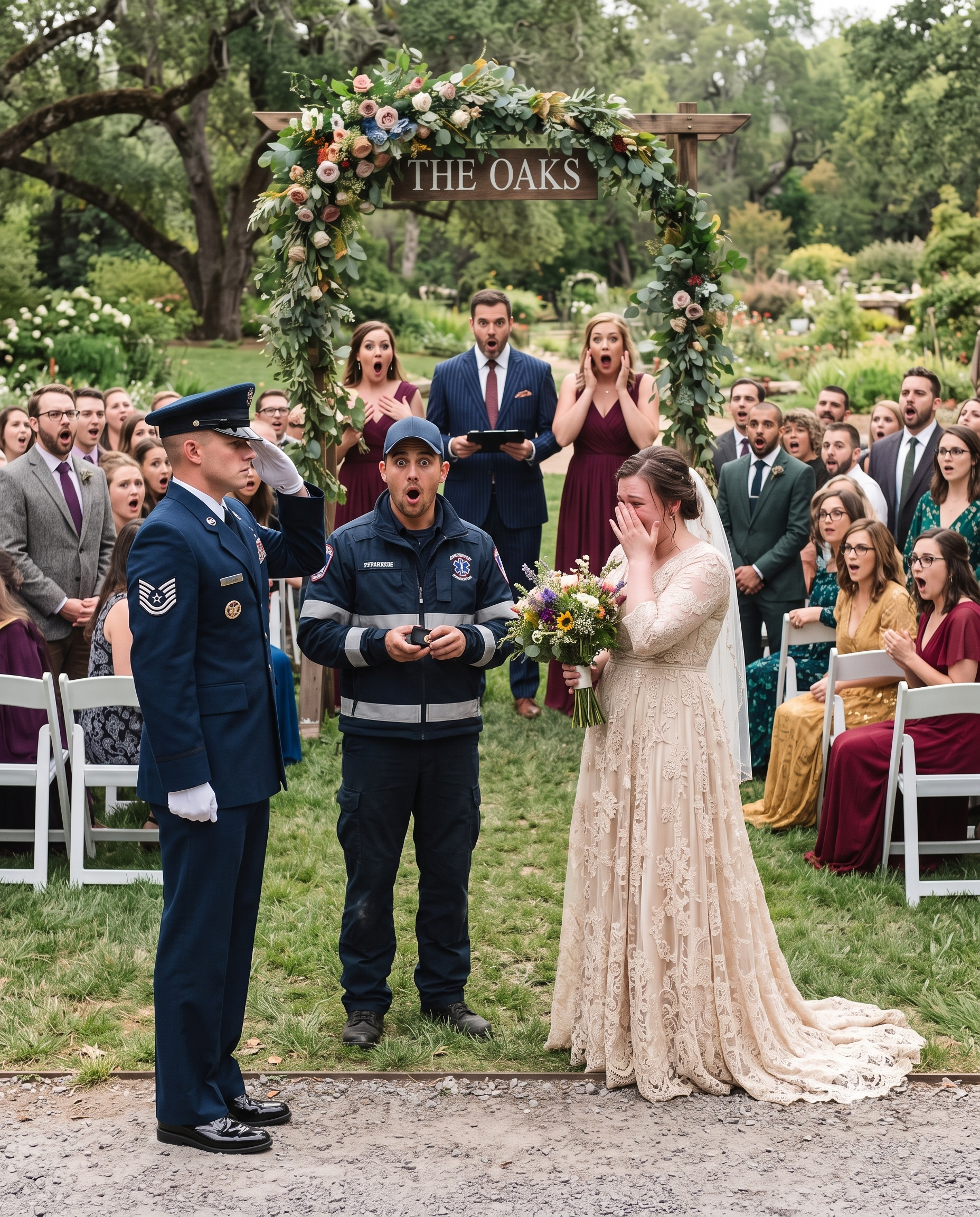
PART 1 — THE MAN THEY CALLED A GARDENER
“I don’t want your pocket change, old man!”
Trevor Langley’s voice thundered through the microphone, carrying into every corner of Willow Creek Community Hall.
Before anyone could react, he slapped the rusted tin box from my father’s trembling hands.
The lid flew open.
Crumpled five-dollar bills, worn tens, old silver coins, and carefully folded envelopes scattered across the polished hardwood floor. Some rolled beneath the guest tables. Others landed near Trevor’s expensive shoes.
One hundred and twenty guests fell completely silent.
My father, Amos Carter, stood frozen in his cheap charcoal suit.
He had purchased it three weeks earlier after secretly pawning the wedding ring he had worn since my mother’s death. He thought I did not know. But I had found the empty velvet box hidden beneath his work gloves.
That suit did not fit him properly. The sleeves were too long, and the shoulders were too wide. Yet when he had first tried it on, he had smiled at his reflection and whispered, “My little girl deserves to see her father looking respectable on her wedding day.”
Now Trevor stared at him as though he were something filthy.
My father slowly lowered himself to his knees.
His joints cracked beneath him.
For twelve years, those knees had carried him through freezing mornings, muddy fields, storm-damaged gardens, and endless landscaping jobs across Washington. His hands were scarred from tools, chemicals, thorns, and machines. His shoulders had bowed under bags of soil and stone.
Yet he still reached for every fallen dollar as if each bill were precious.
Because it was.
That money represented skipped meals, winter jobs, weekend labor, and years of sacrifice.
Trevor adjusted the cuffs of his custom black tuxedo.
“I refuse to spend the rest of my life explaining to my business partners that my father-in-law mows lawns,” he said coldly. “Brynn may be kind, but kindness does not build a corporate legacy.”
My breath caught.
Only minutes earlier, I had been standing beneath white roses, believing I was about to marry the man I loved.
Trevor and I had met three years earlier at a charity gala where I worked as an event coordinator. He had been charming, confident, and attentive. He remembered my coffee order. He sent flowers to my office. He told me he admired that I had built my career without family connections.
But once we became engaged, small things began to change.
He criticized my clothes.
He mocked my childhood home.
He refused to visit my father’s landscaping warehouse because, in his words, the place smelled like fertilizer and failure.
Each time I defended Dad, Trevor apologized and blamed the pressure of managing Langley Strategic Industries, his father’s defense manufacturing corporation.
I believed him because I wanted to believe him.
Now, standing at the altar, I finally saw the truth.
Trevor had never respected us.
His mother, Yvette Langley, sat in the front row in a silver designer gown, her chin raised with obvious satisfaction.
“Families should understand exactly where they belong,” she announced. “This wedding should never have progressed this far.”
Trevor’s father, Conrad Langley, remained beside her. He was a billionaire whose company supplied surveillance equipment, vehicle components, and communication systems to government agencies.
He looked less interested in my humiliation than in checking his watch.
That was when I understood.
This was not a sudden decision.
They had planned it.
Trevor turned toward the guests and lifted the microphone again.
“I cannot marry into a family with no ambition, no influence, and no understanding of the responsibilities attached to the Langley name.”
My maid of honor, Lena, stood behind me with tears in her eyes.
“Brynn,” she whispered, “say something.”
But I could not.
I was watching my father crawl beneath a table to retrieve a five-dollar bill.
A decade of savings lay scattered around him.
He had collected that money because he wanted to give us a wedding gift. He once told me the rusted tin had belonged to my grandfather. Every week, Dad placed something inside it.
Sometimes twenty dollars.
Sometimes only two.
He called it my “new beginning fund.”
Trevor had turned it into a public spectacle.
My grief burned into fury.
I tore the diamond ring from my finger and slammed it onto the wedding cake table.
The impact cracked the frosting beneath it.
Gasps spread through the hall.
“You don’t have to reject me,” I said, my voice shaking. “Because I would rather spend the rest of my life alone than spend one more minute belonging to your family.”
Trevor smiled as though he had expected my response.
“You should be careful, Brynn. Your father’s business survives because we have allowed it to survive.”
Dad stopped gathering the bills.
I stared at Trevor.
“What does that mean?”
Conrad finally stepped forward.
His expression remained calm and detached.
“Your father’s warehouse is located beside property required for the Langley expansion project,” he said. “We offered him more than the building was worth. He refused.”
“That warehouse is all he has.”
“It is inefficient land use,” Yvette replied. “Conrad’s company is preparing a facility connected to a federal defense proposal. Your father’s shed is obstructing progress.”
My stomach twisted.
For months, Dad had received threatening letters from attorneys, city inspectors, and development consultants. His permits were suddenly challenged. Equipment suppliers stopped returning his calls. A bank unexpectedly demanded early repayment on a loan that had never been late.
Dad told me it was only a zoning dispute.
Now I knew the truth.
The Langleys had been trying to destroy him.
Trevor came closer.
“I offered you an easy solution. Once we were married, you could have convinced him to sell. Instead, he remained stubborn.”
“You were using me.”
“I was giving you the opportunity to rise above your background.”
My hand moved before I could stop it.
The slap echoed through the room.
Trevor’s head snapped sideways.
Yvette screamed.
“How dare you!”
Security guards began moving toward me, but my father rose painfully from the floor and stepped between us.
His posture was still bent, yet something in his eyes had changed.
“Don’t touch my daughter,” he said quietly.
Trevor laughed.
“And what are you going to do? Throw grass clippings at me?”
A few nervous guests looked away.
Dad lowered his gaze.
For one terrible second, I thought Trevor had broken him.
Then the walls began to vibrate.
A deep mechanical rumble rolled through the building.
Glasses trembled on the tables.
Outside, heavy tires crushed the gravel in the parking lot.
Everyone turned toward the entrance.
The oak doors burst open.
Three men in pristine dark green military dress uniforms entered the hall.
Their medals reflected the overhead lights. Their polished shoes struck the floor in perfect rhythm.
Conrad’s entire expression changed.
He rushed into the aisle with a broad smile and extended his hand.
“General Mercer. What an extraordinary surprise. Conrad Langley, Chief Executive of Langley Strategic Industries. We have been expecting the Department’s final review of our Sentinel communications proposal.”
The highest-ranking officer did not even look at him.
General Nathaniel Mercer walked past Conrad as though the billionaire did not exist.
He continued down the aisle until he reached my father.
Dad stood beside the scattered money, his silver head lowered.
The General removed one white formal glove.
Then he knelt.
The sight was so shocking that several guests rose from their chairs.
General Mercer picked up a faded five-dollar bill and gently placed it into my father’s palm.
He stood again.
His shoulders straightened.
His heels clicked together.
Then one of the most powerful military officers in the country raised his hand and gave my father a flawless salute.
The other two officers did the same.
No one moved.
My father’s face lost all color.
“General,” he whispered, “you shouldn’t have come.”
“With respect, sir,” Mercer replied, “I should have come fourteen years ago.”
Trevor stared between them.
“Why are you saluting him?”
General Mercer slowly lowered his hand.
“Because that man is Colonel Amos Carter.”
A stunned murmur rolled through the hall.
I stopped breathing.
Trevor laughed uncertainly.
“That’s impossible. He’s a landscaper.”
Mercer turned toward him.
“He is also the officer who saved twenty-seven soldiers during the Al-Rahim evacuation. He carried three wounded men through burning wreckage, returned under enemy fire for classified equipment, and refused extraction until every member of his unit was accounted for.”
I looked at my father.
He would not meet my eyes.
The General continued.
“Colonel Carter was awarded the Distinguished Service Cross in a classified ceremony. His name was removed from public records after intelligence connected the evacuation to a compromised defense network.”
Conrad’s face tightened.
“What does any of that have to do with us?”
Mercer’s gaze shifted toward him.
“Possibly everything.”
The two officers behind him opened a black case.
Inside were documents, photographs, and a sealed military file.
Mercer removed a photograph and held it up.
It showed a younger version of my father in combat uniform. His face was covered in dirt and blood. Beside him stood several soldiers near the wreckage of an armored communications vehicle.
One man in the background wore a civilian contractor badge.
The logo belonged to Langley Strategic Industries.
My father finally spoke.
“The equipment failed during the evacuation.”
Conrad’s jaw clenched.
“Military equipment fails in combat.”
“It did not fail,” Dad said. “It was sabotaged.”
The room erupted in whispers.
General Mercer raised his voice.
“Fourteen years ago, Colonel Carter discovered that a defense contractor had knowingly supplied communication units containing defective components. The defects were hidden through falsified inspection reports.”
Trevor looked at his father.
Conrad remained silent.
Dad’s fingers tightened around the five-dollar bill.
“I reported it,” he said. “The evidence disappeared. Two witnesses were killed before they could testify. I was told my daughter could become a target if I continued.”
My chest tightened.
I remembered fourteen years earlier.
Dad had returned home one night without warning. He had packed away his uniforms, sold our larger house, and moved us to Willow Creek.
He never discussed the military again.
Whenever I asked, he said only that some chapters should remain closed.
“You gave up your career because of me?” I whispered.
Dad turned toward me.
“I chose you. There’s a difference.”
Tears blurred my vision.
Trevor suddenly grabbed the microphone.
“This is ridiculous. My father has operated one of the most respected corporations in the country for thirty years.”
General Mercer looked at him coldly.
“Then perhaps you can explain why Langley Strategic Industries attempted to purchase Colonel Carter’s warehouse.”
“For an expansion.”
Mercer placed a satellite map on the nearest table.
“The warehouse sits above a sealed utility tunnel connected to the former Cascade military testing station.”
Conrad stepped backward.
Dad closed his eyes.
The General pointed to the map.
“Colonel Carter hid the original inspection archive inside that tunnel fourteen years ago. He bought the property under a private trust and built his landscaping business over the access point.”
The guests stared at my father.
The humble warehouse Trevor called a shed had been guarding evidence capable of destroying the Langley empire.
Yvette’s confidence disappeared.
“You’re lying.”
“No,” Dad said. “Your husband found out about the archive six months ago.”
I looked at Trevor.
That was exactly when he had proposed to me.
The realization struck so hard that I nearly collapsed.
“You never loved me.”
Trevor did not answer.
He did not need to.
Our engagement, our wedding, and his promises had all been part of a plan to gain control of Dad’s property.
Conrad pushed past his son.
“You cannot prove any of this.”
General Mercer nodded toward the doors.
“You are correct. Colonel Carter could not prove it alone.”
More vehicles entered the parking lot.
Blue and red lights flashed through the windows.
Federal agents appeared at the entrance.
The General continued.
“But this morning, the archive was recovered.”
Conrad’s face went white.
“That’s impossible.”
Dad looked directly at him.
“You spent months watching the warehouse. So I moved the evidence yesterday.”
Trevor’s mother gripped the back of her chair.
“Where?”
Dad’s gaze shifted toward the rusted tin box.
Everyone looked down at the scattered bills and coins.
General Mercer picked up one of the silver coins. He twisted its edge, revealing that it was not a coin at all.
It was a storage device.
The money Trevor had thrown across the floor had concealed copies of the evidence.
Conrad lunged forward.
Federal agents immediately restrained him.
“You have no idea what you’re doing!” he shouted at my father. “Do you think exposing me will restore your career? Your reputation? The men you lost?”
Dad’s eyes filled with grief, but his voice remained steady.
“No. But it may prevent more families from losing someone.”
An agent approached Conrad with handcuffs.
Trevor backed away from the altar.
“This has nothing to do with me.”
General Mercer turned toward him.
“That depends on what investigators find in your communications.”
Trevor looked at me.
For the first time, his arrogance had vanished.
“Brynn, listen to me. I didn’t know everything. My father told me your dad was hiding financial records. He said marrying you would protect both families.”
“You humiliated him in front of everyone.”
“I was under pressure.”
“You threatened his business.”
“My father made those decisions.”
“And you proposed to me after learning we controlled the property.”
Trevor reached for my hand.
I stepped away.
“You weren’t marrying the daughter of a landscaper,” I said. “You were marrying the daughter of the only man who could expose you.”
Agents led Conrad toward the exit.
Yvette followed them, screaming about attorneys, political connections, and consequences.
But before Trevor could escape, one of the officers handed General Mercer a tablet.
The General read the message, then looked at Dad.
“Colonel, there is another problem.”
Dad’s expression sharpened.
“What happened?”
Mercer lowered his voice, but the room was silent enough for everyone to hear.
“The recovered archive contains only twenty-three inspection reports.”
Dad stared at him.
“There were twenty-four.”
Mercer nodded.
“The missing file is marked Project Nightglass.”
At the sound of the name, Conrad stopped struggling.
For the first time that evening, he looked truly terrified.
Dad’s eyes narrowed.
“Who accessed the tunnel before your team arrived?”
The General turned the tablet toward him.
A security image showed a dark figure entering the warehouse shortly before dawn.
The person wore a hood, but one hand was clearly visible.
On the finger was a large Langley family signet ring.
Trevor looked down at his own hand.
His ring was gone.
And suddenly, every eye in the hall turned toward him.
## **PART 2 — PROJECT NIGHTGLASS**
Trevor slowly raised both hands.
“I lost that ring weeks ago.”
No one believed him.
The security image remained frozen on General Mercer’s tablet. The dark figure’s face was hidden, but the gold signet ring was unmistakable.
Every male heir in the Langley family received one on his twenty-first birthday.
Trevor had worn his constantly.
Even during our engagement photographs.
Even when he slipped the diamond ring onto my finger.
Yet now it was missing.
A federal agent moved toward him.
Trevor backed into the cake table.
“You cannot arrest me because someone wore a ring.”
“We are not arresting you,” the agent replied. “We are requesting that you remain available for questioning.”
“That sounds like an arrest.”
“It becomes one if you run.”
Trevor’s eyes darted toward the side exit.
Two agents immediately blocked it.
General Mercer faced my father.
“What exactly was Nightglass?”
Dad stared at the floor for several seconds.
“When I found the defective communications units, I assumed Langley was cutting costs. Then I discovered the failures were intentional.”
“Intentional for what purpose?” I asked.
Dad looked at me with regret.
“To create blind zones.”
My skin went cold.
He explained that the compromised devices had been designed to lose secure communication during specific environmental conditions. The failures could be triggered remotely, leaving military vehicles and command teams unable to contact one another.
The flaw was not merely negligence.
It was a weapon.
“Nightglass was the control protocol,” Dad said. “Whoever possessed it could disable an entire communications network.”
General Mercer’s expression darkened.
“And the twenty-fourth report contained the activation system?”
“Not the full system. But enough to rebuild it.”
Conrad began laughing near the entrance.
The sound was low and bitter.
“You still don’t understand, Amos. You never did.”
The agents holding him tightened their grip.
Dad walked toward him.
“Then explain it.”
Conrad smiled.
“You thought I wanted your warehouse because of the evidence. The evidence is old. Witnesses disappear. Records can be challenged. Politicians can be persuaded.”
His eyes shifted toward Trevor.
“But Nightglass is worth more than every government contract my company has ever received.”
Trevor’s face hardened.
“Stop talking.”
Conrad’s smile widened.
There was no affection in it.
Only calculation.
“You wanted to prove you could lead the company. You said you would retrieve the file yourself.”
“That’s a lie.”
“Is it?”
Yvette stepped between them.
“Conrad, don’t say another word.”
But Conrad had spent his life controlling rooms, companies, attorneys, and politicians. Now, as his empire collapsed around him, he seemed determined to pull everyone down with him.
“The boy was supposed to marry Brynn, gain access to Carter’s property, and recover the archive quietly,” he said. “Instead, he became impatient.”
Trevor looked at me desperately.
“He’s trying to protect himself.”
Conrad laughed again.
“You failed to persuade her. You failed to control the old man. Then you stole the tunnel key from Brynn’s purse during the rehearsal dinner.”
I remembered Trevor embracing me outside the restaurant.
His hand had brushed against my handbag.
At the time, I thought he was being affectionate.
Now I realized he had been searching it.
Dad turned toward me.
“You had a key?”
“I found an old brass key in your desk last month. Trevor said it might belong to the wedding storage room, so I put it in my bag.”
Dad closed his eyes.
The pain on his face was worse than when Trevor had thrown away his money.
“I should have told you.”
“You were trying to protect me.”
“My silence gave them a way to use you.”
Before I could answer, Trevor shoved the cake table into the nearest agent.
The three-tiered cake crashed onto the floor.
Guests screamed.
Trevor sprinted toward the kitchen.
An agent chased him, but Trevor overturned chairs and pushed through the swinging doors.
General Mercer shouted for the exits to be secured.
I lifted my wedding dress and ran after them.
“Brynn, stop!” Dad called.
But Trevor had lied to me for months. He had used my love, stolen from me, and humiliated my father.
I needed to know whether he had taken Nightglass.
The kitchen was chaos.
Cooks pressed themselves against the counters as Trevor raced through the rear service door.
I followed him into the gravel parking lot.
Rain had begun to fall.
Military vehicles, police cars, and black federal SUVs surrounded the building. Their lights flashed against the trees.
Trevor ran toward his sports car.
He opened the driver’s door, but I reached him before he could climb inside.
“Where is the file?”
He spun around.
His charming expression was gone.
“I loved you, Brynn.”
“Do not say that.”
“I did. At first, you were only a way to reach your father. But things changed.”
“You left me at the altar.”
“Because my father ordered me to destroy your family publicly. He thought humiliation would make Amos surrender the warehouse.”
“And you obeyed.”
“I was going to come back for you after everything settled.”
I stared at him.
“You truly believe that makes it better?”
Trevor grabbed my shoulders.
“You don’t understand what Nightglass can do. With that file, I could have freed myself from my father. I could have built something no government or company could ignore.”
“You stole it.”
His silence answered me.
“Where is it?”
He released me and stepped toward the car.
“You should go inside.”
I blocked the door.
“Where is the file, Trevor?”
His face twisted with anger.
“The old man should have stayed quiet fourteen years ago.”
The words had barely left his mouth when my father appeared behind me.
Rain soaked his silver hair and cheap suit.
General Mercer and several agents followed.
Dad looked at Trevor with a stillness that frightened me.
“You went into the tunnel.”
Trevor sneered.
“It was easier than I expected. Your locks are as outdated as your business.”
“Where is Nightglass?”
Trevor reached inside his jacket.
The agents raised their weapons.
“Hands where we can see them!”
Trevor froze.
Then he slowly withdrew a small black envelope.
Dad’s breathing stopped.
“Put it on the ground,” Mercer ordered.
Trevor looked at the envelope, then at his father being held near the hall entrance.
“For thirty-two years, he treated me like a disappointment,” Trevor said. “No matter what I achieved, it wasn’t enough. This was supposed to be mine.”
Conrad shouted across the parking lot.
“You incompetent fool! Do not hand it over!”
Trevor’s expression changed.
He looked almost calm.
“You see?” he said to me. “Even now, he believes he owns everything.”
Then he tore the envelope open.
Inside was a thin transparent chip.
General Mercer stepped forward.
“Trevor, listen carefully. That device may contain classified technology. Place it on the ground.”
Trevor held the chip between two fingers.
“I want immunity.”
“That is not mine to offer.”
“I want control of Langley Strategic Industries.”
Conrad began cursing.
“I want my father removed, my name cleared, and all charges against me dismissed.”
Mercer remained steady.
“You are in no position to negotiate.”
Trevor smiled.
“I am if this is the only copy.”
Dad stepped out from behind the agents.
“Trevor, you don’t know how to activate it.”
“No. But buyers will.”
My stomach turned.
“You planned to sell it?”
“I planned to survive.”
“You already had everything.”
“That is what people like you never understand,” he snapped. “Having wealth is not the same as having power.”
Dad moved closer.
The agents warned him to stop, but he kept walking.
“Fourteen years ago, men died because I believed the wrong contractor,” Dad said. “For years, I blamed myself. I left the Army. I raised my daughter in hiding. I built a quiet life because I thought silence would keep her safe.”
Trevor tightened his grip on the chip.
“One more step and I break it.”
Dad stopped.
“I am asking you to give it to me.”
“You’re asking?”
“Yes.”
Trevor laughed.
“The great Colonel Carter is begging the man he called unworthy?”
Dad glanced at me.
“I will beg anyone if it keeps my daughter safe.”
The words broke something inside me.
Trevor stared at him.
For one brief moment, I saw uncertainty in his face.
Then Conrad shouted again.
“He has always been weak! Break the chip and let them prove what was on it!”
Trevor looked toward his father.
That distraction lasted less than a second.
Dad moved.
Despite his age and years of physical labor, he crossed the distance with shocking speed. He seized Trevor’s wrist, twisted it away from his body, and forced him to the ground.
The chip fell into the mud.
General Mercer retrieved it while agents handcuffed Trevor.
Trevor struggled beneath my father.
“You ruined my life!”
Dad released him.
“No. You chose what mattered to you.”
By midnight, the wedding hall had become an active federal investigation site.
Guests gave statements. Devices were collected. Conrad and Trevor were transported separately. Yvette was questioned about financial transfers, political donations, and offshore accounts.
I sat on the hall steps in my wedding dress, watching rain wash frosting, mud, and flower petals into the parking lot.
Dad sat beside me.
For several minutes, neither of us spoke.
Then he placed the rusted tin box between us.
Most of the money had been recovered.
Some bills were stained with cake.
Others were damp from the rain.
“I wanted this day to be perfect,” he said.
“It was never supposed to cost you everything.”
“You are my everything.”
I rested my head on his shoulder.
“Why didn’t you tell me who you were?”
“Because Colonel Carter had enemies. Amos the landscaper only had overdue invoices.”
I laughed through my tears.
Dad smiled faintly.
“I also didn’t want you growing up beneath the weight of my past. You deserved your own life.”
“And now?”
“Now the past has found us.”
General Mercer approached.
“The chip is authentic,” he said. “But the Nightglass file has been altered.”
Dad stood.
“How?”
“Someone added a transmission program. When Trevor removed it from the tunnel, the data automatically sent itself to an external receiver.”
“Where?”
“We are tracing it.”
“Was Langley the recipient?”
Mercer hesitated.
“We do not believe so.”
That answer disturbed Dad more than anything else that night.
At 2:00 a.m., Langley Strategic Industries’ federal contracts were suspended pending investigation.
At 3:15 a.m., the company’s primary lenders froze its credit lines.
At 4:00 a.m., international news outlets reported allegations of procurement fraud, falsified inspections, conspiracy, and attempted theft of classified material.
At 4:40 a.m., the company’s stock collapsed in overseas trading.
By sunrise, the Langley family’s private accounts had been frozen, their corporate board had removed Conrad, and federal authorities had seized their estate, aircraft, and company offices.
The family that had mocked my father’s five-dollar bills had lost billions before breakfast.
Trevor called me from federal custody at 6:12 a.m.
I almost ignored the call.
Dad told me the choice was mine.
I answered.
For several seconds, Trevor said nothing.
Then his voice emerged, quiet and strained.
“Brynn, Nightglass was not the only thing inside that tunnel.”
“What are you talking about?”
“There was another case behind the archive.”
I looked toward Dad, who was speaking with General Mercer across the parking lot.
“What case?”
“Your father knows.”
“Knows what?”
Trevor breathed heavily.
“My father never ordered your mother’s death.”
The world seemed to tilt.
My mother had supposedly died in a highway accident when I was six years old.
Dad never spoke about the details.
“What did you say?”
“The case contained photographs, medical records, and a current passport.”
My fingers went numb around the phone.
“A current passport belonging to whom?”
Trevor lowered his voice.
“Your mother.”
The call disconnected.
I stared at the screen.
Across the parking lot, Dad had gone completely still.
General Mercer was holding a newly opened evidence bag.
Inside was a recent photograph of a woman with my eyes.
On the back, someone had written three words:
**NIGHTGLASS IS ACTIVE.**
Dad slowly turned toward me.
His face carried the same terror I had seen when the military officers first entered the hall.
“Brynn,” he said, “there is something about your mother I should have told you years ago.”
Before he could continue, every phone in the parking lot rang at once.
Military radios erupted with urgent voices.
General Mercer looked at his tablet, and all the color drained from his face.
Across three states, secure defense communication systems had suddenly gone dark.
And somewhere beyond the tree line, hidden beneath the fading sound of sirens, a vehicle engine started.
Someone had been watching us the entire night.