Disclaimer: This story is entirely fictional and created for entertainment purposes only. It does not represent any organization or individual, nor does it encourage inappropriate behavior. The content was generated with AI assistance.
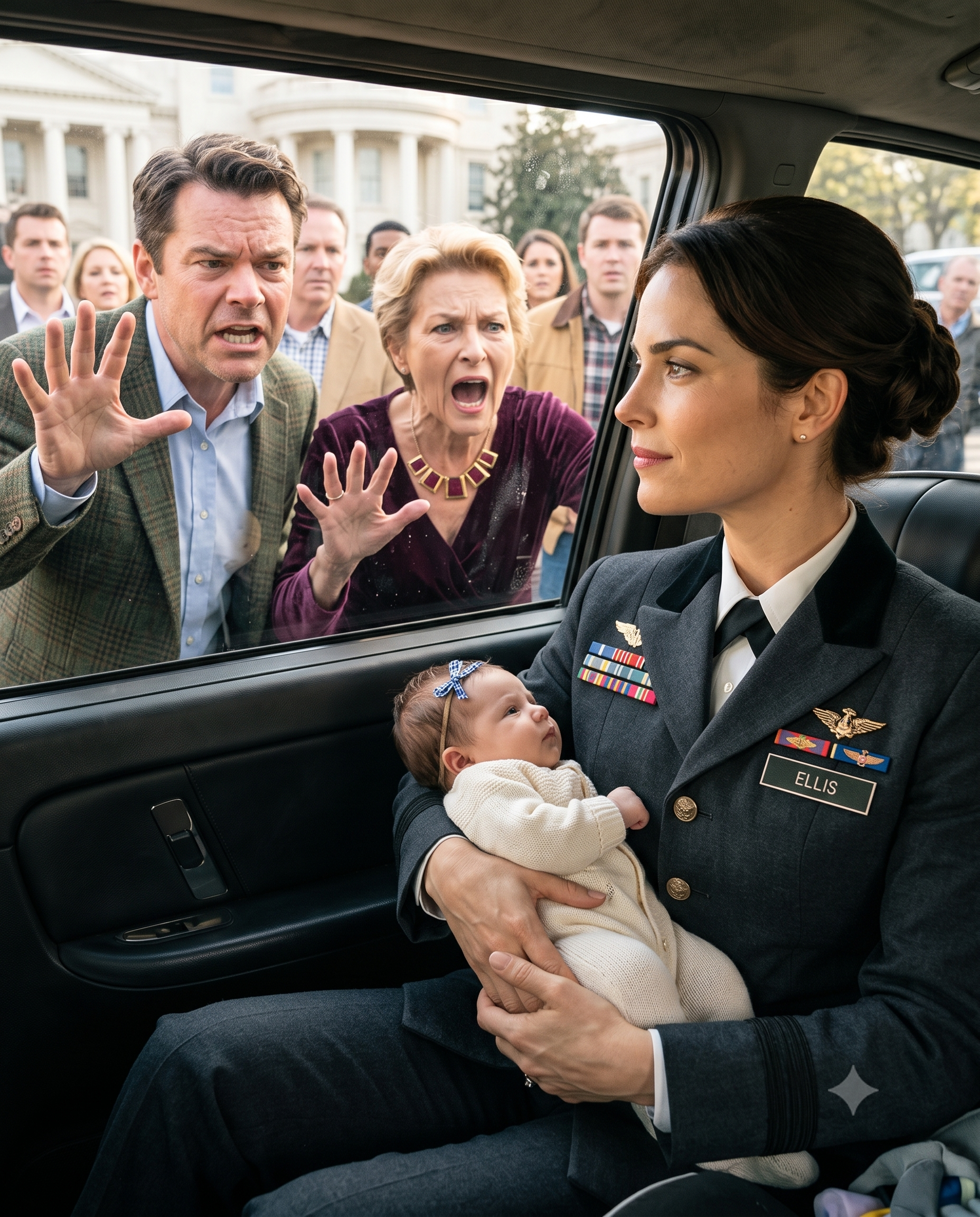
PART 2:
His voice cracked on the word “people.”
I had heard that crack in a hundred soldiers right before they told me a truth they did not want me to hear.
Wesley would not meet my eyes. He stood in the kitchen with his fingers wrapped around the counter’s edge, knuckles pale as milk.
“Your father will be there too,” he said again, quieter this time. “And he’s bringing people with him.”
June slept against my shoulder, her breath warm and even. The coffee I had poured that morning sat untouched. The clock above the stove ticked like a countdown.
“What people?” I asked.
“I don’t know.”
“Then how do you know about them?”
He blinked. He had not expected the question.
That was the problem with Wesley. He was excellent at repeating what his mother told him and terrible at explaining where her information ended and his began.
“My father called,” he said. “He said your dad had contacted him. He said we all needed to be in the same room.”
“Out of the blue?”
“Apparently.”
“At noon today.”
“At noon,” he repeated.
He repeated everything. That was how I could always tell he was lying. When the truth was his, he spoke slowly and owned every word. When he was carrying someone else’s lines, he sounded like a man reading a script in a language he barely understood.
My phone buzzed in my pocket. I did not look at it.
June stirred. I pressed my lips to her forehead. She smelled like baby wash and gentle morning light.
“Wesley,” I said. “Look at me.”
He finally did. His eyes were pale blue and rimmed with red. He had not slept.
“Tell me everything you know,” I said.
“I already did.”
“On my mother’s grave.”
He flinched. My mother was gone, and he knew exactly how much that promise meant to me.
“Mom called last night after you left the party,” he said. “She said your father had called Richard and demanded a meeting. She said he was bringing an entire troop. She said…” He stopped.
“She said what?”
“She said it was our only chance to confront them together.”
A cold chain moved down my spine.
“Confront us about what?”
“She didn’t say.”
He was saying too much. Wesley always over-explained whenever he was nervous about the underlying truth.
June made a small sound, and I shifted her to my other shoulder.
“I’m going to call my father,” I said.
“Nora.”
“I said I’m going to call him.”
I pulled out my phone. Three unread texts.
The first was from my father, sent at six forty-seven that morning: “Charlie. No calls until after the meeting. Drive to the estate at 11:00. Do not bring the diaper bag.”
I stared at that last line.
Do not bring the diaper bag.
The second text was from an unknown number, sent at nine: “Colonel Ellis. Please confirm you will attend the meeting at noon. It is critical that your husband believes you are traveling together.”
The third was from the same unknown number: “Do not tell Wesley what I have sent. Trust your father. Do not bring the baby’s diaper bag.”
I went very still.
“Wesley,” I said, keeping my voice even. “When exactly did your father order the meeting?”
“Last night. After midnight.”
“And your mother called you before that?”
“Around eleven.”
“What time did you get home?”
He hesitated. “After two.”
“Where were you between midnight and two?”
“I drove around.”
“Why?”
“Because I didn’t know what to think.”
I looked down at my phone again. The texts came from my father’s secure line. But my father would never summon me through my in-laws. He would have called me first.
And he would never tell me to leave June’s diaper bag behind without explaining why.
Unless someone had access to that diaper bag.
Margaret had packed it. She had insisted, at the hospital, because she was “the grandmother.”
I set June down in her crib in the next room. She stirred, opened her sleepy eyes, smiled without knowing why.
That smile settled something in me.
I walked back into the kitchen.
“We’re going,” I said. “But we’re taking my car.”
Wesley frowned. “Your car doesn’t have the car seat base.”
“It does now.”
He started to argue. Then something crossed his face—a flicker of fear he tried to hide.
“Okay,” he said.
“And we’re not driving together.”
“What?”
“I’ll leave first. You can say I was already on my way. I’ll meet you at the estate.”
His lips parted.
“Why?”
I stepped closer and watched his pupils expand. Not with surprise. With recognition.
“Because I need to know if you’re going to call your mother and warn her,” I said. “Or if you’re going to show up and stand beside me.”
Wesley went pale.
“I would never,” he said.
“Never do what? Warn her, or stand beside me?”
He did not answer.
I had my answer.
I lifted the diaper bag from the counter and placed it by the front door. Then I remembered my father’s text.
Do not bring the diaper bag.
I unzipped the side pocket.
Inside, beneath a folded burp cloth, was a small gold object.
The bell.
The tiny gold bell from the collar. The one Margaret had lifted in front of sixty guests.
She must have slipped it into the bag while I was holding June and getting pushed toward the door. I never saw her do it.
I rolled the bell between my fingers. It was heavy. Far too heavy for something so small.
Then I saw the seam running around the middle—almost invisible. But I had spent years handling equipment exactly like this.
It was not a bell.
It was a listening device. And a locator.
My heart fell into my stomach.
“Nora?” Wesley’s voice came from the hallway. “What are you doing?”
I closed the pocket and zipped it.
“Nothing,” I said. “Just checking June’s things.”
He stood in the doorway, watching me. Something in his posture did not belong to the man I had married.
Then I heard it.
A soft scrape at the front window.
I dropped behind the kitchen island and dragged him down with me.
“What the—” he started.
“Quiet.”
The scrape moved along the glass toward the back porch.
I had a pistol hidden in the hall closet. But I could not reach it without crossing the kitchen window.
The diaper bag was still by the front door.
The bell inside had been transmitting for nearly an hour.
Whoever was outside was not there to break in. They were there to locate the signal. The signal that was sitting inside my own house because I had carried it home in my daughter’s things.
I made a decision.
I crawled to the bag, unzipped the side pocket, and slid the bell into the pocket of my jacket.
Then I opened the hall closet, grabbed my pistol, and secured it at the small of my back.
“What are you doing?” Wesley hissed.
“Making sure they follow me instead of June.”
“Nora, stop. What is that?”
I stood and looked at my husband. The same soft hands. The same gentle face.
But his eyes kept drifting toward the front door, and I finally understood why.
“You knew about the bell,” I said.
“No.”
“Then why have you been watching me like you’re waiting to see whether I’d find it?”
He said nothing.
I pulled out my phone and dialed the number from the unknown text. It rang twice.
“Colonel,” my father said. “Good girl. Don’t bring the bag.”
“The bell was in it.”
“I know.”
“It’s been transmitting.”
“I know.”
“There’s someone outside the house right now.”
A pause.
“Are you armed?” he asked.
“Yes.”
“Get to the vehicle. Do not take the bag. Listen carefully. When you walk out that door, they will see you, and they will follow you. That is what we need. Your husband can come with you if he chooses. But if he hesitates, leave him.”
I looked at Wesley.
He was crying.
Not the controlled silence he used after our arguments. Real, helpless, frightened tears.
“Nora,” he said, “I didn’t know what she was going to do with it. I thought it was just a keepsake.”
“A keepsake you recognized.”
“I didn’t— I swear.”
“Then why are you crying?”
“Because I’m watching you become a soldier in front of me for the first time. And I’m terrified of what you’re going to do to my family.”
Something in my heart—something that had been bruising for years—quietly closed.
“That’s not why you’re crying,” I said.
And I walked out the front door.
The morning sun hit my face. June was bundled in my arms. The diaper bag stayed on the floor inside, abandoned.
I did not look back to see if Wesley would follow.
I buckled June into her car seat, started the engine, and pulled out of the driveway.
Behind me, a dark sedan pulled away from the curb.
I drove toward the Pembroke estate in Myers Park.
For the next ten minutes, the sedan stayed two cars behind me. It did not try to close the gap. It just followed. Patient, professional, certain.
At a red light, I opened the glove box and pulled out the burner phone I kept there. I typed one word to my father: Pack.
He replied: Watching.
The estate gates appeared ahead.
The circular driveway was full of vehicles I did not recognize. I spotted the security team right away—two plainclothes officers near the side entrance, a woman in a dark blazer speaking quietly into a microphone at her collar.
I parked. I took June. I walked toward the front door.
The woman in the blazer met me at the steps.
“Colonel Ellis,” she said. “Special Agent Reyes. I’ve been coordinating with your father’s office.”
“Is he here?”
“Inside.”
She looked behind me.
“Your husband?”
“I don’t know.”
She studied me for a moment.
“The bell?”
I opened my jacket pocket and showed her the small gold object. She produced a black signal-blocking pouch. I dropped the bell inside.
“You carried it across the city,” she said.
“On purpose. Whoever was tracking it is now standing outside these gates.”
She nodded once. Professional. Cold.
“Let’s go inside.”
The sunroom looked exactly as I remembered. White roses in silver vases. Crystal chandelier. The same polished floor where Margaret had stood with the collar.
But the chairs had been rearranged into two rows.
And at the far end, in full dress uniform, stood my father.
He came to me before anything else. He took June’s tiny hand in his.
“You did right,” he said.
Then his gaze moved over my shoulder.
I turned.
Wesley stood in the doorway. He had followed after all. His face was pale, and there was a thin red mark across his forehead.
“Security intercepted him at the side gate,” Agent Reyes said quietly.
My father nodded.
“Let him in.”
Margaret stood near the fireplace in the same cream suit from the party. Richard sat in a chair beside her. And for the first time in three years, Margaret did not look smug.
She looked afraid.
“What is the meaning of this?” she demanded. “Why are soldiers in my home?”
My father stepped forward.
“Last night, following the party, the Defense Security Service identified a signal coming from a device placed in Colonel Ellis’s residence.”
“I know nothing about that.”
“You were recorded on a neighbor’s security camera outside their home on three separate occasions.”
Margaret’s mouth opened, then closed.
“I visit my son.”
“Your last visit lasted forty-seven minutes,” Agent Reyes said. “Forty-seven minutes after you left, a signal matching the device at the residence was logged.”
Margaret shook her head. “This is a mistake.”
“The device was a tiny microphone and GPS unit hidden inside an ornamental gold bell. A bell identical to the one attached to the collar you lifted at a party in front of sixty guests.”
The room went silent.
Richard’s face had turned the color of parchment.
“Margaret,” he said.
She did not answer.
I watched her carefully. And in that moment, I understood something that changed everything.
She had known about the bell.
But she had not known what it really was.
Someone had taken her cruelty. Her fear. Her need to control. And they had turned it into an instrument aimed at my daughter.
“Who gave you that collar?” I asked.
She pressed her lips together.
“An associate.”
“What associate?”
“Someone helping me protect my son.”
“Who?”
She finally looked at me—truly looked.
“A man named Daniel Corso.”
Agent Reyes’s hand froze over her microphone.
“Spell that,” she said.
Margaret spelled it.
Agent Reyes looked at my father. Something passed between them—silent, urgent, and cold.
“Get everyone out of this room,” my father said quietly. “Now.”
Richard stood. “Will someone please tell me what is happening?”
“Mr. Pembroke,” Agent Reyes said, “that name is on a watchlist we have been running for eighteen months. If your wife has had dealings with him, you need to step into the next room. Now.”
Margaret grabbed Richard’s arm.
“He was a business consultant! He said he handled reputational concerns for wealthy families. He said he could help me protect our name.”
“From what?” I asked.
“From you.”
The words hit like a slap.
“He said Nora was unstable,” Margaret continued. Fresh tears broke through her careful composure. “He showed me a file with photographs of her overseas. He said she had lied about her past to marry into our family. He said if I could prove it, we could end the marriage without Wesley losing his inheritance.”
Wesley stood frozen in the doorway.
“Why didn’t you tell me any of this?” he whispered.
“Because he said you were under her control. He said you could not be trusted to see the truth.”
“And you believed him.”
“He knew things,” Margaret said, her voice cracking. “He knew things about this family. About your father’s business. About the Charleston trust. About the settlement. Things no outsider could possibly have known.”
Richard went white.
“I never told anyone about those,” he said.
“I did.” Margaret’s voice dropped to a whisper. “I told him because he said he could make them disappear.”
The room was completely still.
Agent Reyes was already on her phone, speaking in low rapid bursts.
My father moved close to me.
“He’s been inside this family for months,” he said quietly. “He targeted your mother-in-law’s fear of you and used it to access Richard’s financial secrets. The collar was never about June. It was the first step in a much larger operation.”
“He told her to put it on the baby.”
“No. He told her to bring it near the baby. He used her cruelty as cover. If she had succeeded in placing it on June, the transmitter would have traveled with you everywhere—your unit, your briefings, your safe house. But even when she failed, she slipped the bell into your bag. That was the plan all along.”
My hands were shaking. Not from fear. From fury.
“He used my daughter.”
“He used everyone,” my father said. “And now he knows the device has been discovered.”
On cue, the lights flickered.
Outside, the sound of engines.
Agent Reyes touched her earpiece.
“Incoming,” she said. “Three vehicles, no plates. ETA thirty seconds.”
Richard’s voice rose. “What do we do?”
My father looked at me.
“You know the protocol, Colonel.”
I did.
I looked down at June. She was awake now, calm, watching the chandelier with wide, curious eyes.
Then I looked at Wesley.
He was shaking.
“Come with me,” I said.
“What?”
“The vehicles outside are not here to negotiate. Come with me and my father. Or stay here with your mother and face whatever is pulling into your driveway.”
He stared at me.
“I’m not choosing a side.”
“This isn’t about choosing sides, Wesley. This is about choosing whether your wife and daughter walk out of this house alive. Stay here, and you become the man who let that happen. Come with me, and you get a chance to be the man who didn’t.”
He looked at his mother.
Margaret stood alone among the wreckage of everything she had built.
Wesley walked to me.
“I’ll come,” he said.
“Then move.”
We moved.
My father led. Agent Reyes and two plainclothes officers fell in around us. Through the kitchen, out the service entrance, into the garden.
A single unmarked black SUV idled behind the rose arbor.
The first bullet hit the fountain wall before I reached the door.
I covered June and ran.
I heard Wesley shout behind me. Then his footsteps following.
My father threw himself into the driver’s seat. The engine was already running.
No talking. No questions. Just running.
The last thing I saw as we pulled away was the estate shrinking in the side mirror. The white columns. The chandelier light spilling through the windows.
And Margaret on the front steps, one hand pressed over her mouth, standing completely alone.
Forty minutes later, we reached a secure military facility outside Charlotte.
June was in a safe room with a female captain vetted by my father’s command.
I stood in a small gray office, staring at the wall.
Wesley sat in a chair across from me. There was a cut on his cheek that I had not noticed while we were running.
“Nora,” he said.
I looked at him.
“I didn’t know,” he said. “The collar. The consultant. The bell. I didn’t know any of it.”
“But you knew your mother had been planning something against me.”
He started to argue. Then stopped.
“I thought it was just her normal behavior,” he said. “I thought if I kept you apart, she couldn’t hurt you.”
“You protected me by leaving me in the dark inside a house where your mother was working with a foreign intelligence asset.”
He flinched.
“I didn’t know it was foreign intelligence.”
“You didn’t ask the questions because you didn’t want to know the answers.”
He was crying again.
“Can you ever forgive me?”
I wanted to say something kind. I wanted to say that time would heal everything and that love could survive this.
But I could still hear that tiny gold bell jingling in front of sixty laughing strangers.
“I don’t know,” I said. “But I know one thing.”
“What?”
“My daughter will never wear a collar. And I will never again live in a home where someone else decides whether that is acceptable.”
I walked out.
My father was in the hallway, holding June.
She smiled when she saw me.
I took her and pressed her against my chest, breathing in her warm, soft smell. She grabbed one of my fingers with her whole tiny fist.
“What happens now?” I asked.
“We find Corso. And you and June go somewhere safe until we do.”
“Where?”
He watched me for a moment.
“Home.”
I shook my head. “That estate was never my home.”
“Not that one. The one where you belong.”
For the first time that day, I let myself breathe.
I looked down at June’s face. No collar. No bell. No gold bracelet. Just her—clean and brand-new and already stronger than all of them.
I kissed her forehead.
Then I started walking, and I did not look back.