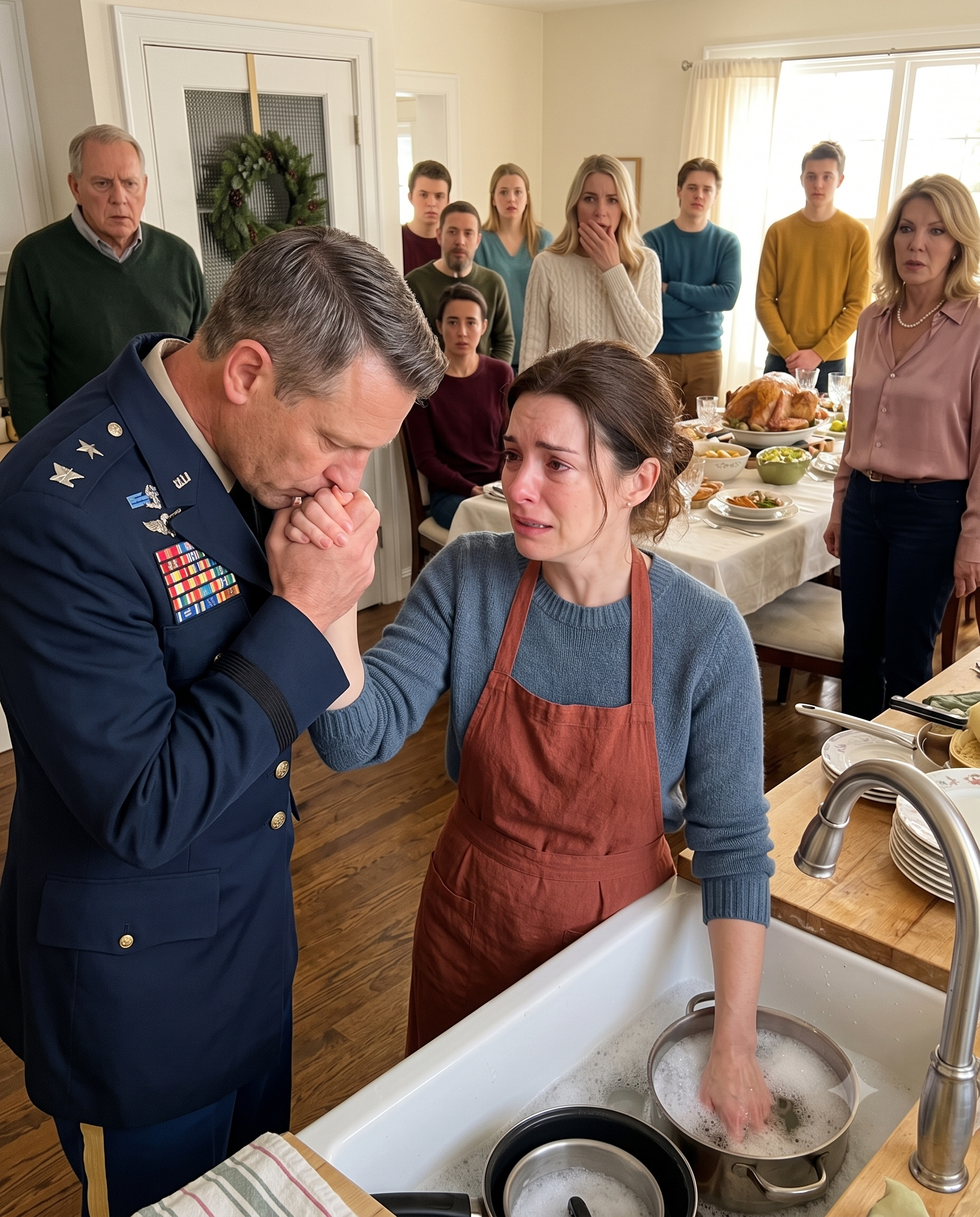
PART 2:
I listened to my mother’s voicemail a third time.
Her voice cracked on the last word.
“I should have saved you a chair.”
I pressed my phone against my chest and stared at the ceiling of my apartment. The rain had stopped outside. The streetlights made wet amber shapes on the hardwood floor.
Alexander was in the kitchen, filling a kettle.
He did not ask what the call had been about.
He never did.
He just set a mug beside me, steam rising, and sat down across the small table.
“You’re thinking about going back,” he said.
It was not a question.
“No,” I said.
The word came out slower than I expected.
He waited.
“Yes,” I corrected. “Part of me is.”
He nodded.
That was one of the things I loved most about him. He never rushed my thoughts. He let them arrive on their own, like guests who had earned the right to be late.
“What would you want to happen if you did?” he asked.
I closed my eyes.
I wanted my mother to say it again, but without the trembling. I wanted her to mean the apology so deeply that she changed the way she looked at me.
But I also wanted her to know that I had not been waiting for her permission to matter.
The ceremony came three weeks later.
I stood in full dress uniform, the blue coat fitted and still, the medals cool against my chest.
Rows of officers sat behind me. Civilians filled the back of the hall.
My parents were there.
Vanessa sat next to them, her children quiet and wide-eyed.
Logan stood near the back, arms crossed, looking like he had been dragged.
Alexander pinned the oak leaf cluster to my collar himself.
His hands were steady.
His eyes were not.
“You earned this,” he said, low enough that only I could hear.
The applause rose around us.
I turned to face the room.
My mother was crying.
Not the polite, decorative tears she had used at weddings and funerals. Real, ugly, mascara-smearing crying.
I held her gaze for three seconds.
Then I looked away.
After the ceremony, a reception line formed.
Strangers shook my hand. Colleagues hugged my shoulders. A veteran with gray hair and a bent spine saluted me, and I returned the salute before we shook hands.
By the time my family reached me, I had already shaken two hundred hands.
My father stepped forward first.
He held out his hand like he was unsure whether I would take it.
I did.
“We’re proud of you,” he said.
The words were correct.
The delivery was not.
He said them the way a man reciting lines he had not written.
I nodded.
“Thank you, sir.”
He flinched.
Sir.
Not Dad.
He had not earned Dad that night.
Vanessa hugged me before I could brace for it.
Her arms tightened around my neck.
“I’m sorry,” she whispered. “I’m sorry I never asked.”
I patted her back once.
It was not forgiveness.
It was courtesy.
Logan shook my hand without meeting my eyes.
“Nice ceremony,” he said.
It was the best he could do.
I accepted it.
Then my mother stepped forward.
She looked smaller than she had on Thanksgiving.
The pearls were gone. She wore a simple navy dress, and her hands trembled around a handkerchief.
“Emma,” she said.
Her voice broke immediately.
She pressed the handkerchief to her mouth.
I waited.
She took a long breath.
“I have been on the phone with your father every night since Thanksgiving,” she said. “And every night, I have said the same thing. I don’t know my daughter.”
She looked at the medal on my collar.
“I don’t know anything about you.”
Her tears spilled again.
“And that is not your fault. It is mine.”
The room around us had gone quiet.
People were pretending not to listen.
I kept my spine straight.
“I wanted you to ask,” I said. “I wanted you to care enough to wonder.”
She nodded.
“I know. I know that now.”
She reached into her purse.
Her hand came out holding a small envelope.
She held it out to me.
My name was on the front in her handwriting.
I took it.
“Open it later,” she said. “Please.”
I slid it into my pocket.
She reached for my hand.
I let her take it.
“I don’t expect you to fix this in one night,” she said. “But I want to try. I want to learn who you are.”
I looked at her fingers wrapped around mine.
They were the same hands that had tied the apron strings for years.
But they were also the hands that had held me when I was sick as a child, that had braided my hair before school, that had waved goodbye at the airport the first time I deployed.
People are not only one thing.
Neither am I.
“We can try,” I said.
She cried harder.
I did not promise her forgiveness.
But I left the door open.
That night, I opened the envelope in my apartment.
Inside was a single photograph.
It was old, creased at the corners.
Me at eight years old, wearing a costume my mother had made for a school play.
I was dressed as a soldier.
My mother had sewn the uniform herself.
I remembered that night.
I remembered her kneeling beside me, adjusting the collar, telling me I could be anything I wanted.
I had forgotten that version of her.
The note on the back said only:
*I am still proud of the woman you became. I am just sorry I stopped looking in time to see it.*
I folded the photograph and tucked it into my uniform jacket.
The next morning, Alexander found me standing at the window.
“Everything okay?” he asked.
I held up the photograph.
He read the note.
Then he wrapped his arms around me from behind.
“You gave her a chance,” he said.
“I gave myself one,” I said. “I’m done carrying the weight of what they didn’t see.”
He kissed the back of my head.
Outside, the sun was rising over the city.
I did not know whether my family would change.
But I knew I had stopped waiting for their permission to be whole.
And that was enough.
PART 3:
The sun had fully risen now, painting the city in shades of gold and gray.
I stood at the window a moment longer, the photograph still warm in my hand.
Alexander’s arms remained around my waist, his chin resting on my shoulder.
“What are you thinking?” he asked.
“That I don’t know what comes next,” I said.
“You don’t have to know right now.”
I turned in his arms and looked at him.
His face was soft in the morning light.
“When do I have to know?”
He smiled. “Never. But you’ll figure it out anyway.”
I kissed him.
It was not a desperate kiss.
It was a grateful one.
The phone rang at 9:47 a.m.
I almost did not answer.
The number was my mother’s.
I stared at it for three rings.
Alexander looked up from his coffee.
“You don’t have to pick up,” he said.
I picked up.
“Emma.” Her voice was different. Not the polished hostess voice. Not the tearful apology voice. Something in between. Careful. “I know it’s early. I know I already left the message.”
“It’s fine,” I said.
“I wanted to ask you something.”
I waited.
“Would you have dinner with me? Just us. No your father. No Vanessa or Logan. No pressure.”
The word pressure hung in the air.
She was trying.
I could hear the effort in her voice.
“When?” I asked.
“Tonight, if you’re free. If not, whenever you want.”
I looked at Alexander.
He nodded.
“Tonight works,” I said.
She let out a breath.
“I’ll text you the address. It’s a small place. Quiet.”
We said goodbye.
I hung up.
Alexander raised an eyebrow.
“Dinner with your mother?”
“Apparently.”
“Are you nervous?”
I thought about it.
“No. I’m curious.”
The restaurant was nothing like my mother’s usual choices.
No crystal chandeliers. No white tablecloths.
A small Italian place with red-checkered cloths and candles in glass jars.
She was already there when I arrived, seated at a corner table, her hands wrapped around a glass of water.
She stood when she saw me.
“Thank you for coming,” she said.
I sat down.
She sat down.
For a long moment, neither of us spoke.
Then she reached into her purse and pulled out a second envelope.
“This one is from your father,” she said.
She slid it across the table.
I did not open it.
“He wanted to give it to you at the ceremony,” she said. “But he lost his nerve.”
I tucked it into my bag.
“I’ll read it later.”
She nodded.
The waiter came. We ordered.
When he left, she folded her hands on the table.
“I’ve been thinking about what I said,” she began. “About wanting to learn who you are.”
I waited.
“I realized I don’t even know what you eat for breakfast.”
I almost laughed.
“Toast,” I said. “Black coffee.”
She wrote it down on a napkin.
I stared at her.
“You’re taking notes?”
“I’m serious, Emma.”
She looked up.
“I don’t want to forget again.”
Something shifted in my chest.
Not forgiveness yet.
But the beginning of something.
Over the next hour, she asked questions I had never heard from her.
Not about my rank or my medals.
Where did I learn to cook?
Did I still like thunderstorms?
What was the hardest thing I had ever done?
I answered some fully.
Others I answered in pieces.
She did not push.
She listened.
When the check came, she reached for it before I could.
“My treat,” she said.
I let her.
At the door, she hesitated.
“I know this doesn’t fix anything,” she said. “But I wanted to start.”
I looked at her.
The pearls were gone.
The polished armor was gone.
Just a woman in a simple coat, standing in the cold, trying.
“It’s a start,” I said.
She smiled.
It was not the practiced smile from Thanksgiving.
It was real.
I walked to my car and sat in the driver’s seat for a long moment.
Then I opened my father’s envelope.
Inside was a check for the full amount of my college savings.
And a note.
*I kept this account open for twenty years, hoping I would have the courage to give it back. I am sorry it took me this long.*
The zeros blurred.
I folded the check and put it in my glove compartment.
I did not know if I would cash it.
But I knew I would keep it.
That night, I told Alexander about the dinner.
He listened without interrupting.
When I finished, he said, “How do you feel?”
“Like I’m standing on new ground.”
He took my hand.
“That’s okay.”
I looked at the photograph of eight-year-old me in the soldier costume, now framed on the nightstand.
My mother had sewn that uniform with her own hands.
Somewhere along the way, she had forgotten the girl who wore it.
But maybe, someday, she would remember.
And maybe I would let her.
PART 4:
I set the framed photograph down on the nightstand.
Alexander’s hand was still warm on mine.
The morning light had shifted from gold to a pale, steady gray.
I looked at the check from my father, still folded in the glove compartment of my car, and thought about what it meant to hold twenty years of guilt in a single piece of paper.
My phone buzzed.
I glanced at the screen.
It was a text from an unknown number, but the area code was familiar.
*Colonel Whitmore, this is Major Chen from the Pentagon. Please call me at your earliest convenience. Secure line preferred.*
I stared at the message for a long moment.
Alexander noticed my silence.
“What is it?”
“Work,” I said.
He did not ask for details.
He never did.
But his thumb traced a small circle on my palm, and that was enough.
I stepped into the bedroom and closed the door.
The call lasted forty-seven minutes.
When I came out, my face was still.
Alexander was standing by the kitchen counter, a cup of cold coffee in his hand.
“Bad news?” he asked.
“Not bad,” I said. “Complicated.”
I sat down at the table.
He sat across from me.
“I’ve been selected for a joint task force,” I said. “Deployment. Six months minimum. Possibly longer.”
He did not flinch.
“Where?”
“I can’t say yet.”
He nodded.
“When do you leave?”
“Three weeks.”
The silence that followed was not heavy.
It was the kind of silence that held space for everything we both wanted to say but knew we did not need to.
“I’ll be here when you get back,” he said.
I reached across the table and took his hand.
“I know.”
Three weeks was not long enough.
But it was all I had.
The next morning, I called my mother.
She answered on the second ring.
“Emma. Good morning.”
Her voice was still careful, but the carefulness had softened.
“I have something to tell you,” I said.
I told her about the deployment.
She listened without interrupting.
When I finished, she was quiet for a long moment.
Then she said, “Can I see you before you leave?”
“Yes.”
“Tonight?”
“Tonight.”
We met at the same Italian restaurant.
This time, she was already seated with a small notebook open on the table.
“I’ve been making a list,” she said when I sat down.
“A list of what?”
“Questions I still want to ask you.”
She turned the notebook toward me.
It was full of handwriting.
Not bullet points.
Full sentences.
*What was your favorite deployment?*
*Did you ever feel afraid?*
*Who was the first person you told about Alexander?*
I looked up at her.
Her eyes were red, but she was not crying.
“I know I can’t make up for fifteen years in three weeks,” she said. “But I’m going to try.”
I closed the notebook gently.
“You don’t have to earn my forgiveness with a list.”
“I know. But I want to earn your trust.”
I looked at her hands.
They were still trembling, but this time it was not from shame.
It was from effort.
“Okay,” I said.
I opened the notebook to the first page.
“Let’s start.”
We talked for three hours.
She asked about my first deployment, the one I had never told her about.
I told her about the dust, the heat, the way night fell like a curtain.
I told her about the friend I had lost on that tour, a woman named Corporal Reyes who had laughed too loud and carried a picture of her dog in her helmet.
My mother did not interrupt.
She took notes.
When I finished, she said, “Thank you for telling me.”
“Thank you for listening.”
She reached across the table and touched my hand.
“I will be here when you come home,” she said. “Not because of the ceremony. Not because of the medals. Because you’re my daughter.”
I felt something crack inside my chest.
It was not painful.
It was the sound of a wall I had built fifteen years ago finally letting in light.
The night before I left, my father called.
“Emma,” he said. “I know I don’t have the right to ask this. But would you let me drive you to the airport?”
I hesitated.
“Just me,” he added. “No speeches. No pressure.”
“Okay,” I said.
He picked me up at 5:30 a.m.
The car was clean, the coffee was hot, and he did not try to fill the silence with conversation.
We drove through the sleeping city.
At the departure drop-off, he stopped the car but did not turn off the engine.
He reached into the back seat and handed me a small box.
“Open it when you’re on the plane,” he said.
I took it.
“Dad.”
He looked at me.
“Thank you,” I said.
His eyes went wet.
He nodded.
“Come home safe.”
“I will.”
I got out.
He waited until I was through the doors before he drove away.
On the plane, I opened the box.
Inside was a set of dog tags.
One side had my name and my service number.
The other side had a single word engraved.
*Daughter.*
I held them in my palm for a long time.
Then I put them on.
Six months in the sand and the wind and the thin, sharp air of places that did not appear on civilian maps.
Six months of nights spent staring at stars that looked different than they did at home.
Six months of letters.
My mother wrote every week.
Not long ones.
Just paragraphs.
*I made your grandmother’s lasagna recipe today. I thought of you.*
*I saw a thunderstorm last night. I wondered if you still liked them.*
*I bought a small flag and hung it in the kitchen window.*
I wrote back when I could.
Short notes.
*Still like thunderstorms.*
*Tell Vanessa I said hi.*
*I miss coffee that doesn’t taste like dirt.*
Alexander sent care packages without warning.
Books. Instant coffee. A photograph of the two of us at the ceremony.
I kept the dog tags on every day.
On the last night of the deployment, I stood outside my tent and looked at the sky.
The stars were the same everywhere, I realized.
The ground underneath them was what changed.
I was ready to come home.
The airport was crowded when I landed.
I walked through the gate in my dress uniform, bags slung over my shoulder, eyes scanning the crowd.
Alexander was there.
He looked tired.
He looked relieved.
He did not salute.
He just crossed the distance and held me.
“Welcome home, Colonel.”
I buried my face in his shoulder.
“Thank you for waiting.”
He pulled back and smiled.
“There’s someone else here to see you.”
I turned.
My mother stood a few feet away.
She was holding a small bouquet of flowers.
She was crying.
But she was smiling.
“I saved you a seat,” she said.
She pointed to the bench behind her.
There was a single chair, separate from the others, with a small handwritten note taped to the back.
*For Emma.*
I walked over and sat down.
She sat beside me.
We did not say much.
We did not need to.
Outside the airport windows, the sun was setting.
It was not the end of anything.
It was the beginning of something new.