PART 1 — THE PARTY SHE WASN’T ALLOWED TO ATTEND
Olivia had always been the person her family called whenever something required time, money, or calm thinking.
Her mother wanted everything to look perfect. Her father avoided conflict at all costs. Her younger sister, Marissa, loved receiving praise but rarely helped with the work behind it.
So when their mother announced her retirement after thirty-two years, Olivia organised the entire celebration.
She booked a beautiful banquet room, hired a caterer, ordered flowers and arranged a cake. She contacted relatives who usually ignored family messages and paid the deposits before anyone else remembered that deposits existed.
Marissa posted excited messages in the family chat but privately complained that the invitations looked too plain. Their father contributed a single thumbs-up.
Olivia told herself that fairness did not matter. The party was for her mother.
Nine days before the celebration, Olivia was sitting at home with Milo, her rescue dog, sleeping beside her feet when a message arrived from Marissa.
“Don’t come. You’re not family tonight.”
Olivia stared at the words until the screen went dark.
Then she noticed something worse.
Her father had liked the message.
He did not ask Marissa what she meant. He did not defend Olivia or call her privately. He simply approved the decision with a small blue symbol.
Olivia nearly wrote a long response. She wanted to remind them that she had planned and funded the event they were now banning her from attending.
Instead, she replied with one word.
“Cool.”
Then she opened her laptop.
She cancelled the banquet room, the catering, the flowers and the final payment for the cake.
She did not threaten anyone or announce what she had done. She simply stopped paying for a party she had been told not to attend.
For two days, nobody contacted her.
That silence proved the message had not been sent impulsively.
On the third day, her mother asked whether the flowers had been confirmed. Marissa accused Olivia of creating drama. Their father wrote, “Can we all act like adults?”
By the day of the party, the banquet hall had been given to another event.
Olivia’s cousin sent her a photograph that afternoon.
The retirement celebration had been moved to her parents’ garage. Folding chairs stood between storage boxes and a lawn mower. A cheap banner hung unevenly against the wall.
Marissa stood proudly beside a supermarket cake while their mother forced a smile.
Olivia turned her phone over and took Milo for a walk.
That evening, the accusations began.
Her family blamed her for ruining the celebration, yet nobody mentioned that they had excluded her first. Nobody asked how Marissa’s message had affected her.
For the first time, Olivia did not try to fix the situation.
She let the silence remain.
PART 2 — MILO DISAPPEARED
A week later, Olivia’s manager asked her to travel for two days.
The boarding facility Milo normally stayed at was full. Her parents had a fenced garden, and Milo enjoyed chasing squirrels there.
Olivia considered asking a neighbour instead.
Then her mother sent a message.
“We can watch him, if you’re finished punishing everyone.”
It was not an apology, but Olivia was exhausted. She convinced herself it was an attempt at peace.
She packed Milo’s food, medication, leash and his favourite stuffed duck. When she dropped him off, her father scratched his ears and said, “See? This is better.”
Olivia kissed Milo’s head and left, though an uneasy feeling followed her.
During the trip, her parents sent no photographs. When Olivia asked whether Milo had eaten, her mother replied with one word.
“Fine.”
Olivia returned early Saturday morning and drove directly to her parents’ house.
She noticed the silence before reaching the door.
Milo always barked when he heard her car. His tail usually struck the hallway table as he rushed to greet her.
This time, there was nothing.
Her mother opened the door with her arms crossed.
“Where is Milo?” Olivia asked.
Her mother looked away.
“Marissa found him another home.”
Olivia could not understand the sentence.
“What do you mean?”
“Your sister knew someone who needed him more,” her mother replied. “After the way you behaved, we thought it might teach you some perspective.”
At that moment, the ruined party no longer mattered.
Olivia stepped into the kitchen. Milo’s food was gone, but his stuffed duck remained trapped beneath a chair.
She picked it up and felt something inside her become cold and focused.
She asked whether Marissa had permission, where Milo had been taken and whether money had changed hands.
Her mother avoided every question.
Olivia found her father outside trimming the hedges.
“Did you know?” she asked.
He refused to meet her eyes.
“Your sister said it was better for everyone.”
In their family, “everyone” had always meant the person demanding the most.
Olivia returned home without calling Marissa.
She placed Milo’s adoption contract, registration papers and microchip information across the kitchen table. Every document listed Olivia as his legal owner.
By midnight, the papers no longer looked like memories.
They looked like evidence.
The next morning, she contacted the police.
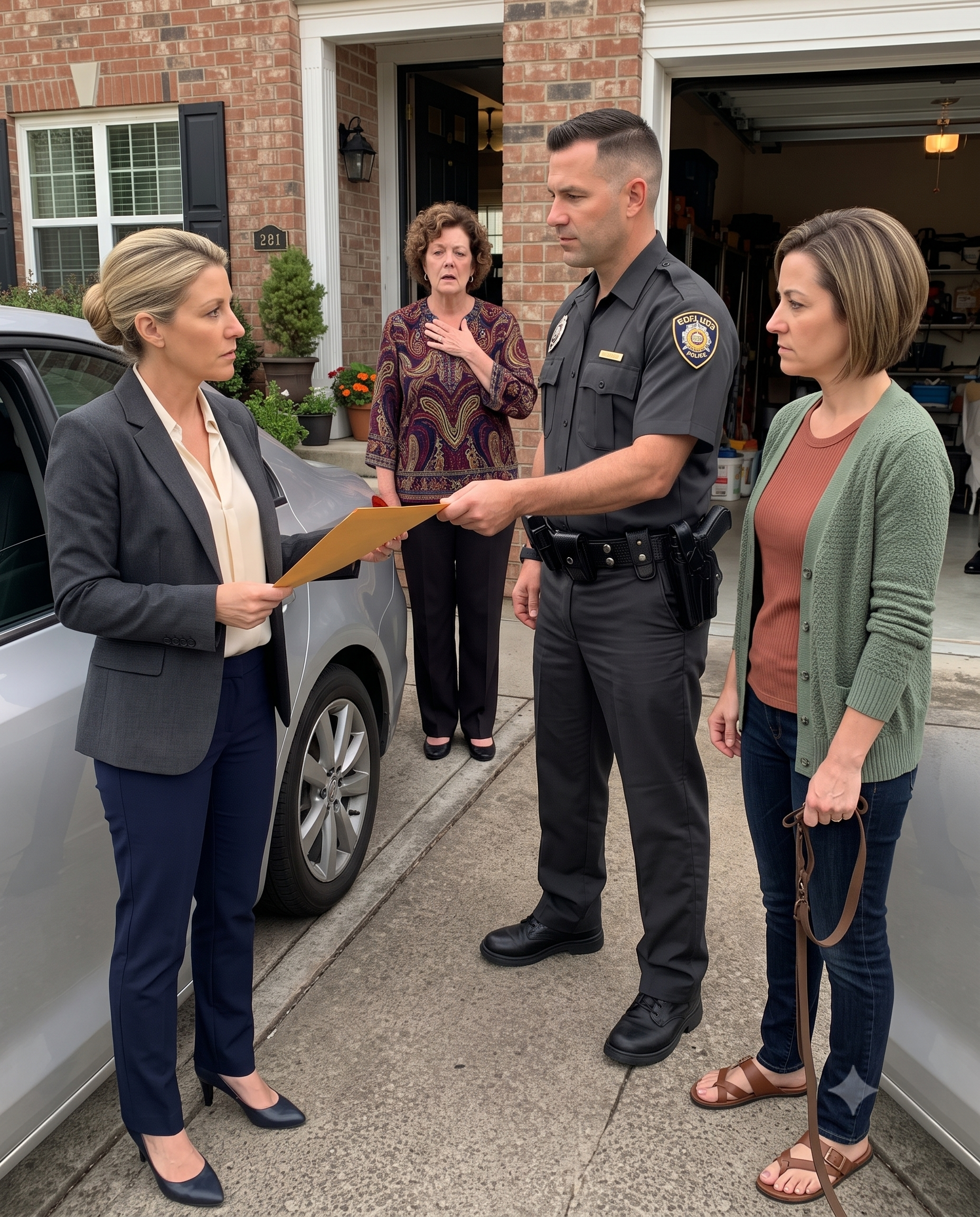
Officer Hayes arrived at her parents’ house and calmly asked one question.
“Who legally owns the dog?”
Olivia handed him the documents.
When Marissa arrived, she initially acted confident.
“I didn’t sell him,” she said. “I rehomed him.”
“Did Olivia give you permission?” the officer asked.
Marissa avoided answering.
Then a message appeared on her phone.
Olivia could read part of the preview:
“If the owner calls, I told her…”
Officer Hayes asked for the buyer’s information.
Eventually, Marissa admitted she had accepted money from a woman she found through a community page.
Before she could invent another excuse, Olivia’s phone rang.
A woman named Karen explained that she had bought a dog from Marissa that morning. She had been told the previous owner was moving away and no longer wanted him.
But the dog would not eat.
He had hidden beneath her dining table and cried whenever she touched his leash.
“His tag says Milo,” Karen said. “He keeps running to the window and looking outside.”
PART 3 — HE FOUND HIS WAY HOME
Officer Hayes drove Olivia to Karen’s house.
The front door opened before they reached the steps.
Milo rushed outside.
He struck Olivia’s knees with enough force to nearly knock her down, then pressed both paws against her chest. His entire body trembled as she dropped to the pavement and wrapped her arms around him.
Karen began crying too.
She had genuinely believed she was helping a dog whose owner could no longer care for him.
Then she showed Olivia the original advertisement.
Marissa had posted Milo online the morning after the failed retirement party—days before Olivia’s work trip.
The listing claimed his owner no longer wanted him and included a photograph taken in her parents’ garden.
Olivia stared at the date.
Her family’s offer to watch Milo had never been a peace offering.
It had been a trap.
Karen gave the police screenshots of every message. Officer Hayes asked Olivia whether she wanted to press charges.
For a moment, old habits returned.
Olivia thought about holidays, relatives and the consequences of reporting her own sister. She had spent her life being the reasonable one, absorbing the damage so everyone else could remain comfortable.
Then Milo pressed his shaking body against her.
“Yes,” Olivia said.
Marissa was processed that afternoon. She received a court date, a restitution order and a permanent mark on her record.
That night, Olivia’s mother left several voicemails. Some were tearful. Others were furious. She accused Olivia of destroying her sister’s future “over a dog” and threatened to remove her from the family unless she dropped the case.
Olivia listened to every message, waiting for one thing.
An apology.
None came.
She deleted them all.
Her father texted that her mother was sick with worry.
Olivia replied, “Milo was sick under a stranger’s table because of what you did.”
He never answered.
After the case ended, Olivia changed her locks, removed her parents as emergency contacts and stopped giving them access to her home.
The practical changes took less than an hour.
The emotional recovery took much longer.
She still missed her mother sometimes. But Olivia finally understood that missing someone did not mean allowing them to hurt her again.
Milo recovered more quickly.
Within weeks, he stopped fearing the leash. A month later, he was sleeping on his back in the centre of the living room, completely relaxed.
Karen later arrived with a new stuffed duck and a note that read:
“He deserves two.”
Olivia cried as she hugged her.
No family meeting followed. No perfect apology ever arrived. Her parents never admitted that they had spent years treating Olivia’s usefulness as though it were the same as love.
But Olivia no longer needed their confession to understand the truth.
For most of her life, her family had taught her that love meant paying, fixing, forgiving and always returning.
Milo taught her something simpler.
Real love does not require someone to surrender their dignity to keep the peace.
And when Milo had been taken away, he had not forgotten where he belonged.
He waited by the window.
He watched the road.
And the moment Olivia arrived, he fought his way back home.