Part 1: The Table for Leftovers
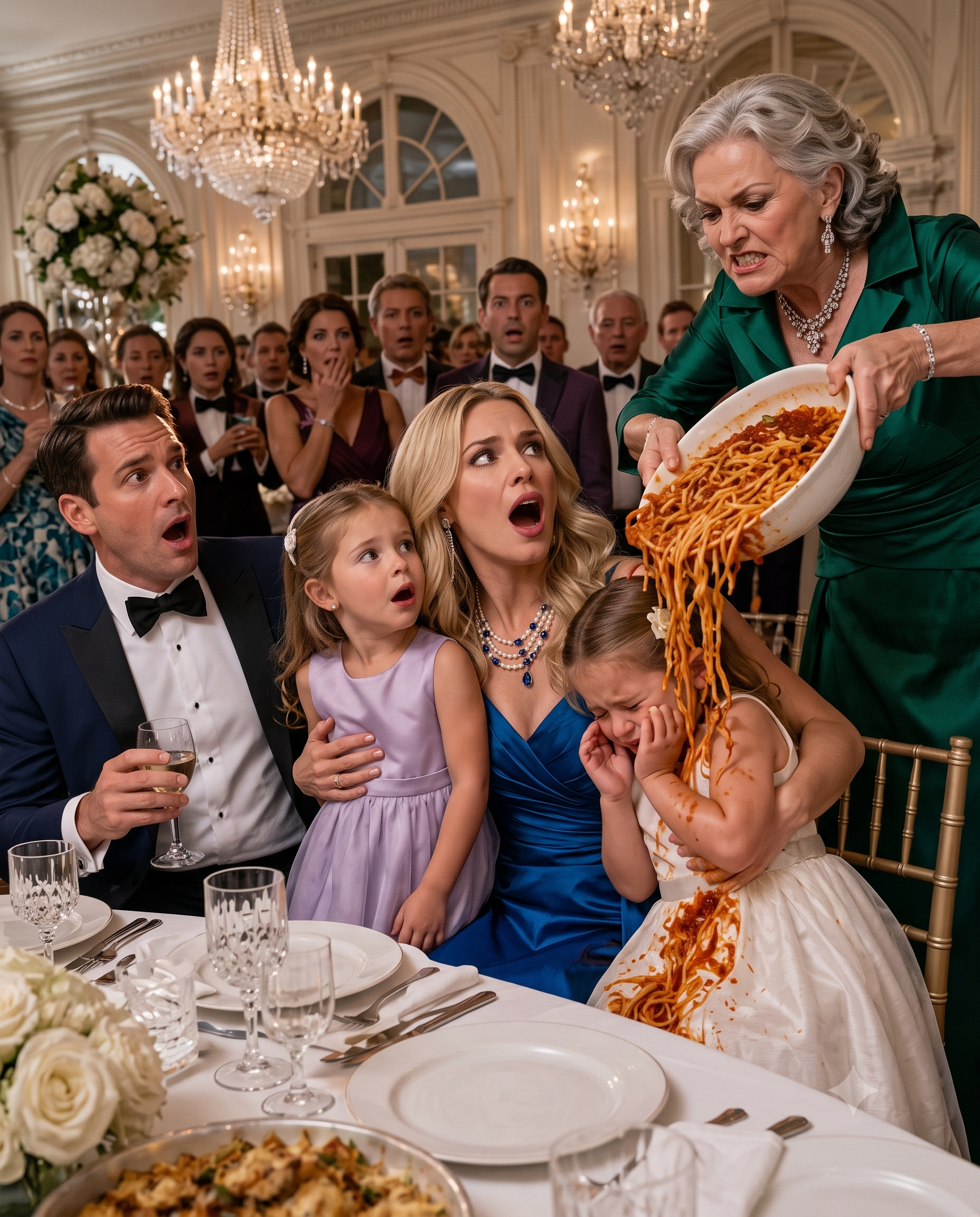
“That food isn’t for girls who won’t carry on the family name,” Patricia said, taking my daughters’ plates away right in front of everyone.
She did it without raising her voice, with the unsettling calm of someone who believed humiliation could also be a form of discipline. Sophia, eight years old, froze with her fork suspended in midair. Chloe, who was only five, stared at her fish fillet as though she couldn’t understand why a grandmother would take dinner away from her in the middle of a celebration.
The party was being held at a rented private estate on the outskirts of Charlottesville, Virginia, although my husband, Andrew Vance, had spent weeks bragging that he had finally bought the place. Long tables were covered with white tablecloths and outrageously expensive floral arrangements. Uniformed servers moved among the guests, a live chamber ensemble played nearby, and almost ninety relatives raised their glasses to “the man who had restored the Vance family name.”
I was seated with my girls at a table off to the side, almost beside the gardens, far from the head table where Andrew laughed with his brothers, uncles, and business partners. According to his mother, that was where we belonged: close, but not too close; present, but never in the way.
Patricia approached wearing an ivory suit, a pearl necklace, and a smile that never reached her eyes.
Without asking, she picked up Sophia’s plate and then Chloe’s.
“Grandma, I was still hungry,” Chloe murmured.
Patricia gave a dry little laugh.
“Sweetheart, the main table is for women who give this family sons. Your mother should understand that by now.”
A few aunts lowered their eyes. One cousin pretended to answer a text. Nobody said a word.
Then Patricia placed a plastic tray of cold leftovers in front of us: clumped rice, stale bread, crushed vegetables, and spilled sauce. As she pushed it toward us, a red sauce stain splattered across Chloe’s yellow dress and onto Sophia’s cheek.
My older daughter didn’t cry. That was what hurt the most. She simply turned toward her father, waiting for him to stand up.
Andrew saw us. He raised his glass from the head table and called out:
“Lauren, don’t start with your drama. Mom knows how these things are handled. Let me enjoy my day.”
My day.
He didn’t say “our daughters.” He didn’t say “my mother was wrong.” He said nothing that could preserve even a little dignity for those two little girls.
I picked up a napkin and wiped Sophia’s cheek. Then I cleaned Chloe’s dress with the same careful patience you use when clearing something fragile from the floor so your children won’t get hurt.
For eleven years, the Vance family had believed I was a wife who lived off her husband. Andrew had told them I worked part-time showing modest apartments. His mother introduced me as “the little girl who got lucky and married well.”
At Christmas, they gave me mops, detergent, and aprons “as a joke,” while my sisters-in-law received designer handbags. Patricia said I should be grateful Andrew had stayed with me despite her disappointment that we didn’t have a son.
What none of them knew was that I was the founder and majority owner of Vance & Horizon Capital, an investment and development firm with commercial projects across Atlanta, Charlotte, and Washington, D.C.
They also didn’t know that the Charlottesville estate didn’t belong to Andrew.
And they certainly didn’t know that inside my purse was a copy of a $350,000 promissory note bearing his signature.
I slowly stood up. I lifted Chloe into my arms, took Sophia by the hand, and looked at Patricia one last time.
“Enjoy the head table,” I said. “Sometimes the leftovers aren’t on the plates. They’re the people sitting around them.”
Andrew shot to his feet, visibly angry.
“Lauren, don’t you dare embarrass me!”
I didn’t answer. I walked toward the exit with my daughters while the music continued playing and everyone pretended not to watch.
But before we crossed the estate’s arched doorway, Sophia squeezed my hand and asked a question that changed everything for me:
“Mom, is Dad ashamed of us?”
And in that moment, I realized the worst of it hadn’t even begun…
Part 2: The Price of Pretending
I didn’t answer right away because any lie would have been another way of betraying them.
I got them into the car, locked the doors, and drove to a small scenic overlook where the road was quiet. Chloe kept touching the stain on her dress. Sophia stared out the window as if she had aged years in a single afternoon.
I climbed into the back seat and sat between them.
“No, my girls,” I said, wrapping my arms around them. “You are not an embarrassment. You never have been.”
“Then why didn’t Dad stand up for us?” Sophia asked.
I took a deep breath. For years, I had softened the truth to protect Andrew’s image. I would say he was tired, that his mother was difficult, that old-fashioned families had ugly traditions. But a little girl doesn’t need polished explanations after someone has just taken away her food in front of ninety people.
“Because your father chose to stay on his mother’s good side instead of protecting your hearts,” I answered. “And I was wrong for allowing that to happen so many times.”
Chloe buried her face against my arm.
“Do we have to go back?”
“No,” I said. “Never again to a table where someone tells you that you’re worth less.”
I turned on my phone only long enough to call my attorney. Then I switched it off. I already had more than twenty missed calls from Andrew in less than fifteen minutes.
While the three of us drove south toward Charlottesville’s quiet countryside, back at the estate, the performance my husband had built was beginning to go up in flames.
I learned what happened later through videos, voice memos, and text messages that some relatives sent me—not out of affection, but because when an arrogant man falls, everyone wants to be close enough to hear the crash.
At 7:30 that evening, the catering manager approached Andrew carrying a black leather folder. The final bill for food, drinks, music, decorations, and staffing came to more than $120,000. Andrew smiled, pulled out his metal credit card, and placed it on top of the folder as though he were signing a monument to himself.
“Charge the whole thing,” he said. “That’s what I work for.”
The card was declined.