Chapter 1: The Dissonance in the House of Vance
In my profession as an architectural acoustician, you are trained to detect structural rot not by what you can see, but by what you hear. A hollow echo beneath a floorboard, a microscopic vibration in a load-bearing wall—these are the subtle, invisible frequencies of impending collapse. I spent my days designing soundproof sanctuaries for corporate giants, yet I had spent the last eight years utterly deaf to the silent screams echoing within my own family.
It was a suffocating Saturday afternoon in late November, the air inside The Vance Estate thick with the scent of lemon oil, old money, and unspoken ultimatums. My daughter, Chloe, was scheduled to perform at the annual winter conservatory recital in less than two hours. At only eight years old, she possessed a preternatural gift for the piano, her small hands capable of coaxing profound emotion from the cold ivory keys. But today, she wasn’t playing music; she was simply striking notes with a frantic, terrified mechanical stiffness.
I stood in the doorway of the grand parlor, watching her hunched over the massive Steinway. Her shoulders were drawn up to her ears, defensive and rigid. She repeatedly fumbled the bridge of a Chopin nocturne, her breath hitching every time she made an error.
“Take a breath, sweetie,” I murmured, stepping into the cavernous room. “It’s just a song. You’ve played it perfectly a hundred times.”
Chloe flinched violently at the sound of my voice. She pulled her hands into her lap, staring down at the suffocating velvet fabric of her recital dress as if it were a straightjacket.
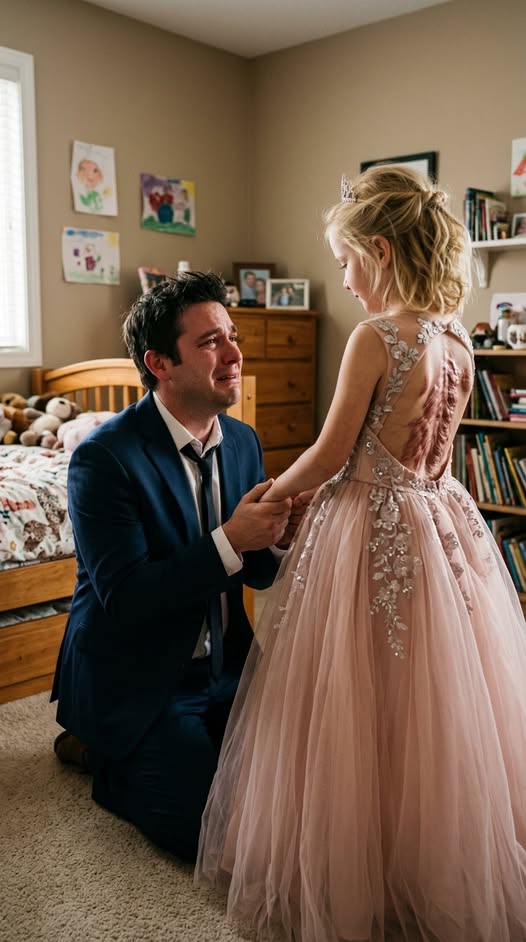
I crossed the Persian rug, my heart performing a strange, heavy stutter. Something was fundamentally wrong in the room’s atmosphere. I knelt on the polished hardwood floor, dropping to one knee to meet her eye level.
“Chloe? Look at me, bug.”
She refused to lift her chin. Her lower lip trembled, and a solitary tear carved a glistening path down her pale cheek.
“What’s hurting you?” I asked, keeping my voice as low and steady as the foundation of a building. “Are you nervous about the crowd? Because we don’t have to go. We can stay right here and watch cartoons.”
Slowly, with a terror that made my blood run instantly cold, Chloe reached around to the back of her velvet dress. With trembling, hesitant fingers, she pulled the heavy fabric up, exposing the tender skin just below her left shoulder blade.
The air was violently sucked from my lungs.
Stamped across her fragile, porcelain skin was a constellation of purplish-black bruises. They weren’t random splotches from a playground fall. They were sickeningly deliberate. Four distinct, oval-shaped contusions aligned perfectly with a thumb mark beneath them. It was a handprint. A massive, adult handprint, pressed into my child’s flesh with enough venomous force to rupture the blood vessels beneath.
A cold dread coiled tightly in my gut, quickly superheating into a blinding, homicidal rage. I forced myself to swallow the bile rising in my throat. I could not terrify her any further.
“Chloe,” I whispered, my voice sounding like it belonged to a stranger. “Who hurt you like this?”
She squeezed her eyes shut, a dam breaking as she burst into frantic, breathless sobs. She threw her small arms around my neck, burying her face into the collar of my shirt.
“It was Grandpa Richard,” she wailed, the words muffled against my chest but ringing with the clarity of a death knell. “He said I wasn’t practicing hard enough. He said I was going to embarrass the family.”
Richard Vance, my father-in-law, was the patriarch of this sprawling estate. He was a retired, highly respected academy principal—a man who had spent forty years molding the local youth, building a reputation as a pillar of aristocratic morality. To the outside world, he was a generous philanthropist. Inside these walls, he was a tyrannical monarch whom the entire bloodline feared to contradict.
As I held my weeping daughter, gently rubbing the back of her head, the heavy mahogany doors of the parlor suddenly swung wide open.
My wife, Vivienne, swept into the room in a cloud of expensive Chanel perfume and agitated energy. She was dressed in a pristine emerald gown, her makeup flawless, her smile tight and artificial.
“Miles, what on earth are you doing on the floor?” Vivienne snapped, tapping her diamond-studded watch. “We need to leave in ten minutes. The photographer is already at the concert hall, and my father is waiting in the foyer. Hurry up.”
I didn’t let go of Chloe. I slowly turned my head to look at my wife, the mother of my child, and the terrifying realization of what I had to do next solidified in my chest.
But before I could speak, Vivienne’s eyes darted to Chloe’s exposed back. Her flawless mask slipped for a fraction of a second, revealing a flash of deep, unmistakable recognition.
She already knew.
Chapter 2: The Architecture of Denial
I slowly rose to my feet, positioning my body like a physical shield between my weeping daughter and her mother.
“You knew,” I said. It wasn’t a question. It was an indictment.
Vivienne’s eyes darted frantically toward the open parlor doors, terrified that the sound of my voice might carry down the marble hallway to where her father was holding court. She rushed forward, grabbing the hem of Chloe’s dress and violently yanking it down to cover the bruised flesh.
“Keep your voice down, Miles!” she hissed, her manicured hands fluttering nervously. “You are completely overreacting. It’s not what it looks like.”
“It looks like a grown man grabbed our eight-year-old daughter with enough force to leave internal bleeding,” I countered, stepping into Vivienne’s personal space, forcing her to step back. “She just told me Richard did this.”
“My dad is just a little strict with her practice schedule!” Vivienne fired back, her voice climbing an octave into a frantic, defensive whine. “He’s from a different generation, Miles. He demands excellence. He would never intentionally harm her.”
I stared at the woman I had married, feeling as though a fault line had just cracked wide open straight through the center of my chest.
“Mommy told me to be quiet,” Chloe whimpered from behind my legs, her small hands gripping the fabric of my trousers. “I showed her yesterday. She told me Grandpa was just helping me be a winner.”
The room spun. The opulence of the Vance Estate—the crystal chandeliers, the imported silk drapes, the curated oil paintings—suddenly looked like the walls of a grotesque slaughterhouse. Vivienne hadn’t just turned a blind eye; she had actively silenced our child’s cries for help to protect her father’s pristine social image. She had sacrificed her own flesh and blood on the altar of the Vance family reputation.
“We are not going to the recital,” I announced coldly, my tone devoid of any negotiation. I reached down and firmly took Chloe’s small, trembling hand in mine. “We are leaving. Right now.”
Vivienne instantly lost her temper. The polite society smile vanished, replaced by the vicious snarl of a cornered animal defending its master. She lunged sideways, physically blocking the parlor doorway.
“You will do no such thing!” she commanded, her voice dropping into the authoritative cadence she had inherited directly from Richard. “Do you have any idea how many board members are waiting at that concert hall? Do you know how this will look if we don’t show up? You are not going to humiliate this family over a misunderstood bruise!”
I raised my free hand, my palm flat, silencing her mid-sentence.
“Your family,” I said softly, staring dead into her panicked eyes, “is a disease. And I am amputating it.”
I didn’t wait for her to respond. I stepped forward, using my shoulder to brush past her with enough force to make her stumble back against the doorframe. I kept Chloe tucked safely under my arm, shielding her face as we marched down the grand hallway, completely ignoring Richard Vance as he barked my name from the foyer. We burst through the heavy front doors, out into the biting November wind, and climbed into my car.
As I threw the vehicle into drive and sped down the winding, manicured driveway, my phone began to vibrate violently in the center console. I glanced at the screen. It wasn’t Vivienne.
It was Richard.
I let it go to voicemail. A minute later, a transcribed message popped up on my dashboard display. I read the words as the blood drained from my face.
“Miles. You have exactly one hour to return my granddaughter to this house. If you take her, I will unleash every lawyer on my payroll. I will have you declared mentally unfit, I will take sole custody, and you will never see her again. Turn the car around. Now.”
I gripped the steering wheel until my knuckles turned bone-white. The true war hadn’t just begun; I was already surrounded. I stepped on the gas, driving toward the city, knowing I had less than sixty minutes to build an impenetrable fortress around my little girl.
Chapter 3: The Fortress of Solitude
I bypassed the local clinics—where Richard undoubtedly had board connections and golf buddies—and drove forty miles across county lines to a specialized child advocacy center.
The building was unassuming, smelling faintly of sterile floor wax and lavender air freshener, a stark contrast to the suffocating lemon oil of the Vance Estate. For three agonizing hours, I sat in a waiting room illuminated by humming fluorescent lights, staring at the scuffed linoleum floor while medical professionals and a trauma-informed social worker spoke gently to my daughter in a secure room down the hall.
Throughout the entire afternoon, my cell phone vibrated relentlessly. The screen illuminated every few minutes with a fresh barrage of texts from Vivienne.
“You are destroying us.”
“Come back before Dad calls the judge.”
“How could you cause a family disaster on the day of her recital? People are asking questions!”
“Miles, please, the social fallout from this will be unrecoverable.”
I scrolled through the twenty-seven messages, a bitter, hollow clarity washing over me. Not a single text—not one—asked how Chloe was feeling. Not once did my wife ask if the bruises were deep, if her daughter was crying, or if she would ever emotionally heal. Vivienne was exclusively mourning the death of a public relations campaign.
When Dr. Aris, the lead pediatrician, finally emerged from the evaluation room, her face was grim. She handed me a thick, sealed folder.
“The physical evidence is undeniable, Mr. Vance,” she said quietly, handing me a card for a family court attorney. “Combined with Chloe’s verbal testimony, we have legally mandated grounds to file an immediate protective order against Richard Vance. Your daughter is incredibly brave. But she is going to need a lot of quiet time to unlearn the terror she was subjected to.”
I took the folder, feeling the immense, crushing weight of the legal battle looming ahead.
The next six months were a masterclass in psychological warfare. Richard attempted to deliver on his threat, burying me under an avalanche of emergency custody filings, defamation lawsuits, and vicious character assassinations. But he had underestimated the immutable power of clinical evidence, and he had vastly underestimated a father who had absolutely nothing left to lose.
I drained my savings, hired the most ruthless litigator I could find, and fought them in the dark, unglamorous trenches of the family court system.
We moved out of the city, taking up residence in a modest, two-bedroom rented townhouse on the quiet side of a new town. There were no chandeliers here, no velvet drapes, and no unyielding expectations. Just peeling wallpaper, the smell of fresh coffee, and safety.
I bought a beautiful, secondhand upright Yamaha piano and placed it right in the center of the living room. But for the first four months, Chloe refused to touch it. Every time she walked past the keys, her small shoulders would tense, anticipating the phantom strike of a heavy hand. I didn’t push her. I simply let the instrument sit there, waiting patiently in the sunlight.
Then, one rainy Tuesday evening in April, as I was cooking dinner in the kitchen, a sharp, authoritative knock hammered against our front door.
My heart seized in my chest. The protective order forbade Richard from coming within five hundred yards of us, but men like him rarely believed the law applied to their bloodline. I wiped my hands on a dish towel, my pulse hammering against my ribs, and walked quietly to the door.
I looked through the peephole, bracing myself for a confrontation.
But it wasn’t Richard standing on my porch. It was Vivienne.
She looked nothing like the emerald-clad socialite from the recital. Her hair was damp from the rain, her designer coat was wrinkled, and the arrogant fire in her eyes had completely burned out. She was clutching a thick, manila envelope stamped with the crest of the state family court.
I cracked the door open, leaving the heavy brass chain engaged.
“What do you want, Vivienne?” I asked, my voice devoid of any warmth.
She looked up at me, a tear mixing with the rain on her cheek, and slid the envelope through the narrow gap in the door.
“He lost, Miles,” she whispered, her voice cracking with the weight of utter defeat. “My father lost his appeal this morning. And… and I’ve lost everything else.”
Chapter 4: The Melody of Courage
I took the envelope, breaking the seal as the rain poured behind her. Inside were the final, court-stamped decrees. Richard Vance was permanently stripped of all contact rights, facing impending criminal charges for child endangerment. Vivienne, having been formally documented as an enabler who willfully ignored the abuse, was stripped of her joint custody.
She had finally accepted the brutal, undeniable truth: the pristine social image she had worshipped had entirely collapsed, leaving her standing in the rubble with absolutely nothing.
“The judge granted me supervised visits,” Vivienne stammered, wrapping her arms around her shivering frame. “Two hours a month. I know… I know I don’t deserve it. But I want to see her, Miles. Please.”
I looked at the shattered woman on my porch. The rage that had sustained me for months had slowly evaporated, replaced only by a profound, heavy pity.
“You can see her when she asks to see you,” I replied firmly. “And not a second before.” I closed the door, locking it tight against the storm.
It took three more months of intense therapy with Dr. Aris before Chloe finally began to thaw. The hyper-vigilance slowly melted from her posture. She began to laugh louder, run faster, and one morning in late June, I woke up to the tentative, beautiful sound of a C-major scale drifting from the living room.
She had finally returned to the piano. But this time, she wasn’t playing to survive. She was playing to heal.
By mid-July, the summer air was thick and warm. Chloe had independently composed a beautiful, complex piece of music—a melody she had started writing before the abuse escalated, but had never possessed the courage to finish. She decided she wanted to perform it. Not in a grand concert hall. Not for board members or local aristocrats.
She wanted a small, private recital right here in the living room of our rented townhouse.
We arranged ten folding chairs in the small space. The guest list was exclusively curated by Chloe: Dr. Aris, her new art teacher, a few friends from her new school, and myself.
And, to my profound surprise, she had hand-written an invitation for her mother.
Ten minutes before the performance, the front door opened. Vivienne walked in, accompanied by the court-mandated supervisor. She looked small, stripped of her arrogance, carrying a modest bouquet of sunflowers. She didn’t try to take over the room. She stood awkwardly near the entryway, her eyes locked on her daughter, brimming with a desperate, painful regret.
Chloe stood by the Yamaha, wearing a simple yellow sundress—no suffocating velvet, no scratching lace. She looked incredibly tall, incredibly brave.
Before sitting down at the bench, Chloe walked over to me. She tugged gently on the sleeve of my shirt. I dropped to one knee, just as I had on that horrific day in November, but this time, there was no terror in her eyes. Only a resilient, quiet strength.
She leaned in, her warm breath tickling my ear.
“Dad,” she whispered softly, her eyes darting toward the entryway. “Can Mom sit in the very back row?”
A tight, emotional knot formed in my throat, but I swallowed it down and offered her the widest, proudest smile I could muster.
“Of course she can, bug. It’s your house. It’s your rules.”
I stood up and gently directed Vivienne to the furthest folding chair in the back corner of the room. She sat down silently, gripping the sunflowers, understanding with agonizing clarity that she was no longer the director of this family; she was merely a spectator who was lucky to be granted admission at all.
I took my seat in the front row, just inches from the instrument.
Chloe sat on the wooden bench. She adjusted her posture, rolled her small shoulders back, and took a deep, cleansing breath. She raised her hands, hovering them over the keys for a fleeting second of absolute silence.
Then, she brought her fingers down.
The music that filled the tiny townhouse wasn’t mechanical, and it wasn’t frantic. It was a rich, soaring, deeply complicated melody. It held notes of sorrow, echoing the pain of the winter we had survived, but it resolved into a sweeping, triumphant crescendo of pure, unadulterated hope.
As I sat there, listening to my daughter finish her uncompleted melody, a tear slipped down my face. The Vance legacy of control and silence had been completely shattered. In its place, built upon the foundation of a secondhand piano and a father’s unyielding love, a new resonance had finally begun.