Chapter 1: The Blind Spots We Choose
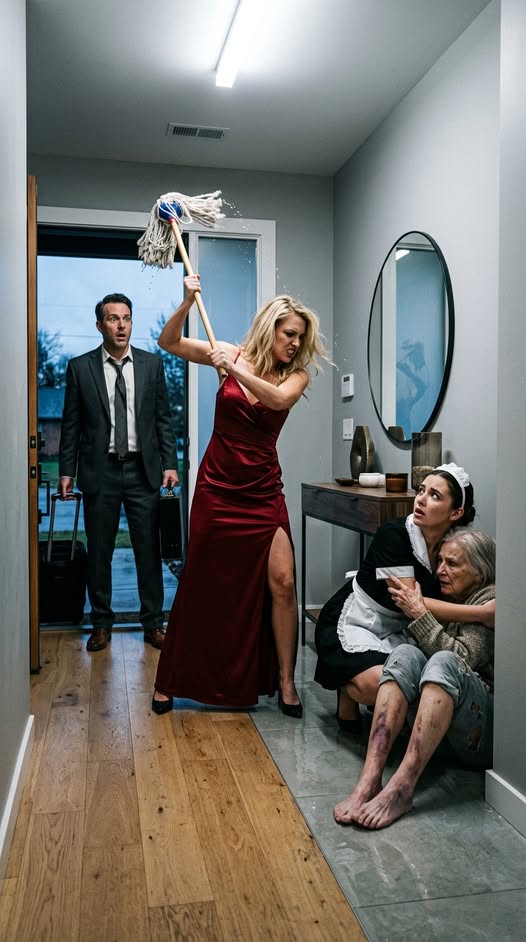
In my line of work, you are trained to look for vulnerabilities. As a senior architect of industrial surveillance networks, I spend my life designing encrypted digital fortresses for oil refineries and offshore rigs. I know exactly how to map a perimeter, how to eliminate blind spots, and how to anticipate a breach. Yet, for all my professional paranoia, the most catastrophic security failure of my life occurred not in a corporate server room, but in the sunlit foyer of my own home.
The first sound that greeted me after an grueling, eight-month deployment in Saudi Arabia was not the welcoming voice of my wife. It was the raw, guttural shriek of my mother.
The heavy leather of my travel duffel slipped from my grip, hitting the imported oak floorboards with a dull thud. My combat boots skidded against the polished wood as I sprinted down the hallway, the blood roaring in my ears like a jet engine. I rounded the corner into the expansive, marble-countered kitchen, and the world entirely ceased to spin.
My wife, Vanessa, stood perfectly balanced over the crumpled form of my seventy-eight-year-old mother, Evelyn Hale. In Vanessa’s right hand, suspended high above her shoulder like a primitive executioner’s axe, was a heavy, maple stirring spoon.
Mom was sprawled on the cold tile, her frail legs tangled in the wheels of her overturned medical chair. But it was the space between them that made my heart physically stutter. Crouched protectively over my mother’s fragile frame was Elena, our twenty-six-year-old housekeeper. Elena was using her own narrow shoulders as a human shield. A violent streak of crimson blood was currently mapping a path from a fresh, jagged split above Elena’s left eyebrow, dripping steadily onto the white collar of her uniform.
“Stop!” I roared, the command tearing from my throat with enough concussive force to rattle the glass in the cabinet doors.
Vanessa froze. She pivoted slowly on her designer heels. For a microscopic fraction of a second, raw, naked terror hijacked her flawless features. She looked exactly like a cornered predator caught in the beam of a high-powered spotlight. Then, with a sociopathic fluidity that made the hair on my arms stand up, the terror vanished. The corners of her mouth stretched into a serene, sickeningly sweet smile.
“Daniel, darling,” she cooed, her voice smooth as expensive silk. She casually lowered the wooden spoon, resting it on the granite island as if she had merely been caught tasting a simmering sauce. “You’re home a week early.”
I stepped into the room, placing myself between the women on the floor and my wife. “What in God’s name is happening here?”
Vanessa let out a light, breathy chuckle, waving a dismissive hand. “Your mother was just having another one of her little dementia tantrums. She knocked her own chair over. I was simply trying to restore some order to the house. You know I have to be strict, or she won’t learn her lesson.”
Behind me, Mom’s trembling, arthritic fingers gripped the blood-stained fabric of Elena’s sleeve. Her voice, weakened by a minor stroke a year prior, was a ragged, terrified whisper. “Danny… she locks me in the dark. She locks the door.”
Vanessa rolled her eyes dramatically, crossing her arms over her cashmere sweater. “Oh, please. She’s completely confused, Daniel. You know how geriatric patients get. The hallucinations are getting worse.”
A violent, chaotic energy demanded that I shatter the marble island with my bare hands. I wanted to tear the kitchen apart. Instead, the glacial, calculating discipline of my profession took over. I didn’t scream. I didn’t argue. I reached into the breast pocket of my jacket, retrieved my phone, and dialed emergency services.
Vanessa’s artificial smile instantly evaporated, replaced by a jagged sneer. “What are you doing? Put that away. You are embarrassing me in front of the help.”
“No, Vanessa,” I replied, my voice dropping to a register so cold it barely sounded human. “You managed to do that entirely by yourself.”
Fifteen minutes later, the flashing red and blue lights of an ambulance painted the walls of our living room. While the paramedics carefully elevated Mom onto a stretcher and applied a pressure bandage to Elena’s bleeding skull, Vanessa shadowed me through the corridors of the house, hissing a steady stream of venomous poison into my ear.
“You have been halfway across the planet for eight months,” she spat, her fingernails biting into my bicep. “You have absolutely no idea what I have endured! Your mother is impossibly cruel, and that immigrant girl has been filling her senile head with absolute lies to extort us for higher wages!”
I ignored her, my eyes locked on the paramedics wheeling the stretcher toward the front door. As they passed, Elena locked eyes with me. Despite the gauze taped over her eye, her gaze was piercing, lucid, and desperate.
“Mr. Hale,” Elena whispered quickly, ensuring her voice carried under the noise of the EMT radios. “Please. You have to check the blue sewing box in the back of your mother’s closet.”
Vanessa heard her. With a feral hiss, my wife lunged forward, her hands outstretched toward Elena’s face. A burly paramedic effortlessly stepped into her path, blocking her with a thick forearm.
“Back up, ma’am. Give the patient space,” he barked.
I stood in the doorway, watching the ambulance doors slam shut. The puzzle pieces in my mind were suddenly shifting, locking into a terrifying new configuration. This was not merely a case of caregiver burnout. This was not a clash of personalities. The sheer panic in Vanessa’s eyes when Elena mentioned the closet told me a much darker truth.
Before I had left for Riyadh, Mom had moved into the guest suite to recover from her stroke. Vanessa had aggressively insisted that she could manage the caretaking alone, demanding we fire all external help. I had hired Elena anyway, believing an extra pair of hands would alleviate the burden and protect them both. Vanessa had thrown a massive fit, calling the financial expense “deeply insulting.”
Now, staring at the blood on my kitchen floor, I finally understood exactly why she wanted my mother isolated.
During my deployment, Vanessa had operated under the assumption that the geographical distance had made me entirely blind, emotionally dependent, and hopelessly easy to manipulate. She had openly mocked my routine phone calls inquiring about bank statements, and she had aggressively labeled me clinically paranoid when I insisted on upgrading the estate’s security protocols a month before my departure.
What my beautiful, treacherous wife fundamentally failed to understand was the nature of my expertise. The camera nodes I had installed throughout the property did not merely stream a live feed to a vulnerable, hackable wall monitor in the den. They were military-grade. They encrypted every single frame of audio and video, routing the data through a localized firewall before uploading redundant copies to a private, offshore server entirely under my sovereign control.
Three months into my deployment, Vanessa had confidently ordered a local contractor to rip out every visible camera lens in the house, claiming they violated her privacy.
She had never found the hidden ones.
Chapter 2: The Archive of Sins
The sterile, iodine-scented air of the emergency room served as the backdrop for the worst night of my life. The attending physician grimly documented the catastrophic reality of my mother’s “care.” Beyond the immediate bruising from the fall, he found severe, chronic dehydration, malnutrition, and a hairline fracture in her left wrist that had been left entirely untreated for weeks. Elena required six heavy sutures to close the gash above her eye.
I sat in the dim, rhythmic glow of the cardiac monitors beside Mom’s hospital bed, holding her fragile hand until the sedatives finally pulled her into a restless sleep. Once her breathing steadied, I unzipped my travel bag, pulled out my encrypted laptop, and connected to the hospital’s secure Wi-Fi network.
My fingers flew across the keyboard, bypassing three layers of biometric authentication before the surveillance archive finally populated on the screen.
The server contained exactly one hundred and twelve days of high-definition, unblinking truth.
I took a slow, agonizing breath, and clicked on a flagged file from six weeks prior. The video player launched, illuminating my face in the dark hospital room.
In the first frame, Vanessa was not acting alone.
Her older brother, Marcus, stepped into the frame of the hidden dining room camera. He was grinning, carrying a thick leather folio of legal documents under one arm and an expensive bottle of Laurent-Perrier champagne in his free hand.
The timestamp in the corner glowed ominously. I watched, my stomach twisting into a cold, hard knot, as they wheeled my mother up to the massive mahogany dining table. She looked incredibly small, exhausted, and visibly terrified. Vanessa uncapped a heavy gold fountain pen and forcefully pressed it into Mom’s trembling, arthritic fingers.
“Just sign on the dotted line, Evelyn,” Vanessa demanded, her voice lacking any of the honeyed warmth she used in public. “Daniel emailed me this morning. He wants the deed to the house transferred into my name before his Saudi contract ends. For tax purposes.”
Mom weakly shook her head, trying to push the heavy parchment away. “No… Danny wouldn’t do that. He would call me. He would tell me himself.”
Marcus leaned across the table. He moved close enough to the hidden microphone embedded in the chandelier above them that the audio captured the wet, sickening sound of his breathing.
“Listen to me, you withered old bat,” Marcus snarled, slamming his fist onto the table, causing my mother to flinch violently. “You are going to sign this power of attorney, or I promise you, your next ‘accidental’ fall down the staircase is going to break your neck.”
I sat in the hospital chair, watching the footage play out, until the roaring inferno of my rage burned down into something infinitely more dangerous. A cold, absolute, and merciless calm settled over my ribs.
I closed the laptop and left the hospital room, driving straight back to the silent, empty house. Vanessa had wisely chosen to abandon the property for the night, likely seeking refuge at Marcus’s downtown condo to strategize her defense.
I walked straight to the guest suite, opened the closet, and retrieved the blue velvet sewing box Elena had protected with her blood.
Inside lay the unvarnished blueprints of their treason. Elena had compiled a devastating dossier. There were the original, physically forged power-of-attorney forms, dozens of carbon-copy withdrawal slips, and a meticulous, handwritten log Elena had kept tracking every missed medication, every denied meal, and every staged “accident.”
Vanessa and Marcus had spent the last four months attempting to systematically liquidate my mother’s life savings, trying to forcibly sell off a small, beloved rental property Mom owned in the suburbs, and attempting to place a massive, fraudulent lien against the primary estate. When Mom stubbornly resisted the paperwork, they pivoted to psychological warfare—isolating her, starving her, and manufacturing physical injuries to build a medical case for her severe mental incompetence.
It was a brilliant, vicious strategy, executed by a pair of sociopaths. But it hinged on one catastrophic, fatal assumption.
Vanessa assumed that this sprawling estate, purchased shortly after our wedding, was marital property. She assumed we owned it equally.
We did not.
My late father had possessed a profound, almost psychic distrust of Vanessa from the day he met her. Before he succumbed to cancer, he had placed the family’s entire liquid wealth and the deed to the house into an irrevocable generation-skipping trust. I was the sole managing trustee. My mother was the lifetime beneficiary. Vanessa had absolutely zero legal ownership interest in the home she was currently trying to steal. She had spent months boasting on the surveillance audio to Marcus that once I returned, she would leverage my guilt and “spineless affection” into signing everything over.
As the sun began to rise, casting long, pale shadows across my ruined kitchen, my phone vibrated in my pocket.
It was a text from Vanessa.
“I’m at the hospital. Working overseas changed you, Daniel. You are paranoid and unstable. Withdraw whatever insane police complaint you are drumming up, or I will publicly tell everyone you attacked me in the kitchen. Marcus has a friend who is a doctor. He’ll sign whatever injury report I need to put you in a cage.”
I stared at the screen. She was attempting to checkmate me with a phantom threat of domestic violence.
A second text chimed immediately after. It was a photograph.
It was an image of the heavy steel wall safe in my home office. The thick door was hanging wide open, the internal shelves completely gutted.
“You always were careless with your paperwork, darling,” her follow-up text read. “Let’s see how you fight me without your financial records.”
I didn’t panic. I simply pulled out my laptop, accessed the cloud server, and pulled up the hidden camera feed located above my office bookshelf.
The video loaded instantly. There was Marcus, forty-five minutes ago, using a high-powered angle grinder and a pry bar to forcefully break the locking mechanism of my safe, stuffing stacks of documents into a duffel bag.
I watched the clip, a dark, humorless smile touching my lips. The safe was a decoy. The actual trust documents and financial ledgers were stored in a subterranean safety deposit box at a downtown bank.
But Vanessa didn’t know that. What she also didn’t know was that by sending me that text, she had just documented a felony.
Chapter 3: The Decoy and the Snare
At exactly 7:00 a.m., I sat in the austere, glass-walled conference room of Priya Shah, the ruthless corporate attorney who managed the Hale Family Trust. I didn’t speak. I simply slid my laptop across the polished mahogany and hit play.
Priya, a woman known for her icy, unflappable demeanor in the courtroom, pressed her hand to her mouth as she watched the footage of Marcus threatening my mother, followed by the footage of the break-in.
“Do not confront them. Do not return any calls,” Priya instructed, her voice vibrating with professional fury as she began rapidly typing on her own terminal. “We are bypassing standard procedure. I am filing for immediate asset preservation orders, high-level banking alerts, and an emergency protective petition. I want them economically paralyzed before lunchtime.”
By noon, the financial trap had snapped shut. The bank’s fraud department flagged the forged wire transfers and permanently restricted the disputed accounts pending a federal investigation. Priya successfully petitioned a superior court judge for a temporary, ironclad restraining order that protected both my mother and the physical boundaries of the trust property.
I took the encrypted USB drives containing the surveillance footage and Elena’s handwritten logs directly to the precinct. I sat in a cramped interrogation room and walked two seasoned detectives through the unedited access logs, proving mathematically that the video files had not been spliced, deep-faked, or altered in any way.
Vanessa, entirely unaware that the ground was collapsing beneath her designer shoes, decided to double down on her offensive.
By mid-afternoon, my phone began blowing up with notifications. Vanessa had taken her campaign public. She posted a tearful, highly orchestrated manifesto on social media, claiming that I had abandoned her for months, returned from the Middle East wildly unstable and violent, and was currently manipulating my “tragically senile” mother into turning against her.
Friends, colleagues, and distant relatives began messaging me in droves. Some expressed deep concern; others, intoxicated by the drama, demanded explanations. Vanessa was attempting to win the war in the court of public opinion before a legal battle could even begin.
Then, one of the detectives stepped back into the precinct room, holding a tablet playing the footage of Marcus breaking open my office safe.
He paused the video on a clear, high-definition freeze-frame of Marcus’s face bathed in the sparks of the angle grinder.
“Mr. Hale,” the detective said, leaning against the cinderblock wall. “Your wife thought she was playing a messy divorce game. But they just forced entry, bypassed a security device, and stole what they believed were high-value financial instruments.” He looked at his partner. “They just upgraded this from a domestic dispute to aggravated burglary, grand larceny, and felony evidence tampering.”
The following morning, as I stood by the hospital window watching Elena gently read a novel to my sleeping mother, my phone rang.
It was Vanessa. I let it ring three times, controlling my breathing, before answering.
“Daniel,” she whispered. The venom was gone. Her voice was trembling, coated in a thick, artificial vulnerability that made my skin crawl. “This has gone too far. The police showed up at Marcus’s condo asking questions about a restraining order. Please, come home. We are still a family. Let’s sit down like adults and settle this privately.”
I looked through the glass at the bandages wrapped around my mother’s frail wrists.
“All right, Vanessa,” I replied, my voice perfectly neutral, yielding nothing. “If you want to negotiate, invite Marcus. Have him bring the documents he took. We’ll settle everything tonight at the house.”
I hung up before she could respond, feeling the final, heavy mechanism of the trap lock firmly into place.
Chapter 4: The Final Audit
I arrived at the house at 8:00 p.m.
Vanessa had spared no expense in staging the ultimate psychological theater. The dining room table—the exact same table where they had tortured my mother—was set with our wedding china. Candles flickered, casting a warm, deceptive glow across the room.
Marcus was already there, lounging arrogantly in my late father’s winged leather armchair at the head of the table. He held a crystal tumbler of my best scotch, looking entirely too comfortable. A thick, manila folder rested on the polished wood beside his drink.
Vanessa stood near the fireplace. She walked toward me, offering a sad, practiced smile, and actually attempted to kiss the air near my cheek.
“There he is,” Vanessa murmured, stepping back to admire her handiwork. “The reasonable, rational husband returns.”
I did not take off my coat. I remained standing just inside the threshold of the room, my hands shoved deep into my pockets. “Cut the theatrics. What exactly do you want, Vanessa?”
Marcus chuckled, a low, grating sound, and flipped open the folder. “It’s simple, Danny-boy. You are going to sign the deed of this house, and the overseas Saudi accounts, entirely over to Vanessa. You pack a bag, and you walk away. In exchange, my sister’s impending police complaint about your unhinged, violent outburst in the kitchen permanently disappears. You keep your freedom; she keeps her lifestyle. Everyone wins.”
I stared at the paperwork. “You mean the domestic violence complaint she has not yet officially filed?”
Vanessa’s smile tightened, her eyes flashing with irritation. “Do not test my generosity, Daniel. Sign the papers.”
I pulled my phone from my pocket and placed it face down on the dining table. “Before I sign anything, Marcus, I need you to explain a minor discrepancy. Why does my mother’s signature appear on the banking withdrawal forms in that folder?”
Marcus took a slow, arrogant sip of his scotch. “Because the old woman finally came to her senses and signed them. She wanted to help us out.”
“No,” I said, the word dropping into the quiet room like a lead weight. “You forged them.”
Marcus slammed his glass down. “Watch your mouth—”
The heavy oak front door of the estate swung open with a resounding crash.
The dining room went dead silent. Priya Shah marched into the foyer, flanked by the two seasoned detectives from the precinct and a stern-faced investigator from Adult Protective Services.
Vanessa staggered backward, the color draining from her face so rapidly she looked like a ghost in the candlelight. Marcus cursed, immediately reaching for the folder on the table, but the lead detective was faster. He slapped his hand down on the documents, pinning Marcus’s wrist to the wood.
“What the hell is this?” Vanessa shrieked, her voice shattering the quiet. “Daniel, what did you do?!”
“I’m giving you exactly what you asked for, darling,” I said coldly. “The private settlement.”
Priya stepped forward, slapping a stack of heavily stamped court orders onto the dining table. “The trust property is under federal lock. The disputed bank transfers are frozen. As of 1:00 p.m. today, Mrs. Hale, you are legally barred from coming within five hundred yards of Evelyn Hale, Elena Silva, or entering this residence ever again.”
Vanessa’s jaw dropped. She stared at me, hyperventilating. “You cannot throw me out of my own house! Half of this belongs to me!”
“It was never yours, Vanessa,” I replied. “The house belongs to the Hale Family Trust. You have no equity. You have no leverage. You have absolutely nothing.”
I turned my laptop around, facing the screen toward them, and pressed the spacebar.
The video began to play. At maximum volume.
The room was filled with the undeniable, high-definition reality of their sins. The audio echoed off the walls: Vanessa striking my mother. Marcus threatening to break her neck. Both of them openly discussing the mechanics of forging the deeds. And finally, the crystal-clear footage of Marcus destroying my safe with an angle grinder.
For the first time in the eight years I had known her, Vanessa had absolutely nothing to say.
She let out a primal scream and rushed at the laptop, attempting to smash it off the table. The second detective intercepted her, catching her wrist in a vice-like grip and spinning her around.
“She’s confused!” Vanessa wailed, tears of genuine panic finally streaming down her face. “The old woman is senile! Elena poisoned her against me! I was just trying to help!”
The APS investigator silently placed a stack of glossy 8×10 photographs beside the computer. They were high-resolution images of my mother’s extensive bruising, her untreated fracture, and the gaping wound on Elena’s head.
“The forensic medical evidence,” the investigator said flatly, “says otherwise.”
The collapse was spectacular. Marcus instantly tried to strike a plea bargain, throwing his sister under the bus, claiming the financial fraud was entirely Vanessa’s idea. Vanessa, sobbing hysterically, accused Marcus of being the physical aggressor. They blamed each other with such venomous speed that the room became suffocatingly quiet around their desperation.
The click of the handcuffs was the loudest sound in the room. Both were arrested on the spot.
The ensuing legal bloodbath lasted nine agonizing months. Confronted with the insurmountable mountain of encrypted audio and video, Vanessa’s defense attorneys urged her to surrender. She pleaded guilty to felony elder abuse, financial coercion, grand fraud, and unlawful imprisonment. Marcus received a staggering stack of additional charges for aggravated burglary, forgery, and tampering with physical evidence.
The court-ordered restitution completely vaporized whatever personal assets they possessed. Vanessa was sentenced to state prison. Marcus joined the general population a few weeks later.
I never found any joy in seeing my wife in handcuffs. It wasn’t a victory; it was an amputation. What actually brought peace to my chest was watching my mother return to the estate, moving through the halls without a shadow of fear in her eyes.
Elena remained with us long after Mom recovered. I aggressively paid off her medical bills and attempted to wire her a massive financial reward authorized by the trust, but she stubbornly refused a single dollar beyond her standard, contracted wages.
“You already gave me more than enough, Daniel,” she told me one evening in the kitchen, touching the faint, silvery scar above her eyebrow. “You believed me when it mattered.”
Over the next year, the trauma that had bonded us slowly evolved. There were no hidden agendas, no toxic rescue fantasies, and no emotional debts disguised as affection. It was simply the quiet, profound realization that we shared the same values. I supported Elena as she enrolled in and completed nursing school, while she patiently helped my mother regain her physical strength.
Truthfully, Mom noticed the shifting gravity between Elena and me long before we were brave enough to admit it to ourselves.
Eighteen months after the nightmare ended, Elena and I were married in the sprawling gardens behind the estate. There were no society photographers, no champagne towers, and no performative grandstanding. Just family. Mom, walking with the aid of a silver cane, stood right between us beneath the canopy of willow trees, her smile brighter than the afternoon sun.
As the evening light began to paint the brick exterior of the house in shades of gold, Mom reached out and gently squeezed Elena’s hand.
“You protected me when nobody was watching,” Mom whispered, her eyes shining with unshed tears.
I wrapped my arm around my new wife’s waist, looking up toward the discrete, unblinking black domes tucked safely under the eaves of the roofline. I smiled.
“Someone was always watching,” I replied softly into the evening air. “And this time, the truth finally came home.”