The Boundary of Trust
Chapter 1: The Illusion of Celebration
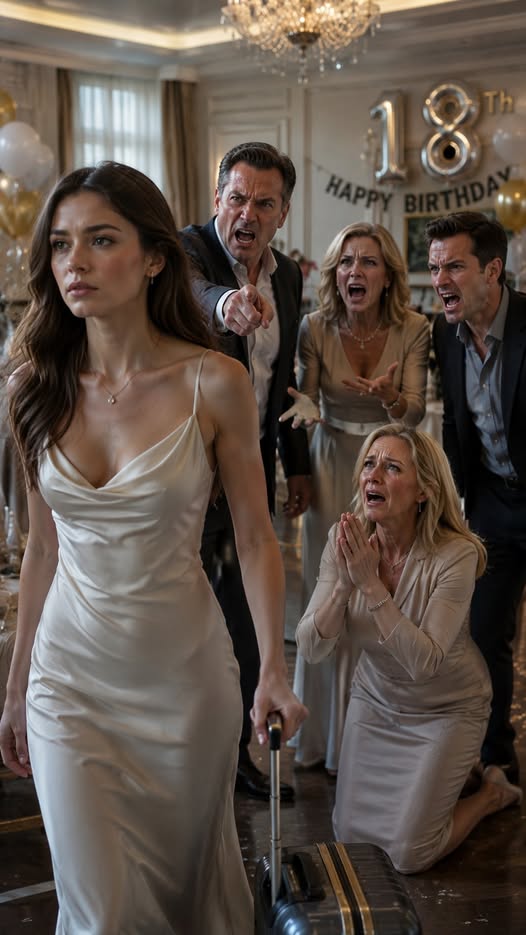
On the night I turned eighteen, my father raised a heavy crystal glass in the grand ballroom of the Graystone Hotel and told two hundred elegantly dressed guests that his daughter was “finally ready to become a woman.”
A wave of polite, manicured applause rippled across the room. The air was thick with the scent of expensive freesia centerpieces, roasted duck, and the sharp, metallic tang of poured champagne.
I stood beside him in a midnight-blue silk gown that my mother had selected, and I smiled. I smiled because that was exactly what Kingsley daughters were programmed to do in public. We were ornaments. We were assets.
My name is Evelyn Kingsley. For most of my life, my existence was defined by the reflection I cast in my parents’ meticulously polished mirror. But beneath the silk and the rehearsed smiles, a quiet rebellion had already taken root.
My grandfather, Robert Hale, had passed away six months earlier after a long, agonizing battle with pancreatic cancer. He had left me a three-million-dollar inheritance, placed entirely in my own name, effective upon my eighteenth birthday. He was a self-made man who distrusted the socialite circles my parents desperately clawed to remain a part of. In his final weeks, sitting in his leather-bound study overlooking the lake, his breathing shallow, he had gripped my wrist with surprising strength.
“Money doesn’t make you safe, Evie,” he had whispered, his eyes locking onto mine with a fierce, desperate clarity. “Control does. Never let them hold the pen when your name is on the line.”
I had not fully understood the weight of his words then. I did now.
Which is why, exactly two hours before my birthday party commenced, I was not at the hotel getting my hair pinned up by a stylist. Instead, I was sitting inside a dimly lit lawyer’s office in downtown Chicago.
I sat with my hands folded tightly in my lap, my knuckles white, while Nora Whitman, my grandfather’s fiercely protective, silver-haired attorney, pushed a stack of thick, watermarked documents across a polished mahogany table. The room smelled of old paper, floor wax, and quiet authority.
“You’re entirely sure about this, Evelyn?” Nora asked, her dark eyes searching my face. She held a gold fountain pen loosely between her fingers. “Once this trust is executed, it becomes an irrevocable fortress. Neither of your parents can access the principal. Not a single dime. Only you and the independent trustee can authorize distributions, and strictly under the terms we discussed.”
I looked down at the paper. I felt a cold knot of anxiety tighten in my stomach, wrestling with a profound sense of self-preservation. I picked up the pen. The metal was cool against my skin.
“I’m sure,” I said, my voice barely above a whisper, but steady.
I signed my name. Evelyn Rose Kingsley.
By seven o’clock that evening, my inheritance was no longer resting in a vulnerable, standard account that my parents could pressure, guilt, or manipulate me into touching. It had been legally locked inside the newly formed Hale Education and Independence Trust. It was shielded, protected solely for my university tuition, securing housing, medical needs, and strictly vetted future investments.
When I arrived at the hotel, the tension was already simmering beneath the surface. My mother, Cynthia, had called my brief disappearance “a dramatic, selfish stunt” before adjusting my collar and shoving me toward the photographers.
My father, Richard, had actually laughed when I casually mentioned I had met with Nora to finalize some “paperwork” for the inheritance.
“At eighteen?” he scoffed, pulling me in for a photo op, his fingers squeezing my shoulder just a fraction too tightly. The pressure was a silent warning. “Sweetheart, you’ve been watching way too many late-night legal dramas. We’ll sit down with my wealth manager on Monday and sort all of this out properly.”
My mother tipped her champagne glass in my direction, her smile tight and razor-thin for the flashing cameras. “You’ve embarrassed us by even entertaining that woman. Nora should know far better than to encourage childish paranoia in a grieving teenager.”
But my older brother, Grant, did not laugh.
Grant was twenty-four, clad in a custom tuxedo, holding a scotch on the rocks. He watched me from across the ballroom with a dark, calculating intensity. He looked at me not like a sister, but like I was a heavy iron door he had just discovered was locked—a door he had been planning to walk through with ease.
The opulent party dragged on. The towering, five-tier cake was served with silver spatulas. My father gave his sweeping, charismatic speech about the paramount importance of “family loyalty.” My mother dabbed at her dry eyes with a lace handkerchief, shedding pretty, performative tears for the society page photographers.
Shortly before midnight, Grant vanished toward the terrace with his new girlfriend, Paige. As she walked past my table, the chandelier light caught a heavy, intricate diamond bracelet clinging to her wrist.
A cold spike drove into my chest. It was my grandmother’s vintage bracelet. The piece my mother had repeatedly sworn was secured in a safety deposit box, waiting for my wedding day. Paige was wearing it like a cheap party favor, without asking, without a second thought.
The masquerade was suffocating me. I slipped away from the ballroom, desperate for oxygen, wandering into the hushed, velvet-lined corridors of the hotel.
At 1:10 a.m., I turned a corner near the executive suites and stopped dead in my tracks.
My father was standing by a heavy velvet drape, aggressively pacing, his phone pressed hard against his ear. His tuxedo jacket was unbuttoned, his tie ripped loose. He was sweating.
“What do you mean she moved it?” he hissed into the receiver, his voice dripping with venom and a rising, palpable panic. “All of it? Three million doesn’t just vanish into a void! Call the bank manager! Call the judge!… No, listen to me, I can’t reverse it if it’s an irrevocable… It’s locked? What the hell do you mean, it’s locked?”
He dragged a trembling hand down his face, a man watching a bridge burn while standing in the middle of it.
I took a slow step backward, my heel sinking quietly into the thick carpet. But the slight rustle of my silk dress betrayed me.
My father snapped his head up. Our eyes met.
The transformation was terrifying and instantaneous. In a fraction of a second, the desperate, panicked man vanished, violently swallowed by the polished, authoritative patriarch. His posture straightened. The fury in his eyes was shoved down into a deep, dark well, replaced by a cold, dead stare.
He lowered the phone slowly.
“Go to bed, Evelyn,” he commanded. The words weren’t a suggestion. They were an executioner’s drop.
Cliffhanger: I turned and fled down the corridor, my heart hammering a frantic rhythm against my ribs. I knew, with absolute, terrifying certainty, that I had just detonated a bomb beneath my family’s foundation. And as I locked the door to my hotel suite, listening to the heavy footsteps echoing outside my room, I realized the explosion was scheduled for dawn.
Chapter 2: The Morning of Consequences
The next morning, the sprawling, Tudor-style Kingsley estate in the suburbs was eerily, suffocatingly quiet.
Usually, a Sunday morning hummed with the discreet energy of the household staff—the clinking of fine china, the smell of fresh Kona coffee, the low murmur of the groundskeepers outside. Today, there was nothing. It felt like a vacuum.
I walked down the sweeping mahogany staircase, the silence pressing against my eardrums. I was wearing a simple gray sweater and jeans, a stark contrast to the midnight-blue silk from the night before. I felt a strange, detached calm settling over me, the kind of numb tranquility that follows a devastating car crash.
I found my parents waiting in the sunlit breakfast room.
There was no coffee laid out on the sideboard. No fresh fruit. No forced, camera-ready smiles.
My mother’s eyes were bloodshot and rimmed with red, but the tight, furious set of her jaw told me it was absolutely not from grief. It was the toxic, burning redness of thwarted entitlement.
My father stood perfectly rigid at the head of the long oak table, his hands resting flat against the polished wood. He looked like a judge about to hand down a terminal sentence. As I stepped into the room, he said the words that proved, beyond a shadow of a doubt, that moving my money had saved my entire future.
“Since you clearly do not trust this family,” my father said, his voice entirely devoid of warmth, echoing off the cold tiled floors, “you can pack your things and leave this house by noon.”
For a long, agonizing moment, the air in the room simply stopped moving. I thought the lack of sleep was playing tricks on my auditory processing. I thought I must have misheard him.
Leave the house by noon.
I stared at him. Not because I had committed a crime. Not because I had harmed a living soul. Not because I had crashed a car, failed out of school, or dragged the pristine Kingsley name into some sordid scandal my mother would have to whisper away at the country club.
I was being exiled because I had legally protected a gift that my grandfather had explicitly left to me.
I shifted my gaze from my father to my mother. Cynthia Kingsley sat perfectly straight in her cream silk robe, her legs crossed, one manicured hand curled tightly around the stem of an untouched mimosa. She looked incredibly annoyed, not devastated. She looked at me the way one looks at a careless maid who has just shattered a priceless Ming vase on the marble floor.
“You’re serious?” I asked, my voice cracking slightly despite my best efforts to keep it steady.
My father’s jaw tightened, a small muscle ticking beneath his skin. “You made an adult decision yesterday, Evelyn. Bypassing us. Humiliating us with that vulture, Nora Whitman. Adults live with adult consequences. You wanted to manage your own life? Start today.”
I almost laughed. A dark, hysterical bubble of amusement rose up in my chest like a cough, but it died instantly in the back of my throat.
“Grandpa left that money to me,” I said, finding my footing, my voice growing firmer.
“He left it to the family,” my mother snapped, slamming her glass down so hard the orange juice sloshed over the rim, staining the white linen tablecloth.
“No,” I said, looking her dead in the eye. “He left it to me. His will was incredibly, legally clear. He knew exactly what he was doing.”
My father slammed his open palm onto the heavy oak table. The silver cutlery jumped and clattered violently. “Do not lecture me about clarity, you arrogant little girl! Do you have any idea what you’ve done? Do you even begin to comprehend what kind of position you’ve just put us in?”
And there it was. The ugly, naked truth stripped of all its high-society dressing.
Not pain. Not the sting of betrayal. Not a broken heart.
Position.
My mind raced backward, connecting the dots with horrifying speed. I remembered his frantic phone call in the velvet corridor. I remembered Grant’s dark, calculating stare from across the ballroom. I remembered Paige carelessly flaunting my grandmother’s diamonds—diamonds my mother claimed were locked away in a bank vault for safekeeping.
“What position?” I asked quietly, my heart pounding a slow, heavy rhythm.
My mother’s eyes widened slightly. She shot a sharp, warning glare at my father, a silent plea for him to rein it in, to maintain the facade.
But Richard Kingsley was too angry, too desperate to stop himself. The mask was cracking, and the ugly reality was bleeding through.
“We had obligations,” he spat, pacing behind his chair. “Immediate, temporary financial obligations. Your brother desperately needed capital to rescue his restaurant investment before the partners force him out. Your mother’s massive charity gala deposits were due on Tuesday. And I had a multi-million dollar bridge loan structured entirely around incoming family liquidity!”
The words hung in the air, toxic and suffocating.
Incoming family liquidity.
That was what I was to them. I was not a daughter. I was not a grieving granddaughter. I was a bailout. I was an asset to be liquidated. I was a human bank account.
“You planned to use my inheritance,” I stated, the reality settling over me like a heavy, freezing blanket. “All of it.”
My mother stood up abruptly, her silk robe rustling. “We planned to manage it! To fold it into the family portfolio until you were mature enough not to be manipulated by some bitter, meddling old lawyer!”
“Nora was Grandpa’s trusted lawyer for twenty years,” I shot back.
“Nora is a vindictive woman who has never liked your father and has always been jealous of our success!” my mother countered, her voice shrill.
My father pointed a trembling finger toward the grand staircase. “Pack your bags. I am not standing here debating my financial strategies with an eighteen-year-old child. You wanted financial independence, Evelyn? You’ve got it. Enjoy it on the streets. Noon.”
I turned and walked upstairs.
I didn’t cry. That surprised me more than anything else. As I climbed the carpeted steps, a strange, hollow sensation hollowed out my chest. Maybe some deep, intuitive part of me had already started grieving the death of my parents the night before.
My bedroom looked untouched, soft, expensive, and suddenly incredibly foreign. It looked like a museum exhibit of a life that didn’t belong to me anymore. The framed equestrian riding ribbons. The private boarding school photographs. The heavy silver music box my grandfather had bought me in Switzerland.
I moved mechanically, stripping my life down to the essentials. I packed my clothes, my passport, my birth certificate, my laptop. I carefully wrapped the silver music box in a sweater. Then, I took three framed photographs from my nightstand: one of me as a child, sitting in a boat with Grandpa at Lake Geneva; one of me standing alone, holding my high school diploma; and one of my grandmother, smiling vibrantly, taken years before she became ill.
I left the diamond earrings my parents had given me for my sixteenth birthday on the vanity. I didn’t want anything they had touched.
At 11:42 a.m., the wheels of my two heavy suitcases thumped rhythmically as I rolled them down the grand staircase.
Grant was waiting at the bottom. He was leaning against the heavy oak front door, his arms crossed over his chest, blocking my exit. He looked hungover and furious.
“You really screwed us, Evie,” he said, his voice laced with disgust.
I stopped on the bottom landing, my grip tightening on the handles of my luggage. “Us?”
He gave me a flat, mocking smile. “Don’t stand there acting innocent. Dad was going to fix everything on Monday. The restaurant, the loans, the margin calls. Everything.”
“With my money.”
“You weren’t even using it!” he yelled, pushing off the door.
“I was going to pay for college, Grant!”
He stepped closer, invading my space, looking down at me with absolute contempt. “You think a piece of paper and a trust fund makes you untouchable? You think you can just walk out of here and survive without the Kingsley name?”
Cliffhanger: Before I could formulate a response, the heavy brass handle of the front door turned. The door swung open, forcing Grant to stumble backward. Standing on the threshold, framed against the bright, freezing Chicago morning, was Nora Whitman. She was wearing a sharp navy wool coat and holding a thick leather legal folder. Behind her, idling in the circular driveway, was a sleek, black town car. Nora’s eyes bypassed my brother entirely and locked onto my father, who had just emerged from the study. “Richard,” she said, her voice echoing like a gunshot in the foyer. “It seems we need to have a conversation about the legal definition of extortion.”
Chapter 3: The Architecture of Foresight
My mother, hovering in the hallway, went completely pale. All the haughty, aristocratic color drained from her cheeks, leaving her looking frail and terrified.
My father opened his mouth to shout a command, to reassert his dominance over his crumbling kingdom, but his vocal cords failed him. No sound came out.
Nora stepped smoothly over the threshold, not bothering to wipe her shoes on the mat. She looked around the opulent foyer with an expression of mild, clinical distaste, before turning her steely gaze back to my father.
“I’m here to collect Evelyn and her belongings,” Nora stated calmly, adjusting her glasses. “Her grandfather fully anticipated this specific temper tantrum. I’m taking her to her new residence.”
“Get out of my house,” my father finally managed to croak, taking a threatening step forward. “You have no right—”
Nora raised a single, leather-gloved hand, stopping him in his tracks. “I would strongly advise you not to interfere, Richard. Or raise your voice. The Hale Education and Independence Trust currently owns the lease to Evelyn’s new apartment, the vehicle idling outside, and my considerable legal retainer. Furthermore, any attempt by you, Cynthia, or Grant to financially coerce, physically intimidate, or otherwise harass Evelyn from this moment forward will be meticulously documented and immediately handed over to the Cook County District Attorney.”
She let the silence hang, thick and heavy. For the absolute first time in my entire existence, Richard Kingsley had no stage left to command. He had no room to perform. He was trapped.
I picked up the handles of my suitcases. I didn’t look at Grant. I walked straight past my father, the wheels of my luggage leaving faint indentations in the plush Persian rug.
No one stepped forward to hug me goodbye.
No one offered a word of apology.
No one told me to be safe.
But as Nora opened the heavy door of the black town car and I slid onto the cold leather seat, I heard my mother whisper from the doorway, her voice trembling with a sudden, horrifying realization.
“Robert knew. My God, he knew.”
Nora paused before closing the car door. She didn’t turn around, but she pitched her voice just loudly enough for the sound to carry across the freezing driveway.
“Cynthia,” Nora said, “Robert knew everything.”
The door slammed shut, severing me from the only life I had ever known.
The apartment was absolutely nothing like the desperate, chaotic scenario I had pictured while packing my bags. I had imagined Nora dropping me at a bleak, temporary studio apartment with cheap rented furniture, a place where I would sit on a bare mattress and frantically try to convince myself I was brave.
Instead, the driver navigated north to Evanston, pulling up to a quiet, elegant building composed of red brick and glass, overlooking a beautiful, tree-lined street near the lake. The lobby smelled deeply of cedar, fresh paint, and expensive floor wax. The uniformed doorman smiled warmly and greeted Nora by name.
“The trust has prepaid the lease on this unit for eighteen months in full,” Nora explained casually as we rode the silent, mirrored elevator upward. “All utilities are covered through an automated system. There’s a modest, but comfortable, monthly allowance deposited into your personal checking account for food, transportation, and living expenses. Your Northwestern university tuition account is entirely separate and fully funded.”
I stared blankly at the digital numbers climbing above the elevator doors. My mind was reeling. “He… he really planned all of this? While he was dying?”
Nora’s expression softened, the sharp edges of the fierce litigator melting away for a moment. “Your grandfather desperately hoped he was wrong about them, Evie. He prayed he was just a cynical old man. But he loved you too much to not plan for the devastating possibility that he was right.”
The apartment was on the seventh floor. When I unlocked the door, the afternoon light was pouring in. It was a spacious one-bedroom unit with clean white walls, hardwood floors, and a small balcony overlooking the water. A heavy oak desk was already set up near the large window.
In the kitchen, the stainless steel refrigerator had been fully stocked with fresh groceries. And resting perfectly in the center of the quartz kitchen island was a heavy, cream-colored envelope.
My name was written across it in my grandfather’s distinct, shaky cursive.
My knees nearly buckled before my fingers even grazed the paper. I tore it open, my vision already blurring.
Evie,
If you are reading this letter in this apartment, then the adults who were legally and morally supposed to protect you have made you pay the price for protecting yourself.
I am so sorry, my brave girl.
Do not go back to them just because the silence of loneliness starts to feel like guilt. You are not responsible for rescuing people who only ever saw you as a resource to be harvested.
Build your life. Your success and your happiness will be answer enough.
I am always with you.
Grandpa
I sank down onto the cool hardwood floor of the kitchen, pulling my knees to my chest, and I finally cried. The dam broke. I sobbed until my ribs ached and I couldn’t catch my breath. I didn’t cry because I had been ruthlessly thrown out of my home. I didn’t even cry because my parents had looked at me with infinitely more anger than sorrow.
I cried because a dying man, in his final agonizing months of life, had known me intimately enough to leave words of armor for the exact moment he knew my heart would break.
For the first week, I existed purely on autopilot. I functioned like a machine. I unpacked my clothes. I answered Nora’s daily check-in calls. I aggressively ignored the sudden, frantic influx of phone calls—first from my mother, then from Grant, then from blocked numbers I did not recognize. I made toast in the mornings, left it on the counter, and completely forgot to eat it. I slept with every single light in the apartment blazing.
On the eighth day, the siege began.
The intercom on the wall buzzed sharply. “Miss Kingsley,” the doorman’s voice crackled. “There is a Richard Kingsley here in the lobby. He is demanding to be sent up to see you.”
My stomach folded violently inward. A cold dread coiled in my gut, my palms instantly slick with sweat.
Nora had warned me this phase would happen. She had also specifically instructed the building management not to allow a single visitor upstairs without my explicit, verbal approval.
“Tell him no,” I said, my voice shaking. “He is not welcome.”
A minute later, my cell phone vibrated on the counter.
Dad.
Then it vibrated again.
Then a text message lit up the screen.
Evelyn, this childish tantrum has gone far enough. Come downstairs immediately. We are going home.
I stared at the screen, paralyzed. I did not type a reply.
Another text fired through.
Your mother is physically ill over this. She hasn’t slept in a week.
Then another, the tone shifting back to the toxic guilt I knew so well.
You are destroying your family over money. Is this what Robert wanted? A broken family? Open the door.
I walked over to the desk by the window and looked down at the street seven stories below. I couldn’t see the entrance from that angle, but I could picture him perfectly. He would be wearing his expensive camel-hair coat, his face set in hard, authoritative lines, one hand tucked casually into his pocket, performing for the doorman, making strangers believe he was simply a deeply worried, loving father trying to reach his troubled teenage daughter.
I took a deep breath, took a screenshot of the barrage of texts, and forwarded them directly to Nora.
Her reply came back within thirty seconds.
Do not engage. Do not reply. Document absolutely everything.
So I did. That became my new, brutal education before my freshman college classes had even begun. I learned how to systematically document harassment. I learned how to keep pristine records. I learned how to separate my deep emotional wounds from cold, hard evidence. I learned how to aggressively read a bank statement, how to parse the dense legalese of a contract, and, most importantly, how to recognize when an abuser disguises “control” as “concern.”
Three weeks after my eighteenth birthday, Nora summoned me back to her downtown office.
“There are things you need to know, Evelyn. Things we can no longer shield you from,” she said gravely, closing the heavy door behind me.
I sat across from her at the same polished table where I had signed my life away to the trust. But this time, I did not feel like a scared child pretending to understand adult business. I felt like a soldier who had survived the first devastating ambush and was grimly waiting for the second wave.
Nora unlocked a heavy drawer and pulled out a massive, intimidatingly thick red folder. She placed it between us.
Cliffhanger: “Your grandfather didn’t just suspect they wanted your money, Evie,” Nora said, her voice dropping to a dangerous hush as she untied the folder’s string. “He hired a forensic accounting team fourteen months before he died. What is inside this file isn’t just poor financial planning by your father. It’s a massive, multi-million dollar house of cards built on federal wire fraud, forged signatures, and stolen charity funds. And they were planning to use your three million to cover up the crimes before the FBI found out.”
Chapter 4: The Discovery and the Counter-Strike
I felt the blood drain entirely from my face. The heavy oak table seemed to tilt beneath my hands.
“Crimes?” I choked out, staring at the thick red folder as if it were a live grenade. “Wire fraud?”
Nora nodded, opening the cover. She began sliding page after page of meticulously highlighted bank records, loan applications, and printed, encrypted emails across the table toward me.
“Your father’s real estate development company has been functionally insolvent and overleveraged for over four years,” Nora explained, her tone clinical, slicing through my shock. “Several of his high-profile downtown projects failed quietly. To maintain the illusion of wealth and satisfy his original investors, he began taking out massive new, high-interest loans to covertly pay off the old losses. It’s a classic Ponzi structure. But worse, he was forging your grandfather’s signature as a guarantor on the bridge loans.”
I touched the cold, glossy paper of a loan document. There, at the bottom, was Robert Hale’s signature. Or at least, a desperate, passable imitation of it.
“And my mother?” I asked, dreading the answer.
Nora sighed, turning over a new stack of papers. “Cynthia’s charity events—the lavish galas she hosts every season—were not as philanthropic as they appeared. The forensic team tracked large, six-figure vendor payments for catering, floral arrangements, and venue rentals. These payments were being routed out of the charity’s accounts and directly into shadow LLCs owned by Cynthia’s closest friends and your father’s business partners. They were skimming the charity blind to pay the mortgage on your family estate.”
A wave of profound, nauseating betrayal washed over me. I wasn’t just cast out for protecting my money. I was cast out because my refusal to surrender my inheritance was going to send my parents to federal prison.
“Were they going to steal my money?” I whispered, looking up at Nora’s steady eyes.
“They wouldn’t have just ‘taken’ it, Evie. That leaves a trail,” Nora said gently. “They would have crushed you psychologically. They would have guilted you. They would have manufactured an ’emergency’—a threat of bankruptcy, a threat of losing the house—and begged you to ‘loan’ them the funds. Or worse, they would have manipulated you into signing on as a co-investor in one of Richard’s fraudulent shell companies, making you legally complicit in the fraud.”
I thought of my father’s sweeping birthday speech. Family loyalty. The words felt like physical poison in my veins now.
“What happens now?” I asked, my hands finally stopping their trembling. A new, terrifying anger was replacing the fear.
“That depends entirely on them,” Nora said, closing the file. “If they walk away, we keep this buried. But if they attack your trust…”
They made their catastrophic choice less than a month later.
My parents officially filed a petition in the Cook County probate court, aggressively challenging the legality of the Hale Education and Independence Trust.
Their legal argument was offensively simple and deeply cruel: They claimed I had been “unduly influenced” by a manipulative attorney (Nora), that I was “emotionally unstable and mentally fragile” following my grandfather’s death, and that I lacked the fundamental cognitive capacity to understand the permanent legal consequences of the documents I had signed on my eighteenth birthday.
My mother signed a sworn affidavit claiming I had “always been prone to manic, impulsive behavior” and was “easily manipulated by older authority figures offering false affection.” My father submitted a document claiming he only sought to “guide” his troubled daughter’s inheritance responsibly.
Even Grant submitted a venomous statement, swearing under oath that I had “arrogantly bragged” to him about hiding the money to purposefully bankrupt the family out of spite.
When Nora handed me the court filings, I sat in her office and read every single word in absolute, suffocating silence. It felt like they were taking turns stabbing a knife into a ghost.
I looked up from the papers. “Can we fight this?”
Nora’s smile was small, but it was sharper than a scalpel. “Evie, we are going to do vastly more than fight it. We are going to obliterate them.”
The emergency hearing took place in Cook County probate court on a bleak, gray October morning. Rain lashed fiercely against the tall courtroom windows. I wore a conservative navy dress and my grandmother’s vintage pearl earrings—the pair she had secretly left me in a separate letter, a letter my mother never knew existed.
My parents sat stiffly across the aisle at the petitioner’s table. My mother dabbed at her dry eyes with a tissue, perfectly timing her sorrow for the moment the judge entered the room. My father stared straight ahead, his jaw clenched, projecting the image of a weary, heartbroken patriarch. Grant sat in the gallery behind them, looking incredibly bored—until he noticed the court reporter’s fingers flying across the stenograph, permanently recording every word.
Their high-priced defense lawyer argued passionately for forty minutes. He painted a picture of a grieving, vulnerable girl, preyed upon by a rogue, greedy lawyer on the very day of her birthday.
When he finished, the judge, an older man with tired eyes, looked over at our table. “Ms. Whitman. Your response?”
Nora stood up slowly. She did not yell. She didn’t need to. The truth doesn’t require a megaphone.
She calmly walked the judge through the unassailable timeline. She presented the ironclad will. The inheritance transfer logs. My legally sound trust documents, countersigned by an independent medical professional verifying my sound state of mind on the day of signing.
Then, Nora turned on the courtroom projector.
“Your Honor, we submit Defense Exhibit D into evidence. A recorded deposition taken from Robert Hale, three months prior to his passing.”
My mother froze, the tissue dropping from her hand.
On the large screen, my grandfather appeared. He was sitting in his leather chair. He looked incredibly thin, his skin pale from the chemotherapy, but his eyes were burning with a fierce, lucid fire. He was fully himself.
He looked directly into the camera lens, straight out into the silent courtroom.
“My name is Robert Hale. I am of sound mind. It is my absolute, unequivocal directive that my granddaughter, Evelyn Kingsley, is to receive her inheritance without a single shred of interference from her parents, Richard and Cynthia Kingsley. I have substantial, documented reason to believe they will maliciously attempt to gain access to her funds through extreme emotional pressure, toxic family obligation, or legal intimidation. My instructions to my counsel, Nora Whitman, are clear: protect Evelyn’s assets, and protect her independence. If Richard challenges this, he is to be considered a hostile threat to my beneficiary.”
The video clicked off. The silence in the courtroom was absolute.
My mother had stopped crying. She was staring at the blank screen, her mouth slightly open.
My father’s face had turned an alarming, mottled shade of crimson. He gripped the edge of the defendant’s table so hard his knuckles were stark white.
Nora wasn’t done. With lethal precision, she submitted copies of my father’s abusive text messages, highlighting the ones where he accused me of “destroying the family over money.” She submitted digital logs proving he had attempted to forcibly access the trust account twelve times in forty-eight hours. Finally, she submitted a sworn, notarized affidavit from a hotel employee who had overheard my father screaming in the corridor: “She moved it. All of it.”
The judge slowly leaned back in his high leather chair, took off his reading glasses, and stared down at my parents with an expression of profound disgust.
Cliffhanger: “Petition to dissolve the trust is emphatically denied with prejudice,” the judge slammed his gavel down. “But before we adjourn,” Nora said, her voice ringing out clearly, “since the petitioners have officially entered their ‘family liquidity and financial management’ capabilities into the public record as grounds for this suit, the defense formally requests full legal discovery into Richard and Cynthia Kingsley’s corporate financial records for the past five years to prove their fitness.” The judge nodded. “Discovery granted.” My father slumped back in his chair, putting his head between his hands. The bomb had finally detonated.
Chapter 5: The Boundary of the Future
The fallout arrived in massive, devastating pieces.
Nora’s requested discovery blew the doors off the Kingsley family vault. Once the forensic accountants gained legal access to my father’s corporate ledgers, the illusion was shattered forever. What emerged over the next four grueling months completely destroyed the pristine version of the Kingsley family that had dominated the Chicago society pages for decades.
My father’s real estate empire wasn’t just drowning; it was a criminal enterprise. When the federal investigators realized he had forged Robert Hale’s signature on bridge loans, they froze all of his assets.
My mother’s charity board, tipped off by the mounting scandal, conducted an emergency internal audit. They discovered the massive vendor irregularities and quietly, but brutally, removed her as chairwoman, effectively exiling her from the high-society circles she worshipped. Grant’s vaunted “restaurant investment” collapsed before it ever opened its doors, leaving him drowning in personal debt.
And my three million dollars was the phantom number they kept desperately returning to in the press.
Three million dollars would not have made them rich forever. It wouldn’t have fixed the rot at the core of their lives. It would have simply bought them time. It would have paid off angry lenders, covered the fraudulent checks, saved appearances through the winter, and kept everyone smiling brightly at holiday parties.
Without my money, the grand performance collapsed into dust.
My father called me exactly once after his assets were seized.
I answered the phone because Nora was sitting right beside me in her office, her finger hovering over the record button on her dictaphone, providing proper legal notice.
“This call is being recorded,” I stated clearly into the receiver.
Silence heavily weighed on the line. I could hear the faint sound of traffic in the background.
Then, my father laughed—a single, harsh, bitter bark of sound. “You’ve become very sophisticated, Evelyn.”
“I’ve become careful,” I corrected him.
“You think you won,” he spat, the old venom laced with a new, pathetic desperation.
“No,” I said, staring at my reflection in the rain-streaked window of the law office. “I think Grandpa protected me.”
His voice hardened, cracking with a terrifying rage. “You have no idea what you’ve cost us. We are ruined.”
I looked around the room. At the walls lined with thick law books. At Nora, who gave me a slow, affirming nod. I looked older than I had at my birthday party. I wasn’t exactly happier. The grief of losing the idea of a family was still a heavy stone in my chest. But I was clearer. My vision was no longer clouded by their demands.
“You cost yourselves,” I said softly, and I hung up the phone.
The Kingsley estate went on the market in late January, sold at a fraction of its value to appease federal creditors. My mother moved into a small condo owned by one of her sisters, refusing to leave the house out of sheer humiliation. My father rented a bleak apartment near his failing office, fighting a barrage of civil lawsuits that would eventually strip him of his license. Grant’s girlfriend, Paige, predictably disappeared from his social media the week after the money officially dried up.
I didn’t watch them fall. I turned my back and started walking forward.
I began my freshman year at Northwestern in the spring. I chose the campus because it was close enough to my safe apartment in Evanston, but far enough away from the terrified, compliant girl I used to be.
I studied economics first, devouring textbooks late into the night, because I desperately wanted to understand every single word people had once used to confuse and manipulate me. Later, I added a double major in public policy, realizing that while numbers explained the harsh systems of the world, policy explained the people who became trapped inside them.
I did not magically become fearless overnight. That would be a lie.
There were lonely nights when I stood in my quiet kitchen holding my phone, staring at my mother’s blocked number, tempted to call her just to hear her voice. There were Sunday mornings when I missed the elaborate illusion of my family so badly it felt like a physical ache in my bones. I missed the birthday breakfasts, even though I now knew they had always been staged. I missed the Christmas photographs, even though I knew everyone in them had been posing for a phantom audience.
But I slowly learned that missing something does not mean it was ever safe to return to it.
Nora Whitman became vastly more than just my attorney. She became a mentor, a surrogate architect of my new life. She taught me how to ask hard questions without apologizing first. She taught me that signatures matter, that silence can be a devastating strategy, and that people who benefit from your confusion will almost always call your clarity “cruel.”
On my nineteenth birthday, I did not have a lavish ballroom party.
I had dinner at a small, dimly lit Italian restaurant with Nora, my brilliant roommate Allison, and Marcus Reed, a kind graduate student who helped tutor me through advanced statistics and who was slowly becoming one of my closest friends.
There were no agonizing speeches about family loyalty. There were no flashing photographers. There was no champagne tower.
There was just spicy rigatoni, genuine, belly-aching laughter, and a slightly lopsided chocolate cake that Allison carried to the table while singing entirely off-key.
After dinner, as the waiter cleared the plates, Nora reached into her blazer and handed me a small, sealed envelope.
“Your grandfather asked me to hold onto this, and give it to you exactly one year after the trust was activated,” she said, her eyes shining with unshed tears.
My hands trembled as I opened it carefully. Inside was another note, written on the same heavy cream cardstock.
Evie,
One year free.
Now, make it two.
Grandpa.
I sat in the restaurant booth, surrounded by people who loved me for who I was, not for what I could provide, and I laughed and cried at the exact same time.
Years later, people would occasionally hear pieces of the story and ask me if I ever regretted moving the money into the trust so abruptly. They usually asked gently, tilting their heads, as though they expected a complex, tortured answer. As though maybe losing my parents permanently balanced the scale unfavorably against saving the money.
But I never saw it that way.
The trust did not cost me my family. The trust merely revealed what my family had already decided I was worth.
That was the hardest truth to swallow, but it was also the cleanest one.
By the time I turned twenty-five, I had graduated with honors, begun working for a prominent downtown nonprofit that specialized in helping young adults and vulnerable women navigate and escape financial abuse, and bought a modest, beautiful condo of my own with funds properly and legally distributed from my trust. I kept my grandfather’s second note framed on the wall, directly above my desk.
One rainy afternoon, after I finished running a financial literacy workshop at the clinic, a seventeen-year-old girl stayed behind in the empty room. Her eyes were glossy with unshed tears, and she was clutching a manila folder to her chest like a piece of body armor.
“My aunt says I’m being overly dramatic,” the girl whispered, looking at the floor. “But my stepdad keeps asking me to sign over the insurance settlement money from my car accident. He says it’s to pay for household groceries. But the math doesn’t make sense.”
I looked at her, seeing a ghost of myself in the defensive way she held that folder. I saw the fear of breaking the illusion of family loyalty.
I did not tell her what to do. I did not insult her intelligence by promising her everything would magically be fine. Instead, I sat down across from her. I gave her the direct contact information for a pro bono legal aid clinic. I carefully explained which specific questions she needed to ask the bank. And I told her to make copies of every single document and keep them somewhere her family could not reach.
Before she stood up to leave, she hesitated, her hand on the doorknob. “Miss Kingsley? Does protecting yourself always make the people who love you angry?”
I thought about my father’s face in the breakfast room. My mother’s cold, calculating eyes. Grant’s bitter accusation at the bottom of the stairs. Nora standing like a sentinel at the front door. And my grandfather’s careful, shaky handwriting saving my life from the grave.
“Not always,” I said softly, offering her a genuine smile. “It only angers the people who were desperately counting on you not to.”
That night, I drove home, rode the elevator up, and unlocked the door to my condo. I placed my keys in the blue ceramic bowl beside the door. The city lights glowed warmly beyond the large windows, casting a golden hue over the hardwood floors.
My life was quiet. It was ordinary. And, most importantly, it was entirely mine.
At eighteen, as I sat in that dark law office holding a gold pen, I thought I had simply moved money.
What I had really moved was the boundary between the future my family had planned to steal from me, and the future I was finally allowed to build.
If you want more stories like this, or if you’d like to share your thoughts about what you would have done in my situation, I’d love to hear from you. Your perspective helps these stories reach more people, so don’t be shy about commenting or sharing.