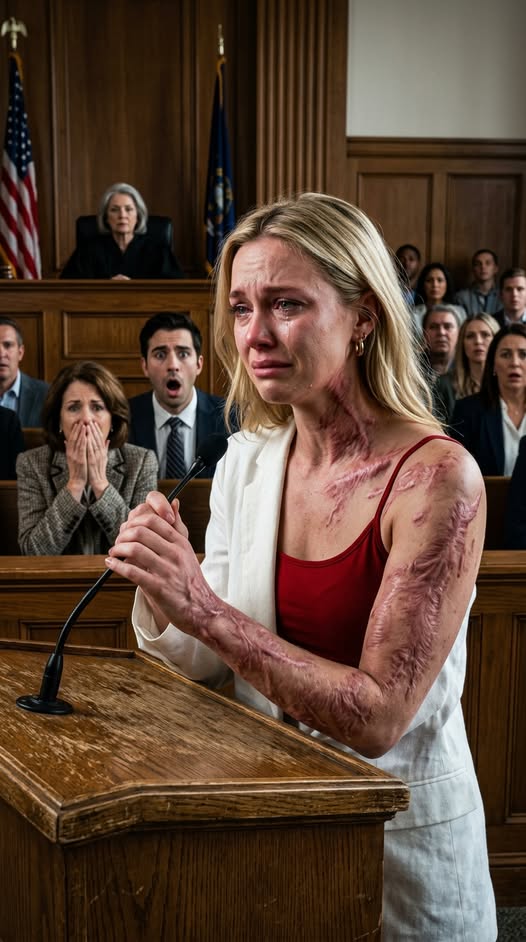
The air inside the Manhattan courtroom was heavy, smelling of lemon polish, aged paper, and the suffocating, undeniable arrogance of my soon-to-be ex-husband. I sat perfectly still at the plaintiff’s table, my hands folded neatly over a blank yellow legal pad. I wore a high-necked, long-sleeved gray silk blouse—a garment meticulously chosen for a very specific, undeniable purpose. The fabric felt cool against my skin, a stark contrast to the burning heat of anticipation radiating in my chest.
Across the wide aisle, Richard Vance leaned back in his tufted leather chair. He looked less like a man fighting a bitter, high-stakes divorce and more like a bored king waiting for a court jester to finish a tedious routine. He adjusted the cuffs of his bespoke navy suit, catching my eye for a fraction of a second. He offered a thin, pitying smile. It was the exact same smile he used right before he told a lie so massive, so destructive, that it would completely ruin someone’s life. It was the smile of a man who believed the world was an intricate machine built solely for his amusement.
Beside him sat Chloe. She wore a tailored white skirt suit that cost more than my first car, radiating the practiced, wide-eyed innocence of a woman who had spent the last two years treating my marriage like a luxury self-checkout aisle. Resting against her collarbone, catching the harsh fluorescent light of the courtroom, was the Sterling Diamond—a delicate, vintage teardrop pendant suspended on a platinum chain. It had belonged to my grandmother. Seeing it on her neck felt like a physical blow, a phantom punch to the ribs, but I did not let my expression change. I had spent five years learning how to turn my face into an unreadable vault.
“Your Honor,” Simon Croft, Richard’s high-priced, theatrically aggressive attorney, began. His voice was a practiced baritone, dripping with faux sympathy as he approached the judge’s bench. He held a thick, heavily bound document in his right hand, wielding it like a weapon. “We had sincerely hoped to keep this matter private to spare Mrs. Vance the profound humiliation. However, her relentless, unfounded demands for company assets, and her refusal to accept a generous settlement, leave us absolutely no choice.”
My attorney, Arthur Pendelton, an older man with a bulldog’s tenacity, stiffened beside me. He leaned in, his breath warm against my ear. “Are we ready for this, Claire?” he whispered.
I didn’t speak. I simply touched his wrist with two fingers, a silent, iron-clad command to hold his ground
“I hold here,” Croft continued, turning dramatically on his heel to ensure the legal reporters seated in the gallery got a clear view of the binder, “a comprehensive, independent psychological evaluation from Dr. Aris Thorne, one of the most respected forensic psychiatrists in the state.”
A quiet, expectant murmur rippled through the courtroom. Richard looked down at the table, pinching the bridge of his nose, playing the part of the long-suffering, exhausted husband to absolute, sickening perfection. Chloe placed a comforting, manicured hand over his arm, leaning her head toward his shoulder.
“This report confirms what Mr. Vance has tragically, quietly dealt with behind closed doors for years,” Croft’s voice echoed against the wood-paneled walls. “Claire Vance suffers from severe, untreated paranoia, accompanied by a well-documented history of borderline histrionic episodes. In fact, her medical records—which we are submitting into evidence—show multiple emergency room visits over the last four years. She has a tragic, compulsion-driven habit of self-harm, Your Honor. She intentionally injures herself, fabricating crises to command her husband’s attention, manipulating reality to fit her extreme delusions. Awarding a woman in this fragile, unstable mental state any control over Vance Medical Technologies would not just be legally irresponsible; it would be a catastrophic danger to the company’s shareholders and employees.”
The silence that followed was heavy, judgmental, and cold. The narrative was set. I was the crazy wife. The hysterical, self-destructive woman clinging desperately to a brilliant, successful man who had simply outgrown her instability.
Judge Davis, a stern woman with a reputation for merciless efficiency, peered over her silver-rimmed glasses at me. The look in her eyes wasn’t anger; it was pity. That was worse.
“Mrs. Vance?” Judge Davis asked, her voice softening slightly, which only made my stomach churn. “This is a remarkably heavy accusation, backed by a licensed medical professional. Does your counsel have a response to this psychological report?”
Arthur began to stand, but I placed my hand firmly over his. I stood up instead.
“No response to the report itself, Your Honor,” I said, my voice low, steady, and carrying clearly across the silent expanse of the room.
Richard’s smugness deepened. His shoulders visibly relaxed. He thought I was finally broken. He had spent years meticulously dismantling my confidence, locking me out of the cybersecurity firm I had helped build from the ground up, gaslighting me into believing my own memory was flawed. He thought this courtroom was his final victory lap.
“I don’t have a response to the paper,” I continued, keeping my eyes locked on Richard, watching the micro-expressions on his face. “Because paper can be bought. A doctor’s signature can be purchased with a generous, untraceable ‘consulting fee’ from a shell corporate account.”
“Objection!” Croft barked, his face instantly flushing a violent shade of red. “Conjecture! Wild slander, Your Honor! She is proving my exact point about her paranoia!”
“Overruled,” Judge Davis snapped, her gavel hitting the sounding block with a sharp crack. Her eyes narrowed, shifting from Croft back to me. “You are on thin ice, Mrs. Vance, but I will let you speak. Make it count.”
“I will, Your Honor,” I said quietly.
I didn’t just speak. I reached up to the high collar of my gray silk blouse. With deliberate, agonizing slowness, I unbuttoned the cuffs at my wrists. The courtroom was so quiet you could hear the faint click of the small pearl buttons slipping through the fabric. Then, my fingers moved to my throat. I unfastened the top button. Then the next. And the next.
“What is she doing?” Richard hissed loudly to his lawyer.
I slipped the garment completely off my shoulders, letting the expensive silk pool onto the back of my wooden chair. Beneath it, I wore only a simple, thin, sleeveless camisole.
A collective, audible gasp echoed from the gallery. A reporter in the second row dropped a pen; it clattered loudly against the hardwood floor.
The scars were undeniable. They were not the chaotic, desperate, symmetrical marks of someone harming themselves for attention. They were jagged, deep, and defensive. There were long, faded lacerations across my right forearm from where I had shielded my face from shattered glass. There was a brutal, dark indentation near my left collarbone that had healed poorly. There was a sweeping, raised white line across my shoulder. They were the undeniable, violent history of a woman who had been repeatedly forced to defend her life against a much larger, enraged man in the dead of night.
The color instantly drained from Richard’s face. The kingly posture dissolved into rigid, absolute panic. His mouth opened slightly, but no sound came out.
“These are not cries for attention,” I whispered, staring directly into my husband’s terrified eyes. “These are survival wounds. And they are just the beginning of the truth.”
Arthur stepped forward, retrieving a sleek, encrypted black flash drive from his leather briefcase. He held it up to the fluorescent light like a beacon.
“Your Honor,” Arthur said, his voice ringing with cold, metallic authority. “The defense would like to present Exhibit A into the record. And I assure you, what is on this drive is going to change the jurisdiction of this court entirely.”
“What is the meaning of this?” Croft demanded, abandoning his polished podium to hurry back to Richard’s side, leaning heavily on the defense table. “Your Honor, we were not provided this supposed evidence in discovery! This is an ambush! It is highly irregular and completely inadmissible in a civil divorce proceeding!”
“It is not civil divorce evidence,” Arthur replied smoothly, walking toward the court’s multimedia terminal. He plugged the flash drive into the port with a definitive click. “It is evidence of continuous, systemic, and violent criminal activity. It was submitted directly to the District Attorney’s office late last night. We have been granted emergency permission to display it here solely to counter the defense’s fraudulent psychological report regarding my client’s state of mind.”
Judge Davis leaned forward, her elbows resting on the polished mahogany bench, her gavel resting loosely but dangerously in her hand. The pity in her eyes had completely vanished, replaced by the sharp, calculating gaze of a veteran jurist sensing blood in the water.
“Proceed, Mr. Pendelton,” she ordered.
The large, high-definition flat-screen monitor mounted on the courtroom wall flickered to life. The first video was silent. It was black-and-white night-vision footage, the timestamp in the corner glowing a stark neon green: October 14th, 02:14 AM. Eighteen months ago.
The screen showed the wide hallway outside my home office. It showed me backing out of the room, my hands raised defensively in front of my chest. Then, Richard entered the frame. The video possessed no audio, but his aggressive, predatory posture screamed louder than any voice could. He cornered me against the heavy mahogany double doors. The footage captured the sudden, violent, sweeping thrust of his arm, the way his fist connected, the way I crumpled instantly to the hardwood floor, curling into a tight ball, raising my forearms to protect my head as he stood over me.
Someone in the gallery let out a sharp, horrified intake of breath. The scratching of reporters’ pens was frantic, a tidal wave of ink hitting paper.
I didn’t look at the screen. I knew every frame of that video by heart. I watched Richard.
His jaw was clenched so tight the muscles in his neck strained against his silk collar. He looked frantically around the room, realizing the walls were closing in. He was trapped. For years, he had paid off private concierge doctors, manipulated board members with lavish retreats, and hidden his monstrosity behind a carefully cultivated veneer of philanthropic corporate respectability. But he had forgotten one crucial, fatal detail.
Before he had isolated me, before he had convinced the world I was too emotionally fragile to work, I was the lead cybersecurity architect for his entire corporate empire. I didn’t just live in his smart-house; I wrote the underlying code that monitored its security systems. When he had “disconnected” the indoor cameras to ensure his privacy, I had simply rerouted the encrypted feeds to an offshore, secure cloud server only I could access. I knew every ghost in his machines because I had put them there.
The video on the screen transitioned. The neon green date stamp flashed forward. Three weeks before I filed for divorce.
The setting changed. It was my private, walk-in dressing room. The camera angle was strange, pointing sharply downward. It was hidden inside a smoke detector I had personally disassembled and rewired.
Richard entered the frame, glancing over his shoulder to ensure the bedroom door was shut. He walked directly to the large, framed mirror mounted on the back wall. He swung the mirror open, revealing the digital wall safe hidden behind it. He punched in a bypass code, gripped the heavy steel handle, and pulled the door open. He reached inside.
When his hand emerged into the light, it was holding a worn, dark blue velvet box. He popped it open, confirming the contents: the Sterling Diamond.
“He told the police we were robbed,” I stated, my voice cutting through the heavy silence of the courtroom like a blade. “He filed a highly lucrative insurance claim with a premier agency, stating my family’s heirloom, valued at over a quarter of a million dollars, had been stolen by the HVAC contractors working on our guest house.”
Croft was whispering furiously into Richard’s ear, but Richard shoved him away, his eyes locked in horrified fascination on the screen. The video wasn’t over.
It cut to a second angle—the sterile, concrete underground parking garage of Vance Medical Technologies. Richard stood leaning against the hood of his black SUV. Chloe walked into the frame, carrying a briefcase, smiling brightly. Richard pulled the velvet box from his suit pocket. He removed the diamond pendant, letting the box fall to the concrete floor. He stepped behind Chloe, swept her blonde hair over her shoulder, and fastened the heirloom around her neck. He kissed her bare shoulder as she admired her reflection in the tinted car window, laughing.
Every single eye in the courtroom—the judge, the bailiff, the reporters, the legal teams—snapped simultaneously from the wall monitor directly to Chloe’s neck.
The pendant rested right there on her chest, glittering defiantly under the harsh courtroom lights. A physical, undeniable anchor to a felony.
Chloe let out a choked, wet gasp. The blood drained from her face, leaving her looking sickly and hollow. Her hands flew to her throat, her manicured fingers desperately trying to cover the diamond, but she was trembling too violently. She looked at Richard, her eyes wide with absolute, primal terror, waiting for him to save her.
But Richard wouldn’t look at her. He was staring at me, his eyes dark with a venomous, cornered, animalistic fury.
Arthur stepped back to our table, folding his hands. “She is wearing stolen property, Your Honor,” he stated matter-of-factly. “Property directly tied to an active, massive insurance fraud investigation.”
“You set me up!” Richard suddenly roared.
The sound tore through the room. He slammed both of his hands onto the defense table, half-rising from his chair, his chair scraping violently against the floor. “This is a pathetic, orchestrated hit job! You think a few heavily doctored videos and an old, worthless necklace entitle you to my company? To the millions I made?”
Croft grabbed Richard’s arm, trying to pull his client back down, hissing, “Shut up, Richard, for God’s sake!” But Richard violently shook him off. The dam had broken. The monster was finally out in the open, bathed in the fluorescent light.
“You have nothing, Claire!” he sneered, spittle flying from his lips, his face contorted in ugly, naked malice. “You want to play the abused victim? Fine! Play the victim. Take the divorce. But you’re leaving with nothing! The accounts are already drained. The company is under my name. I own the patents, I own the board, I own the servers. I own the ground you walk on! You are completely and utterly destitute. Go ahead, take your pathetic ‘survival wounds’ and starve in the street!”
I didn’t flinch. I didn’t break eye contact. I let his echo bounce off the high ceilings, letting the judge, the reporters, and the legal teams fully absorb the sheer, unadulterated malice of his confession.
Then, I calmly reached into my heavy leather tote bag resting on the floor. I pulled out a slim, silver laptop. I placed it on the table and opened the lid. The screen glowed to life, illuminating my face in a pale, blue light.
“You’re right about one thing, Richard,” I said softly, my fingers resting lightly on the keyboard, hovering over the keys. “You did put your name on everything. Which made it incredibly easy to take it all down.”
The quiet hum of the courtroom’s central air conditioning suddenly felt deafening. The atmosphere had shifted from a legal proceeding to an execution.
Arthur reached into his briefcase one last time. He pulled out a single, aged document, the paper thick and slightly yellowed at the edges. He handed it to the bailiff, who cautiously carried it up to Judge Davis.
“What the defense fundamentally fails to understand, Your Honor,” Arthur explained, pacing slowly in front of the judge’s bench, “is the actual origin of the seed capital that launched Vance Medical Technologies. It did not come from a bank loan. It did not come from venture capitalists. And it certainly did not come from Mr. Vance’s empty pockets. The foundational capital came entirely from the Sterling Trust—a private, highly insulated fund established by Claire’s late father.”
Richard let out a harsh, barking laugh, though it sounded reedy and forced. He wiped a hand across his sweating forehead. “That old trust? I restructured that years ago! I absorbed it into a subsidiary holding company. She signed the management rights away the year we were married. She signed the papers!”
“I signed a management proxy, Richard,” I corrected him, my voice cutting through his panic. “A proxy that allowed you to operate as the public face of the company. A proxy that explicitly stipulated it could be instantaneously revoked in the event of gross corporate malfeasance, criminal liability, or breach of fiduciary duty. A clause your lawyers cleverly tried to bury under hundreds of pages of legal jargon, assuming I wouldn’t read it.”
I paused, letting the silence stretch, savoring the profound terror blooming in his eyes.
“But I didn’t just read it, Richard. I coded it into the foundational digital ledger of the company’s corporate charter.”
“You’re bluffing,” Richard sneered, pointing a trembling finger at me. “You don’t have the administrative authority. I am the Chief Executive Officer. I control the system. I locked you out of the mainframe three years ago!”
I looked down at my laptop. A custom-built, black-and-green command terminal was open on the screen. The company’s entire administrative network—a network I had secretly built undetectable backdoors into over the last six months of my supposed “paranoia”—was resting literally at my fingertips.
Checkmate.
“You control the system I allowed you to use,” I whispered.
I pressed the Enter key.
For a split second, absolutely nothing happened. The courtroom held its collective breath.
Then, a synchronized, chaotic symphony erupted.
In the gallery behind us, the phones of the three Vance Medical board members who had come to support Richard simultaneously vibrated and pinged with high-priority alert tones. A moment later, Simon Croft’s tablet, resting on the defense table, buzzed loudly. Chloe’s designer handbag vibrated frantically against the floor.
And then, Richard’s personal cell phone, resting face-up near his legal pad, lit up with a harsh, glaring red screen and an unignorable, blaring chime.
He snatched it up, his hands shaking so badly he almost dropped it. I watched his dark eyes rapidly track the text flashing on the screen.
CRITICAL ALERT: Executive Override Protocol Triggered.
CEO Access Rights: PERMANENTLY REVOKED.
Facility Access Keys: DEACTIVATED.
Corporate Financial Accounts: FROZEN PENDING FEDERAL AUDIT.
“What… what did you do?” he breathed, his voice reduced to a ragged, hollow gasp. He tapped the screen frantically, but it remained locked, glowing with the red alert.
“I initiated Protocol Phoenix,” I said calmly, closing the laptop with a soft, final click. “The silent shareholder emergency failsafe. As of ten seconds ago, you are permanently locked out of the company’s servers. Your corporate emails are currently being routed to a secure legal discovery vault. Your keycard will not open the lobby doors. And the board of directors has been automatically notified of your immediate suspension without pay.”
Richard’s face twisted into an unrecognizable, monstrous mask of absolute, unhinged rage. The civilized, wealthy veneer shattered completely, leaving only the violent core I had lived with for years. He didn’t care about the judge sitting above him. He didn’t care about the cameras, the reporters, or his lawyer. He only saw me. The woman who had dared to break his invisible chains. The woman who had finally fought back.
“I’ll kill you,” he snarled, a guttural sound tearing from his throat. He launched himself over the polished defense table, papers scattering like snow into the air. “I will tear you apart, you miserable—”
“Bailiff!” Judge Davis shouted, violently slamming her gavel, rising to her feet.
But Richard didn’t make it two steps.
Before the armed bailiff could even draw his weapon from its holster, a man in a rumpled gray suit sitting in the very front row of the gallery—a man who had been quietly, unobtrusively taking notes on a yellow legal pad all morning, looking for all the world like a bored junior paralegal—stood up.
He moved with terrifying, practiced speed. He vaulted over the low wooden divider separating the gallery from the court floor, grabbed Richard by the collar of his custom Italian suit, and used Richard’s own forward momentum against him. He slammed Richard face-first onto the solid oak of the defense table.
The loud, sickening crack of Richard’s nose hitting the polished wood echoed through the room like a gunshot.
“Richard Vance, do not move a single muscle!” the man ordered, his voice carrying the hardened, gravelly edge of absolute authority.
Chloe let out a piercing, hysterical scream, shrinking back in her chair and pulling her knees to her chest.
The man reached into the inside pocket of his jacket, pulled out a heavy gold badge mounted on leather, and let it hang down right in front of Richard’s paralyzed, bleeding face.
“Special Agent Miller, Federal Bureau of Investigation, White Collar Crimes Division,” the man stated, his voice calm and methodical amidst the screaming chaos. He pulled a pair of heavy, steel handcuffs from his belt.
He yanked Richard’s arms forcefully behind his back. Richard groaned, spitting blood onto the legal briefs scattered beneath him. The metallic, heavy click-click of the cuffs locking into place around his wrists was the sweetest, most melodic sound I had heard in ten years.
“Richard Vance,” Agent Miller continued, reciting the words as if reading from a menu, “you are under arrest for aggravated wire fraud, grand larceny, corporate embezzlement, evidence tampering, and making terroristic threats against a witness in open court. You have the right to remain silent. Given what you’ve just admitted to on the official court record, I strongly suggest you finally start using it.”
Richard was gasping, struggling weakly against the agent’s iron grip. Blood dripped steadily from his shattered nose onto the floor, staining the pristine wood. He craned his neck, looking desperately for his savior. “Simon! Simon, do something! File an injunction! Do something!”
But Simon Croft had already backed away to the very edge of the room, his hands raised chest-high in a gesture of absolute, undeniable surrender. Lawyers like Croft fought aggressively for money; they did not fight federal agents on open-and-shut fraud and assault cases caught on camera. Croft was already calculating how to distance himself from the wreckage.
Chloe, realizing the ship was rapidly sinking and taking her down with it, scrambled to her feet. “I didn’t do anything!” she cried out, her voice shrill and wet with panic. She pointed a violently trembling finger at Richard, who was now being hauled to his feet by Agent Miller. “He gave me the necklace! I didn’t know it was stolen! He made me sign those offshore transfer documents! He said it was just tax restructuring! I didn’t know the money was stolen from her!”
Agent Miller didn’t even look at her. He didn’t need to. Her panicked confession had just been recorded by the court stenographer. He just nodded toward the heavy double doors at the back of the courtroom.
The doors swung open, and two more agents wearing dark windbreakers walked in, their expressions grim and businesslike.
“Chloe Reynolds,” the lead agent said, approaching her with his own set of handcuffs already drawn. “We have your verified, forged signatures on twelve separate offshore wire transfers, amounting to over four million dollars. You’re coming with us.”
“No! No, please, you don’t understand!” she wailed. She reached up, frantically trying to unclip the Sterling Diamond from her neck, tearing at the platinum chain as if taking it off now would magically erase her complicity. Her manicured hands fumbled, the clasp catching in her perfectly styled blonde hair. She sobbed hysterically as the agents spun her around, pulling her arms behind her back and cuffing her.
I stood motionless at my table, watching the entire empire Richard had meticulously built on my back crumble to fine ash in less than twenty minutes. The man who had terrorized me in the dark, who had whispered into my ear that I was worthless, crazy, and entirely alone, was now crying real tears on the floor of a courtroom, his dignity and power shattered in front of the world.
Judge Davis looked down from her high bench. The courtroom was finally quiet, save for Chloe’s distant sobbing as she was led into the hallway. The judge’s expression was an unreadable mix of profound shock and deep, quiet respect. She slowly adjusted her glasses, looking at the blood on the floor, then looking at me.
“Mr. Pendelton,” the judge said, her voice steady and commanding. “Given the explosive nature of today’s proceedings, the undeniable physical evidence, and the immediate federal arrests taking place in my courtroom, I am granting an emergency, sweeping injunction. All marital assets, properties, and corporate accounts are frozen immediately, pending the outcome of the federal criminal investigation.”
She paused, lifting her gavel.
“Furthermore, the divorce is expedited and granted, with extreme prejudice against the defendant. Mrs. Vance, as the verified majority shareholder via the Sterling Trust, you will retain immediate, unhindered operational control of Vance Medical Technologies and all associated subsidiary entities.”
She slammed the gavel down. It sounded like a cannon shot.
Judge Davis looked directly at me, her harsh features softening just a fraction. “Mrs. Vance. Are you going to be alright?”
I looked at Richard being marched toward the doors, his head hanging low, a broken, pathetic shadow of the tyrant he used to be. I looked at the empty defense table. I felt the cool, recycled air of the courtroom brushing against the scars on my arms and chest—scars I no longer had to hide in shame.
“Yes, Your Honor,” I said softly, a profound, overwhelming sense of peace settling over my heart. “I’m exactly where I’m supposed to be.”
Six months later.
The high-rise executive office in Manhattan was bathed in the warm, brilliant golden light of the late afternoon sun. I stood by the massive, floor-to-ceiling windows, holding a ceramic mug of dark coffee, watching the city pulse and breathe far below me. The traffic looked like tiny ribbons of light weaving through the concrete canyons.
The heavy mahogany doors behind me opened with a soft click, and my newly appointed Chief Operations Officer stepped in.
“Claire?” David asked gently, holding a tablet. “The board of directors is assembled. They are ready for your quarterly presentation in conference room A.”
“Thank you, David. Tell them I’ll be right there.”
I turned around, taking in the expanse of my office. It was no longer dark and oppressive. The heavy leather furniture was gone, replaced by clean, modern lines and bright, vibrant art. The frosted glass plaque on the outer door no longer read Vance Medical. It read Sterling Systems—a tribute to my father, my grandmother, and the powerful legacy I had violently, righteously reclaimed.
Richard’s criminal trial had been a massive media spectacle, but an incredibly short one. Faced with the overwhelming, irrefutable digital footprint I had handed the FBI, his high-priced lawyers—who demanded their retainers upfront—advised a swift plea deal. He was currently serving a mandatory eight-year sentence in a high-security federal penitentiary in upstate New York. Chloe had received a three-year sentence for her role in the financial fraud and wire conspiracy.
They were ghosts now. Bad, distant memories locked away in a system they could no longer manipulate or buy their way out of.
I walked over to my desk and picked up my tailored navy blazer. As I slid my arms into the sleeves, my fingers briefly brushed over the raised white scar on my right forearm. I didn’t cover it with thick, heavy concealer anymore. I wore it openly, like a badge of honor. It was no longer a symbol of my victimization. It was the architectural blueprint of a woman who had been dragged to the very edge of the abyss, only to realize she knew exactly how to fly.
I walked out of my office and headed down the long, sunlit glass hallway toward the boardroom. For the first time in my entire life, my shoulders were completely relaxed. I wasn’t bracing for a verbal attack. I wasn’t shrinking myself to make someone else feel exceptionally tall. I was simply walking into a room that belonged to me.
I opened the heavy boardroom doors. Twelve senior executives turned to face me, their expressions attentive, professional, and deeply respectful. They didn’t see a fragile, broken wife. They saw the architect of their future.
I smiled, took my seat at the head of the long table, opened my laptop, and finally got to work.
If you want more stories like this, or if you’d like to share your thoughts about what you would have done in my situation, I’d love to hear from you. Your perspective helps these stories reach more people, so don’t be shy about commenting or sharing.