Chapter 1: The Illusion of Perfection
The bridal suite at Rosewood Manor, a sprawling historic estate tucked into the most exclusive alcove of the Hamptons, smelled suffocatingly of expensive white orchids and vintage champagne. It was a scent that was supposed to evoke romance and celebration, but to me, it smelled like a lie. I sat quietly in the corner of the velvet-draped room, a ghost at my own feast.
For the past eighteen months, my world had been defined by the sterile, bleach-heavy stench of oncology wards, the rhythmic beep of monitors, and a bone-deep exhaustion that no amount of sleep could cure. Stage-three breast cancer doesn’t just threaten to take your life; it strips you of your vanity, your autonomy, and your very identity, piece by agonizing piece. But I had survived. I was in remission. And today, I was marrying Arthur Sterling, a billionaire philanthropist whose love had been the only anchor holding me to the earth when the storm of chemotherapy tried to wash me away.
Yet, in this room, my survival was treated as an inconvenient social faux pas.
“Make sure you keep that wig secured, Clara,” my mother, Beatrice, whispered frantically. She was fussing over the intricate French lace on my sister Audrey‘s bridesmaid dress, her back turned to me. She couldn’t even look me in the eye. “We cannot have the guests whispering about your… condition. This is a high-society event, and Arthur’s family expects perfection.”
Perfection. It was the altar at which my parents, Beatrice and Harold, worshipped. Growing up in the suffocatingly elite circles of New York high society, I had always been the disappointment. I was the quiet, studious daughter who built her own architectural firm, preferring blueprints and hard hats to galas and gossip. Audrey, on the other hand, was the golden child. Blessed with our mother’s striking features and our father’s ruthless social climbing instincts, she lived a superficial lifestyle entirely bankrolled by their wealth. To them, Audrey was an investment; I was a liability. And when I got sick, I became an embarrassment.
Audrey smirked from her position in front of the gilded floor-length mirror. She ran a perfectly manicured hand through her own cascading, honey-blonde curls. “Don’t worry, Mom,” she drawled, her voice dripping with artificial sweetness. “I’m sure Arthur is used to looking at her pale face by now. Though, honestly, Clara, without that expensive hair piece, you look like a stranger. Let’s hope it doesn’t slip off during the first dance. Imagine the horror of the society photographers.”
I didn’t answer. Instead, my fingers tightened around the heavy velvet box resting on my lap. Inside lay a $15,000 custom-made wig. It had been meticulously crafted from natural European hair to perfectly match the long, chestnut waves I had lost to the poison that saved my life. Arthur had spent months helping me choose it, sitting with me in private salons, holding my hand, and constantly assuring me I was beautiful with or without it. But to me, that wig was my armor. It was my final step toward feeling normal again, a shield against the pitying stares and cruel whispers of the five hundred elite guests waiting outside.
My chest tightened with a familiar, anxious ache. I just wanted this day to be about love. About Arthur and me. But the air in the room was toxic with generational favoritism and malice.
“I’m going to wash my hands,” I murmured, my voice sounding thin even to my own ears. I set the velvet box carefully on the mahogany dressing table and slipped into the adjoining marble restroom.
I turned on the gold faucet, letting the freezing water run over my trembling wrists, trying to ground myself. Breathe. You survived death. You can survive a wedding.
But as I reached for a towel, the sound of the running water couldn’t completely drown out the noise from the other room. I heard the faint, distinct sound of velvet sliding across polished mahogany. Then, the quiet, definitive click of the bridal suite door closing.
And finally, lingering in the sudden silence of the room, Audrey’s muffled, malicious laugh.
Chapter 2: The Cruel Sabotage
Panic is a cold, sharp thing. It pierced through the lingering numbness of my anxiety the moment I stepped out of the bathroom. The bridal suite was empty, save for my silk wedding gown hanging from the wardrobe.
And the dressing table was bare.
The velvet box was gone.
“Mom? Audrey?” I called out, my voice cracking. I dropped to my knees, frantically checking under the antique chaise lounges and behind the heavy damask curtains, my heart hammering a frantic rhythm against my ribs.
Within minutes, the suite was a chaotic blur of motion. The door flew open, and my wedding planner, a woman named Sloane who usually radiated calm, was now crawling on the Persian rug, searching frantically. My mother burst into the room shortly after, her face flushed with a terrifying mix of rage and panic.
“What do you mean it’s gone?” Beatrice shrieked, her voice vibrating with hysteria. “You can’t go out there bald, Clara! It will ruin the photos! The press is out there! What will the newspapers say? You’ll humiliate us!”
She didn’t ask if I was okay. She didn’t offer comfort. Her only concern was the fragile, gilded image of our family name.
When Sloane was called out into the hallway to deal with an arriving vendor, and my mother rushed out to interrogate the catering staff, the room cleared for a brief, agonizing moment. I stood frozen in the center of the room, my breathing shallow and fast.
The door clicked shut. Audrey stepped out from behind the heavy oak wardrobe where she had been hiding, a cruel, triumphant gleam in her eyes.
“I hid it, Clara,” she whispered, her voice like a velvet blade. She stepped closer, her perfume—something heavy and suffocatingly floral—washing over me. “And you’re never going to find it.”
“Audrey, why?” I gasped, the betrayal hitting me so hard my knees felt weak. “It’s my wedding day. Please.”
She grabbed my arm, her manicured nails biting into my skin, and dragged me forcefully toward the full-length mirror. “Because you don’t deserve him,” she hissed, her face contorting with a deep-seated, ugly jealousy. “A bald bride for a perfect groom. You look like a sick rat. If you walk out there like that, everyone will pity Arthur for marrying a charity case. You’re broken, Clara. You’ve always been broken.”
I stood there, trapped in her grip, and stared at my reflection. I looked at the woman in the glass. I saw the smooth, pale expanse of my bare head. I saw the faint, raised scars from my chemo port near my collarbone. I saw the hollows beneath my eyes, the evidence of a war fought in the trenches of my own body. And then, I looked over my shoulder at my sister’s smug, flawless face.
For thirty years, I had shrunk myself to fit into their world. I had hidden my intelligence, swallowed their insults, and, for the last year, apologized for the inconvenience of my own mortality.
And in that precise moment, standing in front of the glass, something inside me snapped. It wasn’t a loud, dramatic break. It was a quiet, profound fracture. The panic evaporated. The fear vanished, replaced instantly by a cold, pristine clarity.
I survived the venom in my veins, I thought, looking directly into Audrey’s eyes. I will not be killed by the venom in yours.
“I am not a charity case,” I said. My voice was no longer trembling. It was steady, quiet, and carried the weight of a woman who had looked death in the face and won.
Audrey blinked, her grip loosening in surprise at the steel in my tone. I pulled my arm away. I turned my back on her and walked to the vanity. I took a tissue and calmly wiped the subtle, neutral lipstick my mother had insisted upon from my mouth. From my personal makeup bag, I withdrew a bold, classic red—a color Beatrice despised—and applied it with perfectly steady hands.
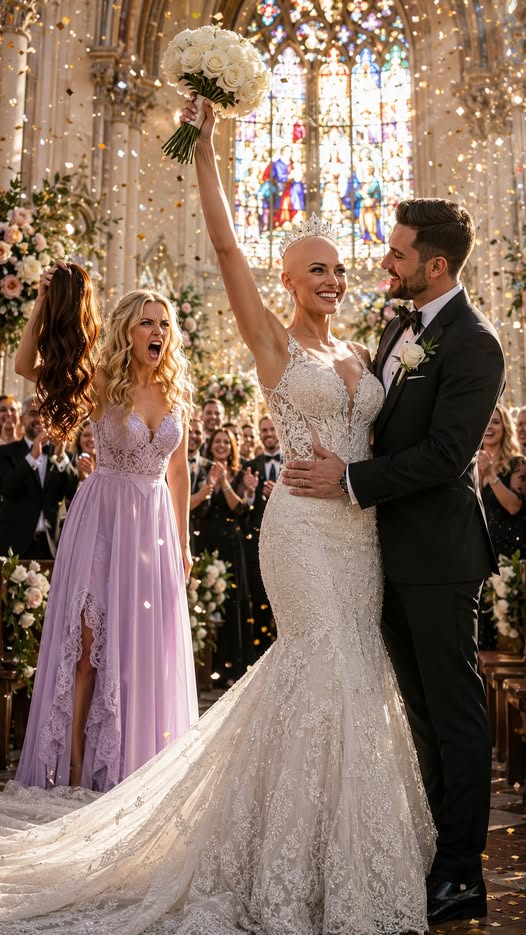
I pushed the traditional lace veil aside, letting it fall to the floor. Then, I reached for the heavy mahogany jewelry box Arthur had sent to the room that morning. Inside was his wedding gift. I lifted it out: a breathtaking, $2 million diamond tiara, an antique piece that had belonged to his great-grandmother.
With slow, deliberate movements, I placed the glittering crown directly onto my bare head. It was cold, heavy, and magnificent. I looked like a warrior queen who had just survived a siege.
I didn’t say another word to Audrey. I simply turned and walked out of the suite, the diamonds catching the light of the hallway chandeliers.
As I reached the grand vestibule of the cathedral, Sloane took one look at me and gasped, her hands flying to her mouth. I gave her a single, sharp nod.
As the heavy oak chapel doors swung open, exposing my completely bare head and the glittering tiara to the five hundred elite guests, a heavy, suffocating silence fell over the cathedral—until a sharp gasp from the very front row cuts through the quiet.
Chapter 3: The Walk of Dignity
The cathedral was a masterpiece of gothic architecture, boasting vaulted stone ceilings and massive stained-glass windows that fractured the afternoon sun into brilliant shards of ruby, sapphire, and gold. As I stepped over the threshold, those beams of colored light caught the $2 million tiara resting on my bare scalp, casting dazzling, prismatic reflections across the ancient stone walls.
The silence in the room was absolute. It was a heavy, physical thing, pressing against my eardrums. Five hundred of New York’s most wealthy, powerful, and judgmental individuals were staring at me. I could see the initial shock registering on their faces—eyes widening, jaws slightly dropping. I felt the phantom weight of the wig I was supposed to be wearing, the sudden vulnerability of the cool air against my skin.
But I did not lower my gaze. I pulled my shoulders back, lifted my chin, and took my first step down the long, velvet-lined aisle.
I expected the whispers. I expected the muffled snickers and the polite, devastating pity that my mother had so hysterically predicted.
But no one laughed.
Instead, a profound shift rippled through the congregation. From the third row, an elderly woman with silver hair—the matriarch of a prominent banking family—slowly rose to her feet. Beside her, her husband followed. Then, the row behind them stood. One by one, like a wave of quiet reverence, the guests began to stand. This wasn’t the obligatory standing for the bride; it was a deliberate, respectful rising. They were looking at my scars, my bald head, and my defiant red lips, and they were seeing exactly what I wanted them to see: a survivor. The pity Beatrice had feared was entirely absent. The air was thick with sheer, unadulterated awe.
Out of the corner of my eye, I saw Audrey standing in the bridesmaid lineup near the altar. Her smug smile had frozen, slowly curdling into a mask of confused horror. She looked frantically around the room, expecting smirks and whispered insults, but she saw only respect. Her ultimate act of sabotage had only served to elevate me.
And then, I looked at Arthur.
He was standing at the end of the aisle, dressed in a sharp, midnight-blue tuxedo. When the doors had first opened, he hadn’t flinched. He didn’t look shocked or embarrassed. As I walked toward him, I saw his jaw clench, a muscle feathering in his cheek. His dark eyes were brimming with tears—tears of love, of overwhelming pride, and of a fierce, dangerous protection.
He didn’t wait for me to reach the altar. Ignoring tradition, Arthur stepped down from the raised platform and walked down the center of the aisle to meet me halfway. A soft murmur of surprise rippled through the standing crowd, but Arthur only had eyes for me.
He took both of my trembling hands in his large, warm ones. He didn’t look at my dress, or the diamonds. He looked at my bare head, at the scars that mapped my survival. He leaned down, and right there in the middle of the aisle, he pressed his lips to my bare forehead. The kiss was so tender, so full of absolute devotion, that a sudden, sharp ache blossomed in my chest, and a single tear escaped my eye.
“You are the most beautiful woman I have ever seen,” Arthur whispered, his voice thick with emotion, yet loud enough to carry through the hushed cathedral.
He offered me his arm, and together, we walked the remaining distance to the altar. My parents were sitting in the front row. Harold looked pale, staring at the floor, while Beatrice was visibly shaking, her face buried behind her program, mortified by her daughter’s lack of “perfection.”
Arthur led me up the steps and turned to the priest. He gave the holy man a brief, respectful nod. Then, to the absolute bewilderment of the congregation, Arthur stepped past the altar and reached for the microphone resting on the pulpit.
The softness in his eyes vanished, replaced instantly by a look of cold, calculating, and terrifying authority. It was the look of a man who built empires and crushed his enemies without a second thought.
Arthur raises the microphone, his eyes locked onto Audrey’s pale face. “Before we exchange our vows,” he announces to the 500 guests, “we have a brief, unfinished piece of business to address—courtesy of our behind-the-scenes documentary crew.”
Chapter 4: The Public Unmasking
A collective murmur of confusion swept through the cathedral. People exchanged bewildered glances, the heavy rustle of silk and taffeta echoing off the vaulted ceilings. Even I looked at Arthur in surprise, my hand still resting in his. He squeezed my fingers gently, a silent promise that everything was under control.
High above us, flanking the massive pipe organ, two massive, high-definition screens had been discreetly mounted to display the ceremony for the guests in the back. At Arthur’s signal, they flickered to life.
Suddenly, the entire congregation was no longer looking at the altar; they were peering into the private, velvet-draped bridal suite. The footage was crisp, the colors vivid, and the audio, piped through the cathedral’s state-of-the-art acoustic system, was crystal clear.
On the screens, the guests watched as the room emptied, leaving only my wedding gown hanging in the background. Then, the door clicked shut. Audrey stepped out from behind the heavy oak wardrobe.
The silence in the cathedral was so absolute you could hear a pin drop.
The footage showed Audrey darting toward my vanity. The camera captured the vicious, manic gleam in her eye as she snatched the heavy velvet box. She opened it, ripped the $15,000 custom wig out by its roots, and shoved it viciously into a nearby trash bin, burying it beneath a pile of discarded plastic garment bags.
A sharp, collective gasp echoed through the chapel. In the front row, Beatrice let out a strangled cry, clapping a hand over her mouth.
But the video wasn’t over. The screen showed me walking out of the bathroom, the panic setting in. It showed Audrey cornering me, her manicured hand digging into my arm as she dragged me to the mirror.
And then, Audrey’s voice rang out, echoing off the stained glass, amplified for five hundred of the most influential people in the country to hear: “Because you don’t deserve him. A bald bride for a perfect groom. You look like a sick rat. If you walk out there like that, everyone will pity Arthur for marrying a charity case. You’re broken, Clara. You’ve always been broken.”
The footage cut to black.
The aftermath was catastrophic. The silence that followed was not of awe, but of profound, unadulterated horror. People were staring at Audrey as if she had suddenly transformed into a monster before their eyes. Whispers erupted like wildfire—harsh, condemning, and ruthless.
Audrey’s face had drained of all color, leaving her looking sickly and hollow. She took a step back, shaking her head, her hands trembling as the weight of her public execution settled over her. Beatrice was sobbing openly, her face buried in her hands, entirely consumed by the shame of social ruin. Harold sat paralyzed, his jaw slack, his eyes wide with the realization that his family’s reputation had just been immolated.
Arthur brought the microphone back to his lips. “I believe in transparency,” he said, his voice calm, even, and terrifyingly cold. “And I do not marry into a family of monsters.”
He looked directly at my parents. “To Clara’s parents, who stood by for thirty years and enabled this cruelty, who prioritized their social standing over their daughter’s life: your invitations to this wedding, and my life, are hereby revoked.”
Harold tried to stand, opening his mouth to protest, but Arthur cut him off.
“To Audrey,” Arthur continued, his gaze pinning my sister to the floor. “My security team has already retrieved the property you disposed of. Furthermore, my legal team has already filed a police report for the theft and destruction of the $15,000 custom piece, alongside a civil suit for intentional infliction of emotional distress. You will be hearing from them on Monday.”
Arthur paused, turning his attention to the imposing, dark-suited security guards waiting discreetly at the entrance of the cathedral. He gave them a sharp nod. “Please escort these people out of my sight.”
As the guards began a brisk march down the aisle toward the front row, Arthur turned back to the congregation, his face softening only slightly. “And to honor my wife’s incredible strength, her resilience, and the sheer beauty of her spirit, I am announcing a $10 million donation in Clara’s name to the National Breast Cancer Foundation, starting today. Now, if you will excuse the interruption, I have a woman to marry.”
The chapel erupted into applause. It started from the back—a slow, thunderous clapping that quickly overtook the room, a standing ovation that drowned out the frantic, pathetic protests of my mother.
As the security guards grab Audrey’s arms to lead her out, she frantically reaches for her father’s arm, but Harold ignores her, staring at his phone as a series of urgent, devastating notifications from his business partners begin to flood his screen.
Chapter 5: The Spoils of Truth
Three months after the wedding, the tabloids were still talking about the “Barefoot and Bald Bride of the Hamptons,” but the narrative had shifted entirely from what my mother had feared. I wasn’t a laughingstock; I was a symbol. The footage from the wedding, mysteriously leaked to a major news outlet, had gone viral. My brave, diamond-crowned walk down the aisle had inspired thousands of women going through chemotherapy. My social media, once a quiet, private space, was now flooded with messages of support and tearful gratitude from survivors worldwide. I was invited to speak at global health summits and lead symposiums on patient advocacy. My architectural firm was booming, flooded with commissions from clients who admired my integrity.
My life with Arthur was a sanctuary of peace and unconditional love. The wedding, once my family had been excised from it, had transformed into a beautiful, intimate celebration. We danced until dawn, my bare head resting against his chest, completely free of the toxic weight I had carried my entire life.
Meanwhile, the universe had a way of balancing the scales, and Arthur’s retribution had been absolute.
In a small, rented apartment on the grim outskirts of the city, Audrey sat alone. The $5 million wedding she tried to ruin was her last connection to high society. Her husband, an ambitious investment banker horrified by the video broadcast and the subsequent, catastrophic loss of his own business connections due to his association with her, filed for divorce within forty-eight hours. Her friends—the shallow, sycophantic socialites she had spent her life courting—abandoned her instantly, treating her name like a contagious disease.
Her parents fared no better. The notifications Harold had received in the chapel were just the beginning. Arthur, true to his ruthless nature in business, had pulled his massive venture capital investments from Harold’s firm. Without Arthur’s backing, Harold’s other partners panicked and pulled out of their deals. The resulting financial collapse was spectacular. Their sprawling estates were facing foreclosure, their country club memberships were revoked, and the precious social status they had sacrificed their daughter for was utterly destroyed.
I was sitting in the sunlit study of our Manhattan penthouse, looking over blueprints for a new pediatric oncology wing I had been commissioned to design, when Arthur’s head of security gently knocked on the door and handed me a letter.
It had been heavily vetted, of course, but it was handwritten. I recognized the cursive immediately. It was from Beatrice, written in a shaky, desperate script that smeared the expensive stationary.
“Clara, please,” the letter began. “Your father is losing everything. The bank is taking the Hamptons house next week. Audrey is in a terrible state, she won’t even leave her apartment. We are your family, Clara. You have millions now, billions with Arthur—surely you can spare enough to help us keep the house? We did what we did to protect you, to keep you strong, to prepare you for the real world. You know we love you. Please call us. We need you.”
I read the words twice, feeling a strange, hollow sensation in my chest. There was no apology. There was no remorse. Even in ruin, she was trying to gaslight me, framing their abuse as some sort of twisted maternal protection. They didn’t miss me; they missed my proximity to a checkbook.
I stood up, walked over to the heavy-duty paper shredder by Arthur’s desk, and fed the letter into the machine. The vicious whirring sound of the blades turning Beatrice’s desperate pleas into confetti was profoundly satisfying.
Clara folds the letter and drops it into the shredder. But as she turns to leave the room, her phone buzzes with a restricted-number call, and a voice on the other end whispers, “You think you won, Clara? You haven’t seen the end of this.”
Chapter 6: A Crown of One’s Own
Two years later, the threat of that whispered phone call had dissolved into nothing but the empty, impotent rage of a ruined woman. Audrey never followed through. There was nothing left for her to follow through with.
I stood in the grand, gilded ballroom of The Plaza Hotel, hosting the annual Hope Gala, a charity event Arthur and I had founded to fund aggressive breast cancer research. The room was dripping with crystal chandeliers and overflowing with New York’s true elite—the innovators, the philanthropists, the people who actually built things rather than just feeding off them.
I was healthy. I was radiant. My hair had finally grown back in soft, dark waves. I could have let it grow out to its original, cascading length, but I chose to keep it cut in a short, chic pixie style. It wasn’t just a fashion choice; it was a deliberate styling choice that honored my past rather than hiding it. It was a reminder of the battle I had fought and the armor I no longer needed. I wore an elegant emerald gown that draped perfectly over my frame, the color bringing out the life in my eyes.
During a lull in the speeches, I excused myself and walked toward the terrace for some fresh air, the hum of the string quartet fading behind me.
On my way through the labyrinth of the catering hall, I passed a line of staff furiously clearing glasses and preparing the dessert trays. I walked past a woman carrying a heavy silver tray, and something made me stop.
The woman was wearing a stained, ill-fitting white apron. Her hair was pulled back into a messy, frantic bun. She had tired, sunken eyes, and premature lines of deep stress etched into her face, robbing her of the flawless beauty she had once wielded like a weapon.
It was Audrey.
She must have felt my gaze, because she paused, turning her head. Audrey froze, clutching the silver tray so hard her knuckles turned white. She stared at my emerald gown, at the diamonds sparkling at my throat, and most of all, at the quiet, unshakable confidence radiating from me.
For a fleeting second, my mind flashed back to the bridal suite. To the cruel smirk, the stolen wig, the venomous words calling me a sick rat. I waited for the surge of anger. I waited for the cold, vindictive sense of satisfaction to wash over me, the thrill of seeing my abuser brought so utterly low.
But it didn’t come.
Instead, standing there in the warm light of the corridor, I felt only a profound, quiet pity. She looked so small. So hollow. A woman who had built her entire existence on a foundation of sand, only to be washed away by the first real tide.
“Clara…” Audrey whispered, her voice cracking, her eyes darting nervously toward the banquet manager at the end of the hall, as if expecting security to throw her out again, just like they had on my wedding day.
I looked at her, truly looked at her, and I realized something beautiful: she had absolutely no power over me anymore. The ghost was gone.
I simply smiled—a warm, genuine smile of a woman who has entirely healed.
“Drink some water, Audrey. It’s a long shift,” I said softly.
I didn’t wait for a response. I turned and walked back into the warm light of the ballroom, leaving her standing in the shadows of the service hallway.
Arthur met me at the grand terrace doors, his eyes lighting up the moment he saw me. He wrapped a strong, familiar arm around my waist, pulling me close. “Everything okay, Mrs. Sterling?” he asked, pressing a kiss to my temple.
“Everything is perfect,” I murmured, resting my head against his shoulder.
I looked up at the man who had loved me when I was dying, and who loved me even more now that I was truly living. Then, I looked down at my hands. The wig I had once cried over was long gone, discarded in the trash where it belonged. But the crown of self-worth I discovered that day in the bridal suite would never be taken away. It was a permanent fixture, invisible but indestructible.
As Clara looks out over the glittering city skyline, she gently touches the faint scar near her collarbone, realizing that the greatest crown she will ever wear was never made of diamonds, but forged in the quiet fire of her own survival—a legacy of strength that she would pass down to the child growing quietly beneath her heart.
If you want more stories like this, or if you’d like to share your thoughts about what you would have done in my situation, I’d love to hear from you. Your perspective helps these stories reach more people, so don’t be shy about commenting or sharing.