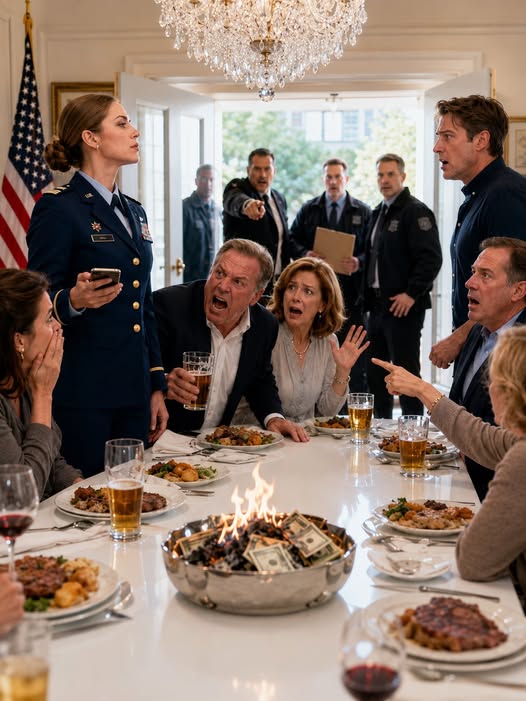
At the family dinner, Dad tapped his beer glass and demanded I take the fall for Luke’s felony. “Cover for him, or I’ll leak your crazy PTSD files to everyone!” I just smiled, stood up tall in my Dress Blues, and hit “Execute.” That $15K bribery fund turned to ash the exact second three Federal agents kicked the front door wide open. Dad choked on his drink, staring at my uniform: “Wait… you’re the Pentagon Major arresting my son?!”
Part 1 — The Moment I Walked Away
The remote clicked three times before my father finally spoke.
Outside, rain hit the windows of my parents’ house in Branton, Ohio, turning the glass into a dull sheet of silver under the porch light. Inside, everything smelled the same as always—stale beer, fried onions, old carpet, and the faint cigar smoke my father insisted never came from indoors.
He sat in his recliner, one socked foot resting on a milk crate, eyes locked on football highlights like nothing else in the world mattered.
“We are not driving all the way to Maryland for your little job ceremony,” he said without looking at me.
My mother, Vesta, sat on the couch sorting coupons, a laundry basket beside her. She didn’t look up either.
“Your brother needs help this weekend,” she added calmly. “Family comes first, Cerise.”
I stood near the doorway in my dress coat, rainwater dripping onto the warped floorboards.
“My promotion ceremony is Saturday,” I said.
My father let out a short laugh. “Promotion. Government people love fancy words. You just sit behind a desk now, don’t you?”
That desk had taken me eighteen years to earn—deployments, inspections, sleepless nights, missed meals, constant pressure where one mistake could end everything. But none of that mattered in this house.
Here, my brother’s failures always weighed more than my accomplishments.
Blaine’s business collapsed from drinking and gambling. They called it bad luck. He missed payments; they called it stress. He lost contracts; they said people were jealous.
Meanwhile, I paid their bills, covered their mortgage twice, and sent money whenever something broke.
And still, I was “distant.”
“I already reserved two seats,” I said quietly.
My mother didn’t look up. “Don’t start that face.”
“What face?”
“The one where you act like we’re bad people.”
My father pointed the remote at the TV. “If you want applause, clap for yourself.”
That was it. No argument. No emotion. Just a final kind of dismissal that settled into the room like dust.
I took a slow breath, set my overnight bag down, and turned toward the door.
And I left.
Three days later, I stood in a government auditorium in Maryland as rows of families filled the seats.
The air smelled like floor wax, wet coats, and burnt coffee. People whispered, children fidgeted, and cameras waited.
Two chairs I had reserved sat empty in the second row.
Perfect view of the stage.
Perfect view of who they refused to be there for.
When Colonel Saye called my name, I walked forward with steady steps. The insignia at my collar felt cold, then heavy, as it settled into place.
Polite applause followed.
Then a whistle cut through the room.
I turned.
Merritt Cole stood near the wall—seventy-three, cane in one hand, gas station coffee in the other. A neighbor from my parents’ street. Someone I barely expected to see, let alone here.
He had driven hours in bad weather.
He raised his cup slightly and nodded once.
That small gesture hit harder than anything else that day.
After the ceremony, people gathered outside, laughing, taking photos, opening coolers. I stood alone near my car holding a box with my old insignia.
Colonel Saye approached.
“You earned this, Major Vale.”
No extra words. No softness. Just truth.
In the car, rain hammered the roof. On the passenger seat sat a brown envelope—fifteen thousand dollars I had saved to take my parents on a cruise I had imagined would finally make them proud.
Looking at it now, I understood what it really was.
Not a gift.
A final attempt to buy love that was never offered back.
I shoved it into the glove compartment and locked it.
My phone lit up.
Mom.
It rang.
For eighteen years, I had always answered.
This time, I let it ring until it stopped.
Then I deleted her contact.
And when her name disappeared, something inside me went quiet in a way that felt permanent.
I started the engine and drove away.
Not knowing that this ending wasn’t the end at all.
Because six weeks later, a single photograph would pull my family back into my life—
and this time, they wouldn’t be coming for me.
They would be coming for what I had become.

Part 2 — The Photograph That Changed Everything
At first, the photograph meant nothing.
That was my instinct when I saw it in the Washington Post—blurred, distant, almost forgettable. I was standing near the edge of a press briefing room, partially hidden behind a podium and two officials in dark suits. My face was out of focus. My uniform barely visible beneath a folder. Anyone outside my world would have scrolled past it without a second thought.
But Branton, Ohio, never scrolled past anything.
Branton lived on gossip, church parking lot conversations, grocery store rumors, and bar stories where men like my father turned half-truths into proof.
By Tuesday night, my phone was exploding with unknown numbers. Old neighbors. Distant relatives. People who hadn’t spoken to me in years suddenly appeared in my life again.
One message read: “Girl, when were you going to tell us you were important?”
Important.
Not successful. Not safe. Not even alive.
Important.
At 7:18 p.m., my mother called from a number I never bothered to delete. I answered on speaker without thinking.
“Cerise, sweetheart,” she said warmly, almost proudly. “Why didn’t you tell us about your job?”
I stood in my Alexandria kitchen, one hand resting on the cold marble counter. Outside, rain traced uneven lines down the glass. Everything in my apartment was quiet, controlled, mine.
“It’s just a routine work photo,” I said.
“Oh, don’t be modest,” she replied. “Your father already cut it out and took it to McGarry’s. Everyone’s talking about it.”
Of course he did.
The same man who dismissed my promotion had carried my image into a bar like it was his own achievement.
“He told people you work with top-level offices now,” she added. “He’s proud.”
I said nothing.
Then she continued.
“He also told the Gazette that Blaine’s business is connected to your department.”
My grip tightened.
“What?”
“It’s just for the article,” she said quickly. “You know how people exaggerate. It makes him look established. He’s trying, Cerise.”
I turned toward the phone.
“What exactly did he say?”
“Oh, don’t sound like that. Your brother just has a bid file. Some government supply thing. He needed help getting started.”
A bidding file.
The words landed heavily.
Blaine had no clearance, no approval, no qualifications for federal work. Just a failing repair shop—and my last name.
“I have another call,” I said flatly.
“Cerise—”
I ended the call.
The phone lit up again almost immediately. A text from Blaine.
Big sis. Proud of you. Need your help reviewing a federal vendor file. Nothing serious.
Nothing serious.
I read it once. Then again.
Outside, rain kept tapping the glass. Life continued normally for everyone else while my family casually stepped into federal fraud and called it opportunity.
I didn’t respond.
The next morning, I forwarded everything to my secure work account and logged it as routine documentation. Not emotion. Not accusation. Just record.
Because records couldn’t be argued with.
For two days, nothing happened.
Then Friday morning arrived.
Two security officers met me outside a restricted corridor in the Pentagon. Mercer, a legal oversight officer, stood behind them holding a folder.
“Major Vale,” he said evenly, “you are being suspended pending investigation.”
The hallway felt longer than it should have. Fluorescent lights buzzed overhead.
“On what grounds?” I asked.
He opened the folder. “Vendor fraud tied to Vale Marine Repair and Supply. Your name appears in authorization chains.”
Blaine hadn’t asked for guidance.
He had already used my identity.
They removed my badge first. The sound it made when I placed it on the table was small—but final.
Inside the interview room, Mercer laid out printed emails, signatures, timestamps, and approval logs with my name attached to documents I had never seen.
A carefully constructed fraud.
Not sophisticated—but enough.
Colonel Saye arrived later. He dismissed Mercer and closed the door behind him.
He didn’t sit.
“The board wants someone accountable,” he said.
“I didn’t sign any of that.”
“I believe you.”
That should have helped.
It didn’t.
“Belief isn’t proof,” he continued. “You have forty-eight hours to produce original source files or a hard drive showing who created this. Otherwise, I can’t protect your position.”
Protect.
The word felt distant.
“My family is involved,” I said.
His expression didn’t change.
“Then stop thinking like their daughter.”
Silence filled the room.
And I understood exactly what that meant.
By noon, I booked a flight to Cleveland. By afternoon, I packed one bag, two encrypted drives, my laptop—and the brown envelope with fifteen thousand dollars I had once planned to use for a gesture that now felt like a joke.
The plane descended through gray clouds, and Ohio spread below like a memory I had tried to outgrow.
At the rental counter, I was told to drive safely.
I almost laughed.
Safety wasn’t part of this anymore.
When I pulled into my parents’ driveway, the porch light flickered weakly in the cold.
Before I could get out, my mother appeared at the door, smiling too brightly.
“My powerful girl is home,” she called.
I stepped out into the cold, carrying a duffel bag in one hand and a collapsing life in the other.
Inside, they were waiting—with smiles, food, neighbors, and the same confidence they always had when they believed family would protect them from consequences.
Part 3 — The House That Was Never Safe
My mother hugged me like there had never been an empty chair in Maryland.
She smelled of cheap vanilla lotion and laundry soap. Her hands stayed on my shoulders a second too long, as if she could measure rank through fabric.
“You look so official now,” she whispered. “So important.”
“Now,” I said.
She blinked. “What?”
“Nothing.”
The house was too warm. Smoke from the kitchen mixed with lemon cleaner and beer. The television blared in the living room where neighbors sat with paper plates, watching like it was entertainment.
On the coffee table sat a framed Washington Post clipping—my blurred face cut out and displayed like proof of success.
My father stood beside it, beer in hand, freshly shaved like he expected an audience.
“There she is,” he announced. “My Pentagon girl.”
The neighbors looked at me with sharp curiosity. Someone whispered about “working under big people.”
I didn’t correct them.
Blaine came in through the back door wearing a stretched Browns hoodie, heavier than before, eyes still restless and calculating.
“Major big shot,” he said, opening his arms.
I stepped aside.
He hugged nothing but air.
His smile flickered for half a second before returning too loudly.
My father forced cheer into his voice. “Eat. Blaine smoked ribs.”
I looked at my brother. “We need to talk about the vendor file.”
The room changed immediately.
Heat still filled it, but the atmosphere tightened. Plates paused midair. Conversations stalled. My mother’s smile turned thin.
Blaine rubbed his neck. “It’s just paperwork.”
“You forged my authorization.”
He laughed too quickly. “That’s dramatic.”
My father slammed his beer down. “Don’t talk like you’re law enforcement. He made a mistake.”
“He bribed a records clerk.”
My mother stepped in, pressing herself between us. “Lower your voice.”
I scanned the room—neighbors, relatives, all watching to see which version of me would appear.
The quiet fixer.
Or something else.
I picked up my bag.
“Where are you going?” my father asked sharply.
“Upstairs.”
“We’re not finished.”
“No,” I said, climbing the stairs. “You’re not finished lying. I’m done listening.”
The guest room was unchanged—faded quilt, cracked ceiling, stale air. I locked the door and opened my laptop.
I worked through the night.
Records. filings. invoices. vendor logs. slowly, the structure of the scheme began to appear. Blaine hadn’t built it alone.
At 1:12 a.m., I found a trace: a consulting payment routed through a shell name—Kestrel Administrative Solutions. No address. No identity. Just a disappearing financial trail.
Blaine was careless—but not this careful.
At 2:03 a.m., I heard voices below.
I moved silently into the hallway. The house was dark except for a yellow glow from the basement.
My mother’s voice was tight. “What if she doesn’t protect him?”
My father answered calmly. “She will.”
“You don’t know that.”
“Then we remind her what she has to lose.”
I froze.
“The file?” my mother whispered.
“Her evaluation,” my father said. “The one from after deployment.”
The air left my lungs.
My evaluation.
A classified medical and psychological record—one my mother had once insisted on keeping “to help me.” One I had trusted her with when I was exhausted, medicated, and recovering.
“If she refuses,” my father continued, “we send it to investigators. Let them decide if she’s stable enough to hold clearance.”
Silence followed.
Then my mother said softly, “She’ll lose everything.”
“Then she’ll choose family,” he replied.
That word didn’t break me.
It hardened something inside me instead.
I stepped back without sound and returned to the guest room. My hands were steady as I opened a secure file. I wrote everything down.
Every word I had heard.
By sunrise, I was no longer trying to protect them from consequences.
I was planning how to step completely out of their reach.
And just after dawn, my phone lit up with a message from Odessa—Blaine’s wife.
One address. One time.