Chapter 1: The Weight of a Single Sheet
This is the chronicle of my own resurrection, a testament to the fact that sometimes the universe must burn your house to the ground to force you to find a castle.
The winter chill in Washington, D.C. that year felt malicious, carrying a biting wind that shrieked through the warped window frames of the apartment I had paid to keep afloat. I sat anchored to the frayed fabric sofa, my hands intertwined and pale in my lap as the early dusk devoured the room’s meager light. Upon the glass coffee table, a fragile, white sheet of paper weighed upon my chest like a granite slab. The ink from the private specialist’s printer was brutally crisp, each letter an invisible blade sinking directly into my ribs.
The clinical conclusion stated that due to a severe congenital malformation of the uterine structure, conception was highly unlikely. The word infertility wasn’t explicitly typed out, but its ghost hovered over the page, mocking me. I had just turned twenty-eight. To the world, it was the prime of a woman’s life; to me, it felt like a premature burial.
I was originally Cecilia, a Midwestern girl from the quiet cornfields of Indiana. I had migrated to the East Coast five years prior, bringing nothing but a suitcase full of diligence and an unfortunate propensity to believe in fairy tales. That was when I met Julian. Back then, he was a bottom-tier corporate grinder, full of sweet vows and ambitious dreams. For a half-decade, I bent my spine for him and his mother, Eleanor. I worked grueling, bone-aching hours as a seamstress in a dusty alteration shop. Every frayed hem I repaired, every needle prick that drew blood, translated to dollars that I poured directly into their mortgage. I denied myself warm lunches and new winter boots, existing on ramen and tap water, just so Julian and Eleanor could parade their perceived status at the local country club.
Yet, as the years ticked by and my stomach remained flat, the gratitude evaporated. Julian’s late nights grew more frequent, his excuses flimsier. Eleanor’s passive-aggressive barbs about the neighbor’s grandchildren morphed into direct, venomous glares. This morning, suffocated by the pressure, I had secretly visited the clinic, praying that my failure to conceive was merely a byproduct of exhaustion and malnutrition.
I was wrong.
I wiped a rogue tear with my frayed sleeve, my chest tightening as the metallic clack of the front door deadbolt echoed through the dark hallway. Julian had arrived. But as the door swung open, the scent that preceded him wasn’t the stale coffee of a long workday. It was an overpowering, cloying wave of designer women’s perfume. And he was not alone.
Chapter 2: The Ejection
Julian strutted into the living room, shedding his cashmere coat—a coat my alterations salary had paid for—without even a glance in my direction. Trembling, I stood up, the medical report clutched in my fist. A bitter knot of dread lodged in my throat.
“What are you doing standing there in the dark like a ghost?” Julian snapped, his eyes flashing with a bored irritation. “Did you make dinner, or am I supposed to starve?”
His absolute indifference shattered my final illusion. With shaking hands, I extended the paper. “I saw a specialist today,” I whispered, the words scraping against my vocal cords. “The doctor… he says it’s practically impossible for me to be a mother.”
I squeezed my eyes shut, bracing for the phantom embrace of a husband who loved me. Instead, I heard a sharp, disdainful scoff. Julian snatched the paper, barely skimming the text before dropping it onto the hardwood floor like a piece of trash.
“I suspected as much,” he said, his voice dropping several degrees. “If we’ve been trying this long with zero results, obviously you were the defective one.”
Before I could even process the ice in his veins, the hallway door violently banged open. Eleanor had been eavesdropping. She marched into the room, her face mottled with an ugly, purplish rage. She swooped down, retrieved the report, and aimed a manicured finger directly at my face.
“A barren mule!” Eleanor shrieked, the veneer of her country-club manners entirely stripped away. “We let a defective, incomplete peasant into our home! You’ve been leeching our food, wasting our time, and you can’t even give me a grandson!”
I collapsed to my knees, tears searing my frozen cheeks, begging Julian to intervene. He merely leaned against the drywall, crossing his arms and checking his phone.
Then, the doorbell buzzed—a long, piercing shriek.
Eleanor wrenched the door open. A young woman, perhaps twenty-two, strutted in. She wore scarlet lipstick and a tight, ribbed dress that unapologetically hugged a prominent, four-month baby bump. She looked down at my kneeling form with absolute revulsion.
“Julian, honey,” she cooed, ignoring me entirely as she hooked her arm through his. She turned to Eleanor with a saccharine smile. “The doctor confirmed it today. It’s a boy, Eleanor. But I am not raising your grandson as a bastard. I want my legal status, tonight.”
Her name was Chloe. For over a year, she had been warming Julian’s bed while I hemmed trousers to pay for his electricity. Julian didn’t even have the decency to look ashamed. He opened his leather briefcase, retrieved a pre-printed stack of uncontested divorce papers, and slammed them onto the glass table.
“Sign them, Cecilia,” Julian ordered, his tone devoid of humanity. “You smell like cooking grease and poverty. You embarrass me at corporate dinners. Chloe knows how to dress, how to entertain, and she’s giving me an heir. The condo is mine through the prenup. Step aside.”
Cornered, exhausted, and utterly disgusted by the monsters unmasked before me, the tears suddenly stopped. A cold, hard clarity crystallized in my chest. I grabbed the pen and carved my signature into the paper, severing my soul from theirs. The moment the ink dried, Eleanor dragged my battered suitcase from the bedroom, unceremoniously kicking it into the hallway. She shoved me by the shoulders, slamming the heavy wooden door shut. The deadbolt clicked.
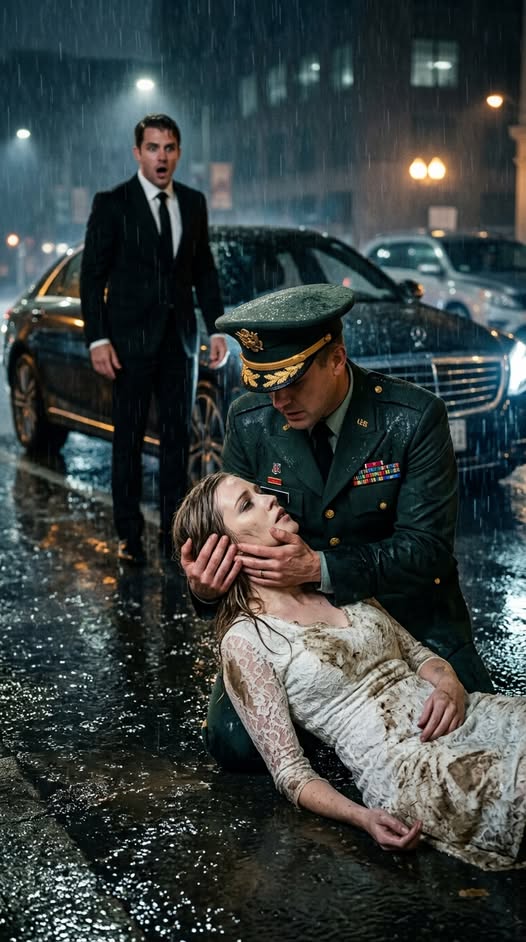
I was entirely alone in a freezing, torrential sleet. I stumbled down the asphalt, the freezing rain soaking through my thin wool sweater, my heavy suitcase dragging behind me like a corpse. Hunger gnawed at my stomach; the biting Northeast wind slashed at my pale face. The streetlamps blurred into chaotic, blinding halos. At a deserted intersection, my knees simply gave out. I collapsed onto the wet pavement beneath a skeletal sycamore tree, the darkness rushing in to claim me.
But just as my consciousness faded, a blinding beam of headlights cut through the storm, and the deafening screech of heavy tires halted inches from my body. A pair of heavy, military-grade leather boots splashed onto the asphalt.
Chapter 3: The Colonel’s Harbor
I awoke to the aggressive scent of clinical bleach and the rhythmic beep-beep of a heart monitor. I was cocooned in crisp, white hospital sheets, an IV line tethering me to reality. Through the translucent fabric of the curtain dividing the emergency room, the hushed gossip of two night-shift nurses drifted into my ears.
“Poor thing was freezing to death,” the first voice murmured. “Not a dime in her pocket. Probably kicked out by an abusive husband.”
“But did you see who brought her in?” the second voice countered, a thrill of awe elevating her pitch. “It was the Colonel. Carried her right through the double doors himself. Put her entirely on his premium military tab and ordered the chief of staff to spare no expense.”
Tears hot and fast leaked from the corners of my eyes, soaking the sterile pillow. The people I bled for had discarded me like refuse, yet a phantom of the night had scooped me from the jaws of a freezing death.
The heavy wooden door pushed open without a sound. The nurses instantly snapped to attention, offered a respectful nod, and scurried out. The man who entered seemed to absorb all the oxygen in the room. He was in his early fifties, with silver-peppered hair clipped into a flawless military high-and-tight. He possessed the rugged, angular features of a man who had weathered decades of combat, his shoulders broad beneath the silver eagles pinned to his uniform. He was Colonel Harrison Grant.
Despite his intimidating aura, when his sharp, slate-gray eyes found me, they softened into a pool of immense warmth. He pulled up a vinyl chair, moving with a calm, deliberate grace. From a stainless-steel thermos, he poured a steaming bowl of homemade chicken noodle soup.
“If you don’t eat, you can’t fight the cold,” he said, his voice a deep, resonant baritone that instantly anchored my frantic nerves.
I propped myself up, whispering a fragile thank you. As I ate, Harrison introduced himself. He was stationed at the Pentagon. He was a widower; his wife had succumbed to illness over a decade ago, and his grown children had migrated to Texas to forge their own legacies. He lived alone in a sprawling colonial estate in Alexandria.
“The nurses found your divorce petition and your medical report in your wet coat,” Harrison said softly, leaning forward. “What kind of hurricane tore through your life, Cecilia?”
The dam broke. In the presence of this honorable stranger, I vomited the entire tragedy—the financial abuse, the infertility, Chloe’s smug arrival, the midnight eviction. Harrison’s jaw clenched, a muscle feathering near his temple. He didn’t offer hollow pity. Instead, he offered tactical salvation.
“A hotel in the district will drain what little you have,” he stated, his tone brooking no argument. “Going back to Indiana as a broken woman will only wound your pride. I have a massive house with five empty guest rooms. You will stay with me. You will rest, you will eat, and you will wait out the legal storm until you are ready to march again.”
I was too stunned, too devastated to argue. That afternoon, I was discharged. I sat in the passenger seat of his armored SUV, crossing the Potomac River, leaving the ashes of my old life behind as we drove toward an impossible sanctuary. But a dark shadow still loomed: the finalization of the divorce.
Chapter 4: The Decree and the Vow
A month in Harrison’s Alexandria estate breathed color back into my cheeks. I repaid his staggering generosity the only way I knew how: I transformed his cavernous, silent house into a home. I cultivated the overgrown orchids, scrubbed the oak floors until they gleamed, and filled the evenings with the scent of slow-roasted beef stew and fresh rosemary bread. Watching Harrison’s stern face melt into absolute joy over a hot meal became my daily religion.
Then, the law firm called. It was time to finalize the paperwork at the downtown courthouse.
Harrison caught me staring blankly at the phone. He placed a massive, calloused hand on my shoulder. “Leave the ghosts where they belong, Cecilia. Surrender the past, so your hands are free to catch the future.”
Armed with his strength, I walked into the courthouse. Julian was already pacing the hallway, looking frantic and disheveled. Chloe’s nagging for legal security had clearly worn him down. He expected me to cry, to beg. Instead, I bypassed him entirely, my posture rigid, my eyes coated in frost. During the brief mediation, I barely spoke. I signed the final decree with a sharp, lethal stroke of the pen, legally erasing Julian from my universe.
That evening, I returned to Alexandria feeling lighter than air. I opened the door to find Harrison wearing an apron over his dress shirt, pulling a golden-skinned roasted chicken from the oven.
After dinner, I brewed a pot of chamomile tea. Harrison took his mug, set it on the table, and leaned back, his eyes locked onto mine with a terrifying, beautiful intensity.
“Cecilia,” he began, every syllable measured and deliberate. “You are free. I am unattached. Let us stop pretending this house isn’t better when we are together. I am asking you to share the twilight of my life. Marry me.”
The teapot lid clattered against the porcelain tray. My breath hitched. Panic, hot and toxic, surged up my throat. How could I?
“Harrison, you read the report,” I choked out, tears spilling over my lashes. “I am flawed. I am a barren woman. You are a commander, a man of status. I cannot give you a family. I am not worthy.”
Harrison didn’t flinch. He reached across the table, engulfing my trembling hands in his warm, steady grip.
“I have children, Cecilia. I have grandchildren in Texas. I don’t need an incubator to continue my bloodline,” he said fiercely, obliterating my insecurities with military precision. “I spent half my life in war zones. What I want is peace. I want a partner whose soul recognizes mine. I want you.”
The last barrier protecting my battered heart shattered. We were married three weeks later at the county courthouse.
My first night in the master bedroom, I sat rigid on the edge of the mattress, haunted by the ghost of Julian’s cruelties. But Harrison simply handed me a pair of soft cotton pajamas, dimmed the lights, and lay on the far side of the massive bed.
“I will wait for you,” Harrison whispered into the dark. “Even if it takes decades. You are safe here.”
Under the heavy duvet, I finally exhaled. I fell into a sleep so deep it felt like a baptism. Over the next few months, our hesitant dance turned into a fierce, consuming love. I was entrusted with the family finances, given access to his colonel’s salary, and ordered—ordered—to buy myself beautiful things. But nothing could have prepared me for the storm that was brewing inside my own body.
Chapter 5: Two Heartbeats in the Silence
Autumn painted Virginia in strokes of amber and gold, and we had been married for over six months. My days were a symphony of domestic bliss, punctuated by high-society military galas where Harrison paraded me on his arm like a prized jewel.
But an insidious fatigue began to anchor my limbs. I felt perpetually bruised, a heavy fog clouding my mind. One Tuesday morning, I descended the stairs to prepare Harrison’s breakfast. The moment I lifted the lid off a skillet of sizzling bacon, my stomach violently rebelled. I sprinted to the marble bathroom, collapsing onto the cold tiles as I retched until I tasted bile.
Staring at my pale, sweaty reflection, sheer terror gripped my throat. Cancer. It had to be a tumor. My reproductive organs were diseased—the old doctor had said they were malformed. Now, the rot was spreading. Just as I had found heaven, the reaper had come to collect me.
I tried to hide my pallor at the breakfast table, but Harrison, a man trained to spot ambushes in pitch-black jungles, noticed immediately. He abandoned his coffee, touched the back of his hand to my clammy forehead, and immediately dialed his commanding officer to cancel his day.
“We are going to Walter Reed National Military Medical Center,” he declared, his voice leaving no room for debate.
Within two hours, I was sitting on crinkling paper in the VIP obstetrics ward, waiting for the chief of medicine to interpret my blood panels. I gripped Harrison’s hand so tightly my knuckles turned white.
The heavy door opened. The silver-haired doctor stepped in, holding a tablet, a blinding smile cracking his weathered face. He snapped a crisp salute to my husband before turning to me.
“Mrs. Grant,” the doctor chuckled. “I don’t know what quack clinic you visited years ago, but your uterus is in immaculate condition. No malformations. Complete structural integrity. I suspect your previous ‘infertility’ was actually a severe hormonal shutdown caused by extreme stress and malnutrition.”
I blinked, the clinical words scrambling in my brain. “But the nausea… the fatigue?”
The doctor tapped the screen, turning it toward us. A grainy, black-and-white sonogram glowed in the dim room. “Mrs. Grant, your body has healed itself entirely. You aren’t dying. You are ten weeks pregnant. And judging by these two distinct fetal poles…” He pointed to two tiny, flickering rhythmic pulses on the screen. “You are having twins.”
The silence in the room became holy. The breath punched out of my lungs. I clamped a hand over my mouth as a dam of miraculous, agonizingly beautiful tears ruptured.
Harrison, the unbreakable Colonel, the man who commanded thousands, completely fractured. His slate-gray eyes flooded. He fell to his knees beside the examination table, burying his face into my neck, his broad shoulders shaking with heavy, silent sobs. For a warrior at the end of his career, these two microscopic heartbeats were the ultimate medals of honor.
Meanwhile, across the city, a very different kind of storm was about to drown my ex-husband.
Chapter 6: Reaping the Whirlwind
I didn’t seek out the news of Julian’s ruin; the universe simply delivered it via the hyperactive tongue of Mrs. Higgins, my old building superintendent, whom I ran into at a Whole Foods weeks later.
According to her gleeful recounting, Julian’s life with Chloe had rapidly devolved into a waking nightmare. Chloe refused to cook, clean, or work. She treated Eleanor like an indentured servant, weaponizing her pregnancy whenever Eleanor dared to complain. The condo was buried in dirty laundry and towering piles of credit card debt.
But the true execution came on a stormy night, a poetic echo of the night they threw me away.
Chloe went into premature labor. Julian rushed her to the hospital. After a harrowing delivery, a frail, bruised baby boy was born, requiring an immediate, life-saving blood transfusion due to congenital anemia. Julian, desperate to save his “heir,” rolled up his sleeve and demanded they take his blood.
The doctor returned with a look of profound pity. Julian was Type O. Chloe was Type A. The infant on the respirator was Type AB.
Biological impossibility.
The revelation struck Julian with the force of a freight train. He was not the father. He had bankrupted himself, destroyed his marriage, and alienated his soul to support another man’s bastard. Eleanor, who had rushed to the waiting room, overheard the doctor’s explanation. The shock was too violent for her frail system. She suffered a massive, catastrophic myocardial infarction on the spot, collapsing onto the linoleum.
While Julian screamed for the crash cart, Chloe executed her final maneuver. Pretending to need the restroom, she slipped out the back exit, raided the apartment’s safe of its remaining cash, and vanished into the wind with her actual lover.
Left with a mother in a cardiac ICU and creditors circling like vultures, Julian was annihilated. He was forced to fire-sale his beloved condo. His corporate job terminated him due to plummeting performance. The man who once scoffed at my cheap clothes was now living in a roach-infested studio in Baltimore, working the graveyard shift as a freight loader at an Amazon warehouse, his soft hands split and bleeding from manual labor.
Karma had not merely knocked on his door; it had kicked it off the hinges.
Chapter 7: Shadows at the Gate
Winter returned to D.C., but this time, I was insulated in luxury and love. Julian, however, was freezing.
Late one November evening, after hauling heavy pallets for ten grueling hours, an exhausted Julian sat in a grimy roadside diner, nursing a tap water. With blistered, filthy fingers, he scrolled through a local news app on his cracked phone.
A headline froze the blood in his veins: Wife of Army Colonel Delivers Massive Holiday Donation to Underprivileged Children.
Beneath the text was a high-resolution photograph. There I was, draped in a white cashmere coat, radiating a serene, ethereal glow, my belly heavily rounded with an eight-month pregnancy. Beside me, looking at me as if I hung the moon and the stars, was a decorated, imposing military titan.
The psychic shock broke Julian’s mind. The contrast between his squalor and my majesty drove him to madness. Leaving the diner, he began to walk. He walked for ten freezing miles through the sleet, his boots dragging against the asphalt, driven by a masochistic need to see it with his own eyes.
By nightfall, Julian stood shivering like a stray dog behind a massive oak tree across from the wrought-iron gates of my exclusive military housing enclave.
At exactly seven o’clock, Harrison’s black government SUV rolled up to the security checkpoint. I watched from the passenger seat as Harrison stepped out into the rain. He opened a massive black umbrella, walked around the hood, and gently opened my door. He offered his hand, helping me navigate my heavy belly, pulling me flush against his side to shield me from the wind. He whispered a joke into my ear, and I threw my head back, my laughter echoing like wind chimes into the dark street.
From the shadows across the road, Julian watched. He saw the insurmountable abyss separating us. He remembered the bowls of mac and cheese, the way I used to massage his shoulders, the absolute, blind devotion I had offered him. He had held a diamond, convinced it was glass, and threw it away for a glittering piece of trash.
Tears of agonizing, toxic regret carved paths through the grime on his face. He didn’t dare call out. He didn’t dare step into the light. When the heavy iron gates slid shut, locking him out of paradise forever, Julian turned around and vanished back into the frozen dark, condemned to carry the corpse of his mistakes for the rest of his miserable life.
Chapter 8: The Fragrance of the Bloom
When the spring thaw finally broke the spine of winter, my water broke with it.
The emergency protocols Harrison had established were executed flawlessly. I was rushed to the VIP maternity suite at Walter Reed. Through hours of blinding pain, Harrison never once left my side. He anchored me to the earth, wiping the sweat from my brow, whispering fierce mantras of love and courage.
At exactly ten in the morning, the sterile room erupted with the sound of life. Not one, but two robust cries pierced the air. A boy, bearing the strong, stoic jawline of the Colonel, and a girl, with my soft, fair features.
When the nurses laid them on my chest, Harrison leaned down, his face entirely wet with tears, and captured my lips in a kiss that tasted of salt, survival, and absolute victory.
Three years have passed since that morning.
Today, the Alexandria estate is no longer silent. It echoes with the chaotic, joyous stampede of toddler footsteps. This morning, I lay propped up in the master bed, watching my imposing husband—wearing his immaculate uniform—expertly test the temperature of a baby bottle against his wrist before handing it to the nanny.
He walked over to the bed, leaned down, and kissed my forehead. “I’ll be home by five, Cecilia. We’ll take the twins to the park.”
“I’ll be waiting, Colonel,” I smiled, tracing the silver eagles on his shoulder.
As I listened to his heavy boots descend the stairs, I closed my eyes and breathed in the scent of fresh orchids and morning coffee. I thought about the freezing rain, the cruel medical report, the sting of Eleanor’s venom. I realized I harbored no anger toward them anymore.
When you strip away the weeds, you make room for the roots of something magnificent to take hold. My descent into darkness was not an execution; it was a planting. The cruelty of my past was merely the harsh winter required to prepare the soil for the most breathtaking spring a woman could ever harvest. Let them rot in the bed they made. I am too busy blooming in mine.