Chapter 1: The Inciting Joy and the Looming Shadow
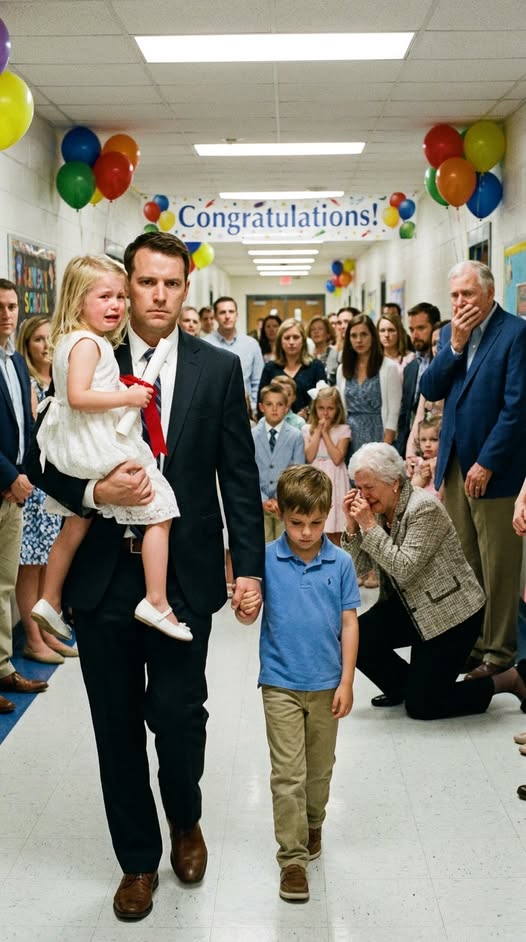
For three months, the walls of our home absorbed the sweet, determined voice of my six-year-old daughter, Lily. Every evening after dinner, as the fading sun cast long, golden rectangles across the hardwood floor, she planted her tiny, light-up sneakers firmly on the living room rug. She was preparing for the Illinois Young Voices Recitation Competition. It was not a casual endeavor. She had selected a complex, whimsical piece by Shel Silverstein, a poem that required not just memorization, but an understanding of comedic timing and theatrical pacing.
I would sit on the sofa with my wife, Hannah, watching this miniature force of nature rehearse. Lily would recite her poem with sweeping, rehearsed hand gestures, her brow furrowed in concentration, and a face so fiercely serious it made my chest ache with a profound, terrifying love. When she stumbled over a stanza, she didn’t cry. She would take a deep breath, push a stray curl of brown hair behind her ear, and start again from the top. We built a world where her effort was the currency of our household, where the act of trying was celebrated long before the outcome was ever known.
When Saturday afternoon finally arrived, the local middle school auditorium smelled of floor wax, nervous sweat, and cheap floral perfume. I sat in the third row, my knee bouncing with an anxiety I couldn’t suppress, my hand gripping Hannah’s so tightly my knuckles were white. When Lily walked out onto that massive stage, she looked impossibly small. The microphone had to be lowered down to its absolute minimum height. But the moment she opened her mouth, the nerves vanished. She commanded the room. She hit every beat, every dramatic pause, and every punchline with a natural, magnetic cadence.
When the judges lined the children up and the head adjudicator leaned into the microphone to announce her name for first place in the primary division, the universe seemed to stop spinning.
Lily froze. The applause roared around her, but her wide brown eyes bypassed the crowd, panning the audience until they locked onto mine from the stage. She was silently asking if she had heard correctly, if this impossible, magnificent thing had actually happened to her.
“You won, sweetheart,” I mouthed, my own eyes burning with hot, sudden tears.
She sprinted across the stage to accept the oversized gold ribbon and the embossed certificate, holding them against her chest like they were royal crown jewels. The car ride home was a symphony of unadulterated joy. She couldn’t stop looking at the certificate, running her small fingers over the foil seal.
But the warmth of that victory began to chill the moment Hannah, with the absolute best of intentions, suggested we take a slight detour.
“We should drive over to Naperville,” Hannah said, turning around in the passenger seat to smile at Lily. “We can share the news with Grandma and Grandpa. They’ll be so proud.”
Lily adored them. Or rather, she adored the concept of grandparents. She adored the idea of a house where older people spoiled her, an idea fed to her by television shows and storybooks.
I gripped the leather steering wheel, a familiar, icy dread pooling in the pit of my stomach. The twenty-minute drive to Naperville felt like a slow march toward a firing squad.
My parents, Patricia and Richard, did not live in a home; they occupied a museum. Their sprawling, colonial-style brick house in an upscale subdivision was a sterile monument to their own perceived social status. The lawns were manicured with violent precision. The interior was a canvas of unforgiving whites, cold grays, and fragile glass decor that screamed at children not to exist within its walls.
But the architecture was merely a reflection of the inhabitants. For thirty-two years, I had walked up that aggregate concrete pathway carrying straight-A report cards, university acceptance letters, college degrees, and lucrative corporate promotion letters, only to be met with indifferent nods and immediate subject changes. My achievements were never celebrated; they were merely logged as the minimum acceptable standard, before being immediately overshadowed by whatever my cousin, Mason, had accomplished that week.
I pulled the SUV into their pristine driveway, putting the car in park. I looked in the rearview mirror at Lily, who was carefully unbuckling her car seat, clutching her gold ribbon. She was entirely made of light. She had no armor. She didn’t know that the house we were about to enter was built on a foundation of emotional starvation.
I prayed to God they wouldn’t do to her what they had done to me.
As Lily sprinted up the manicured walkway, clutching her certificate with both hands, her face radiating pure, blinding sunlight, I reached for the heavy brass front doorknob, completely unaware that I was about to witness the exact moment my childhood trauma would attempt to claim its next victim.
Chapter 2: The Evisceration of Innocence
The heavy mahogany door swung inward, revealing the cavernous, immaculate foyer. The air inside smelled of expensive vanilla diffusers and lemon polish—a scent that had historically signaled to my nervous system that I needed to make myself as small and agreeable as possible.
Lily didn’t know the rules of this house. She burst through the front door, practically vibrating with a joy so pure it felt tangible.
“Grandma! Grandpa! I won first place!” she beamed, her voice echoing off the high ceilings. She ran straight into the sprawling, open-concept kitchen, placing the certificate on the cold granite of the center island with trembling, hopeful pride.
My mother, Patricia, was sitting on a pristine white barstool. She didn’t look up. She didn’t even lock the screen of her iPhone. She was wearing a beige cashmere sweater, her hair perfectly coiffed, her posture rigid. She merely shifted her eyes, glancing at the gold ribbon for a fraction of a second, as if it were a piece of junk mail that had blown onto her counter.
“Oh. That’s nice,” Patricia muttered, her tone flatter than a heart monitor flatline, instantly returning to her scrolling.
The silence that followed was suffocating. Lily’s massive smile faltered, the corners of her mouth twitching downward as her brain struggled to process the total absence of the celebration she had anticipated. But she was a resilient child. She pushed forward, her little voice tightening with a desperate need to be seen.
“I was the youngest one in my whole group,” Lily offered, stepping closer to the island, tapping the edge of the certificate. “There were second graders there, but I remembered all my words.”
At the far end of the kitchen, seated at the glass breakfast nook, my father, Richard, folded his Wall Street Journal with a heavy, deeply irritated sigh. He looked over the top of his reading glasses, not at Lily, but at me, conveying his profound annoyance at the interruption.
Then, he looked at his six-year-old granddaughter and casually swung a sledgehammer at her heart.
“Well, it’s nothing compared to what your cousin Mason did,” Richard said, his voice dripping with condescension. “He got invited to that regional science program at the university. Now that’s impressive. That takes real intellect.”
The air in the kitchen instantly turned into a vacuum.
Lily blinked. The vibrant, triumphant energy she had carried into the house evaporated. I watched, paralyzed for a microsecond, as her shoulders slumped. Her tiny fingers, which had been so proudly tapping the gold seal, slowly curled inward, wrapping around the edge of her certificate and unconsciously crumpling the heavy paper.
Patricia, never one to miss an opportunity to twist the knife, chimed in without taking her eyes off her phone. “Mason has always been advanced. Competitions like this reciting thing are cute, Lily, but you know, some children are just naturally gifted. Mason is going to be a doctor. You have to be born with that.”
I watched my daughter physically shrink in front of them. The light in her brown eyes died, replaced by a dark, confusing shame.
In that exact moment, the ghost of my own childhood stood beside her. I saw myself at ten, holding a science fair trophy, being told it was a shame I didn’t make the all-star baseball team like Mason. I saw myself at eighteen, holding a full-ride scholarship letter, being told that Mason was attending a more prestigious, private out-of-state college. I felt the bleeding of a thousand identical paper cuts, the suffocating, lifelong desperate hunger for a scrap of validation that was systematically withheld as a tool of control.
But I was no longer a ten-year-old boy begging for love.
Something deep inside my chest—a rusted, heavy chain of filial obligation I had dutifully dragged behind me for three decades—simply snapped. The sound of its breaking was completely, terrifyingly silent. The anxiety, the dread, the lifelong fear of their disapproval vanished, replaced by an arctic, absolute clarity.
I walked over to the granite island. I gently pried the crumpled certificate from Lily’s hands. I smoothed the bent corner with my thumb, folded it carefully, and handed it back to her, pressing it against her chest.
“Go wait by the front door with Mom,” I said softly. Hannah, who had witnessed the entire exchange, was already moving, her face a mask of furious, maternal rage. She took Lily’s hand and pulled her into the foyer.
I turned back to my parents. I didn’t raise my voice. I didn’t scream or throw a tantrum. The anger I felt was too vast, too cold for theatrics.
“From today on,” I said, my voice echoing in the sterile kitchen with a cold, absolute authority that made my father actually drop his newspaper onto the glass table. “Lily will not be coming here to beg for approval from people who make a child feel small.”
Patricia finally looked up from her phone, her eyes wide with shock at my tone. “Excuse me? Daniel, how dare you speak to—”
“You will not speak,” I cut her off, taking a step forward. The sheer physical presence of my anger made her flinch back against the barstool. “You will not compare her to Mason ever again. You will not dismiss her achievements. In fact, you will not be allowed near her until you understand exactly what you just did, and until you can prove to me that you are capable of loving her without conditions. Which means you will likely never see her again.”
“You are overreacting!” Richard bellowed, standing up, his face flushing red as he tried to reclaim his patriarchal dominance. “She needs to learn that the world doesn’t hand out participation trophies! We are preparing her for reality!”
“No, Richard,” I said, looking at the man I had spent a lifetime fearing, realizing suddenly how small and pathetic he actually was. “You are preparing her for therapy. And I am cancelling your subscription to my family.”
I turned on my heel and walked out, the soles of my shoes echoing like gunshots on their hardwood floor. Hannah had the front door open. We walked out into the fading afternoon light, and I pulled the heavy door shut behind us with a resounding, final slam.
As I buckled a silent, confused Lily back into her car seat, I glanced through the sheer curtains of the front window. Patricia’s face was white with the realization that she had just lost her favorite emotional punching bag. But standing behind her, Richard was violently picking up his cell phone, his eyes narrowing with arrogant indignation, preparing to launch a family-wide smear campaign that would force me to turn a verbal boundary into a legal war zone.
Chapter 3: The Asymmetrical Warfare and the Secret Lever
The fallout was not silence; it was a coordinated, hysterical siege. Narcissists do not process boundaries as healthy relationship parameters; they process them as acts of profound disrespect and direct challenges to their authority. When they lose control of their primary victim, they experience an “extinction burst”—a desperate, escalating franticness to force the dynamic back to the status quo.
For two weeks, my phone was relentlessly bombarded by what Hannah and I grimly referred to as the “flying monkeys.”
My Aunt Susan, Patricia’s sister, left a weeping, five-minute voicemail on a Tuesday morning. “Daniel, I cannot believe what you are doing to your mother. She has been crying for days. She said you screamed at her in her own home over a simple misunderstanding. You are breaking her heart, Daniel. You need to come over here, apologize, and stop keeping Lily from her loving grandparents.”
My Uncle Robert texted me at 2:00 AM on a Thursday: “We all know Hannah is controlling you. You were a good, obedient son before you married her. Grow a spine and call your father.”
Patricia took to Facebook, weaponizing her social circle. She posted vague, victim-baiting quotes over pictures of sunsets: “The greatest pain a mother can endure is the coldness of an ungrateful child. Praying for my family to heal from this toxic separation.” The comments from her country club friends were a chorus of enabling sympathy, painting me as a cruel, unstable monster.
I didn’t reply to a single message. I didn’t argue. I didn’t justify my actions. I systematically blocked every phone number, unfriended every relative who participated in the smear campaign, and sent one single, formal email to Patricia and Richard detailing my boundaries and stating that any further contact would be considered harassment.
They took my silence not as a boundary, but as a provocation. They decided to bypass me entirely.
On a Tuesday afternoon, my phone rang. The caller ID displayed Lily’s elementary school. A spike of pure adrenaline shot through my chest as I answered.
“Mr. Evans, this is Principal Hayes,” the voice on the other end was tight with professional discomfort. “Your mother, Patricia Evans, is currently in the front office. She is demanding to see Lily.”
“Do not let her near my daughter,” I said, my voice eerily calm, though my hands were shaking as I grabbed my car keys. “Keep Lily in her classroom. I am five minutes away.”
When I walked through the double doors of the school’s administrative office, Patricia was leaning against the reception desk. Resting on the counter next to her was a massive, incredibly expensive, professional-grade chemistry set. It was a deliberate, passive-aggressive nod to Mason’s science program—a physical manifestation of her belief that Lily’s interests were frivolous and needed to be corrected to align with the “golden child” standard.
“I am her grandmother,” Patricia was loudly explaining to a terrified secretary, performing for the audience of waiting parents. “I have a right to give her a real educational gift. Her father is just going through a phase.”
“He is not going through a phase, Patricia,” I said from the doorway.
She spun around, her performative smile dropping instantly into a sneer. “Daniel. Good. Tell this woman to pull Lily out of class. I bought her something useful for once.”
I ignored her completely. I walked directly to the reception desk, pulled a notarized document from my briefcase, and handed it to the principal, who had stepped out of her office.
“This is a formal revocation of pickup and visitation rights for Patricia and Richard Evans,” I said clearly. “They are not authorized to be on school grounds. If they return, you are to call the police immediately.”
Patricia gasped, clutching her pearls in a display of theatrical horror. “You wouldn’t dare.”
I picked up the massive chemistry set from the counter. It was heavy, wrapped in glossy paper. “And as for this,” I said, turning to look my mother dead in the eyes. I walked out the front doors of the school, marched across the parking lot to the industrial green dumpster, lifted the lid, and threw the three-hundred-dollar chemistry set directly into the garbage. It hit the bottom with a satisfying, echoing crash.
I walked back to my car without looking back, leaving Patricia standing on the sidewalk, sputtering in rage.
That night, sitting in the quiet sanctuary of my home office, I decided it was time to cut the final, hidden string.
There was a secret my parents guarded with their lives, a reality that completely contradicted their arrogant, wealthy facade. For five years, I had been quietly paying the property taxes on their sprawling Naperville home.
When Richard’s investments took a hit half a decade ago, they were faced with the reality of downsizing. The thought of losing their status symbol house was intolerable to them. They had gone to Mason’s father—Richard’s brother, a flashy, arrogant real estate agent who drove a leased Porsche—begging for a loan. He had laughed them out of his office, claiming his money was tied up.
Desperate, they had come to me, crying, manipulating my ingrained sense of duty. I had agreed to quietly transfer two thousand dollars a month into an escrow account to cover their exorbitant taxes, under the strict condition that no one in the family ever knew. For five years, they had praised Mason and his father to the heavens, bragging about their wealth to anyone who would listen, while I secretly worked overtime to keep a roof over their heads.
I opened my laptop. The glow of the screen illuminated the dark office. I logged into my banking portal, navigated to the automated transfers tab, and highlighted the recurring monthly payment to Patricia’s account.
They praised Mason while I paid their bills. They crushed my daughter’s spirit while I funded their arrogance.
I moved the cursor over the red button and clicked ‘Cancel.’
As the confirmation screen flashed, I knew the first of the month was only three days away. When that payment bounced, triggering a cascade of automated bank alerts on Patricia’s phone, she would realize her smear campaign had failed entirely. But narcissists do not surrender when their resources are threatened; they become desperate. And as I closed my laptop, I knew they would search for any public venue to force a confrontation, unaware that I was already preparing for absolute war.
Chapter 4: The Arena of Hubris
The lobby of the St. Jude Community Theater was a chaotic, joyous ecosystem. It was the night of the annual spring dance recital, and the air was thick with the smell of hairspray, stage makeup, and the sweet scent of hundreds of cellophane-wrapped bouquets. Parents, grandparents, and siblings milled around the marble-floored atrium, holding programs and adjusting their digital cameras, waiting for the auditorium doors to open.
I was kneeling near the coat check, carefully zipping up Lily’s lightweight jacket over her sequined dance costume. She had just finished a breathtaking jazz routine, her face flushed with adrenaline and pure happiness. Hannah was standing beside us, holding a bouquet of bright yellow tulips. We were a fortress of warmth in the middle of the crowd.
And then, the temperature in the room seemed to drop.
I saw them push through the heavy glass entrance doors. Patricia and Richard had arrived. They were dressed immaculately—Richard in a tailored navy blazer, Patricia in a flowing silk blouse and her signature pearls. They had clearly scoured our shared family calendar before I locked them out of it, identifying this public event as their prime opportunity.
They marched through the dense crowd with a terrifying sense of purpose. Patricia was holding her smartphone up, the red recording light blinking. They were intending to corner us in public, to perform the role of the tragic, loving grandparents violently separated from their grandchild, assuming that my lifelong conditioning to “be polite” and avoid public embarrassment would force me to play nice and grant them access.
They assumed wrong.
“There’s our little dancer!” Patricia practically shrieked, her voice pitched unnaturally high to ensure maximum attention from the surrounding families. She waved enthusiastically at the camera lens, documenting her own fake joy. “Grandma and Grandpa are here! We wouldn’t miss it for the world!”
Lily froze, shrinking back against my leg, the joy draining from her flushed face.
Before Patricia could get within ten feet of my daughter, I stood up. I didn’t hesitate. I stepped directly into her path, placing myself squarely between the incoming threat and my family, turning my body into an impenetrable physical barricade.
“Stop right there,” I commanded. I didn’t shout, but I projected my voice from my diaphragm, a deep, resonant boom that sliced through the ambient chatter of the lobby like a machete.
The surrounding parents fell silent. Conversations halted mid-sentence. Heads turned. A circle of quiet observation rapidly formed around us.
Richard stepped forward, attempting to utilize his physical size and patriarchal authority to push past me. “Daniel, move out of the way,” he growled, his face reddening. “We are here to see our granddaughter perform. You are causing a scene and embarrassing yourself.”
“No, Richard. You are trespassing,” I said, my voice echoing off the marble floors, hard and unyielding as granite. I didn’t break eye contact. I reached into the inside pocket of my jacket, pulled out a thick, legal-sized envelope, and slammed it flat against his chest.
Richard instinctively brought his hands up, catching the envelope before it fell. He stared at it, bewildered.
“This is a formal Cease and Desist order, drafted by my attorney and filed with the county clerk,” I announced, speaking loudly and clearly so that every parent, teacher, and child in a fifty-foot radius could hear the absolute truth. “If you attempt to contact my daughter, approach her school, or follow my family ever again, I will have you arrested for harassment and stalking.”
Patricia’s face drained of color. The performative smile collapsed into a mask of genuine horror. The smartphone trembled violently in her hand, the recording capturing the exact moment her social facade was incinerated.
“You can’t do this!” Patricia gasped, her voice cracking, looking around at the disgusted faces of the other parents watching her. “We are your parents! We gave you everything! We raised you! How can you be so ungrateful?”
“You gave me a lifetime of inadequacy, and you tried to give my daughter the exact same poison,” I said coldly, the words sharp and precise. “You abused me in private, and now you are being held accountable in public.”
Richard’s shock began to curdle into a desperate, feral rage. He gripped the envelope, stepping into my personal space. “You think a piece of paper stops me, you little brat? I am the head of this family. You owe us respect. You owe us your life!”
It was the ultimate invocation of the narcissistic contract—the belief that biology grants a license for endless abuse. It was time to drop the guillotine.
“I don’t owe you a single damn thing,” I said, leaning in slightly, my voice dropping to a register of pure, menacing ice. “And since you value achievements and wealth so much, here is another milestone for you to celebrate: I cancelled the property tax automated transfers on Tuesday.”
Richard froze. The air left his lungs in a sudden, audible wheeze.
“I am no longer funding the mansion you live in while you brag to your friends about Mason’s father,” I continued, making sure my voice carried. “I am no longer subsidizing your arrogant lifestyle while you tear down my child. You are officially cut off. From my family, and from my bank account. Go ask your golden child to pay your mortgage.”
The silence in the lobby was absolute. It was the sound of a total paradigm collapse.
Patricia let out a sound that wasn’t a word—a high, reedy keen of absolute panic. The reality of her impending financial ruin, coupled with the catastrophic public humiliation, broke her mind in real-time. She burst into hysterical, genuine tears, her hands clawing at Richard’s arm.
“Richard, do something! Make him fix it! We can’t lose the house!” she sobbed, completely forgetting the audience she had so desperately tried to manipulate moments before.
But Richard had nothing left. Stripped of his fake wealth, his unearned authority, and his primary victim, he looked like a deflated, terrified old man. Under the disgusted, judgmental stares of fifty other parents, Richard grabbed his weeping wife by the arm and violently dragged her toward the exit. They practically ran through the glass doors, fleeing into the night, leaving the Cease and Desist order crumpled on the marble floor.
I didn’t watch them leave. I turned around. Hannah was looking at me with an expression of profound, fiercely proud awe. I knelt back down, picking up Lily.
She wasn’t crying. She was entirely unbothered, a bright smile returning to her face as she wrapped her arms around my neck, completely oblivious to the fact that her father had just slaughtered his own demons on a marble altar to ensure they could never touch her again.
Chapter 5: The Ebb of Toxicity and the Dawn of Peace
The universe possesses a ruthless, beautiful mechanism for restoring equilibrium. When parasites are forcibly detached from a healthy host, they do not find a new equilibrium; they wither. Over the next six months, the carefully curated, arrogant lives of Patricia and Richard completely, spectacularly unraveled.
The fallout was apocalyptic.
Unable to afford the staggering property taxes in Naperville without my secret monthly subsidies, the county quickly placed a lien on their house. Desperate, Richard finally swallowed his immense, toxic pride and went back to Mason’s father—the brother they had worshipped and elevated for years. He laid out their financial ruin and begged the “golden” side of the family for a loan to save their home.
Mason’s father laughed, cited a poor market quarter, and hung up the phone. The illusion of their “golden family,” the very standard they had used to beat me into submission my entire life, was revealed to be a hollow, transactional sham.
Forced into a corner, my parents had to sell the Naperville house at a massive loss in a buyer’s market. They were forced to downsize to a cramped, two-bedroom condo in a significantly less prestigious town two counties over. The transition was a social death sentence. Their country club friends, having witnessed or heard the whispers about the theater incident and the sudden, humiliating financial collapse, quietly but firmly excommunicated them. Narcissists rely on an audience to sustain their reality; without it, they are left with nothing but the echo chamber of their own bitter company.
My reality, however, was anchored in absolute, intoxicating light.
The chronic tension in my shoulders—a physical, leaden weight I had carried since childhood, the perpetual bracing for criticism—miraculously vanished. Our home became an impenetrable fortress of unconditional love.
We hosted Thanksgiving that year. For the first time in my life, the holiday was not a high-stakes performance designed to appease impossible judges. Hannah accidentally burnt the edges of the turkey, and instead of a passive-aggressive lecture on culinary competence, we laughed until our stomachs hurt, eating the salvaged meat with extra gravy. The air in our house was clean, warm, and entirely free from the suffocating anxiety of Patricia’s judgment.
Lily blossomed like a rare flower pulled from the heavy shade into direct, brilliant sunlight.
Unburdened by the looming, invisible threat of being compared to her cousin, or the fear that her efforts were fundamentally inadequate, her confidence soared. She didn’t just recite poetry anymore. She joined a youth robotics league, coming home with grease on her nose and a fierce determination to make a pile of metal gears spin. She took up painting, covering massive canvases in wildly chaotic, beautiful colors. She failed at things, she succeeded at things, and she learned that in our house, her effort was always, unequivocally, enough.
One evening, I sat on the living room couch with Hannah, sipping a glass of red wine. We were watching Lily sitting on the rug, intensely focused on building a lopsided, structurally dubious tower out of Lego bricks.
“She’s so fearless,” Hannah whispered, leaning her head against my shoulder.
“She is,” I agreed, wrapping my arm around my wife. I realized then that breaking a generational curse doesn’t require a negotiation. It doesn’t require “finding common ground” with abusers, and it certainly doesn’t require forgiveness. It requires an execution. It requires the absolute, unapologetic severing of the infected limb to save the body.
I had amputated my parents from my life, and I didn’t feel a single ounce of guilt. I felt only the profound, deep peace of a man who had successfully defended his castle.
As I helped Lily place the final, crooked blue block on the top of her towering Lego structure, my phone buzzed on the coffee table. It was an automated alert from the USPS informed delivery system, signaling that the day’s mail had arrived in our locked mailbox.
I glanced at the preview image on the screen. It was a scan of a heavy, cream-colored envelope. In the top left corner, in unmistakable, sweeping cursive handwriting, was the return address of a condo two counties away. It was a certified letter from Patricia, requiring a signature for delivery, demanding to be acknowledged.
Chapter 6: The Final Emancipation
I stood at the kitchen island, holding the thick, cream-colored envelope in my hand. The certified mail receipt sticker was violently green against the expensive paper. Patricia’s handwriting, usually so deliberate and elegant, looked slightly erratic, the ink pressed too hard into the paper.
It was undoubtedly a sprawling, desperate manifesto. It was likely a pathetic attempt to invoke the memory of a dutiful son who no longer existed. I knew the anatomy of these letters. It would be a masterful exercise in gaslighting, begging for a reconciliation while subtly blaming me for the estrangement. Or, more likely given their recent downgrade in lifestyle, it was a thinly veiled plea for a financial bailout disguised as an apology.
A year ago, the mere sight of her name in my mailbox might have elicited a spike of conditioned guilt, a rapid heartbeat, or a hollow, aching pang of grief for the mother I wished I had been born to.
Today, looking at the envelope, I felt absolutely nothing. It was just a minor administrative annoyance, a piece of trash interrupting my evening.
I didn’t open the flap. I didn’t hold it up to the light to try and decipher the words through the paper. To read it would be to invite her voice back into my head, to grant her the power of my attention.
I walked out the back door onto our patio. The autumn air was crisp and cool. I walked over to the stone fire pit we had built over the summer. The embers from last night’s fire were cold, but a flick of a lighter and a piece of kindling quickly brought a small, bright flame to life.
I held the envelope over the fire. I watched as the bright orange flames licked at the edges of the thick paper, turning the cream color to a dark, brittle brown. I dropped it directly into the roaring center of the fire pit. I stood there, my hands in my pockets, watching as her words, her excuses, her manipulations, and her existence turned to glowing ash, fracturing and drifting up into the vast, indifferent night sky.
The trauma bond was permanently, irreversibly severed.
Five years later, I sat in the front row of a massive, echoing middle school auditorium.
The room was packed with nervous parents and pacing students. I sat next to Hannah, my hand resting comfortably on her knee. We were waiting for the final round of the regional debate tournament to begin.
The moderator called the next speaker to the stage.
Lily, now eleven years old, stood up from the competitors’ row. She was taller now, wearing a sharp navy blazer, her hair pulled back in a neat ponytail. She walked to the center podium, adjusted the microphone with a practiced, professional ease, and laid out her index cards. She looked out at the sea of faces, found mine in the front row, and offered a small, fierce smile.
She began to speak, and she radiated an unshakeable, blinding confidence. She commanded the room with absolute brilliance, deconstructing her opponent’s arguments with surgical precision and rhetorical grace. She was a powerhouse, entirely untouched by the toxicity that had almost consumed her in a sterile Naperville kitchen five years ago.
Society constantly conditions children to tolerate the cruelty of their elders. We peddle the dangerous lie that “family is family,” demanding that we offer our own children as emotional sacrifices on the altar of our parents’ fragile egos, all to maintain a toxic peace.
But what Patricia, Richard, and narcissists like them will never understand is the terrifying, unstoppable alchemy of a father who finally wakes up. When you look at a child’s greatest achievement and attempt to crush it into dust to make yourself feel tall, you do not assert your superiority. You do not win.
You simply teach her father how to weaponize his silence. You teach him how to lock the iron gates of his empire, pull up the drawbridge, and leave you to starve in the cold, barren wasteland of the reality you created.
I smiled, my chest expanding with a pride so immense it threatened to break my ribs, as the auditorium erupted in deafening, sustained applause for my daughter. I watched her step fully into the brilliant, limitless light of her future, completely at peace with the knowledge that the greatest gift a parent can ever give their child is the ruthless, unyielding willingness to become the monster that hunts their monsters in the dark.
If you want more stories like this, or if you’d like to share your thoughts about what you would have done in my situation, I’d love to hear from you. Your perspective helps these stories reach more people, so don’t be shy about commenting or sharing.