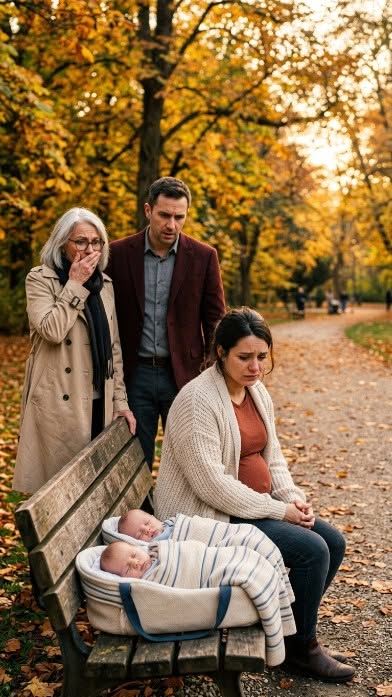
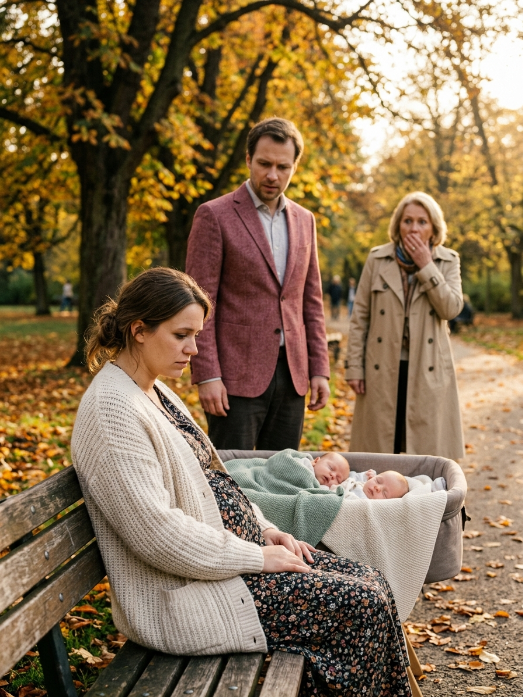
My name is Ethan Carter, and I had finally built the life I always wanted: a thriving business, growing investments, and a sprawling estate outside Cleveland, Ohio, a far cry from the cramped apartment Claire and I once struggled in. From the outside, my life looked perfect. But that day, while walking through Riverton Park with my mother Margaret, I saw her—Claire, the woman I hadn’t seen in over a year, the woman I once thought I’d grow old with—asleep on an old wooden bench, her jacket too thin for the October chill, and beside her, two tiny bundles wrapped in pale yellow and soft green blankets. My mind went blank. Two infants, sleeping peacefully, tiny hands peeking from under their blankets. My mother gasped behind me, and the sound woke Claire. She blinked up at me, and the moment her eyes met mine, I knew this wasn’t a coincidence. “Ethan,” she said softly, not surprised, just tired. “What are you doing here? And whose children are those?” I asked, my voice sharper than I meant. She instinctively pulled the blanket tighter around one of the babies, a mother’s protective reflex, and said quietly, “They’re mine.” My stomach dropped. Looking closer at their tiny faces, their soft blond hair, something felt achingly familiar. My mother stepped in gently, asking if she was okay, and Claire just whispered, “We’re managing.” Not thriving. Not okay. Managing. This wasn’t the woman I remembered—the one who dreamed of opening a bookstore and laughed too loud at movies. She looked worn down, like life had taken more than she had left to give. When I asked why she was sleeping outside with two newborns, she said the babies slept better that way, but the answer felt rehearsed, like she was hiding something. Then one of the babies stirred and opened his eyes—bright blue eyes. My eyes. The ground seemed to disappear beneath me. My mother’s hand flew to her mouth. Claire looked away, and suddenly every strange memory from the months before our divorce came rushing back—the arguments, the silence, the things that never added up. “Claire,” I said, my voice shaking. “Tell me the truth.” For the first time, I saw real fear in her eyes, and I knew she had been carrying a secret alone for a very long time—one that was about to change everything I thought I knew about my marriage, my past, and those two babies sleeping on that bench.
Claire didn’t answer right away.
The seconds stretched painfully, the only sound the rustle of leaves and the soft breathing of the babies between us.
Finally, she sat up straighter, pulling both children closer to her chest as if bracing herself.
“Ethan, I need you to stay calm,” she said, her voice barely above a whisper.
“Calm?” My voice cracked. “Claire, that baby has my eyes. Tell me what’s going on.”
My mother placed a hand on my arm, steadying me, though I could feel her own hand trembling.
Claire looked down at the two infants, then back up at me, and for the first time in over a year, I saw tears welling in her eyes.
“After the divorce,” she began, “I found out I was pregnant. Twins.”
The words hit me like a physical blow. I took a step back, my mind racing through the timeline, the dates, the arguments that suddenly made horrible sense.
“You were pregnant? During the divorce? And you never told me?”
“I tried,” she said, her voice breaking. “I called you so many times that first month. You never answered. Eventually I just… stopped.”
I remembered those calls. I remembered seeing her name on my phone and ignoring it, too angry, too hurt, too proud to pick up. I had assumed she just wanted to argue, to relitigate everything that had gone wrong between us.
I had no idea she was carrying my children.
“Why didn’t you leave a message? Why didn’t you tell my mother, or—”
“Because I was scared, Ethan.” Her voice rose slightly, the first real emotion breaking through her exhaustion. “Scared of what you’d think. Scared you’d believe I was trying to trap you, or get money out of you, or use the babies against you. You were already so angry with me. I didn’t want our children to be born into that anger.”
My mother’s hand tightened on my arm.
“So instead,” I said slowly, the anger and disbelief warring inside me, “you decided to raise two infants alone? On a park bench?”
Claire flinched at that, and immediately I regretted how harsh it sounded. But the question still hung in the air, demanding an answer.
“It’s not what it looks like,” she said quietly. “Not entirely.”
“Then what is it?”
She hesitated, glancing toward the tree line at the edge of the park, and for the first time I noticed something I had missed before—a worn duffel bag tucked beneath the bench, and a stroller folded up against the armrest, clearly used, clearly carrying more than just baby supplies.
“Claire,” I said again, softer this time. “Where have you been living?”
Her silence answered the question before she ever opened her mouth.
Part 2
Claire’s eyes stayed fixed on the duffel bag beneath the bench, and when she finally looked up at me, the exhaustion in her face seemed to deepen into something closer to shame.
“We’ve been staying at a shelter,” she said quietly. “Two streets over. The Hopewell Family Center.”
The words landed heavier than I expected. I had passed that building dozens of times over the years and never once thought about who might be inside it.
“A shelter,” I repeated, almost to myself. “For how long?”
“Since they were born. About four months now.”
Four months. My children had been alive for four months, and I hadn’t known they existed.
My mother let out a soft, pained sound beside me, and I felt her grip on my arm tighten further, as if she needed something to hold onto.
“Why today, then?” I asked. “Why are you out here, on a bench, instead of there?”
Claire’s jaw tightened, and for a moment I saw a flash of the woman I used to know—proud, stubborn, unwilling to ask for help even when she desperately needed it.
“The shelter has rules,” she said. “Curfews. Check-in times. If you’re not back by six, they can give your bed away to someone else on the waiting list.” She glanced down at the babies, adjusting the green blanket gently. “I had a job interview this morning, across town. The bus schedule didn’t line up. I knew I’d be cutting it close getting back, so I thought… if the boys napped here for an hour, in the fresh air, it would be easier than trying to keep them quiet in a waiting room somewhere.”
“A job interview,” I said. “For what?”
“Filing work. At a dental office.” She gave a small, humorless laugh. “I used to run spreadsheets for a marketing firm. Now I’m hoping someone will let me alphabetize patient charts.”
I didn’t know what to say. Everything I thought I understood about the last year of my life had just been rewritten in the span of a few minutes, and I was still trying to catch up.
My mother, ever practical even in shock, crouched down slightly to get a better look at the babies. “What are their names?” she asked gently.
Claire’s expression softened for the first time since she’d woken up. “This one,” she said, touching the yellow blanket, “is Noah. And this is Wesley.” Her hand rested protectively on the green bundle.
Noah and Wesley.
My sons.
I stared at them, at their small faces, at the way Noah’s eyes—my eyes—blinked sleepily up at the gray afternoon sky, and something inside me cracked open.
“Claire,” I said, my voice unsteady. “Why didn’t you come find me? Not for money. Not for anything. Just… to tell me. I would have—”
“Would you have believed me?” she cut in, and the question wasn’t angry—it was tired, resigned, like she’d asked herself the same thing a thousand times. “Six months after the divorce, showing up pregnant with twins? After everything that was said during the divorce, all those accusations about me being dishonest, about hiding things—” She shook her head. “I didn’t think you’d believe me. And I didn’t want to find out I was right.”
The accusations. I remembered them now, the things I’d said in anger during those final arguments, things I hadn’t meant but had said anyway because I was hurt and wanted her to hurt too.
I had built a wall, and Claire had been standing on the other side of it with my children for four months.
My mother straightened up slowly, and when she spoke, her voice carried a steadiness that cut through the moment. “Ethan,” she said, “I think we need to take them home. Tonight. All three of them.”
Claire’s head snapped toward her. “Margaret, I can’t just—”
“You can,” my mother said simply. “And you will. Because these are my grandsons, and I am not letting them spend one more night on a bench in October.”
I looked at Claire. At Noah and Wesley. At the duffel bag and the folded stroller that represented everything she owned in the world right now.
And I realized that the question I needed to answer wasn’t whether I believed her.
It was what I was going to do now that I did.
Part 3
Claire opened her mouth to argue again, but my mother held up a hand, the same gesture she used to use when Ethan and his brother fought as kids—a silent signal that the discussion was over before it began.
“Margaret, you don’t even know me anymore,” Claire said softly. “Not really. It’s been over a year. I’m not the same person, and you don’t owe us anything.”
“I know my grandsons,” my mother replied, her eyes glistening. “That’s enough.”
I crouched down slowly, getting eye level with the boys for the first time. Wesley was still asleep, his small chest rising and falling steadily, but Noah was awake now, staring up at me with an unfocused, curious expression that babies have when the world is still mostly shapes and light to them.
I reached out, hesitant, and gently touched his tiny hand. His fingers curled instinctively around mine.
Something in my chest gave way completely.
“Claire,” I said, not looking up. “I know I don’t deserve to ask this. I know I wasn’t there, and I know that’s on me. But please—let us help. Not because of guilt. Because they’re mine too. Because you shouldn’t have had to do this alone.”
I heard her breath catch.
When I finally looked up, she was crying—quietly, the way someone cries when they’ve spent so long holding it together that they’ve forgotten how to fall apart gracefully.
“I didn’t want it to be like this,” she whispered. “I didn’t want you to find out this way. I had this whole plan—get stable, get a job, get an apartment, and then come to you. Show you I could handle it. Show you I wasn’t asking for anything.”
“You don’t have to handle it alone anymore,” I said. “Either of us.”
My mother already had her phone out, calling ahead to the house, telling Mrs. Patterson—who had managed the estate for years—to prepare the two guest rooms on the second floor, the ones with the big windows that faced the garden. I heard her voice shift into the brisk, organizing tone she used whenever she decided something was happening, efficient and unstoppable.
Claire watched her, then looked back at me, searching my face like she was trying to determine if this was real or if she’d wake up back at the shelter in twenty minutes.
“Just for tonight,” she said carefully. “Until I figure out next steps.”
“Okay,” I agreed. “Just for tonight.”
We both knew it wouldn’t be just for tonight. But neither of us said that part out loud.
I gathered the duffel bag while Claire lifted Wesley carefully into her arms, and my mother—without asking—reached out and took Noah from the bench, cradling him against her shoulder like she’d been waiting months for the chance. He didn’t cry. He just settled against her, like he somehow understood he’d found something he didn’t know he was missing.
The walk back to the car was quiet. The afternoon light had shifted, turning the park gold and amber, and for the first time since I’d seen Claire on that bench, the tightness in my chest eased slightly.
I had walked into Riverton Park that day believing my life was finally under control—success, stability, everything in its place.
I left it understanding that none of that had meant anything at all, not really, because the most important pieces of my life had been missing the entire time, asleep on a park bench two miles from my front door.
As I opened the car door for Claire and the boys, she paused, looking at me with an expression I couldn’t quite name—relief, fear, hope, all tangled together.
“Thank you, Ethan,” she said quietly.
I shook my head. “Don’t thank me yet. We have a lot to talk about. But first—let’s get them somewhere warm.”
She nodded, and for the first time that day, she smiled—really smiled, the way she used to.
We drove home as the sun began to set behind us, four people in a car that had only ever carried one, and somewhere in the back seat, two small boys slept peacefully, completely unaware that their entire world had just changed.
It was the beginning of something none of us could have predicted that morning.
But for the first time in a long time, it felt like the beginning of something right.
THE END
Here’s a short summary of the story and the lesson we can all learn from it…
After a painful divorce, Ethan Carter believed he’d moved on completely, building a successful new life while his ex-wife Claire faded into his past. But a chance encounter in a park revealed she had been secretly raising his twin sons alone, living in a shelter, too afraid and too proud to reach out after the bitterness of their split left her doubting he’d ever believe or support her.
The lesson: anger and pride can build walls that cut us off from the people who need us most, and we rarely know the full story of what someone else is carrying. A little compassion—and the willingness to listen before judging—can change everything, for everyone involved.
👉 Click Here For Continue Reading:👉 PART2: “Take This Mute Child Away—She Stains The Vance Legacy!” Her Grandfather Cast Her Into A Snowstorm At Six. Twenty Years Later, The Entire Nation Rose To Its Feet As The Girl He Rejected Heard Her Name Announced On Music’s Biggest Stage…
👉 Click Here For Continue Reading:PART3: They Forced My 7-Year-Old Daughter To Sit Beside The Trash Because We Were ‘Poor’—Then Grandma Arrived, Heard One Tearful Sentence, Opened An Envelope, And Left The Entire Family Fighting Over A Fortune They Never Saw Coming…
👉 Click Here For Continue Reading:PART4: My In-Laws Sold My 11-Year-Old Daughter’s Dog While She Was At School And Left A Cru:el Note Saying “Don’t Make A Scene” — But When I Discovered They Secretly Pocketed $2,500 From The Sale, One Knock At Their Door Changed Everything Forever…