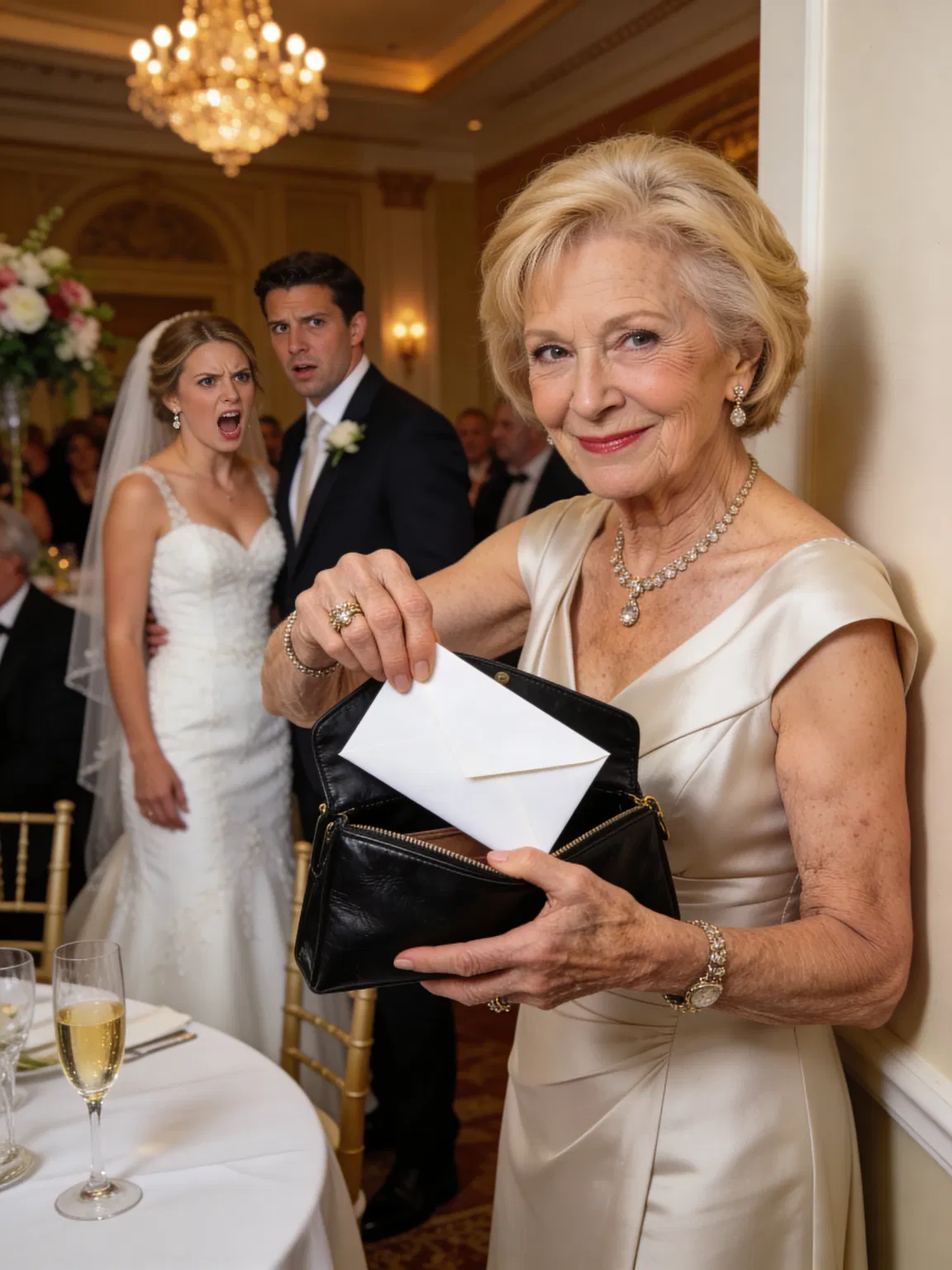
“Sit by the kitchen doors,” Allison Parker said softly, though the softness could not disguise the contempt in her eyes.
Then she leaned closer and added quietly, “Your face would ruin the family photos.”
I was standing inside the Crystal Ballroom of the Lakeshore Regency in Chicago wearing a navy lace dress I had altered twice because Allison wanted everything to look clean and elegant. My hair had been curled that morning at a salon in Raleigh, and my makeup was careful and understated. I had told myself that today my son would look at me the way he once did, when I was the most important person in his world.
The seat reserved for the groom’s mother had already been taken by one of Allison’s college friends, who was laughing with the bridal party as if he had always belonged there. The change was not loud or dramatic. It was quiet, deliberate, and humiliating.
I did not raise my voice or demand she repeat what she said in front of everyone. Years of polite endurance had trained me well.
“Of course,” I replied with a small smile, as if she had asked me to pass her a glass of water.
Instead of walking toward the ceremony chairs, I turned toward the gift table in the center of the ballroom. My envelope sat neatly between a crystal vase and several pastel boxes. My handwriting curved carefully across the front.
Inside the envelope was a cashier’s check from my bank in Raleigh made out to my son, Matthew Bennett, and Allison Parker. It was dated that morning for twenty-five thousand dollars. I had also paid for the rehearsal dinner, covered vendor deposits when prices increased, and quietly handled several unexpected expenses because I believed supporting your child’s future was what love looked like.
I slipped the envelope into my clutch.
Then I walked calmly toward the event coordinator and asked if I could review the contract I had signed as the primary financial guarantor. She looked surprised but led me to a small office beside the ballroom.
Within minutes I found the cancellation clause and exercised my right before the ceremony even began.
Less than thirty minutes later, confusion rippled across the ballroom as vendors were informed that payment authorization had been withdrawn.
Allison’s father, Gregory Collins, stormed toward me with anger written across his face.
“What exactly did you do?” he demanded.
“I removed my financial support,” I replied calmly. “If I am not suitable for the photographs, I am not suitable to finance the celebration.”
Matthew found me near the elevators a few minutes later. His face was pale.
“Mom… please tell me this isn’t what I think it is,” he said.
“I was asked to sit by the service doors because my face would ruin the photos,” I answered evenly. “I will not pay to be erased.”
The ceremony eventually went forward because Gregory managed to arrange emergency payments, but the atmosphere in the room had shifted. Everyone knew something had happened.
I left before the vows were exchanged.
That evening, back in my hotel room, Matthew called.
“Allison is devastated,” he said. “Her family thinks you tried to humiliate them.”
“I told the truth,” I replied quietly. “If the truth humiliates someone, perhaps the behavior should be examined.”
Two days later he arrived at my home in Raleigh holding a small bouquet of flowers and looking more exhausted than I had ever seen him.
The first thing he noticed when he walked into the living room was the empty mantel above the fireplace.
The framed photographs of his childhood, his graduation, and the day he moved into his first apartment were gone. I had packed them carefully into a box in the guest room closet.
I refused to display a story that no longer reflected reality.
“I spoke to Allison,” he said slowly as he sat down. “I told her she was wrong. I told her her parents crossed a line.”
“And what did she say?” I asked.
“She thinks I’m choosing you over her,” he admitted quietly. “Her mother says you’re manipulating me. Her father says you’re trying to control everything.”
“I’m not asking you to choose,” I told him gently. “I’m simply saying I will not remain in a place where I am tolerated instead of respected.”
I explained that if we rebuilt our relationship, it would happen on new terms. I would no longer serve as emergency funding, silent support, or convenient backup. When I said no in the future, it would mean no.
He nodded slowly.
“What if she never apologizes?” he asked.
“Then you will have to decide what kind of husband and what kind of son you want to be,” I answered.
Three days later I boarded a flight to San Diego to visit my longtime friend Denise Harper in La Jolla.
We spent our mornings walking barefoot along the shoreline while the Pacific stretched endlessly in front of us. For the first time in months, I felt my lungs fill with air without tension.
At one point my phone began vibrating in my pocket.
Matthew.
I silenced the call and slipped the phone back.
A few minutes later it rang again. And again. And again.
By sunset I had twenty-three missed calls.
That night the phone continued lighting up the dark guest room. I turned it face down on the nightstand.
By morning there were sixty-one missed calls and a long list of messages asking me to please answer.
I didn’t respond.
Not because I wanted revenge, but because I needed him to understand the weight of absence.
By the end of the second day, the number had climbed to one hundred forty-seven missed calls.
One hundred forty-seven times my phone rang while I stood beside the ocean watching waves move endlessly toward the shore.
One hundred forty-seven times he tried to reach the woman he had asked to sit by the service doors.
Denise glanced at my phone once and raised an eyebrow.
“Are you going to answer?” she asked gently.
“Not yet,” I said.
“He needs to understand that access to me is not automatic.”
On the third evening I finally sent a short message.
We will talk when I return home. Conversations about respect require more than panic.
Then I turned the phone off and watched the sun sink slowly into the Pacific.
And for the first time in a long time, I felt something settle inside my chest that was better than revenge.
Peace.
Because I had stopped shrinking myself to preserve someone else’s comfort.
If my face was too much for their photographs, then my presence was too valuable for their convenience.
And at sixty-eight years old, I had finally learned that belonging to myself mattered far more than belonging in anyone else’s frame.