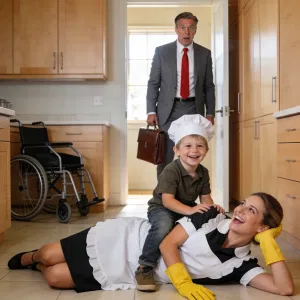
I told them I was going away for three days to attend a conference overseas. I said it with the same flat tone I used when announcing meetings or acquisitions, as if my absence were routine and insignificant. The house would be theirs during that time. Full access, no supervision, no interference. I wanted to see who that woman truly was when she thought no one was watching.
I stepped out of the car and stood under the morning sun, but a strange cold crawled through me, starting in my stomach and spreading upward. It made no sense. The weather was mild, the sky clear, yet I felt as if something inside me had already gone wrong. It had only been a month since I hired Grace Miller, a young woman sent by a cheap agency after every licensed nurse refused the position. They cited my temperament, the isolation of the estate, and the emotional weight of caring for a child who could not walk. I paid the agency more and stopped asking questions.
Grace was quiet. She did not complain. She did not flinch at the silence or the size of the house. What unsettled me was how she treated my son, Noah. She spoke to him constantly, sang to him, encouraged him, touched him with patience rather than efficiency. It did not look professional. It looked personal, and that bothered me more than negligence ever would.
I drove away, then circled back an hour later and parked across the street, watching through the iron gate. I told myself this was caution. A father’s responsibility. Not jealousy. Not suspicion.
Inside the house, I saw her lower Noah to the floor, not into his wheelchair, but onto a mat she had placed herself. She sat beside him, rolling a ball back and forth, laughing when he missed it, praising him when he tried again. There was no rush. No frustration. Something tightened in my chest.
That night, instead of leaving the country, I booked a hotel nearby. I slept badly. The next morning, I returned unannounced.
I expected disorder. I expected negligence. Instead, I found my son laughing as Grace lifted him high, his small hands touching the ceiling lamp, his eyes wide with wonder as she spun him gently. When she saw me, she froze.
“I was just playing,” she said carefully.
I did not answer. I took Noah from her arms, feeling his legs cling to my neck, alive and strong. He laughed again, a sound I realized I rarely heard.
Later, after Noah fell asleep in my arms, I looked around the living room and saw the truth. The glass tables. The sharp corners. The cold surfaces. This house was not made for a child who needed to fall in order to learn.
“This place is dangerous,” I said quietly.
“It was built for adults who never fall,” Grace replied. “Not for a child learning how to stand.”
That afternoon, my phone vibrated with reminders of a board meeting that would decide the fate of two companies. I looked at the screen, then at my son, then at Grace standing silently nearby. I turned the phone off and placed it on the table.
“Tomorrow,” I said, “the furniture goes. The rugs go. This house will change.”
She looked at me, surprised.
“I want you to teach me,” I added. “Everything.”
“It will hurt,” she warned. “You will sweat. You will cancel meetings.”
“I have enough money,” I said. “I do not have enough time.”
That night, I asked her the question I had avoided for months. “When I was gone, did he ask for me.”
She hesitated, then answered honestly. “At first. Then he stopped.”
The words hurt more than I expected, but I accepted them.
Three months passed. The house changed. I changed. Noah changed. He fell. He cried. He stood again. I carried him when he was tired. I stopped being a spectator.
Then came the hospital. Dr. Keller reviewed the files with professional boredom. “You canceled therapy. You refused mobility equipment. This is denial.”
“I came to show you something,” I said.
I placed Noah on the floor. He clung to my leg. Fear filled his eyes.
“He cannot walk independently,” the doctor said.
Grace knelt. “Remember the explorer game,” she whispered. “This is just a cold cave.”
She moved across the room and opened her arms. Noah hesitated. Then he let go. One step. Another. A stumble. Recovery. Then he crossed the room and fell into her arms.
The doctor stared in silence.
“My son is not a case study,” I said. “We are done here.”
Later that day, in a public park, I offered Grace a legal document that would secure her future. She tore it in half.
“My place is here,” she said, watching Noah try to run.
Years passed. Noah climbed a stage at school, trembling but victorious. He later slid across a soccer field, unafraid of the ground. When another father asked me how it was possible, I answered simply. “Reality is what you build when you stay.”